by Caitlin Downs
**Contains spoilers for Gwledd/The Feast**
Follows a young woman serving privileged guests at a dinner party in a remote house in rural Wales. The assembled guests do not realize they are about to eat their last supper.
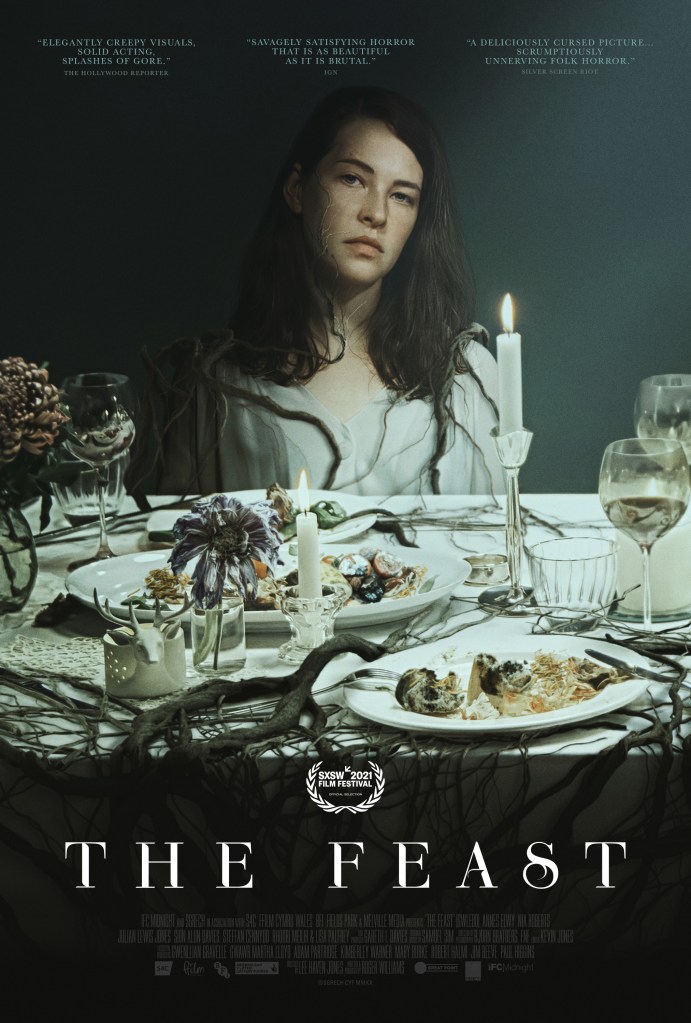
Director Lee Haven Jones’ and writer Roger Williams’ The Feast (Welsh title Gwledd) is a notable entry into Welsh horror and film production, perhaps most notably in its treatment of the Welsh language. The Welsh language standards, were introduced in 2016, with the main goal that Welsh is not treated ‘less favourably’ than English. That has, for the most part, not translated into film and television production. There is often little confidence in Wales’ ability to export entertainment in the Welsh language alone, meaning television programmes like Y Golau (2022) have an English-language counterpart (The Light in the Hall) (2022) filmed at the same time. Although most other exports from other countries are distributed in their native language, this has become an industry-standard in Wales. Despite that convention, Gwledd was only filmed in Welsh. For a film like this to screen at Sundance and later be snapped up by Picturehouse is a testament to the fact that many audiences want to see media presented within its language. More importantly, Gwledd is a film that has much to say about Welsh identity and people’s relationship to the land.
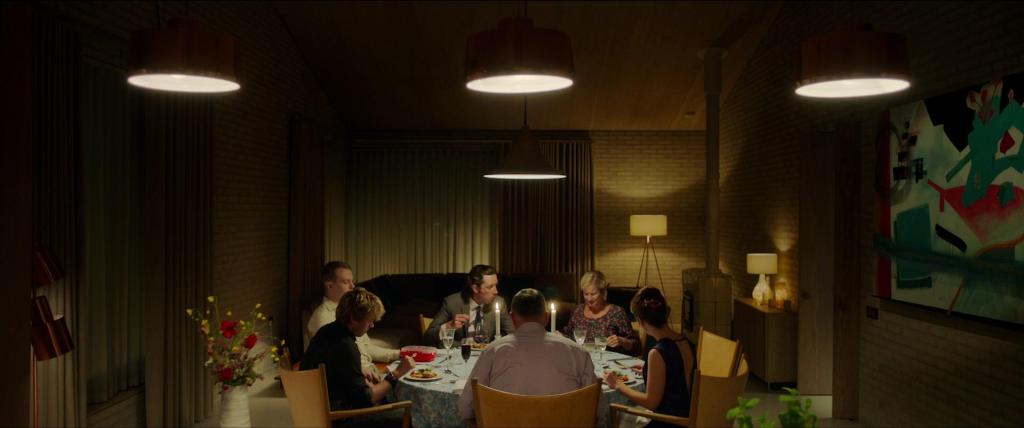
Gwledd’s narrative revolves around a dinner party held at the home of wealthy couple Gwyn (Julian Lewis Jones) and Glenda (Nia Roberts). Gwyn is a serving MP, meaning the family spend much of their time in London, returning to rural Wales as a break from that life. On what was previously the farm belonging to Glenda’s parents they have built a lavish home – part of a partnership with a company that seeks to mine the buried assets. To proceed further with the mining, the pair need to convince neighbouring farmer Mair (Lisa Palfrey) to sell some of her land to the company. The elegant evening is poised to introduce her to developer Euros (Rhodri Meilir). However, the house is trying to contain their two sons, relapsing addict Guto (Steffan Cennydd) and intense triathlon trainee Gweirydd (Sion Alun Davies) as well as a new, uncertain helper in the form of mysterious Cadi (Annes Elwy).
Gwledd’s “Life House” differs from many haunted houses – there are no creaking floorboards, no peeling wallpaper, no hidden corners – in fact, the whole house is a large, sleek, open-plan living space with lavish furnishings. Unlike other film haunted houses, the Life House is available to book a stay in, should you still view it as a retreat after watching. As in the film, the house sits within the Radnorshire countryside, the dark exterior standing out from the green, remote location. The house also appears in Netflix horror You Should Have Left (2020) (starring Amanda Seyfried and Kevin Bacon) which indicates that despite the home’s literature reinforcing the tranquil nature of the property, there is just something unsettling about it in the way it doesn’t seem to belong. Within Gwledd the house and the items within it, particularly a £10,000 painting are symbolic of how far the family have strayed from their roots. Glenda mocks those who view the painting as having a meaning ‘like hope’, reducing it to simply a map that she then uses to show Mair what she needs to hand over to the developers.

The film begins with one of its most symbolically provocative moments, at least in ecological terms. Loud industrial noise interrupts the countryside, as the ground is penetrated by a loud drill that becomes an audio onslaught on the audience. As the drilling continues, a man stumbles away from the equipment, clutching his ear. These first moments set out the film’s central thesis – to hurt the land is to hurt the people. This link is furthered by the shift to a guided tour of the property, the camera gliding through the large rooms, open spaces and crucially, a self-care space that appears more as a prison cell. Later in the film, Mair refers to it as a cell, much to the confusion of Glenda who labels it a ‘retreat from the world’. The first time we see Glenda, she is in this space, tearing a charcoal facemask carefully from her face. This is intercut with Gweirydd, clad in a black leotard, admiring his body – a masturbatory fantasy of privilege. Glenda and Gweirydd have become one with the house, finding peace within the status it affords them.
By contrast, Guto is first seen outside the house, signalling his discomfort with the space. Throughout the film, Guto tries to escape it, heading out into the green space with his guitar. He too, is interrupting the peace, albeit he would rather not be there at all, only held at the house due to his addiction issues taking hold in London. Gwyn too, is first seen outside the house, shattering the peace with his hunting. Unlike Glenda and Gweirydd, the other two are more reluctant inhabitants. Gwyn’s gunshot sends Cadi into a state of shock as she tries to lay the table – a first hint that she is more connected to the land than being a local. It is no surprise that Gwyn’s haunting comes in the form of a piercing sound that eventually forces him to take drastic measures to stop it. All the characters are undone by the things that Cadi observes of them within the house: Guto’s addiction, Gweirydd’s drive for sex and control, Euros’ greed and Glenda’s tortured connection to her mother.

The history of Wales is deeply complex, with even the word Wales a contentious one. The word Wales is from an Anglo-Saxon word for foreigner – a word placed upon the Welsh by the English. The view of the Welsh as outsiders in their own space has been long held, resulting in harsh treatment. The most infamous of these is the Welsh Not, a piece of wood that children were forced to hold if they were caught speaking Welsh during school time. This was seen as an appropriate response to children underperforming in assessments that were undertaken in English when they primarily spoke Welsh – hardly the fairest possible way to test children. Any child left holding the Welsh Not at the end of the day would face corporal punishment, a move that served to foster an environment of students desperate to not be left holding it and therefore willingly tell on other children for any use of Welsh. Gwledd, perhaps interestingly doesn’t delve into this too far, preferring to focus on the family themselves as outsiders who have forgotten their history, lost in their cosy home and wealth, all too happy to see those around them suffer. Many representations of the Welsh in media are keen to represent the Welsh as secretive and unwelcoming, as shown in the recent 73 Yards episode of Doctor Who. They are often shown as a monolithic group, united by their opposition to the English, most dramatically perhaps in Chris Crow’s Devil’s Bridge (2010). Gwledd, by being situated entirely within Wales with all Welsh characters shifts the focus to look inward. Wales has long been rosy about its past, viewing itself as entirely oppressed rather than examining their own role in colonialism at various stages. Gwledd is unique in that introspection. The moment where Euros, having inhaled a canape starts to pull a long, threaded hair from his throat is another of the film’s symbols of introspection – something is clearly wrong, yet Euros chooses to continue to eat.
Throughout, Gwyn is seen trying to reduce Glenda’s relationship to her Welshness. As she and Cadi lapse into a familiar childhood song he quickly mocks her desire to start a choir. The choir is another of Glenda’s connections to her home that her new status has undermined. Welsh identity does, at times, feel slippery. I am not a fluent Welsh speaker, something I’ve long considered a source of shame and indeed, I’ve found myself feeling like an imposter, with no real claim to an identity. How can I, for example, critique the Gwledd’s MP for not having Wales’ best interests at heart when he at least speaks the language? Similarly, the very rural Wales of Gwledd is relatively removed from my own life. Guto’s lament about the lack of parties in the area plays into a relative stereotype of Wales that ignores the cultural and social efforts made across the country. However, this is to be taken in the context that those scenes are often not appreciated by those in the country who prefer to look further afield.
During a heated confrontation, Guto furthers the idea that Gweirydd is the house, bitterly stating, ‘You deserve to be here’. Crucially, tying to the film’s first shot of the land being penetrated, Guto reveals that Gweirydd’s career sabbatical results from his transgressions against patients. His horrifying exploitation of vulnerable patients is linked to the placement of the house, the attempted exploitation of the land and the wealth that allows it all to go unchallenged.
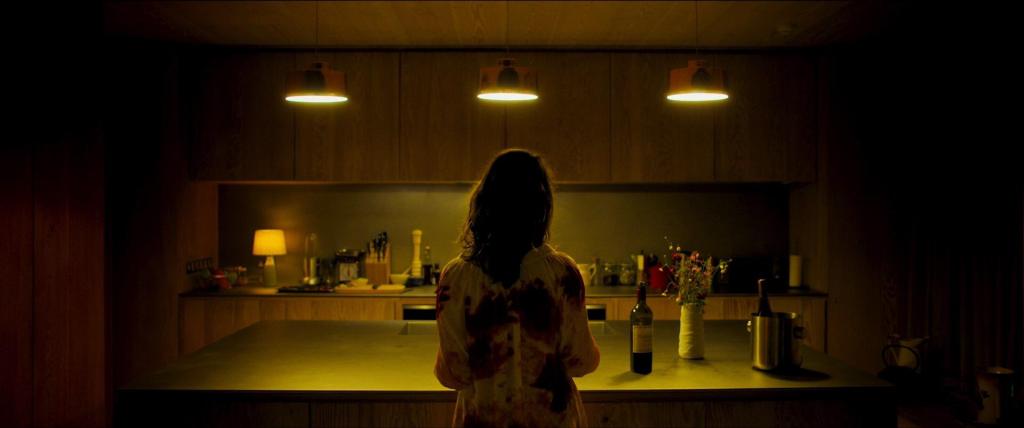
Ar ôl i ti gymryd popeth, beth fydd yn weddill? – After you’ve taken everything, what will be left?
It feels apt that Gwledd descends into an explosion of feminine rage. Mair’s defiant influence and spitting of ‘your mother would be ashamed’ draws Glenda into a new headspace. Mair is a defender of the land and a rural lifestyle throughout the film, bluntly calling Glenda’s spa a cell and being unimpressed by both the tour of possessions and Euros’ character. Newly reconnected to her mother, she mounts a rifle into Euros’ mouth and asks him the above question. Clad in her mother’s old dress, having shed her sleek dinner party look, it functions as a possession – heading outside to call everyone away from The Rise – a place given a sacred, horrific lore. If Cadi herself has come from The Rise, the land and the house are now in full battle with the land’s ghosts returning to fight.
Following the decimation and burning of the family, Cadi walks across the same field from the opening scene. As she stops and faces the camera, the fourth wall is broken, first by her smile as an indication of triumphant revenge enacted. Mere moments later, however, the sadness takes over and she looks on the cusp of tears. While this particular haunted house has been dealt with, it was built by those who know enough about the legacy of the area that they should have known to protect it. To not anger the spirits of The Rise and to not sell the land to be mined. Gwledd is ultimately an eco-folk-horror that borrows heavily from body horror to internalise that discussion and turn it inward on its own community rather than looking to an outside threat. Cadi’s final look of betrayal challenges the viewer to confront their own principles and values – after you’ve taken everything, what will be left?
Caitlyn Downs (she/her/hi) is a Tomatometer-approved horror film critic and essay writer, with bylines for Horrified Magazine, Ghouls Magazine and her blog Scared Sheepless. She lives in Wales with her aptly-named rescue dog Casper in a house next door to a graveyard. If you don’t fancy a long conversation, please do not engage with her about Ben Wheatley films – you’ll be there a while!
X/Twitter – scaredsheepless
Instagram – scaredsheeplessblog
Blog – scaredsheepless.com

 NightTide Magazine
Leave a comment