By Leanna Renee Hieber
If you’ve had a particularly evocative experience with a haunted house, whether it was pleasant thanks to a friendly ghost or unsettling due to negative energy, it will continue to haunt you long after you leave its doorstep. I can say this definitively, having been perennially haunted since the age of six and having made my living as a ghost tour guide and paranormal author for over twenty years. Some places, and the people involved, just… keep whispering. The concept of being haunted is the idea that something recurs. Unnerving in its return. Unforgettable and impossible to ignore.
If you’ve ever published a book, you know you’ll always want to change something. It doesn’t ever really feel finished. Picking up a printed copy, doing a reading, flipping through to find something I want to reference – I notice there’s always a line I wish I could edit. But it’s too late. This became additionally jarring for me when publishing non-fiction about haunted spaces. Because such locations are never static. They are, themselves, an ongoing entity, refusing to be contained to one set account. Ghost stories say as much about the living as they do about the dead and our narratives are constantly deepening and reshaping themselves. Memory is plastic.

From the notorious Lizzie Borden to the innumerable, haunted rooms of Sarah Winchester’s mysterious mansion this offbeat, insightful, first-ever book of its kind explores the history behind America’s female ghosts, the stereotypes, myths, and paranormal tales that swirl around them, what their stories reveal about us–and why they haunt us…
One of the things I was not prepared for when Kensington published A Haunted History of Invisible Women: True Stories of America’s Ghosts, co-authored with Andrea Janes, is just how much I’d still be haunted by the subjects I chose to write about in my first non-fiction book,
a discussion of women ghosts that examines how we talk about women, alive and dead. I couldn’t have predicted how much I’d still think of the women we focused on and the places they lived and died. I’ve wanted to reach out and hold each spectral hand to take them all with me, wherever the muse wishes, to get their read on where we’ve been and what’s to come. I want to check in on them, to see how they’re doing and most of all, wanting to apologize for things I didn’t mean to leave out of their narratives in the heat of writing particularly emotional chapters.
Our chapters became conversations with the women involved, and in some cases, I asked their (spiritual) permission and blessing. I visited Sarah Winchester’s gravesite in New Haven, CT before heading out to California to explore her mysterious mansion where I hoped to learn
more about the generous, kind woman and amateur architect, not, as myth would have it, the crazed woman ‘driven mad by spirits’ which does not hold up to scrutiny. I feel I gained a concrete sense of the ways in which the Winchester Mystery House is haunted and the ways it is not. Her haunting feels more holistic. With Sarah, I felt I gained a fellow traveller and inspiration. But they’re not all so neatly tied with black crepe.
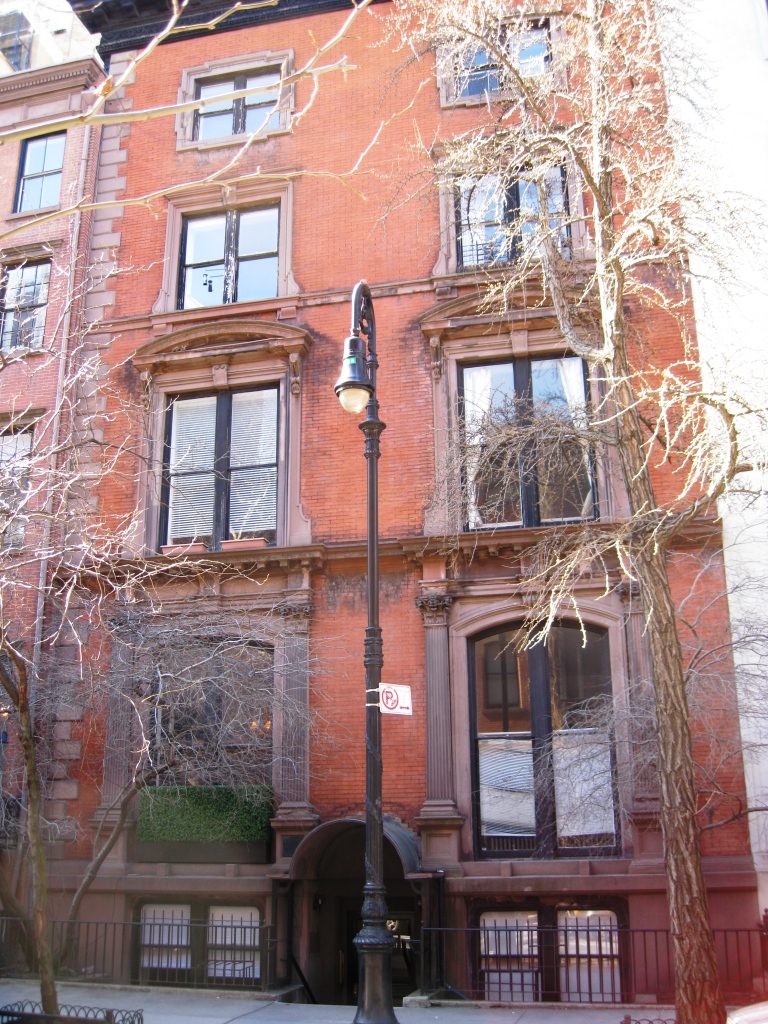
I don’t know that I’ll ever feel “settled” about 14 th West 10 th Street. I’m not sure I ever can be. My “Unreliable Narrator” chapter in the book was originally meant to be co-authored, as it remains a stop on many Boroughs of the Dead tours and Andrea, founder of the tour company, and I both have a lot of thoughts about place. But Andrea liked my visceral take on the entire setting and thought it was best to leave the chapter be; raw and deeply personal. She and I each receive compliments on specific chapters and the “Unreliable Narrator” seems to unnerve people as much as it did me as I wrote it.
The building in question is an unassuming brownstone townhouse in one of the most fashionable and expensive neighborhoods in the country. It’s stoop goes down instead of up, an oddness not replicated by other adjoining structures, and it has had trouble through the years of maintaining full occupancy. An author wrote a book about her time living in the building whose energy some caretakers described as cursed. She haunts me most.
It all began when young actress-poet Jan Bartell moved with her husband into the old Greenwich Village Townhouse once inhabited by Mark Twain. At first there were only the strange phenomena of unexplained shadows and sounds, and a presence that seemed to clutch at her in the dark. Then the deaths started, claiming one after another of the building’s occupants.
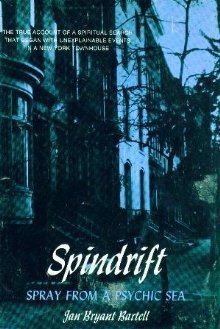
In the case of Jan Bryant Bartell, I feel like we’re still having a conversation. Well, I’m talking to Jan, at least. I’d like to think she’s in a peaceful place that would rather not be troubled by me or my thoughts on any of the events she felt she had to “exorcise” into the pages of her memoir. Spindrift: Spray from a Psychic Sea, is Jan’s now-out-of-print memoir about her time at (also haunted) 16 West 10 th Street and then 14 West 10 th . The buildings share a wall and with it, a pervasive sense of misery and dread.
Spindrift was the first book about New York I read when I moved there in 2005 and began studying for my tour guide license. I didn’t know anything about the address when I first wandered by it, only that I felt extremely queasy. Later, diving into Bartell’s narrative, similarly odd synergies she described were happening to me at the same time she was talking about the increasing number of people who were sick, dying or who had taken their own life at that premises over a period of time – an inordinate percentage of affected lives considering it’s not a large building.
She remained in those buildings for over two decades of her life, and the dizzyingly shifting smells of sweetness or decay, the sounds of things crashing when nothing was disturbed, the presence of ghostly cats and black miasma creeping from one wall into the next, all of them contributed to a perilous concoction of a weakening physical form and a depressed, anxious mind that was counting the ever increasing number of people who seemed to be falling ‘victim’ to this house. As she tries to reason with her surroundings and her own senses over the course of the sometimes-meandering narrative, she’s not believed by her husband or other friends, and sometimes not even believed by herself.
In one of our book tour appearances, Andrea noted the fact that Jan lived on the top floor; playing into the “Madwoman in the Attic” stereotype and I was so frustrated with myself that the
detail hadn’t been made directly textual in my chapter. If I failed in an important correlation I wonder if it’s because there are some things I still actually can’t process about the energy of that place; so negative it stifles me. Even just thinking about it, talking or writing about it, I’m short of breath.
While Bartell’s narrative fit the stereotype and the tropes we were unpacking in our “Madwomen” section of the book (always in quotes as the concept has been lobbed at and weaponized against women for centuries regardless of any legitimate mental health diagnoses), I don’t think she was “mad”; labeled as such instead by loved ones or those who could not or would not engage with her memoir as truth. But if people had truly listened to her insistence that something was truly wrong with that address, could something have been done to prevent a little girl’s murder there, a mere few years after Jan moved out and died suddenly of a heart-attack? I wrote this about Jan and her haunting narrative in my chapter:
“The inevitability of Spindrift is unbearable. An actress who once starred in the paranormal classic Bell, Book and Candle, Bartell’s exploration of psychic waters veers further towards the undiscovered country. The title of the book is apt; “Spindrift” refers to the churning
wake of a ship. The haunted premises of Tenth Street cut the agitated waters of Bartell’s sensitivities and the spray in their wake grew increasingly dangerous. The reader knows Bartell’s fate, it is stated on the dust jacket of her memoir. Reading the book is one elaborate, dread
precognition. The house would take her in the end.”
Just as Bartell had managed to escape Tenth Street for New Rochelle, she died. The coroners listed her cause of death as a heart attack. Only a few weeks after she had completed the manuscript, the book she’d told friends was a kind of catharsis was published posthumously. Transcribers working from her notes repeatedly fell ill and the book nearly wasn’t published at all. But something had to stand as a testament to her experiences.
In her last chapter, Bartell ominously states “The writing of this book has been an exercise in personal exorcism. I hope it is done haunting me, although for you, the haunting may just have begun. If it reads like a Gothic novel, it lived like one; being unprepared for truth, I
found it strange, much stranger, than fiction.” Her final line tolls like a funeral bell: “If the spindrift has not reached you yet, it will, it will…”
It has and it will. That psychic spray still rocks on the edge of my mind, lapping against the hull of my skull.
There are things I still want to say. I hold up my well-worn copy of Spindrift when I do interviews, sharing the mesmerizingly beautiful, striking photo of Jan on the back of the dustjacket. I want Jan to know that I’m still thinking about her, talking about her, that my being rattled by her experiences never ends. How much Andrea and I wish her memoir was still in print so that her warning about that place, written and published long before the infamous murder of a 9-year-old girl was committed in the building, could be more widely seen as predictive. I want to tell her that she was on to something; that we believe her. I have daydreamed more times than I can count of having a cup of coffee with her and commiserating just so she could feel seen and heard. I would ask how are you? And I’d really want to know, rather than those who dismissed her lived truths, her concerns and experiences through her life.
I have to make my peace with all this, because there is never a last word. I can’t know if I did her justice or just stirred up her traumas. I still feel too emotionally drawn in to be objective about it.
Even in writing this, I’m sure I’ll have more to say a year from now, when I keep returning to discussions of Jan and the house that vampirically drained her. Thoughts will still occur; energy will continue to be exchanged, words I regret not including will still haunt me and
make me wonder if there’s more I could have done to make her more of a heroine of an admittedly doomed narrative. I will remain haunted by ongoing, unending words and I promise to keep turning pages. I owe it to Jan’s memory. She’s become a part of my psychic family, for better or for worse. I find myself no longer caring about the haunted house or its nasty vibes. It’s Jan. She’s who haunts me. I’m so desperately sad she never got to enjoy her hard-earned rest away from that place or the full catharsis her memoir could bring. She was cheated.
This all shifts, then, from a location-based haunting to an identity-based haunting and that feels like lifting up a rock and seeing what scurries out from under it.
Maybe Jan’s distracted narrative and fear she couldn’t complete things, feeling tired and off-kilter, maybe it hits me so deeply and I remain so unsettled because she mirrors my own concerns bubbling to the surface. She is a mirror to my anxiety about whether or not I can meet all my growing artistic deadlines or overcome what feels like an increasingly scatter-brained nature in an aching, disordered, unequal and often violent world. As her through-line wandered, maybe so does mine, curving around a bend in the spiritual road. So I suppose the existential question remains:
When is a haunting through with you? I’ll tell you if mine ever ends.
Leanna Renee Hieber is an actress, playwright and award-winning, Barnes & Noble bestselling author of fiction and Non-fiction for publishers like Tor and Kensington Books. A Haunted History of Invisible Women: True Stories of America’s Ghosts was a Bram Stoker Award nominee for Superior Achievement in Non-fiction and Leanna was a Daphne du Maurier award finalist for Darker Still. Her short stories have appeared in numerous anthologies such as Queen Victoria’s Book of Spells, on Tor.com and PseudoPod and her essays have appeared in Apex Magazine, Psychopomp, The Deadlands and more. She is a NYC ghost tour guide and has been featured on TV shows Mysteries at the Museum and Beyond the Unknown discussing Victorian Spiritualism. https://leannareneehieber.com


 NightTide Magazine
Leave a comment