

by Matt Belenky
In film scholar Carol J. Clover’s book, “Men, Women, and Chain Saws”, Clover proffered the “final girl” theory largely seen in slasher films. Exhibit #1 being Halloween, with the idea being that when the film finally ends, all who’s left standing is the leading lady. Though, by the end, a
lady she’s anything but. Instead, a certain rage or masculinity overtakes said girl, lessening the femininity and fear factor exhibited earlier, en route to victory against Michael Myers,
Leatherface, or Freddy Krueger, to name just a few ghoulish icons.
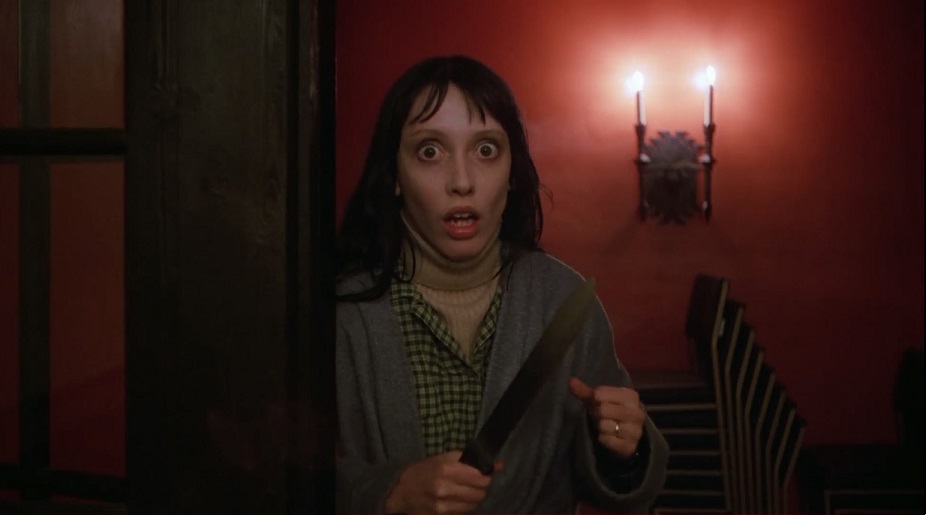
To call The Shining a slasher would be improper given the picture takes place in what’s effectively a haunted house. Though the film kind of becomes a slasher by the end, with Jack Torrance (Jack Nicholson) wielding an axe and “here’s Johnnyy”-ing himself to a state of psychosis. And opposite to Jack is Shelley Duvall’s (RIP) Wendy Torrance, who by story’s end is closer to “final mom” status than just a
girl. My apologies, No Doubt.
But isn’t this picture also about something else? Perhaps, a domestic disturbance of sorts? Why yes, it’s also about a possessed male, husband figure on a mission from hell. Duvall’s performance, well documented for the gruelling state of unrest that director Stanley Kubrick put her through during the shoot, is that which the audience clings onto the most. Not least because her terror and wide-eyed expressions emanate onto the viewers cheering for her. At the Razzies in 1981, an awards show known for celebrating cinema’s “worst” pictures, both Kubrick and Duvall found themselves nominated, for Worst Director and Worst Actress, respectively. The irony being that just a few years later The Shining would be considered one of the greatest films of all-time. As the other Razzie nominated cult hit, Showgirls, helped show: time heals all wounds. And then some.
Duvall isn’t given the most interesting role in The Shining. At times it feels like she’s in another film entirely, apart from her son Danny, who’s experiencing supernatural phenomena, and husband Jack, who’s struggling to write in the hotel’s lobby. In her review for The New Yorker,
Pauline Kael described Wendy as “the drudge who does the work at the hotel…a woebegone, victim role…”. Kael later adds that at the start of the film, Shelley Duvall “seems not quite there, as if her lines were being spoken by someone else in another room…”. If Duvall doesn’t seem quite there it’s because of the dialogue and role that she’s been given as the mom, jetting lines typical of other female roles at this time. As the “straight (and only sane) woman”, though, Wendy is also a direct link to the audience. A sign of sanity and order in a haunted hotel fuming with bad vibes and minacious figures. As the Overlook’s manager, Stuart explains to Jack early in the picture, the previous caretaker of the hotel was a man named Charles Grady. A man who
ended up killing his wife, two young daughters (see: twins) just a decade before the Torrance’s arrival. Where things turn for Wendy is halfway through the film, when she finds Jack’s typewriter pages with “all work and no play makes Jack a dull boy” written in perpetuity. The
fear and confusion build to that moment.
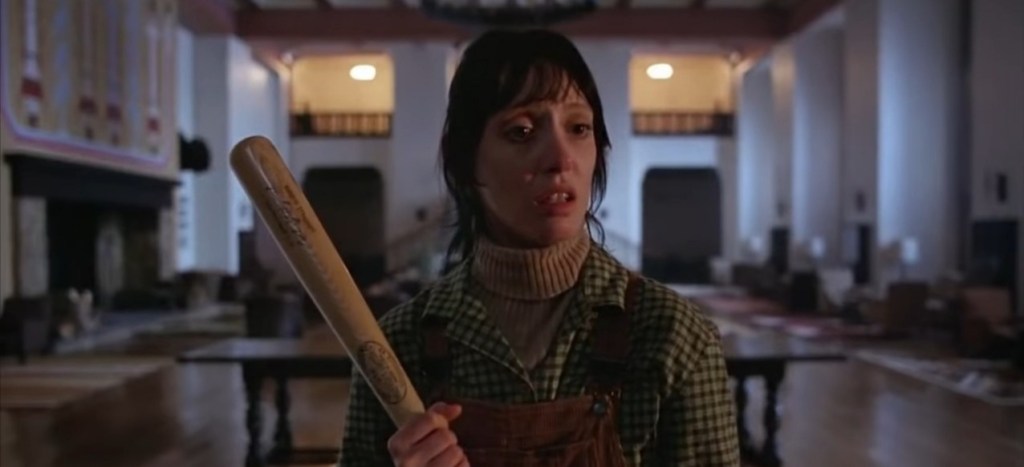
Wendy, in “final girl” fashion, in real-time, changes from a matriarch figure content to appease (via eggs and bacon breakfasts) her husband to someone willing to swing the bat. But that steady
change has to feel tried and true. Wendy isn’t given the quippy lines between Jack and the blank- stared, android-esque bartender Lloyd. Nor does she get to ride the tricycle through the hotel, like Danny, and have a run-in with the Grady twins, or see a pool of blood crashing from wall to wall. Yet, Wendy is the only one who realizes that something is tormenting them. That whoever (the old lady) tried to choke Danny is in room 237 and that these ghosts are here to stay. This motherly, boilerplate card that Wendy’s been dealt feels intentional, however. Wendy’s life at home taking care of Danny and tending to his paranormal seizures and psychologist visits fall in
line with playing Danny’s protector by the second half of the film. She loves her husband but there’s also a sense that, maybe driven by that one-time drunk outburst in which Jack dislocated Danny’s shoulder, evil might rear its ugly ahead on her family yet again. And in that event,
Wendy would take Danny’s side over Jack.
Where the ghosts of the haunted house expel their demons onto Jack and Danny for nefarious means, it’s Wendy, who aside for spotting an illicit act by way of a bear suit, who fights back and realizes that escape is the only way out. To go from a domestic tenant to a knife wielding, blank stare screaming hero is no easy feat. Sometimes a haunted house can help highlight the drudgery of a marriage and lead to an innocent wife looking to play hero. The Shining, with the help of
King’s story and Kubrick’s direction, is a film that captures many “ideas” or conspiracies (please Ascher’s terrific Room 237 documentary), and on rewatch, you can’t unsee the domestic intrigue
at its core.
Twenty years after The Shining, in-between shooting Cast Away and waiting for Tom Hanks to lose weight while growing a Jesus (or Forrest Gump) sized beard, director Robert Zemeckis made What Lies Beneath. Two films serving as different ways to evoke a sense of craft and magic behind the camera. The other nexus is Michelle Pfeiffer, as Claire Spencer, the housewife to Harrison Ford’s Dr. Norman Spencer (a successful scientist and professor). Unlike the wide expanses of The Overlook, that on first look breed a foreboding sense of doom, Claire and Norman live a quaint, upper-middle class life on a lakeside home in Vermont. As Claire’s daughter is sent off to college so begins her what-do-I-do-around-the-house-now period.

With that, the film starts as a voyeuristic Rear Window riff where Claire spies on, and then suspects, that their neighbors (Warren and Mary Feur) are having a feud and Warren might be up to some
very bad things. James Remar, who plays Warren, is surprisingly underused in this one but that storyline is also a red herring for what’s really going on—there’s a spirit in the house.
In his review of the film for The New York Times, critic Elvis Mitchell remarked that “Ms. Pfeiffer plays the kind of damaged-goods housewife with too much time on her hands, that is one
of the few horror-genre cliches Scary Movie didn’t get around to making fun of.” He’s not entirely wrong, either. We’ve seen this pony before, in a Twilight Zone episode or something of the like.
As doors begin to open and shut, and items get rearranged in Poltergeist-esque fashion, and after Warren is ruled out as a possible invasion suspect, the real games begin. Unlike The Shining,
which shared screentime between the three leads, Claire is in every scene of the movie. Here, Zemeckis doubles down on the crazy mirror shot from Contact and shows off every which way to shoot a mirror or any form of reflection. Though it takes a solid hour for the film to gain
muster or feel realized, the back half is impressive and Pfeiffer’s performance is the reason why.
As the spirit begins communicating with Claire, via broken photo displays and computer messages, suddenly Claire gains power. A not-so subtle fusion between the spirit tormenting the house and Claire starts to take shape. Claire gains more sexual agency and vigor, to seduce husband Norman, for example (as seen in the film’s trailer). Objects in the mirror, or in reality, are not what they appear and Claire’s evolution to a Catwoman-like (see Batman Returns) figure
is a welcome surprise. In some regard, the plot shift does have a touch of the erotic thriller genre that by 2000 had all but dried up and been left for dead.
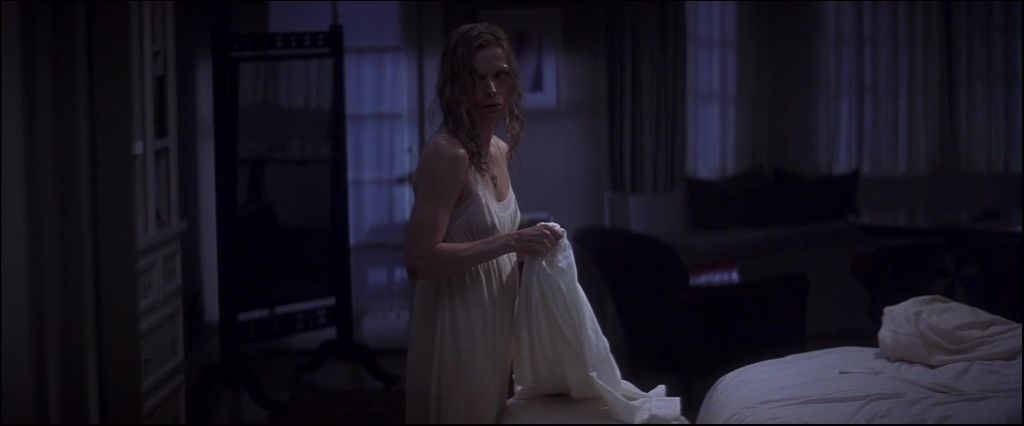
Where Wendy is gaslit by Jack into believing there’s nothing in room 237 nor that anything otherworldly laid hands on ‘ole Danny boy, Claire visits a therapist (played by Joe Morton) at Norman’s request to make sure she doesn’t fall too hard off the rails. Norman, like Jack, is
constantly at work, late nights not sold separately as he preps for some conference down in Boston. Kubrick though shoots Wendy at a distance, unlike the zoomed in shots of Claire and those piercing, ocean hued eyes of Pfeiffer. In that regard, Claire is the one experiencing a hint of that “shining” feeling. Less telepathic and more paranormal. Claire’s physical resemblance to the missing (see: dead) woman who’s haunting her is used to great effect as their faces nearly merge, a technical feat that Zemeckis had once displayed in Death Becomes Her. The haunted becomes the hauntee, or something other.
What Lies Beneath is by no means a great film and its issues have largely to do with Clark Gregg’s unevenly, laboriously paced script. Yet, it is an effective depiction of upper crust malaise by way of a murder mystery and unearthly forces. And also of the relationships between
women, final girls or not. Jody (Diana Scarwid), Claire’s pro-séance best friend is a clear bright spot in this picture, as Jody is someone invariably looking for a good time and carries with her a mystical sensibility. The film straddles the line between the supernatural and a whodunit quite seamlessly and without haste. Clover may not necessarily have dubbed either starlet, Duvall or Pfeiffer, as “final girls”, as neither film is a slasher. But, the progression of both ladies from amiable wives to fiery defenders by movie’s end does make a strong case for their inclusion.
Women in bathtubs, as What Lies Beneath and The Shining remind us, aren’t all who they appear to be. There are certain forces, of great terror, bubbling at the surface in these pictures and perhaps it’s best if the men proceed with caution. As playing with water, and promiscuity, may prove fatal.
Matt Belenky (He/Him) is a Brooklyn based lawyer, indie film producer, Alanis Morrissette enthusiast, monster movie lover, and a Coen Brothers devotee. His writing has been featured in The Gutter Review, Massive Cinema, and Pittsburgh Orbit.
 NightTide Magazine
Leave a comment