
By L. Marie Wood
A young woman named Sam finds herself trapped in New York City during the early stages of an invasion by alien creatures with ultra-sensitive hearing.

A Quiet Place: Day One is a perfect movie.
I’ll say it again for the people in the back.
A Quiet Place: Day One is a perfect movie. And it’s not because it has all the elements of good storytelling: relatable characters, conflict, compassion and other emotions. It’s not because of the most amazing cat (bar none) or the fact that it’s a horror movie chock full of all the quiet suspense you can take and creepy spider-like Demogorgon-faced beasts with Alien-esque teeth (though that would be enough right there, wouldn’t it?). It’s not even because we were given the backstory of Man on Island played by the dynamic Djimon Hounsou. It’s because of the social structure that it reveals, one that is rooted in reality, whether actively recognized or not.
It harkens back to what Night of the Living Dead did over 55 years ago.
Let me let that simmer for a minute.
No, this movie did not break new ground like Night did. It didn’t even do the job of a prequel, not really – we don’t know any more about why the aliens have come than what was shared in the earlier releases and, indeed, this isn’t even our first time seeing the moments before the so-called Death Angels came crashing into town riding meteors; A Quiet Place Part II treated us to that. But while Day One didn’t make good on the promise of new information that would help to explain and/or advance the plot, it did provide a landscape to consume, a tapestry that reflects the truth beneath the smoke. The casting showed it all.
A story like this does not benefit from selective casting; no one demographic would be better suited than another to reflect the human response to such a catastrophic event. In that way, the role could have gone to anyone. Set in modern day New York City, viewers certainly could have found themselves following anyone – a merchant, a businessperson, a kid coming home from school, a homeless person, etc. Any and all of those people could have found themselves on that street at that time of day. But we found ourselves following a hospice patient and her service cat. A Black woman alone in a city under siege.

I could go on and on about Lupita Nyong’o’s performance here, and believe me, I am tempted to because I found the way she expressed emotion with her facial expressions to be absolutely stellar, but I won’t. I will focus, instead, on her character Sam, and what she means to
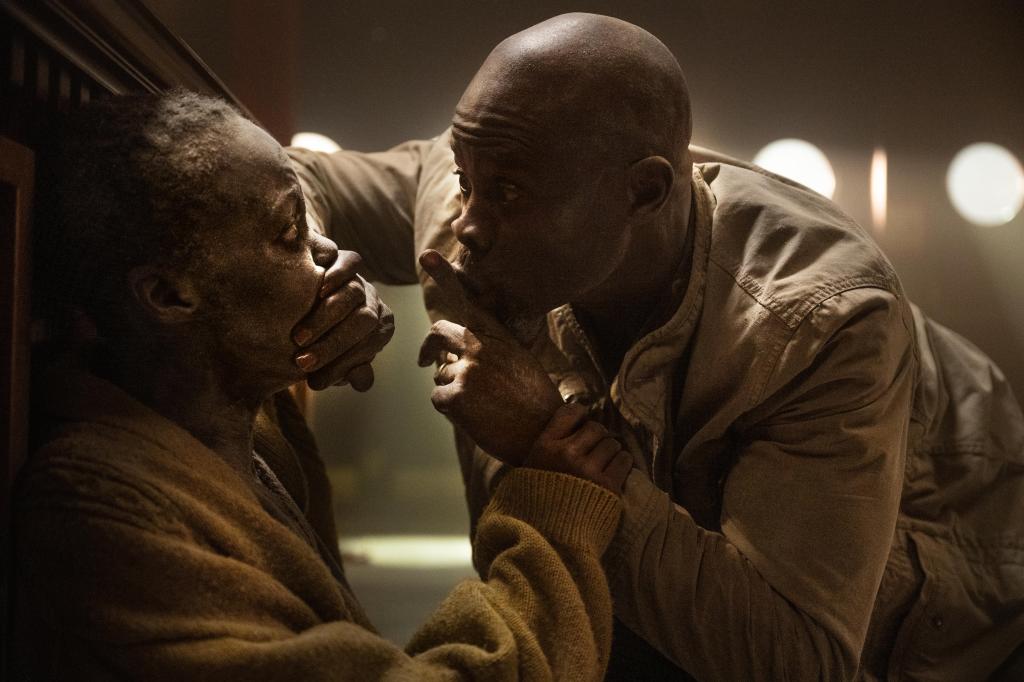
moviegoers and society at large. I would say it was fair to surmise that Sam wasn’t having a good day. She is dying, she is in pain, and she is over it all. But she still found a way to feed two hungry children and lead them to the next leg in the evacuation path, protect her cat, and save the life of a young man finding himself far away from home at the end of the world. Sam, this ailing Black woman whose life is in tatters because cancer has ruined her body and stolen her future, still shares herself with those she encounters: a gentle touch with the woman writing down notes from the radio broadcast, commiserating glances on the rooftop when the bridges were demolished, even an apology to a friend she’d hurt in a tense moment. These things don’t sound extraordinary. Indeed, they just sound like what a human would do, right? I agree. But so often, Black people are not shown in this light, especially when the cast is diverse.
Black characters are not afforded the ability to do the compassionate thing, the natural thing… the right thing. That distinction is often left to others and the Black character either reaps the benefit of the benevolence or chooses a not so savory path, doing, instead, the devious thing, the conniving thing, the foolish thing. We, as audiences, shake our heads when the latter occurs and wait for them to get their comeuppance, are pleased when it happens, and feel the movie is set right again when all is said and done, whether the main character metes out justices or another Black auxiliary character does the work for them.
But not this time.
This time the main character, the one who does the right thing, the one who is strong even in the face of indescribable fear, is a Black person. Better still, she’s a woman. Best yet… she’s a BLACK WOMAN who saves the life of a WHITE MAN.
!!!!!!

Most people can point to a strong woman in their lives; we have all felt that presence and recognize it for what it is. But movies still depict women as the weaker sex, the ones who need to be taken care of, the ones with the illogical head on their shoulders (READ unstable, anxious, unsettled) when things get hairy. The men are often in front, leading the way, forging a way through. But in Day One, it is Sam who helps Eric, a law student from Kent, England, survive. It is Sam who helps him navigate that first night, giving him something to hang on to.
Sam.
Her.
She.
And Eris knows it. (An aside – his dedication to her is a beautiful depiction of what happens in real life between people. Neither race, creed, religion, or any other delineators that you can come up with hold a candle to the power of human connection and empathy). Sam doesn’t do it because she is maternal – nothing about her character speaks to that, especially noting the mental state she opens the movie in. She doesn’t do it because she is looking for something from him, protection or otherwise – indeed, she tells him to leave many times. She does it because he is a person who has clearly been broken by the experience happening to the world and she shows compassion… as anyone is capable of.
There is good and bad in every racial group, every religious group, every neighborhood. Both can even coexist within the same person. Far too often in the real world Black people are not shown to have the capacity for good to be prominent in them. Newscasts are jam-packed with accounts of crime featuring Black faces and stereotypes work covertly to form implicit biases that become indelible on the psyche of anyone and everyone exposed to them. It gets compounded by separation in our music, or movies, or fashion, our pop culture. Before long, exaggerations and falsehoods become bonafide facts and the divide deepens.
But it doesn’t have to.
Movies like this make clear that we are all human, we all feel emotions, we all wonder if our reactions are appropriate. Sam is unsure about what she’s doing at many points in the movie, as was Ben, the Black character played by Duane Jones in Night of the Living Dead – he was only looking for a way to survive. They were everyday people reacting to a crisis in the most human of ways, whether people wanted to recognize that or not. Just like the folks Ben was stuck in the house with. Just like Eric from Kent.
I hope that Sam’s character resonates with people. I hope they see her as a regular person dealing with an unfathomable event and that the fact that she’s Black is less prominent than other aspects of her character. If this happens it is a step toward Black responses, Black thought processes, Black people being normalized in society or, said differently, being perceived the same as everyone else’s. Because we are. The fact is if aliens fall from the sky intent on annihilating the human race, you have to understand that whether you are Black, White, Asian, Indian, Latino, Middle Eastern, Hindu, Muslim, Baptist, Baháʼí, Catholic, a hockey fan, a boxing aficionado, whether you say soda or pop, whether Rocky Mountain Oysters are your jam or you like Snow crab legs, we are all going to run like hell.
Bestselling author L. Marie Wood is a psychological horror author, recipient of the Golden Stake Award, a MICO Award-winning screenwriter, a two-time Bookfest Award winner, a two-time Bram Stoker Award® Nominee, a Rhysling nominated poet, and accomplished essayist. Wood is the Vice President of the Horror Writers Association, founder of the Speculative Fiction Academy, an English/Creative Writing professor, and a horror scholar. Learn more at www.lmariewood.com.

 NightTide Magazine
Leave a comment