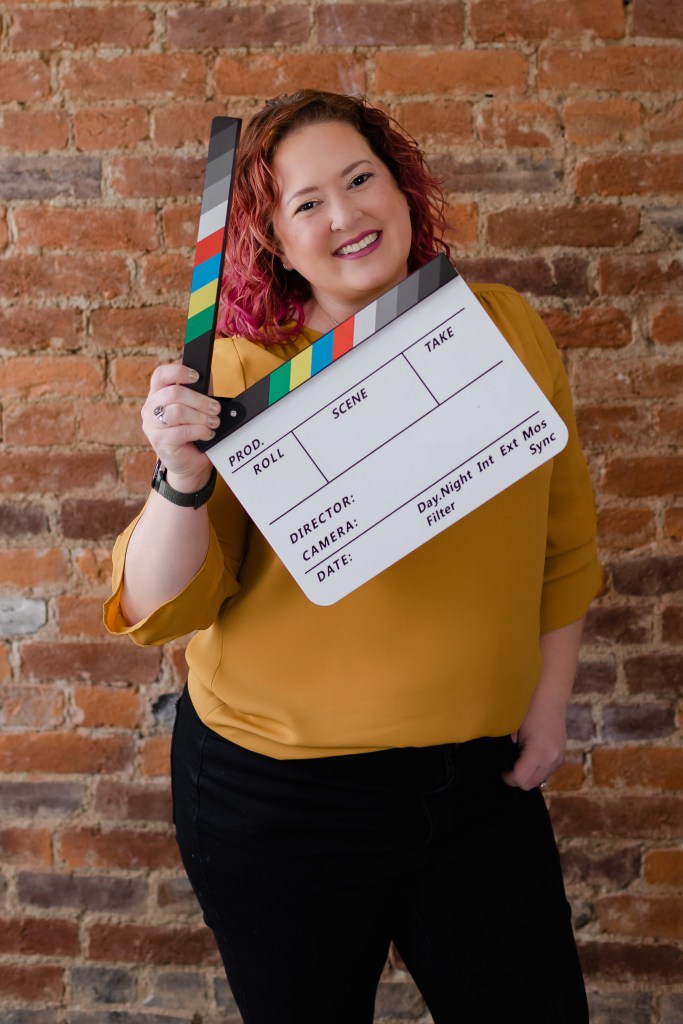
Tara Garwood (she/her) is an award-winning filmmaker and screenwriter, and owner of Tarakata Films. Garwood’s background as an actor and former horror theatre Co-Founder and Co-Artistic Director informs her work as a writer, director, and producer.
Garwood’s short films “Lonely,” “The Lake,” and “The Strangle of Ivy” have appeared in several festivals, with “The Lake” and “The Strangle of Ivy” receiving awards for independent short, directing, acting, and more. She recently won the Hayes Horror Workshop screenplay synopsis competition and is currently being mentored by Chad and Carey Hayes (writers of “The Conjuring”). Garwood is also an award-winning actor and a voice over artist.
Give us the best elevator pitch on your work.
Did you know that in 2022 only 24% of directors, writers, producers, editors, and cinematographers working on the top 250 grossing films were women? I tell women’s stories through the lens of horror because it’s a genre that is both progressive and in some ways regressive. It allows for greater freedom in telling interesting and unusual stories, but often still relegates women to playing the stereotypical virgin, whore, or monster. I want to be part of expanding the breadth of stories we tell and the roles of women behind the scenes in the horror genre.
Tell us about your first brush with the horror genre.
Although I was afraid of a few movies in my childhood, especially “The Last Unicorn” and “Darby O’Gill and the Little People,” my first real horror movie was “Candyman.” In high school, I watched it with a group at a friend’s house. One guy went into the bathroom and very loudly chanted, “Candyman… Candyman… Candyman…” after I had begged him not to. I left the house and refused to return, so all my friends walked around the neighborhood with me for about two hours before they could get me to go back inside. It wasn’t until I played the lead antagonist in an independent horror film years later that I could watch them without getting too scared!
What about the genre pulls you to work within it?
I love that we can use horror movies to put regular people in extreme circumstances and thereby explore the human psyche. I also think that horror is a great genre for exploring social issues from a more oblique angle, without being too preachy or obvious.
On this horror journey have there been bumps or disappointments?
I think my biggest disappointment in the horror world is how overwhelmingly male-centric it still is. I want more horror told from a woman’s perspective, so I guess I’ll just have to make some!
What was the first horror screenplay you’ve written? Any production, publishing?
I’ve written three short horror films and produced and directed all three of them. The first, “Lonely,” a very short post-apocalyptic love story with zombies, is available on my website. The other two, “The Lake” and “The Strangle of Ivy,” may be available on streaming in the next year or so. “The Strangle of Ivy is on the festival circuit and so far it’s been accepted to 14 festivals and won 16 awards. I’m also currently writing my first feature-length screenplay with my mentors, Chad and Carey Hayes.
What’s your process when beginning a screenplay?
With short films, it was always pretty simple… Have idea, write screenplay. Now that I’m working on a feature, I’m finding that I do best if I write an in-depth outline and really flesh out my characters and their story arcs before starting on the screenplay.
World-building in horror can be as extensive or as contained as we wish. What comes first for you in the idea department, the plot, the character, or the atmosphere?
Usually, what comes first is a situation that makes me wonder how someone would react to it. The characters come out of that. Often, I’m looking for a character who would really struggle with the situation. For example, my current screenplay starts with a nerdy journalism major who hates the Greek system going undercover in a sorority to break a story about an unsolved death.
Who and/or what are your horror influences?
Oh, geez, there are so many. I love Ari Aster, Robert Eggers, Mary Harron, Jennifer Kent, and both Cronenbergs. I also love this little British indie film, “A Dark Song,” which was writer/director Liam Gavin’s only feature film. I’m influenced by writers Shirley Jackson, Chuck Pahlaniuk and Grady Hendrix, too. Cosmic horror, sci-fi horror, and religious horror really get in my head. I love those subgenres. I also often find myself influenced by topics like familial relationships, women’s issues, and the cost of keeping secrets.
Is there a story inside that you have seeds of but can’t seem to connect that’s dying to get out?
I have several horror film ideas, but the one idea that’s stumping me right now is actually a sci-fi story that I think may work better as a novel than a screenplay. My author friends all want me to take the leap and write a book, but I find the idea of writing an entire novel intimidating. They’re so much longer than screenplays!
How do you handle extensive notes or a rejected screenplay?
Because I’ve produced my own films so far, I haven’t dealt with a rejected screenplay yet, but I have co-written a screenplay with the author of the short story it was adapted from. Between trading drafts with her and suggestions from our other co-producer, there were a lot of notes flying back and forth! We all agreed that we were in this to make the best screenplay and film possible and tried not to take things personally. My co-writer and I in particular checked in with each other a lot.
What has been the most difficult part of your screenwriting journey?
The most difficult part for me is probably resisting the urge to fix everything while I’m writing the first draft. I tend to overthink things and be very critical of my work, so to counteract that I remind myself that the first draft doesn’t need to be good. It only needs to be done.
What has been the best/most rewarding?
I have two answers to this question. For writing itself, it’s those brief, rare moments when something simply works, and you know it’s exactly how the story needs to happen. But, I also love all the wonderful people I’ve met in the film and writing communities. I love bouncing ideas around with my smart friends in both industries and seeing them blossom as we refine them. Actually, I guess those are both really the same thing, except that the first happens alone, in your own mind, and the second comes from collaboration.
Which horror element or creature from film/lit terrifies you and why?
I find realistic evil people the scariest. I don’t even watch things like “Last House on the Left” because the premise scares me too much. I also find existential horror to be extremely frightening because of the nihilistic nature of it. But I do still love to watch existential horror.
What project are you looking forward to next?
I’m very excited about the screenplay I’m working on with my mentors. It’s a horror comedy about a college freshman who goes undercover to solve a sorority sister’s murder and inadvertently becomes the last line of defense against her soon-to-be sisters’ sinister plot to awaken an ancient goddess, forcing her to outwit the homicidal sorority to prevent the impending apocalypse.
Where can folks find your work?
You can find my work and sign up for my newsletter at https://tarakatafilms.com!

 NightTide Magazine
Leave a comment