
By Monica Ferrall
Some girls run. Some girls fight. Some girls scream. Some girls survive. As expected ina slasher as a killer with a knife is the girl who survives him. The Final Girl. The trope has been reiterated, analyzed, parodied, and over-simplified. We expect her to be feisty,
resourceful, a virgin and for some reason – brunette. She’s the perfect foil to the slasher predator, an often mute, sexless man, armed with a phallic weapon. His kills are intimate, violent. She is his match, the only one who can challenge him.
What defines the Final Girl? Why was she the formula for success? And more importantly, why is she back?
A Brief History of the Final Girl
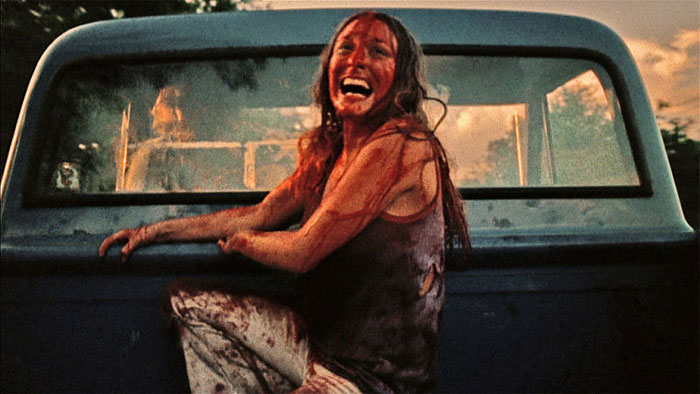
We begin in 1974. A young woman named Sally Hardesty makes a fateful stop on a road trip through Texas, only to be bound to a dinner table, slashed with a chainsaw and pursued until she jumps from a window to escape. heralds a new era for the slasher film. Though it’s as much about economic anxiety as it is about male violence and female terror, Tobe Hooper’s Texas Chainsaw Massacre gives us the forerunner of the Final Girl.

Sally is a final girl only in that she survives. As David Roche says in Making and Remaking Horror in the 1970s and 2000s: Why Don’t They Do It Like They Used To? “Sally, the hippie, is very ‘feminine’ and not especially heroic: she undergoes intense suffering, attempts to sell her body, and seems to lose her mind. Sally is, in effect, the most resisting body.” Unlike the Girls who follow her, Sally does not take down her assailant. She does nothing to harm Leatherface, though she does take action – in particular, action against her own body (jumping out of a window), effectively taking power away from the men who wish her harm. More striking than Sally’s badass escape is that the women in this film are literally pieces of meat. Sally’s friend Pam enters the home in a backless tank top and daisy duke shorts, her skin exposed in a fashion (while suitable for the Texas heat) risque for the time. But instead of being sexualized, her bare back is placed on meat hooks. The message may not be intentional, but it is clear: women who dare leave the domicile are slabs of meat at the mercy of male violence. And just tuck this away for later…this seeing women as slabs of meat thing — it isn’t done by the typical male, but by the “Other”.
Halloween, Friday the 13th and A Nightmare on Elm Street follow and establish the role of the Final Girl as we know her. These classic heroines not only survive, but fight back, ultimately killing their adversary, the stalker who’s killed all of their friends.
Again, here, the stalker is uncanny. He is the stranger, male violence incarnate. Our heroines are cautious, investigative, often butch and prudish. If violence is gendered male, fear is gendered female and the hero we root for must embody both.
The Audience Surrogate
There is much discourse on why the Final Girl is represented as she is. As Carol J. Clover puts it In Men, Women and Chainsaws, “The Final Girl is boyish…she is not fully feminine — not in any case, feminine in the way of her friends…figuratively seen, the Final Girl is a male surrogate…to the extent she means ‘girl’ at all, it is only for the purposes of signifying male lack.”
Clover posits that the Final Girl rips the phallic chainsaw from the killer to yield it herself to represent not a woman gaining agency, but a man coming of age. Her interpretation assumes a strictly male audience, though she does identify a revolutionary staple of the slasher genre — the adapting POV and shifting audience allegiance. Slasher films open with the POV of the killer and we, the audience, kill with him for the chunk of the film.


We root for him as he slaughters teens until we pivot into the POV of the Final Girl. Then we wait with her in the closet, planning our defense and counterattack until the final showdown. Here film theorists note that in order for the male audience to put themselves in the final survivor’s shoes, she must abstain from penetrative sex, something a straight male could never relate to – or god forbid the audience feel too gay.
This “male gaze”, even as audiences grow and progress, becomes impossible to separate from the slasher genre. In 1981, Rita Mae Brown writes Sleepless Nights, a feminist critique in the form of a slasher movie parody, but in the hands of producers the film becomes stripped of all irony into the Slumber Party Massacre. This is a vital moment for the slasher, because as much as it evolves, as much as it becomes self- aware, it cannot break away from gendered perspective.
The Cautionary Tale
The abstinence at the heart of surviving a slasher film is often looked at as a morality tale. The women who party, show their breasts and/or have sex are soon in the killer’s clutches, whereas the woman who doesn’t flaunt her femininity or exhibit sexual desire is clear-headed enough to survive. But someone has to die. And the death and dismembering of beautiful women — sex juxtaposed with violence — is what we expect from the genre. The message of punishing sexual agency in women has been carried on and spoofed in Scream and Cabin in the Woods. Though it may not be that simple.
It’s important to note that not all Final Girls are virginal. In fact, most aren’t — the Final Girl in Black Christmas is considering an abortion — though in the most successful films, the Final Girl abstains. Though she doesn’t always abstain because she’s disinterested in sex, but often because she has more important shit to do. Nancy (A Nightmare on Elm Street) and Alice (Friday the 13th) are both in romantic relationships, but spend more of the movie investigating their perils than retreating to their respective partners.


John Carpenter himself argued against the punishment of female sexuality. As he put it “[Laurie’s] the most sexually frustrated. She’s the one that killed him. Not because she’s a virgin, but because all that repressed energy starts coming out…she and the killer have a certain link: sexual repression”. Both Clover and Carpenter seem to agree that the gender and sexuality of the Final Girl are posed to mirror that of the killer. To destroy him, she must recognize him.
Still, the slashers that follow elaborate on the Final Girl’s characterization, specifically her sexuality. If classical slashers were brought about and encouraged by the gender confusion of women gaining agency in the workplace, the neo-slasher were brought about by women gaining agency in their own sexuality. As they evolve, slashers echo the anxieties of ‘violence against women’. The violence we’re taught to defend ourselves against, defend our daughters against, but never taught to outright end. This violence, the slasher genders male, but conveniently is only carried out by “The Other”. Even the men of the slasher film as they attempt to protect the female, fall victim to it. This violence is inevitable. Its only hope is female resistance. As long as women are taught to abstain and keep themselves from becoming sexual objects, society need not worry about curbing male violence.
Coinciding with the rise of the slasher film is the rise of birth control. Birth control gave women control over their bodies — the control they were supposed to already have by playing coy. If women could now have sex without consequences, what would happen
to the natural order? The women punished in horror — the women we watch lustfully, then judge mercilessly — are the ones choosing to have sex. The Final Girl’s friends happily traipse up to the bedroom. Their shorts ride high because they want to be desirable. And subconsciously, that’s what America flocked to. Films where male violence was an unstoppable force. No one can stop a slasher villain. Not men. Not police. The only thing that can stop the unstoppable force of male violence? The woman who chooses to remain a virgin. After all, by focusing on the choices of women, the responsibility of men vanishes.
Death of the Slasher: The self-referential era
Following, the slashers that dominate the 90s and into the 2000s capitalize on the “rules of horror movies” and self-parody.
Scream, the mother of the self-referential meta-horror film, differs from the classical slashers by adopting the female POV. Instead of witnessing the first kill from the killer’s POV, we open on the soon-to-be-victim answering the phone. We stick with her as the phone call turns from flirty to threatening to deadly. Throughout the film franchise, the audience only experiences fear and paranoia vicariously, never the thrill of the kill. Scream is not about the fear of the Other or the stranger — the killer is always directly connected to the Final Girl and often romantically linked. Incidentally, Scream is obsessed with the virgin complex of the Final Girl.

When Sidney Prescott does finally consent to having sex, the loss of her virginity is immediately followed by the reveal of her boyfriend’s role in the murder of her mother — A truth that makes her more than regret the decision for intercourse. Sidney stabs her boyfriend with an umbrella, going so far to penetrate his wound with her finger. In this act of ‘reverse- intercourse’, Sidney reclaims her virginity. Through satire and breaking the fourth wall, the Scream franchise hits on something poignant: the constant fear of sexually- frustrated men. If Classical Slashers fear a stranger’s violence against women, Scream invokes the fears of acquaintance rape.
Cabin in the Woods, on the other hand, destroys the Final Girl, casting her off as a relic from a by-gone era. Dana Polk, the would-be Final Girl, is having an affair with her college professor. In sardonic self-referentialism, Cabin in the Woods fudges the rules on purpose, the joke being that a real virgin would be too rare these days. In this world, the blatant misogyny of the slasher doesn’t come from The Other or a particular man, but from civilization itself. As Dana becomes aware that she is meant as a sacrifice, she decides the world should end with her. The ending can be interpreted as a funeral for the subgenre and the gratuitous violence that marks it.


Happy Death Day and Freaky take the slasher film on a tour of light fantasy tropes, mimicking Groundhogs Day and Freaky Friday, respectively. Freaky, through a cosmic turn of events, the Final Girl is played by Vince Vaughn, easily a wink to an audience who already understands the non-binary language of the Final Girl.
Rebirth: The Neo Slasher
Thirty years and two slasher cycles after Carol Clover, we’re tempted again to claim The Final Girl as a feminist win. Scream boasts multiple surviving women — women with a broad spectrum of femininity from Courtney Cox-Arquette to Bex Taylor- Klaus. X totes itself as a sex-positive neo-slasher. And yet…someone has to die. The Final Girl’s juxtaposition to the other women in the film delivers a striking message. One that’s hard to ignore.
In the 2010s, a new wave of feminism collides with patriarchal rape culture and the public discourse changes. #FreetheNipple and #MeToo trend. And in a world where rape revenge films should have a comeback — instead we get the return of the slasher and a little film called Happy Death Day.
Happy Death Day is a slasher, though not in the traditional sense. Tree, the would-be Final Girl, gets caught in a time loop on the day of her death. No matter what she does, her day always ends with a masked killer stabbing her with a knife. In this sense, she begins as the overtly feminine victim and through her character arc becomes the more masculine, self-rescuing Final Girl. At first glance, she’s a blonde, sexually- active, sorority girl as the Final Girl heroine, but in further analysis, that’s the version of her doomed to die. This version wakes up from a one-night stand with Carter, the film’s version of a dweeby ‘nice guy’. She then attends a meeting with her sorority sisters where they make their disapproval of Tree’s sexual choices clear. Tree’s version of femininity (one who pursues sex merely for pleasure) is condemned.

However, Tree conforming to the ‘ideal woman’ according to her Sorority Sisters does not win her out of her time loop. She only breaks out of her time loop once she acknowledges Carter as a viable boyfriend rather than a one-night stand. As a romantic partner, rather than a sexual one, Tree is able to fight back, destroy the killer and break out of her time loop bonds.
One of the most successful new film franchises of course is Ti West’s X. X, in an homage to Classical slashers, takes place in the 1970s and follows a film crew out into a dilapidated farm house to film pornography. X delivers a giant wink to the audience as the main character convinces his crew that pornography is about to hit mainstream and become a cash cow. It also laughs in the face of the virginal Final Girl trope as the X’s final girl, Maxine, is a porn star. However, X proves that everything created new must also feel familiar. X still relies on the original tropes in order to twist them and applauding the film for its sex positivity would be premature. By the function of necessary conflict, all of X’s women are still defined by their relationship to men.

Jenna Ortega plays the “virginal” brunette final girl archetype, Lorraine. Boyish and shy, she’s the only member of the crew ‘against’ their filming of sexual activity and complains of its crassness. She’s the archetype we’re familiar with, but interestingly, not virginal and not a final girl. Lorraine asks for a part in the porno film — much against her boyfriend’s wishes — and she’s punished for it. Her boyfriend storms off and as Lorraine is looking for him, she’s taken captive in the killer’s basement. Lorraine’s sexual agency affects her relationship and even worse, her man suffers for it. X plays with our expectations, as Lorraine picks up a hatchet and rescues herself, only to get shot in the head. However, the heroization of Maxine, the only woman whose sexual agency is celebrated by her boyfriend, seems to indicate that even in a film full of violent and agency-possessing women, the male gaze still wins out. Because her boyfriend approves, Maxine’s sexuality is deemed acceptable.
Conclusion
Final Girls have come a long way. No matter how inexorably punished femininity or sexuality may be in each era of the slasher, she’s still – like Dorothy in the Wizard of Oz — “a girl in the boy story”. She makes her own choices, fights her own battles and invites an audience of all genders to prevail along with her.


Monica Ferrall (she/her) is a director/screenwriter originally from the Pacific Northwest. She studied screenwriting and horror film theory at Loyola Marymount University. She writes queer, feminist-themed horror features, television and has earned a fellowship in After Dark Film’s Feature Lab as well as a place in Millennia Scope Entertainment’s TV Writer’s Room, which focuses on bolstering LGBTQIA+ representation.
Leave a Reply