by Mo Moshaty
Hell Hole (2024)
Hell Hole hails from the filmmaking family behind Hellbender and centers on an American-led fracking crew that uncovers a living French soldier frozen in time from a Napoleonic campaign, whose body hosts a parasitic monster.

Mo Moshaty: This is a departure from what you’ve done before. So talk to me about what that process was like, how it felt kind of moving out from under your usual atmosphere into something like this.
Toby Poser (Actor, Writer/Director): It was, I’ll be honest. It took some getting used to. I think at first it was I thought I personally found it a little overwhelming being outside our tiny intimate space and not only that, but we wear every hat in our production. Sharing those things with other people was a great lesson in collaboration and letting go and in generosity because it’s hard when it’s something you’ve written. There definitely were some growing pains, but there are also things that I enjoyed about it, especially in the letting go and trusting in other people’s abilities.
John Adams (Actor, Writer/Director): We grew up the four of us grew up making films together. Me, Zelda, Lulu and Toby. We all started at the same time. Zelda was 5, Lulu was 10 and so we all learned how to make films together. We didn’t go to film school. No one else taught us, so we we learned together. What was interesting for us is suddenly we went in and worked with industry people and industry rules, and that was fascinating. I think what we learned is that if you want to work in the industry and you want to work with a big production team, you kind of got to follow the rules because that’s the only way a group of people can walk in the same direction, if everybody understands and follows the rules. I think what we really do love about filmmaking is that we never had any. And so we love “no rules”. So, this was a great experience and it was really fun and we couldn’t have done it any other way, but we also really came to fall in love even further with our way of making our punk rock films as a family of four.
MM: I think it’s great how your unique style still shines through. Watching your work, it’s clear what your touches are, even with different elements at play. The punk rock vibe, especially in the music, is still there. It’s fun and touches on so many themes like the monster. I want to talk about the symbolism of the parasitic monster in this film, and what your view of that was and the big the grand scheme of the story, what it represented to you.
TP: It’s something I love about monster movies in general, is that yes, they’re about monsters, but inevitably, they’re about human nature, because when you have a monster, you’re afraid of something alien, something different, something other. And that always says something about humanity’s fears within itself. So in this case, I love the concept of the monster in this film because for a science geek like me, I look at it and I think to myself. Well, who is the monster here, you know? Is there something that’s scary and wants to survive? That is frightening, especially for the men, because they’re the ones dealing with it.
Or is this something very highly evolved which is just in today’s world trying to reach its fruition? So, you know for me it’s not an alien. It’s something that’s sort of been under the ground. This is evolutionary horror is how I like to think about it, but it’s also something ecological and political, you know, there’s a political monster here. You have these very elitist Americans coming in and making their money pillaging someone else’s earth.

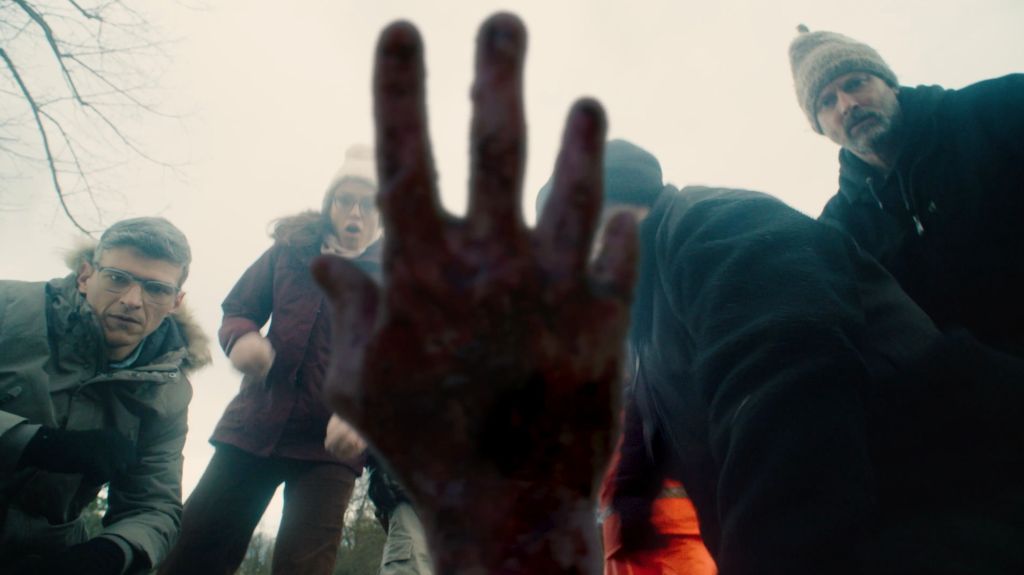
Aleksandar Trmčićin, Toby Poser, John Adams, Olivera Perunicic in Toby Poser and John Adams’ HELL HOLE. Courtesy of Shudder.
MM: The American Way.
TP: So there are lots of iterations of monstrosity. Here, of course my favourite is the one about just if you’re carrying something that wants to survive but you don’t want to be carrying it, what does that? What does that monster say to you in this case to the men?
JA: We had been watching a lot of horror movies as a family, especially 1950s monster films like Creature of the Black Lagoon. So when we got the opportunity to make a monster movie, we were excited because it’s something we couldn’t do as a family before. We thought it would be fun to flip the classic monster movie tropes. We kept the science, the scientists, the assistants, the remote setting, and the monster, but we changed the love interest. Instead of the typical young, pretty woman on a boat, we made it something different. America is acting like it’s in the 1950s right now, so the film serves as a reflection of that era’s monster movies, as well as a commentary on how America seems to want to return to that time. It also reflects how angry men are at the moment, especially in how they deal with women’s issues—often through violence, self-hate, or resentment. We hope the film offers a way to talk about this strange virus that seems to be infecting America right now.
MM: You have the parasite, the morality issues around fracking, and the American team coming in with a typical attitude of “everything sucks here”—complaining about the lack of Wi-Fi, bad food, and everything else. And then there’s the gender aspect. You managed to bring all these themes together into a cohesive story, which seems almost too much to hope for. There’s no scene where the theme you’re tackling isn’t clear, and you’ve maintained your unique style throughout, especially with the recurring family dynamics.
Tell me about the dynamic between Emily and John versus her relationship with Teddy. We see two different Emilys, and I think it’s crucial that this contrast is shown. It was a really nice touch.
TP: OK, so let’s talk about Emily and her relationship with John. I wanted to portray a woman who has zero interest in motherhood. In all my films, I’ve played mothers, and I’m comfortable with that because it’s who I am in real life. But I’m really fascinated by women who don’t have a single maternal bone in their body, and I’m glad I finally got the opportunity to play one. It’s important, especially today, with some of the things people say about non-parents. Emily and John’s relationship is interesting because you have a guy who thinks it’s beautiful that women can be mothers, and she’s like, ‘No, not for me.’ I love that about her. Now, with Teddy, her relationship as his aunt is distant, but she loves him and would do anything for him—even risking the lives of the others on the crew. We also wanted to flip the script a bit—Teddy’s the one who wants to be a stay-at-home dad, the one that has that paternal instinct.

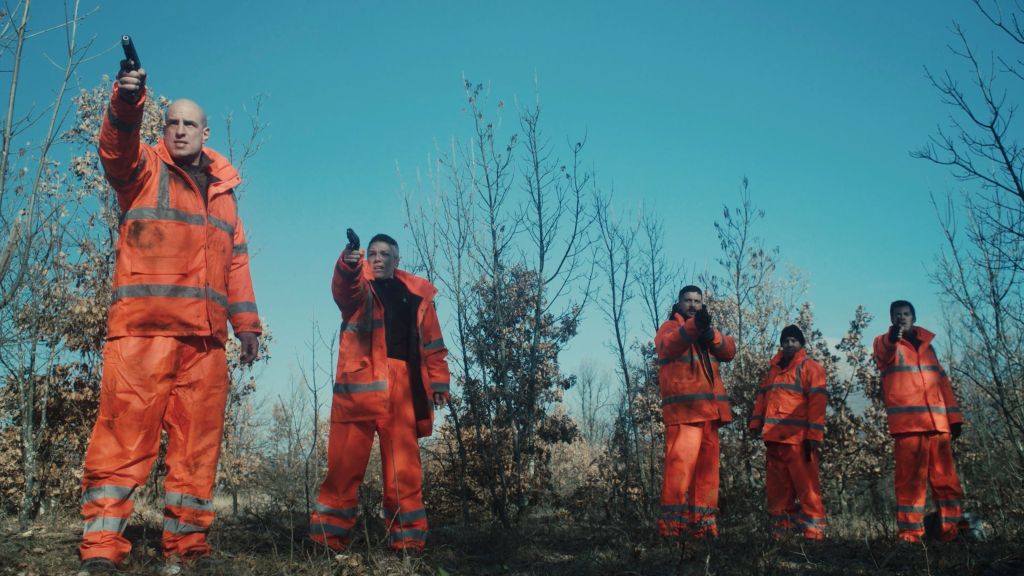
John Adams, Boris Lukman and Joana Knezevic in Toby Poser and John Adams’ HELL HOLE. Courtesy of Shudder.
MM: And how do you feel about John and Emily’s dynamic in the film, John?
JA: Like you can tell that Emily likes John even though he is such a just classic American male. Like he just can’t help himself. But he’s also, at least to me, I hope, lovable, even likeable, with all of his flaws. So, we’re hoping that when people watch this, nobody says, oh, this is too, like, cartoonish in terms of the political commentary. There’s definitely political commentary in there. We weren’t trying to paint this as a red or blue movie. Emily votes for Bernie Sanders and yes, she’s running a fracking camp. And so, I think part of the statement that we’re trying to say is we’re all in this together whether we like it or not and it’s complicated. All these things are very complicated, even people that don’t want to drill, drive a car of work. And so, it’s all very, very complicated, but we’re all in this together, so we got to stop committing suicide.
MM: This film is showing that, yeah, literally side by side with the scientist who is incredibly self-serving, the really eager protégé, you know Teddy who just wants to live the dad life. Emily, that wants to get the job done, get in and get out and John seems to be very smitten with her but also still just being a bro and I feel like these are all people that we know. These are people that are in our lives and I think that’s why you want to stick with them throughout the film.
It’s also location, location, location. How did you go about scouting that?
JA: That was actually not by choice the the script that we had written was to take place in Canada and we were going to shoot it up in the Catskills, right next to our house. And the production company then said can actually we need to shoot it in Serbia. And so there were two problems there which 1) Serbia doesn’t look like Canada and 2) We said, what do we do about the language? And there they were like we “you rewrite the script.”.
So they went and scouted and found this old Soviet mine when they sent those pictures to us, that helped Toby really rewrite the script because once we saw that mind, we realised ohh, that beautiful landscape, that beautiful old Soviet mine can serve the same purposes that we understand about the Catskills or about the Canadian Outback and that became a character. So it worked out very well because it was beautiful and it just brought its own character to the film. That mine is from the 30s so it’s just another historical fact sitting there as a backdrop for this fun monster movie.
MM: It’s a good pairing, congratulations on an such a fun film, the Shudder fam never disappoints!
HELL HOLE drops today on SHUDDER!
Read our Fantastia Fest review here!
 NightTide Magazine
Leave a comment