
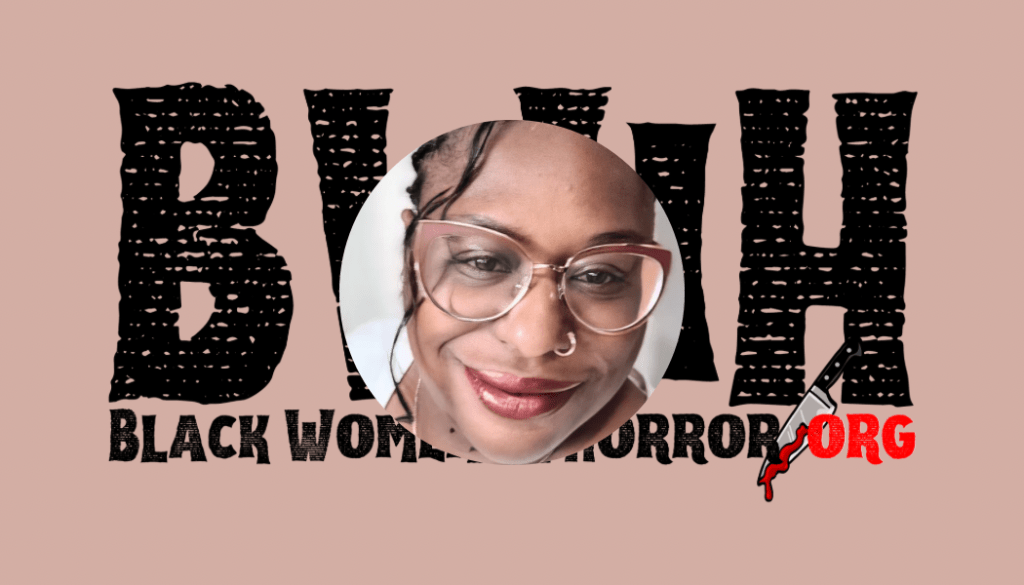
Birthing the essence of darkness: RJ Joseph writes with a consciousness of what constitutes horror and monstrosity, focusing on the specific implications they have on the intersections of race, gender, and class.
Rhonda Jackson Garcia, AKA RJ Joseph, is an award winning, Stoker Award™ and Shirley Jackson Award nominated, Texas based academic and creative writer/professor/editor whose writing regularly focuses on the intersections of gender and race in the horror and romance genres and popular culture.

Rhonda is also an instructor at The Speculative Fiction Academy and the co-host of the Genre Blackademia podcast. She is also working with Raw Dog Screaming Press, editing a new novella line, The Selected Papers for the Study of Anomalous Phenomena.
She occasionally peeks out online through social media from @rjacksonjoseph orwww.rhondajacksonjoseph.com.
1. What was your first published work?
My first published work was an angsty romance poem in a romance confessions magazine when I was seventeen. My first horror work was published in 1994. I’ve been around for a while LOL.
2. Is there a story inside that you have seeds of but can’t seem to connect that’s dying to get out?
Oh, yes, all the time. My current one is a dream I had a couple of months ago that’s still so hazy in my head, but it’s haunting me. All I can remember is arguing with a group of people that we shouldn’t bury some guy that they were saying was dead. I argued that maybe he really wasn’t dead and we shouldn’t bury him or else really bad things would happen. Who was the guy? I don’t know. Why did I think he might not be dead? I don’t know. What are the very bad things that would happen? Again, I don’t know. I’m excited to see where this story goes and I’ll be thrilled when it finally lets me know what it wants to be.
3. How do you handle a rejected story?
I mostly give myself a little bit of time to reflect on whether the story was a good fit for the venue in the first place and where I can send it next. If it gets too many rejections, I usually keep it until I can take another look at it, maybe for a future story collection.
4. What does literary success look like to you?
Literary success is divided into equal parts for me. One part is getting recognition of my work from within my writing and social communities. Another part is being offered lucrative opportunities based on my work. I also feel that having my work taught in classrooms and at workshops is a part of literary success.
5. Do you read your book reviews? How do you deal with bad or good ones?
I try really hard not to read my book reviews. I won’t go on Amazon or Goodreads to read them, for sure. I’m not that big a fan of torture. I will read the ones where the reviewer tags me in on social media. My experience has been that if a reviewer tags me in, they’re usually saying constructive things that I want to engage with.
If I do happen on one that isn’t glowing, I take what I can from it and keep it pushing. When I do catch wind of the good ones, I allow myself to sit in the positivity and use it as confirmation that I’m doing what I’m supposed to be doing and I’m pretty good at it.
6. What is the most difficult part of your artistic process?
The most difficult part of my artistic process these days is staying healthy and motivated enough to keep up with all the things I want to do. There are health considerations here in middle age that require more attention than I anticipated and staying on top of those and being proactive are a must. That takes time—when I’d rather be writing or doing an engagement!

7. As in most times, the truth is stranger than fiction, what has been the hardest scene or chapter you’ve had to write, if you were channeling personal experience?
The hardest thing I’ve ever had to write is something I’m still not done with because of how difficult it is for me. For about 14 years now, I’ve been writing a novel about a woman with a disabled daughter who has to fight discarnate spirits as she thinks, wrongly, that her daughter’s health is improving. Every time I add a few words to the story, I stop. Just thinking about the health situations I constantly weather with my own disabled daughter, always fighting everybody for her care, is exhausting enough. I can’t imagine doing the same with wicked spirits making things even harder. It’s a little too close to home for me. I keep working on it, though, because one day, it’ll be finished.
8. What inspired your latest work?
My latest work is a short story, “We Were Meant to Be Buried”, which appears in the anthology To Root Somewhere Beautiful by Outland Entertainment. This is an eco-horror story (in an eco-speculative fiction anthology) where residents in an inner-city neighborhood that’s being gentrified watch an old, demolished building take revenge on the interlopers.
The story has roots in the neighborhood where I used to live when I was younger, close to downtown Houston. The area has been gutted and none of the older, beautiful buildings are there anymore—there are now only million dollars plus loft apartments and townhomes. As the first of those were going up, the builders tore down a beautiful building at the end of my street. I was sad to see it go and could never find any history on what it used to be or anything. I like to imagine that the resulting neighborhood rat infestation that came after it was torn down was the building leaving a last message.
9. If you could tell your younger writing self anything, what would it be?
I would tell younger writing Rhonda that everything we experienced would pay off in the long run. I’d also remind her that it would never get any easier in these writing streets but to hold steady because this is where we belong.
10. Best advice you’ve ever gotten from a fellow author?
I’ve gotten two bits of advice from fellow writers that had a huge impact on me and my writing. The first was from an interview Joe Lansdale did some years ago where he basically said, “Write like everybody you know is dead.” I love Lansdale, and being a fellow Southerner, I intimately understand how difficult it is to write about the things in my life that my family and/or friends might not quite understand. His words were freeing and gave me permission to write my truths the way I want to write them—and to get really good at telling my loved ones its all just made up.
The latest bit was given just a few days ago. L. Marie Wood called me out about a novella I’m supposed to be working on right now that I’ve sort of shelved. She asked, “Have you set a deadline for it?” She knows me really well and she finally figured out that when I put something on my calendar with a deadline, it likely gets done. So she called me out on not putting my own unsolicited stuff on my calendar so that I hold myself accountable to finishing them. She told me to treat my own stuff as importantly as I treat stuff I do for other people. A smart one, that L. Marie!
11. What is your go-to comfort horror/Sci-Fi book?
I do a regular re-read of Beloved frequently. Not just because it’s foundational to my academic and creative work, but because its so beautifully written. Being in fellowship with Master Morrison keeps me sustained at times when I think I can’t keep going.
12. If you were to genre-hop, which genres would you most like to try writing?
I started out writing romance and I always say I’ll get back to it one day. I still get story ideas I want to work on. But they’re so dark, and yet not paranormal romances. I think I have to wait until the market changes from wanting mostly romantic comedies and lighthearted romances to making a space for heavier topics that don’t fall under the umbrella of the paranormal. Then I can make my way back.
Find more of R.J. Joseph’s work here!
 NightTide Magazine
Leave a comment