

by Andrew Pope
Inferno (1980)
An American student investigates the disappearance of his sister and the death of a friend, both connected from New York to Rome by an old alchemy book.

Dario Argento’s Inferno (1980), the sequel to his 1977 masterpiece Suspiria, is sometimes dismissed as the lesser movie – a partial misfire, derailed by Argento’s own illness while shooting the film. Nonsense. Inferno stands as a testament to the Italian director’s ability to transcend genre conventions while simultaneously embracing and reconfiguring them. Like Suspiria, Inferno is a kind of post-giallo film — reconfiguring that genre’s tropes into a surreal, absurdist nightmare that deconstructs the stylistic and thematic concerns of classic giallo cinema. To fully appreciate Inferno as a unique artifact within Argento’s filmography, it is essential to understand its roots in the giallo tradition and the personal and professional context in which it was created.
Giallo, which means “yellow” in Italian, derives its name from the yellow-covered crime novels that were popular in Italy during the mid-20th century. This sub-genre, which emerged in the 1960s, is characterized by a blend of mystery, horror, and eroticism. Giallo films often feature lurid, violent murder sequences, a focus on female victims, and intricate, sometimes nonsensical plots involving psychosexual elements and masked killers. Directors such as Mario Bava and Sergio Martino played pivotal roles in shaping the genre, but it was Dario Argento who truly elevated giallo to international acclaim.
Argento’s early films, such as The Bird with the Crystal Plumage (1970) and Deep Red(1975), are quintessential gialli, marked by their intricate murder mysteries, baroque aesthetics, and a pervasive sense of paranoia. These films are anchored in a tangible reality, where the horrors, though stylized, are rooted in the psychology of the human mind. However, as Argento’s career progressed, his work began to move away from the straightforward crime narratives of traditional giallo, venturing into more abstract and supernatural territories. This shift was clearly marked in Suspiria, but culminates in Inferno, a film that not only builds on the giallo tradition but also explodes it into a realm of pure nightmare.


Inferno belongs to Argento’s “Three Mothers” trilogy, a series of films exploring a mythos surrounding three ancient witches. While Suspiria introduced the first of these witches, the Mother of Sighs, Inferno focuses on the Mother of Darkness.
Broadly speaking, Inferno follows the mysterious and terrifying events that unfold when Rose Elliot, a poet living in New York, discovers a book that reveals the existence of the three malevolent witches. After uncovering clues suggesting that one of these witches, the Mother of Darkness, resides in her apartment building, Rose reaches out to her brother Mark, a music student in Rome, for help. When Mark arrives in New York, he finds Rose missing and is drawn into a nightmarish investigation filled with inexplicable deaths, surreal visions, and encounters with the supernatural, as the dark forces of the Mother of Darkness close in on him and those around him. However, all of this serves more as a loose framework for Argento to delve into a dreamlike narrative that defies logical coherence.
In Inferno, Argento pushes classic giallo tropes forward into an abstract, almost absurdist form. The film’s emphasis on visual and aural experiences over narrative clarity marks a departure from the gialli that precede it. While the genre is known for its convoluted plots, Inferno pushes this to the extreme, with its story unraveling in a series of disjointed, hallucinatory set pieces. The murders, a staple of giallo cinema, are depicted with an operatic grandeur that borders on the surreal. The standout scene in which a bookseller is attacked by rats in a Central Park-like setting before being gruesomely killed is a sequence of escalating absurdity whose orchestration feels more like a fever dream than a conventional horror scene.


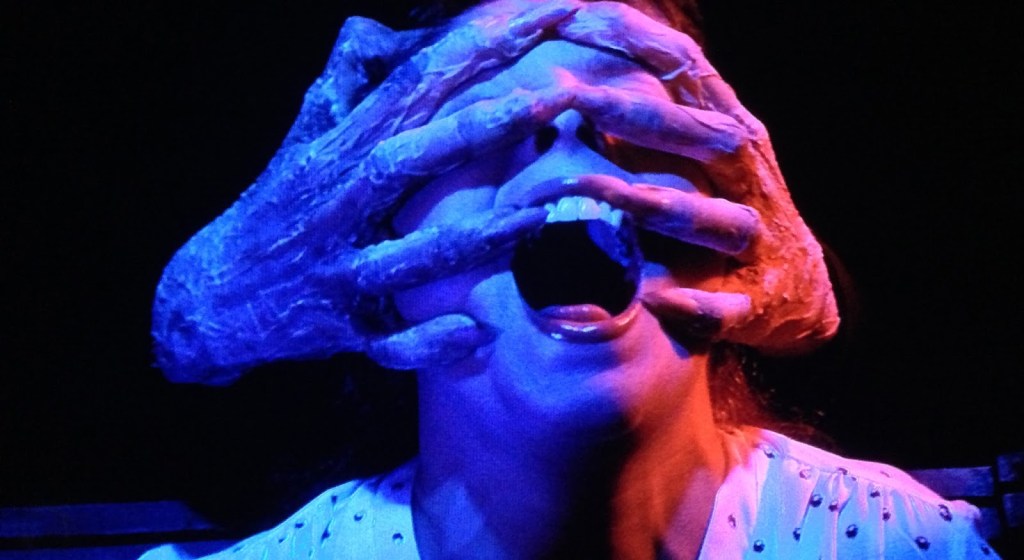
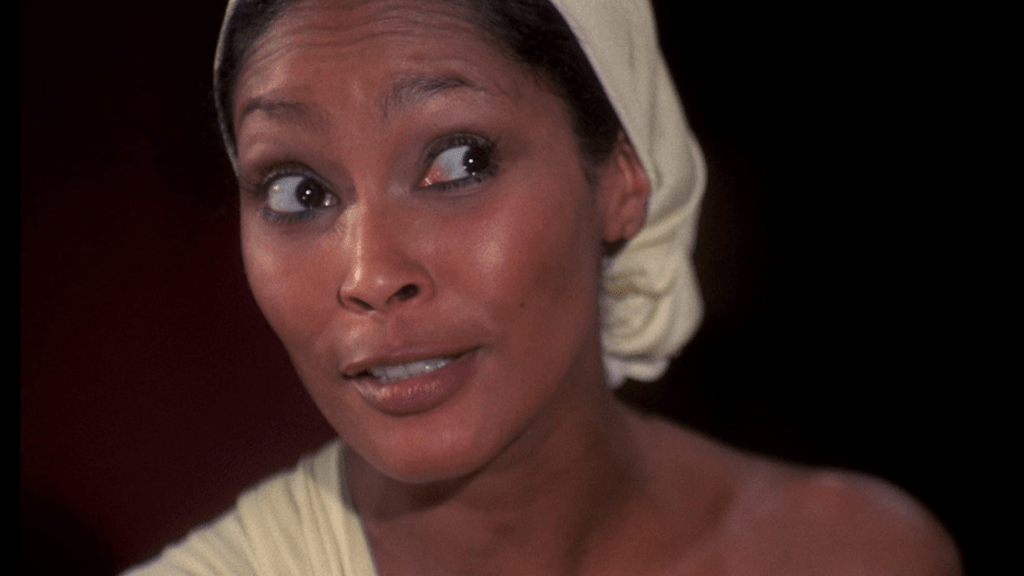
Irene Miracle in Inferno
Giallo films are often associated with vivid, lurid color palettes, but together with Suspiria, Inferno is the high water-mark of Argento’s approaches in this area. The film’s lighting, dominated by deep blues and reds, transforms the environment into a nightmarish landscape. Argento’s obsession with the interplay of light and shadow here transcends the genre’s typical stylization, creating an environment that is both beautiful and disorienting. The use of color in Inferno not only heightens the film’s surreal quality but also underlines the characters’ descent into madness.
The making of Inferno was marked by significant personal and professional challenges for Argento. During production, the director was suffering from a severe case of hepatitis, which left him bedridden for much of the shoot. This illness forced him to delegate some directorial duties to his collaborators, including his wife, Daria Nicolodi. Nicolodi, an actress and screenwriter who had worked closely with Argento on several of his films, played a crucial role in shaping Inferno. Though uncredited, her influence is palpable, particularly in the film’s exploration of occult themes and its focus on the feminine aspects of horror.
Argento’s illness during the making of Inferno may also have contributed to the film’s fragmented, dreamlike structure. The sense of disorientation and helplessness that pervades the film could be seen as a reflection of Argento’s own physical and mental state at the time. The result is a film that feels deeply personal, a manifestation of the director’s fears and anxieties projected onto the screen.
While Inferno shares many stylistic elements with traditional giallo films—such as its elaborate murder sequences and its use of first-person camera work—it diverges in its approach to narrative and meaning. Where classic gialli often hinge on a final revelation that ties the narrative together, Inferno offers no such closure. The film revels in its ambiguity, presenting a series of increasingly bizarre and disjointed events that resist easy interpretation. This absurdist approach aligns Inferno more closely with the works of surrealist filmmakers like Luis Buñuel than with the giallo films of Argento’s contemporaries.
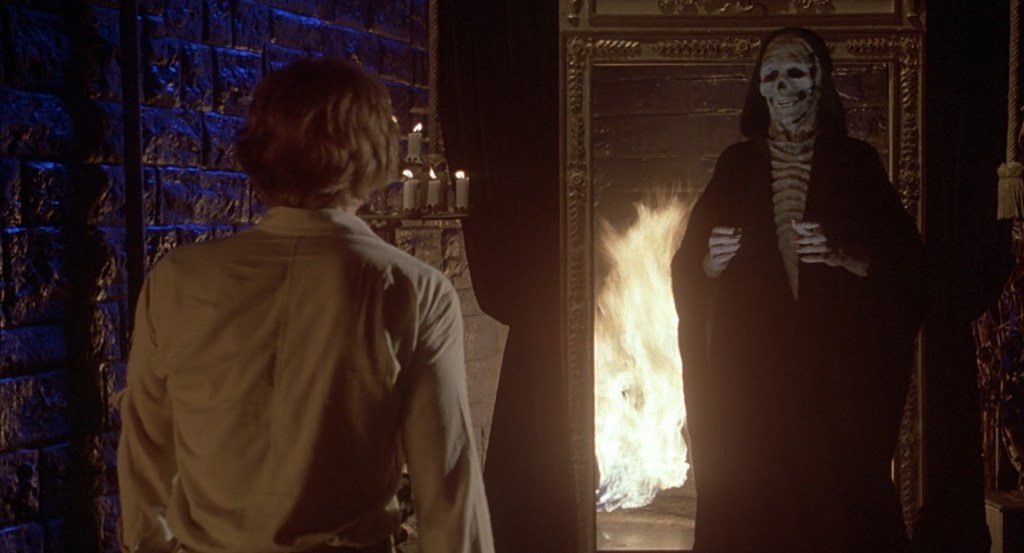
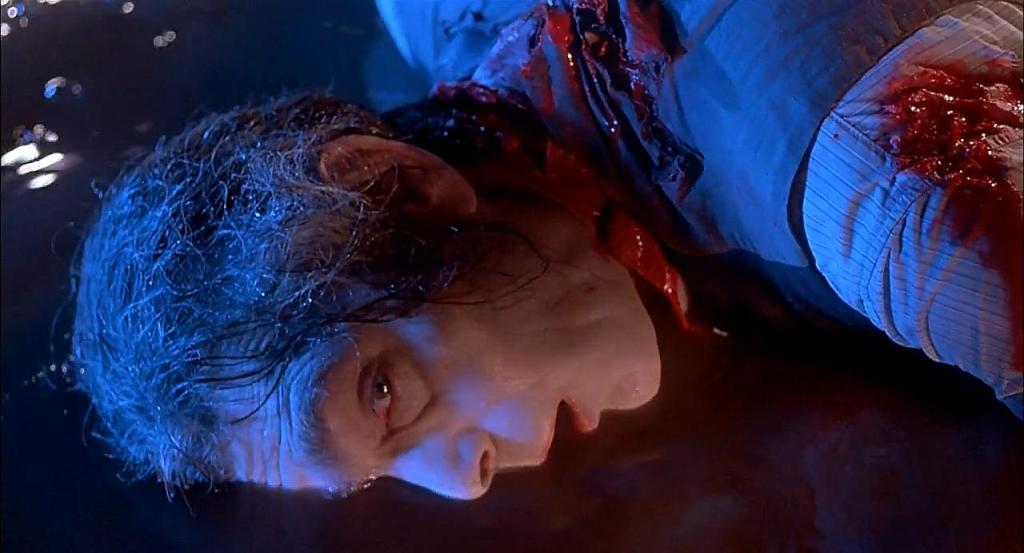
Leigh McClosky and Sacha Pitoëff in Inferno
In Inferno, the line between reality and fantasy is constantly blurred. Characters move through environments that seem to shift and change around them, with little regard for the logic of time and space. The narrative, if it can be called that, is driven more by mood and atmosphere than by character or plot development. This sense of dislocation is heightened by Argento’s use of unconventional camera angles and sudden, jarring cuts, which further destabilize the viewer’s sense of reality.
Inferno stands as a unique entry in both the giallo genre and Dario Argento’s filmography. While it draws heavily from the stylistic and thematic conventions of giallo, it ultimately transcends these influences, offering a vision of horror that is more abstract and nightmarish than anything Argento had previously created. For him, the film represents a bold step forward, beyond even Suspiria – an ongoing departure from the psychological horrors of his earlier gialli into a realm where nightmare reigns supreme. In Inferno, Argento’s vision of horror is fully unleashed, creating a film that remains one of the most enigmatic and haunting entries in the annals of Italian horror cinema
Viewed in this way, Inferno is a post-giallo masterpiece—an absurdist reimagining of the genre that distills its essence into a pure, unrelenting nightmare. Its supposed weakness when measured against Suspiria is perhaps really its greatest strength – where Suspiria has a classic fairytale structure, Inferno never quite resolves into anything so coherent. Instead, narrative elements chase each other through the storyline, consuming and disrupting each other. Suspiria is a bedtime story. Inferno is the nightmare that comes after.
Andrew Pope is the co-founder of Whitlock and Pope, a online film journal focusing on cult and genre cinema.
 NightTide Magazine
Leave a comment