By Jonathan Helland
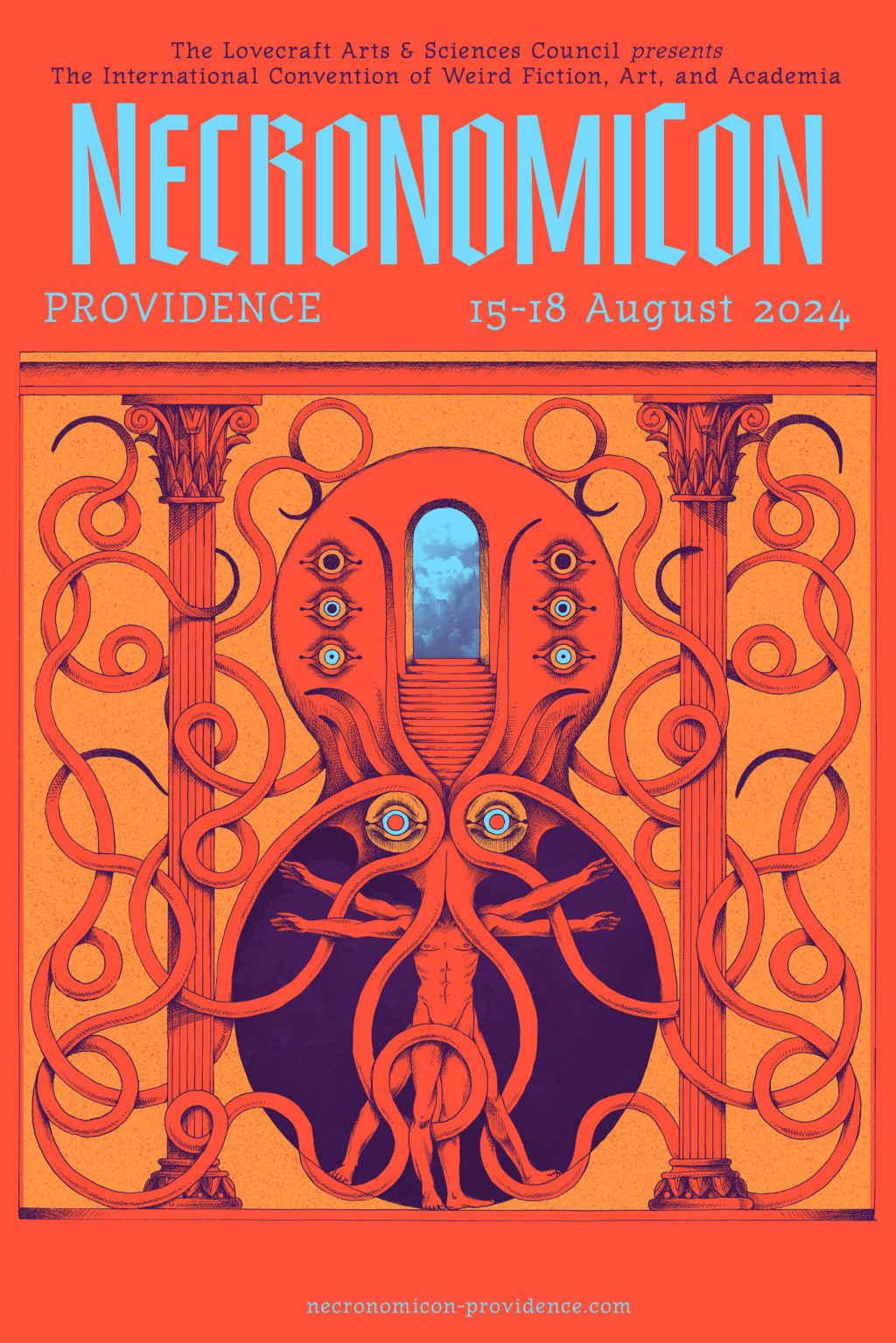
At this year’s NecronomiCon—A biannual celebration of cosmic and Lovecraftian horror—Tonnvane “TL” Wiswell performed shadow play adaptations of two of HP Lovecraft’s weirder short stories.
I didn’t know what to expect when I walked into a black box theater attached to a bar in Providence, Rhode Island (Lovecraft’s hometown). I certainly hadn’t expected the crowd that filled the sidewalk to fit inside a theater smaller than the average high school classroom. Nor had I expected the centerpiece of the event to be an overhead projector that would be perfectly at home in such a classroom (if you, like me, went to high school in the 20th century.)
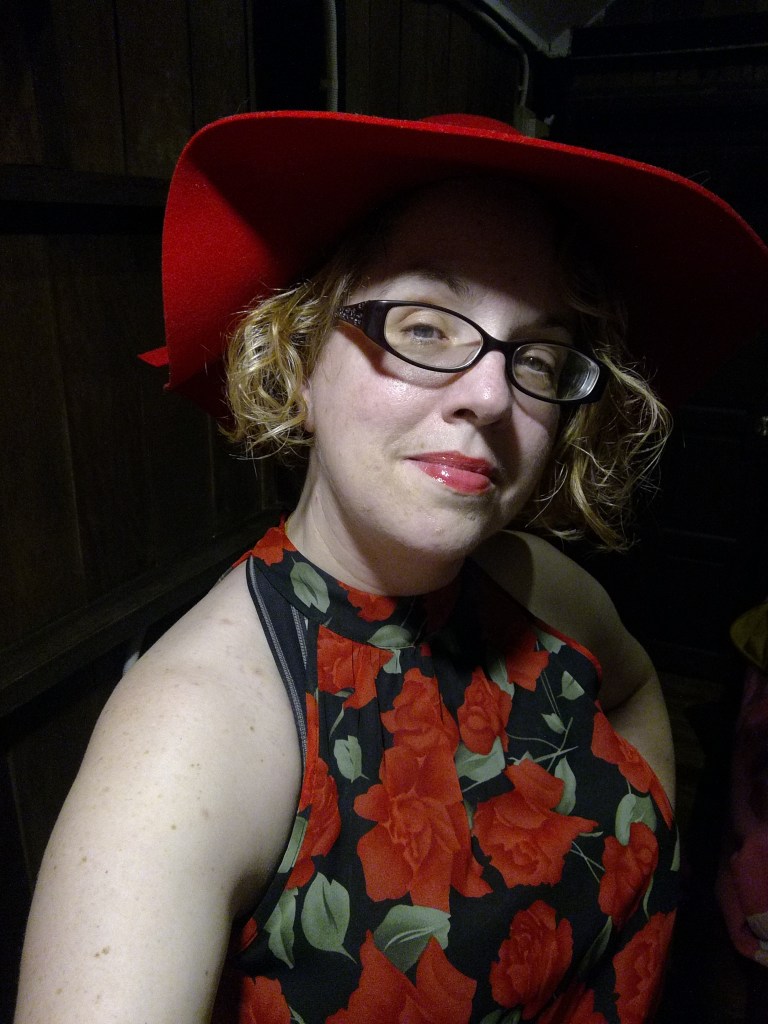
After a brief introduction, during which Wiswell assured us we’d soon stop noticing her hands, the projected white square was replaced by a starry night, and then by an alien landscape and the silhouette of a woman in a turn-of-the-century dress. A voice began to recite a story in accompanied by eerie music.
Wiswell is an American living in England, and her collaborators didn’t make the trip across the pond. Jim Osman’s narration and Sam Enthoven’s musical accompaniment on theremin were pre-recorded. Osman’s narration was sonorous and professional, and Enthoven’s theremin far exceeded my expectations of what that instrument was capable of—it’s an instrument more closely associated with mid-century science fiction sound effects, than with beautiful and haunting music. Or so I thought.
I would have loved to see Osman and Enthoven’s performances live. However, their absence also added to the magic of Wiswell’s performance in an unexpected way. While it was, as promised, easy to become immersed in the shadow play to the extent that you no longer saw her hands manipulating the silhouette puppets, it was also possible to glance away at Wiswell herself as she hunted through a pile of paper cutouts in search of the puppet she needed in the next moment. From time to time, she’d lift a starry sky or landscape off the base of the projector—I assumed it was simply for the blurry effect that created, but she later told me it was so she could better see her stacks of cut-outs to find the one she needed. With her collaborators on a recording, this had the effect of a high-wire act without a net. The risk of disaster is a feature of all live theater, all the more so in this case, with Wiswell’s prerecorded costars unable to pause or slow. It added an element of excitement and made the timing of Wiswell’s choreography all the more impressive.
Overall, the performance was charmingly analog. Apart from the recorded voice and music, there was nothing digital at work. The overhead projector might have been half-a-century old. Each of the silhouette puppets was designed by Wiswell herself and hand cut with the help of her artistic collaborator Kate Brown, who also contributed research and concept drawings. Wiswell had performed these pieces before at the London Lovecraft Festival (of which she is founder and creative director), but she told me after that this crowded black box in Providence held the largest audiences she’d had.
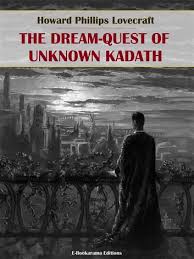
The first of Wiswell’s performances was an adaptation of “The Dream Quest of Unknown Kadath”, a novella in H.P. Lovecraft’s “dream cycle.” It’s clear why Wiswell chose this story rather than a story from the better-known Cthulhu mythos. While most Lovecraft stories feature a single monster toward the very end, Kadath is filled with fantastical landscapes, impossible architecture, and outlandish creatures at every turn. Wiswell’s adaptation is very faithful to the original, except that Lovecraft’s dreamer protagonist Randolph Carter is gender-swapped into Miranda Carter. This change has no narrative effect, but the full-skirted, high-necked dress likely made for a more interesting silhouette. And there is certainly some joy to be had from the fact that the conservative and bigoted Lovecraft would have hated the change.

The second performance was an adaptation of Lovecraft’s “The Doom that Came to Sarnath,” again with Enthoven’s theremin, but this time narrated by an equally skillful Laura Sampson. “Sarnath” is concerned with the rise and fall of an ancient city to the even more ancient frog-people who lived there beforehand. It was a shorter performance based on a shorter work, but I preferred it—it’s a more cohesive story than Kadath, a fact which Wiswell used to her advantage to build to a more impactful final effect.
Neither of these stories would have been easy to adapt into an engaging performance. The Dream Quest of Unknown Kadath is a something of a picaresque, in that it’s more interested in moving between fantastical set-pieces than telling a single cohesive narrative. While “Sarnath” is much more cohesive and driven, it is still a story with no protagonist and no characters to root for. Wiswell, et al., made up for this deficiency in narrative drive by leaning into the dreamlike, surreal qualities of these stories. The nature of the shadow puppet medium invites audience participation and investment, as we are the ones who must fill in the black silhouettes with defining detail, and, combined with the vocals and music, the effect was hypnotic.
Between the punk-rock DIY approach, the virtuosic performances, and the novel medium, both of Wiswell’s shows were memorable and utterly fantastic. Look for “The Doom that Came to Sarnath” at the Croydonites Theatre Festival on October 31 and two new Lovecraft adaptations when Necronomicon returns in 2026.

 NightTide Magazine
Leave a comment