The son of a Video Nasties Pirate, Matt became a fan of genre cinema at a disturbingly early age. He writes about the intersection between Roman Catholicism and the Horror film. His writing features in House of Leaves Publishing’s Filtered Reality: The Progenitors and Evolution of Found Footage Horror, The Nottingham Horror Collective’s Last Closet on the Left volume 2, and Arrow Video’s upcoming release of Exorcist 2: The Heretic. Matt’s first two books, The Vatican versus Horror Movies (2024) and Fulci’s Inferno: Faith in the films of a Giallo and Horror Auteur (2025) are both published by McFarland & Co.
Matt writes genre film analysis and criticism, specifically the intersection between the Roman Catholic Faith/Church and the Horror film. His writing is usually semiotic analysis contextualized with Horror film directors’ own belief systems, and how they antagonized the Church. Basically, he’s the guy you go to when you want to know what the Vatican thought of certain horror films, and why.

What was your first published work?
I was first published in print in House of Leaves Publishing’s Filtered Reality: The Progenitors and Evolution of Found Footage Horror, in 2023. Prior to that I’ve been contributing to various online horror magazines and websites since about 2015. In a past life (in 2000) I saw my first stage play commissioned and toured.
Is there a story inside that you have seeds of but can’t seem to connect that’s dying to get out?
Kind of. Much of what I write about involves Italian genre cinema (it comes naturally, given Italy is the home of the Vatican and Italian cinema is my favourite). What I would really like to do is write for an Italian audience. I’ve been slowly learning to read and write in Italian for a few years (my book The Vatican Versus Horror Movies required translating a number of texts into English for the first time), but I’m not there yet. I want to write about Italian Neorealism film in the context of the movement’s anti-Catholic and anti-Fascist sentiments, but I want to be able to write it in Italian with all the nuances of the language – and do it myself, not rely on translation services. Will it ever happen? I don’t know. But I will keep trying.
How do you handle a rejected story?
With as much grace as possible. At the moment, it seems as though the sun is shining on me and most things I pitch are successful. I’ve had more than my share of rejection though, especially when I was trying to become a screenwriter. I placed highly in a Hollywood Screenwriting initiative (the PAGE Awards 2012) and that got my foot in the door…but then my prize screenplay was rejected by every Production Company, Agent and Manager I spoke to. It was disheartening, but you just have to ask for as much constructive feedback as possible and then act on it. If you do that, and still get rejected? Well then it becomes clear nobody really knows what they are doing!!!
What does literary success look like to you?
My words in print or on a screen, and the respect of my peers. I’ve spent a good number of years idolizing various writers of genre film analysis and criticism, and now I find myself appearing alongside them in various publications and it gives me a great sense of achievement. Financial success would always be nice but I’m fortunate to be in a privileged enough position where it isn’t entirely necessary – I have a reasonably well paid day job. l’art pour l’art, as they say.
Do you read your book reviews? How do you deal with bad or good ones?
I will happily read any reviews/feedback that is constructive and written in good faith. If someone finds my work boring or difficult to engage with, then it’s important I learn why so I can improve as a writer! It’s usually pretty easy to spot those written in bad faith or any review-bombing, and I just ignore those. Some people have lots of time on their hands…I am not one of those people!
What is the most difficult part of your artistic process?
Outlining. I have an idea of what I want to write about and then something might pop into my head about a specific chapter or section and I’m giddy with excitement and want to start writing it right away. On occasions where I have done that, I’ve soon come unstuck. Sitting down and plotting out the book summary, aim and scope, contents list (with detailed synopsis of each chapter) and then marketing (my book’s strengths or USP, intended market, is there any competition and what am I adding to the ongoing academic or critical conversation)…this is all vital. It provides my work with a structure and it also gives me a ready-to-go proposal for potential publishers.


As in most times, the truth is stranger than fiction, what has been the hardest scene or chapter you’ve had to write, if you were channeling personal experience?
Content Warning: Child Sexual Assault.
As I write primarily about horror movies, Roman Catholic censorship and the darker side of the Roman Catholic Church, this very much channels personal experience. I was raised in a Roman Catholic family, with my grandmother as the matriarch who also sat on the local council censor boards (so she was one of many people responsible for bans and prosecutions during the UK’s Video Nasties controversy), while my Dad was a Video Nasty Pirate so very much rebelling against her and against censorship. However I also have other personal experiences that can be difficult to recall, let alone write about – trauma related to growing up in the Roman Catholic
Church. Films that include rape or child sexual assault (especially when perpetrated or aided by the clergy) are something I feel I have to discuss because I have a personal connection to them, but this can makes things very difficult for me, mentally and emotionally. It can be triggering and I need to exercise a lot of self-care when doing so.
What inspired your latest work?
My love of Lucio Fulci, and my frustration with a number of the long-form texts about the director that are in circulation. Most writers of Fulci focus on his reputation as a second-string Italian horror director, a gore aficionado and architect of gruesome Video Nasties. His conflicts with his Faith and his Church are rarely mentioned, despite the director discussing them himself in many interviews. Fulci channeled his apostasy (his conscious uncoupling from his Faith) into his films throughout his entire career, in much the same way that the great Dante Alighieri channeled his apostasy into The Divine Comedy, or Pier Paolo Pasolini channeled his into his films (something which, it is credibly argued, eventually got him murdered, killed by Vatican- allied agents). I wanted desperately to lay all of this out, and write something about the director that stands out from the crowd – and I believe that’s what I’ve done.

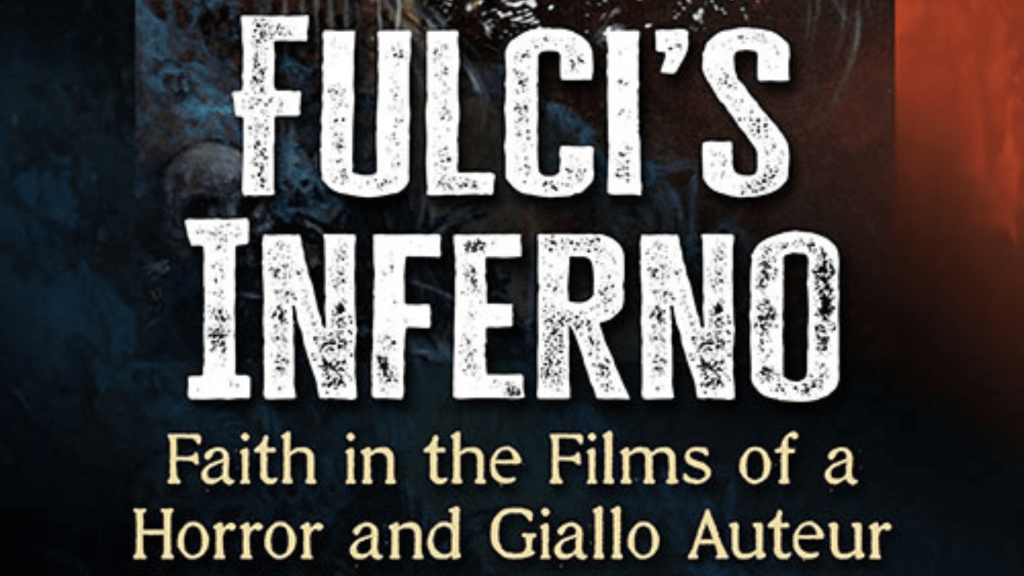
Italian director Lucio Fulci garnered an international cult following for his horror and giallo films. He is perhaps most well-known for his zombie horror cycle of the late 1970s-early 1980s, films that were censored and censured by moral guardians around the world and were prosecuted in the UK as part of the ‘Video Nasties’ controversy. There is, however, much more to Fulci, his filmography, and his legacy on the horror genre. In his home country, Fulci worked across a number of genres (including comedy and satire, western, historical drama and family adventure) and regularly criticized the Church and State through his films. The director weaved a faith-based narrative across his career, from his earliest credits as a screenwriter and assistant director in the 1950s to his very final films as director in the 1990s. This book analyzes the tenets and iconography of Fulci’s Roman Catholic faith across key films in his filmography, plotting an apostate’s journey through his art in the vein of many celebrated Italian artists that went before him. The volume also considers how exploring his faith and apostasy through his films led Fulci to develop an entirely new storytelling mechanism which has influenced genre directors ever since.
If you could tell your younger writing self anything, what would it be?
Persevere. You’re going to experience a lot of rejection, decades of rejections as well as serious personal issues, all of which will make you want to give up your dream. But your day will come, and when it does, I promise you that it will make you happy!
Best advice you’ve ever gotten from a fellow writer?
A writer friend told me to stick to my guns regarding my preferred subject matter and personal style, even when everyone else was telling me my subjects were too niche and I should write the same old stuff about the same old films in order to get work, to get published. I stuck to my guns, let my work be informed by who I am, my experiences and my knowledge base, and here I am.
Published multiple times by one of the major publishing houses in my field.
To think that I once had an editor refuse to publish a commissioned piece – it was about Brandon Cronenberg’s Possessor – because in reviewing the film I linked it back to the experiences of cPTSD sufferers. This was despite me being asked to write something that had critical value, not just a “cinematography, acting, editing, four stars” copypasta piece. Time has shown that I do have valuable insights that people want to publish and people want to read.
What is your go-to comfort horror/Sci-Fi book?
For fiction, Mark Z Danielewski’s House of Leaves and David Mitchell’s Slade House are favourites. I adored Out There Screaming, the recent collection of horror stories by Black writers, and plan to revisit it. Stephen King’s Dark Tower series. Any horror with meta-
narratological elements, or that which deals with liminality and liminal spaces.
For non-fiction, anything by Alexandra Heller-Nicholas. She’s my favourite writer of genre cinema analysis and criticism, her work is always engaging and an education, which I appreciate.
If you were to genre-hop, which genres would you most like to try writing?
I already mentioned I’d like to write about the Neorealism film movement. Also, the Commedia all’Italiana (Comedy, Italian-style), an equally subversive cinematic movement that began during the same time of political and spiritual upheaval in the country. I’ll persevere with learning the Italian language, but if I get too stuck I might have to revert back to writing in English!
Pre-order ‘Fulci’s Inferno: Faith in the Films of a Horror and Giallo Auteur here!
 NightTide Magazine
Leave a comment