
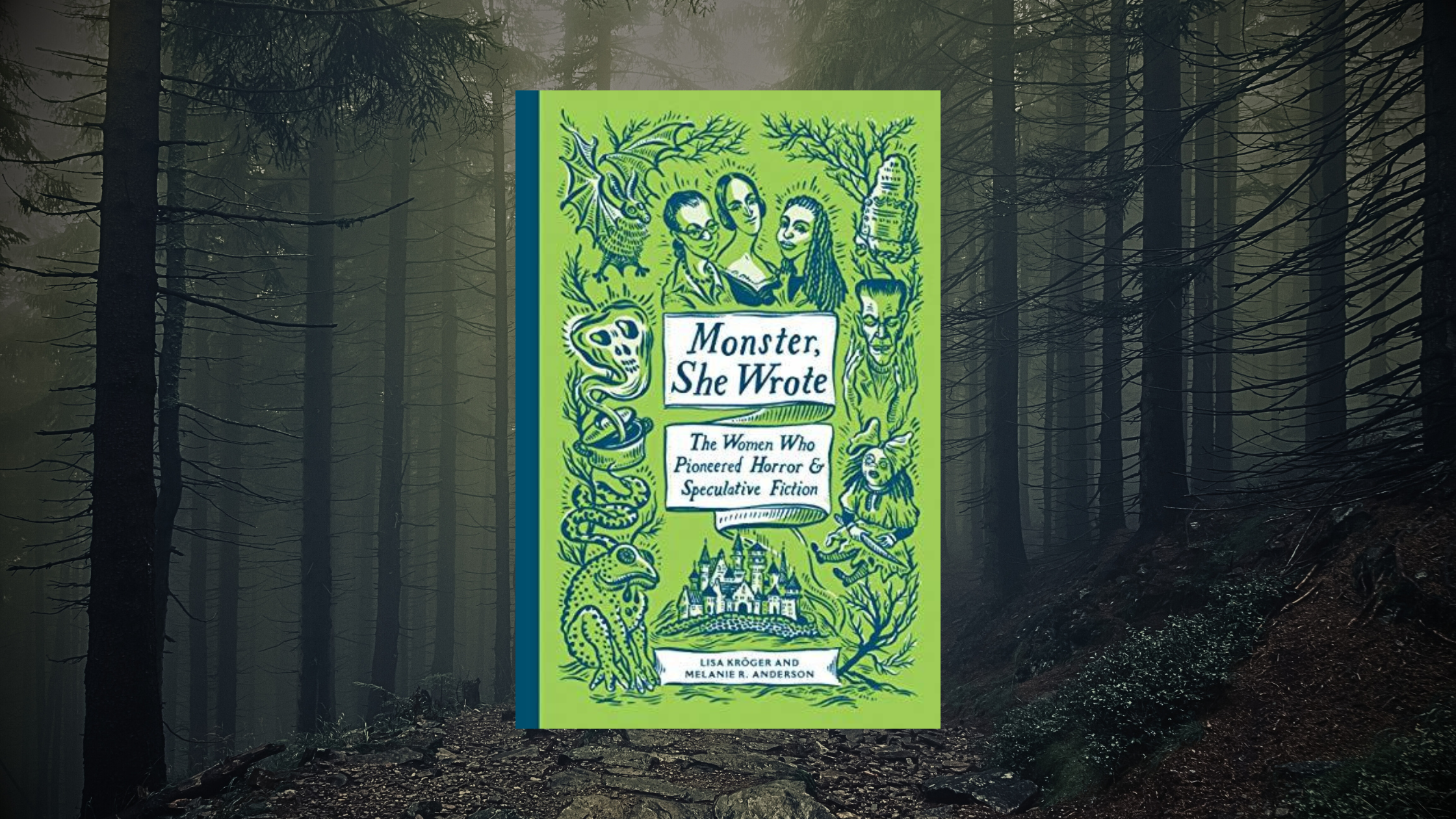
Step into the eerie and electrifying world of women in horror! The Leacock Museum, in collaboration with authors Lisa Kröger and Melanie R. Anderson, presents “Monster, She Wrote,” an exhibit spotlighting the forgotten pioneers of female-driven horror fiction. From the immortal tale of Frankenstein to spine-chilling stories lost to history, this exhibit brings these women’s dark and daring works to life with the help of local artists.
NightTide got to sit down with Lisa Kröger and Melanie R. Anderson on the creation of this incredible work and pulling women’s horror history out of the shadows with this upcoming exhibit.

Monster She Wrote (2019)
Meet the women writers who defied convention to craft some of literature’s strangest tales, from Frankenstein to The Haunting of Hill House and beyond.
Frankenstein was just the beginning: horror stories and other weird fiction wouldn’t exist without the women who created it. From Gothic ghost stories to psychological horror to science fiction, women have been primary architects of speculative literature of all sorts. And their own life stories are as intriguing as their fiction. Everyone knows about Mary Shelley, creator of Frankenstein, who was rumored to keep her late husband’s heart in her desk drawer. But have you heard of Margaret “Mad Madge” Cavendish, who wrote a science-fiction epic 150 years earlier (and liked to wear topless gowns to the theater)? If you know the astounding work of Shirley Jackson, whose novel The Haunting of Hill House was reinvented as a Netflix series, then try the psychological hauntings of Violet Paget, who was openly involved in long-term romantic relationships with women in the Victorian era. You’ll meet celebrated icons (Ann Radcliffe, V. C. Andrews), forgotten wordsmiths (Eli Colter, Ruby Jean Jensen), and today’s vanguard (Helen Oyeyemi). Curated reading lists point you to their most spine-chilling tales.
Part biography, part reader’s guide, the engaging write-ups and detailed reading lists will introduce you to more than a hundred authors and over two hundred of their mysterious and spooky novels, novellas, and stories.
1. What inspired you to write Monster She Wrote and highlight the contributions of women in horror and speculative fiction?
Melanie Anderson: Lisa and I met in graduate school where we both ended up writing dissertations focused on the work of women writers of Gothic or supernatural fiction, but from different time periods. As a result of our shared interests and research, we collaborated on two academic projects, and we often had conversations about women throughout history who wrote horror and influenced the genre yet still could be unknown to many readers. We wanted to write for a broader audience beyond academia and help introduce that audience to the writers we’d been reading. We felt like a guide to these women and their work, as we ultimately created in Monster, She Wrote, would be the best way to accomplish both goals.
2. How did you choose which authors and works to include in the book? Were there any difficult omissions?
Lisa Kröger: We probably had enough names to fill two books, if not more, but ultimately we had to make some difficult decisions. We had a few “rules” for ourselves: the books had to be available for people to read, so nothing that was lost to history, and we had to be able to find verifiable biographical information on each author. But even then, we still had to make painful omissions. If an author wasn’t included, it wasn’t because they didn’t deserve a mention!
3. How do you think the contributions of women to the horror genre have shaped modern horror, and what trends do you see emerging from contemporary female writers?
MA: Women have been major players in the development of important subgenres of horror from the Gothic of the eighteenth and nineteenth centuries to the nineteenth-century ghost story to Gothic Romance of the mid-twentieth century, to name a few. Women were even writing weird fiction in Lovecraft’s day. One contemporary trend I see is revisiting and revising horror classics; I’m thinking of T. Kingfisher’s What Moves the Dead and The Twisted Ones. Rachel Harrison has been focusing on female friendship in her novels, which is an often ignored relationship in fiction. She also reimagines creatures in interesting ways. An example of this would be her book Such Sharp Teeth. Tananarive Due’s The Reformatory is a masterful example of historical fiction incorporating hauntings to make the influences of the past visible in the present.
4. How did you choose which authors and artifacts to feature in the exhibition? Were there any works or writers you felt were essential to include?
LK: The museum team already had a list of names from the book they wanted to include, so we didn’t put together the full list. We did, however, suggest one name: Pauline E. Hopkins. She was an early writer of color whose work spans the speculative fiction and horror genres. Of One Blood was published in 1903, and it was recently republished. It is set in a proto-Wakanda African country that has high technological advances and has never been colonized. I really want more people to read Hopkins, so I’m happy it was included.

5. How did the visual and thematic design of the exhibition help to capture the eerie and imaginative world of the writers featured in Monster She Wrote?
LK: We didn’t have too much control over the visual and thematic design since that was mostly done by the team at Leacock. We did have some early discussions with them, though, about including some of the artwork from the book. All of the artwork in Monster, She Wrote was done by artist Natalya Balnova–I’m such a fan of her illustrations. I really think it helps capture this kind of eerie imagination.
6. Were there any challenges in curating the exhibition to reflect the depth and diversity of women’s contributions to horror and speculative fiction?
LK: When we were putting together the book, we ran into biographical issues. Unfortunately, a lot of these women–especially women of color–were lost to time. We know who writes the history books and who preserves the artifacts, and it isn’t often women’s contributions who are prioritized. So a big part of our book–or a project like this exhibition–is that we just don’t have the information we need. But we will always keep digging in archives and libraries to see what we can find.
7. What impact do you hope the exhibition will have on how visitors view the horror genre, particularly regarding the contributions of women?
LK: I hope that people will come to realize that women were always a part of the horror genre, since its inception. Our modern idea of horror/Sci-fi was literally invented by a teenage girl when Mary Shelley wrote Frankenstein, but we’ve always been telling these stories. Women, I think, have a unique vantage point when it comes to describing the real life horrors and translating those into fiction. It’s the same for anyone who is not a white, cisgendered male in our society.
8. How do you think the physical presence of the exhibition will enhance people’s understanding of the book’s themes and its celebration of women writers?
MA: I’m hoping the experience of the physical representation of the book will inspire visitors to check out the book and our podcast and give them a gentle nudge to explore more horror fiction by women beyond what they see in the gallery. I also love that local artists’ artwork inspired by and related to the stories that are mentioned in the exhibit will be included as well, adding another layer of interaction and interpretation to the experience.

About the team behind Monster, She Wrote
Lisa Kröger – Lisa Kröger is a Stoker- and Locus-award-winning writer living in Memphis, where she enjoys a life of reading, writing, and all things horror. She holds a Ph.D. in Gothic literature and writes horror in all formats: fiction, nonfiction, podcasts, and screenplays. She’s on the Board of Trustees of the Horror Writer’s Association, and she’s an active member the Nyx Horror Collective, a group focused on women-created genre content for film, television, and new media. Most recently, she produced 13 Minutes of Horror: Folklore, and the sequel 13 Minutes of Horror: Sci Fi Horror, both of which streamed on Shudder. The second installment won the Rondo Hatton Award for Best Short.
Lisa is represented by Ann Leslie Tuttle at Dystel, Goderich, & Bourret.
She’s also a host on the Monster, She Wrote and Know Fear podcasts, biweekly casts that dissects the horror genre. Visit the Know Fear website for more details.
Follow her newest work on Instagram.
Melanie Anderson – Melanie R. Anderson holds a Ph.D. in American Literature from the University of Mississippi. She is an associate professor of English at Delta State University in Cleveland, MS, where she teaches courses in American literature. She researches and writes about the American Gothic and supernatural literature. Her co-authored nonfiction on women and horror has won the Bram Stoker and Locus awards. When she is not writing or teaching, she is one of the hosts of The Know Fear Cast, a podcast about horror and all the things that scare us. She also co-hosts The Monster, She Wrote Podcast, a podcast about women creating in the darker genres.

Mo Moshaty is an acclaimed horror writer, lecturer, and producer whose work combines visceral storytelling with the psychological insight of her Cognitive Behavioral Therapy background. She has lectured internationally, including as a keynote speaker at Nightmares from Monkeypaw: A Jordan Peele Symposium (Prairie View A&M), No Return: A Yellowjackets Symposium (Horror Studies BAFSS Sig), The Whole Damn Swarm: Celebrating 30 Years of Candyman (University of California), and with the Centre for the History of the Gothic (University of Sheffield). Mo has also presented at the BFI, Miskatonic Institute of Horror Studies, and Final Girls Berlin Film Festival’s Brain Binge on women’s trauma in horror cinema, Cine-Excess on The Creepy Kid Horror Subgenre and Mother/Daughter Trauma in Horror, and Romancing the Gothic on Cosmic Horror’s Havoc on The Body Electric Her short film, 13 Minutes of Horror: Sci-Fi Horror, won the 2022 Rondo Hatton Classic Horror Award for Best Short Film. As a core producer with Nyx Horror Collective, Mo co-created the 13 Minutes of Horror Film Fest and partnered with Shudder in 2021 and 2022, while also establishing a Stowe Story Labs fellowship supporting women creatives over 40+ in horror. A member of the Black Women in Horror Class of 2023 and featured in 160 Black Women in Horror, Mo’s short fiction appears in A Quaint and Curious Volume of Gothic Tales (Brigid’s Gate Press) and 206 Word Stories (Bag O’ Bones Press). Her debut novella, Love the Sinner, was released July 5, 2024, with Clairviolence: Tales of Tarot and Torment released in October 2025. The first of her five-volume non-fiction series, The Annex of the Obscure: The Afterlife, will be released in 2027 from Tenebrous Press. As the Editor-in-Chief of NightTide Magazine and founder of Mourning Manor Media, Mo champions marginalized voices in horror. Under her leadership, NightTide plans to launch a film festival in 2028, furthering her mission to reshape the genre through inclusivity and representation.
Leave a Reply