by Mike Leitch (@autistichorror)
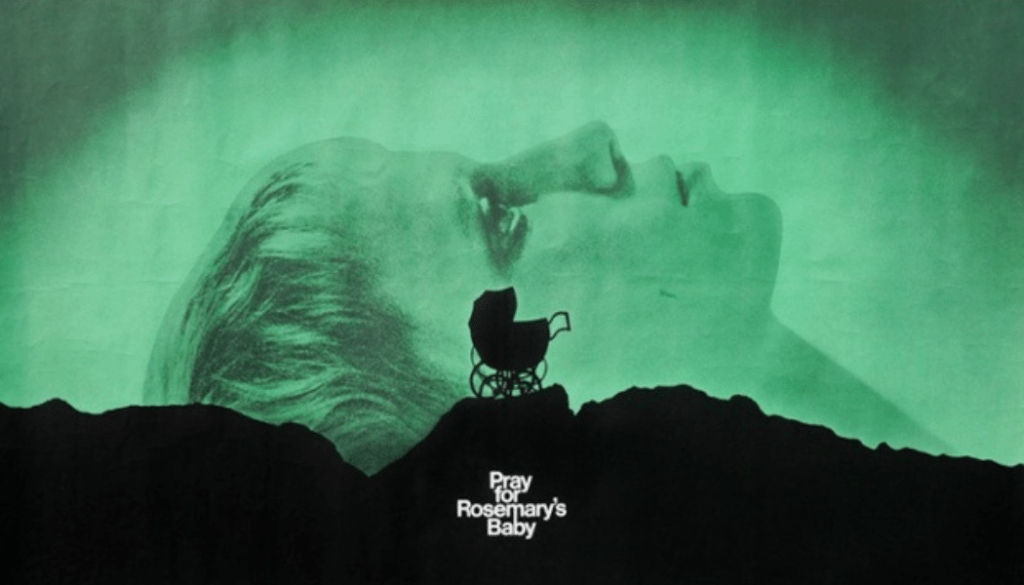
Across novels, film, and television, Rosemary’s Baby has been retold and sequelised for over half a century. At the (tannis) root of this series is a simple story about a woman in pain, but as the story is turned over and over, by more and more people, how much of this
is there left?
With the release of Apartment 7A, we see the latest release in an almost sixty year old series. The obvious question it raises is why this story keeps returning – it’s hardly one that is obviously franchisable and is significantly influential on so much horror that
followed. Tracing each entry across novels, films, and television, we can see how the story mutates and which areas are expanded. The fact that some of these were more culturally impactful than others doesn’t mean that they aren’t all worth looking at, especially as it helps us pin down exactly what it is about Rosemary’s Baby that still resonates.
THE BOOK
The primary tone of Ira Levin’s novel is anxiously satirical, exploring a fantastical concept through the perspective of an individual desperately trying to fit in to wider society. We are introduced to Rosemary convincing her husband, Guy, to cancel a tenant agreement for a new apartment because they have been offered a nicer apartment in the Bramford. Its exterior of “gargoyles and creatures climbing up and down between the windows” (p. 26) immediately sets off alarm bells for the reader, but all Rosemary cares about are the possibilities that the apartment offers, both as a literal space and as a signifier of social respectability.
Throughout the novel, Rosemary tries to reconcile her personal desires with social expectations resulting in her often confusing which is which. Her innocuous comment “that I’ve never been alone in my whole life” (pp. 78 – 79) reveals how much she has relied on
external support despite her independent spirit, having left her Catholic family in Omaha to secretly marry a Protestant in New York. This and Guy’s ambitious for stardom are exploited by the coven to not just house the Antichrist but to keep her in a state of
helplessness. At first, her pregnancy enlivens her: “Now she was alive; was doing, was being, was at last herself and complete’ (p. 92); but as it takes over her life, limiting her freedom, she begins to lose her self outside of what is growing inside her: “Until now it had
been inside her; now she was inside it; pain was the weather around her, was time, was the entire world” (p. 110).
While it is the devil inside Rosemary creating this world of pain, the coven enables it through its social manipulation. Minnie and Roman exploit the social convention of being so nice, you can do what you want, and so they are able to convince Rosemary to ignore
her doubts and blindly accept their advice, even when that means withdrawing from her friends. The revelation that they are a devil’s coven thus emerges out of their forced normalcy; they seemed too good to be true because they were too good to be true.
Orchestrating deaths and blindings may be traditionally occult horror, but Levin understands that the scary thing about the coven is their organisation around hellish beliefs, something Rosemary is able to perceive:
‘I’m not saying they’re really witches,’ Rosemary said. ‘I know they haven’t got real
power. But there are people who do believe, even if we don’t; just the way my family
believes that God hears their prayers and that the wafer is the actual body of Jesus.
Minnie and Roman believe their religion, believe it and practise it, I know they do’ (p. 138)
While Rosemary’s self-belief is eroded by the coven imposing their beliefs onto her, it is not entirely gone, as Rosemary uses the mother role forced upon her to claim the right to name her child, the start of her secret plan to make him good. This is how evil can be beaten, by asserting her goodness as strongly as they assert their evil. Who will win is left ambiguous, at least until subsequent sequels.
THE FILM
It’s impossible to discuss this film without acknowledging the director’s literally criminal behaviour in later life, the nature of which, as many have noted, is unfortunately related to the story’s themes. There isn’t space here to fully unpack separating art from the artist in this case but I had to at least mention it.
The film began production in the same year that the book had been published and was released the following year. As such, it is not surprising that it is a very faithful adaptation with practically all the dialogue lifted directly from the book. However, the absence of
Levin’s narrative voice means that the psychological drama gains more focus. Rosemary is in almost every scene as the film firmly roots us in her perspective, so that scenes become a sensory experience – the party with her friends is busy, noisy and lively in
contrast to her quiet days of loneliness and isolation. The dream sequences particularly benefit from this, evoking the novels ambiguity around what is real or not, as conversations and characters bleed in and out of Rosemary’s consciousness.
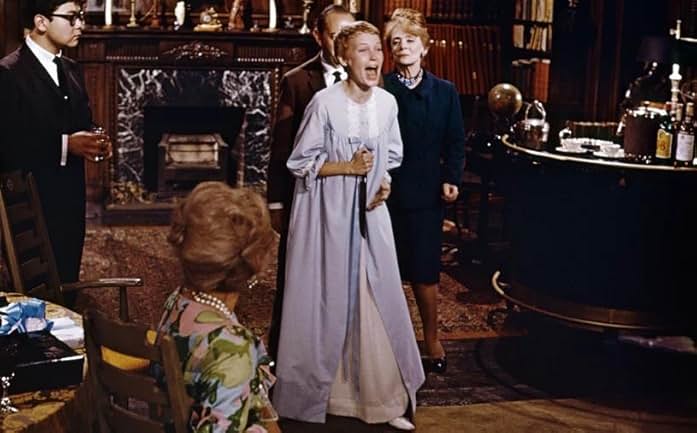
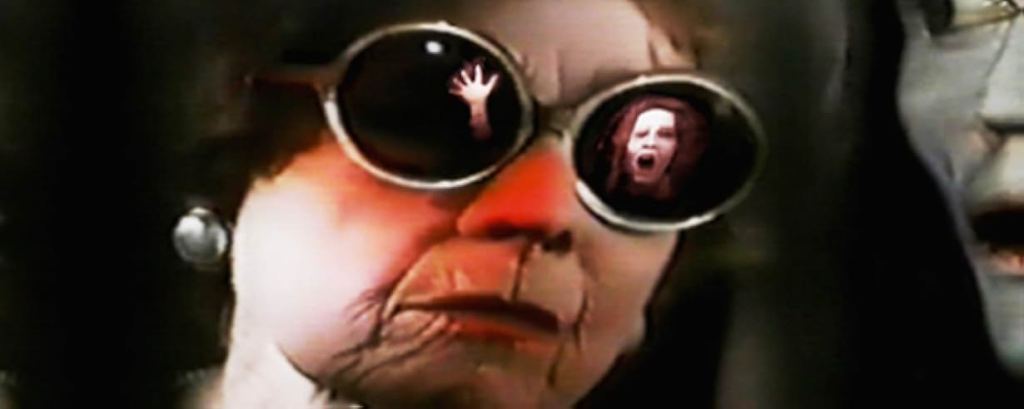
The other consequence is that the occult threat feels more literal, with the use of continuous shots and natural lighting creating a realistic aesthetic that allows the supernatural to be caught in glimpses, hinted at through score, and heightening the horror implicit in everyone’s behaviour. This contrast is best seen when Rosemary drops a knife into the floor which Minnie removes, rubs the mark left behind, then walks away as if mildly irritated about her floor being ruined. The abnormal is indistinguishable from the normal to
these characters and it is deeply unnerving.
While the story is identical to the book, seeing the events played out rather than reading them emphasises Rosemary’s helplessness. Guy in the book appears so ordinary that even his name is uninspiring, but John Cassavetes, who had been Oscar nominated the
previous year, brings a certain Hollywood charm to the role, i.e. making promises that hides actual, more selfish desires. His gaslighting behaviour and the Castavet’s over- familiarity is clear to us as viewers but we are outsiders; Rosemary has to survive it, and does so, even if her fate is ambiguous.
THE SEQUEL
It’s hard to imagine anyone thinking that the best way to make a sequel to an Oscar winning movie is to do it as a direct-to-television movie and give it some comedic sounding title like Look What’s Happened to Rosemary’s Baby. And yet in 1976, that is what
happened with none of the key creatives involved in book or film returning, though Ruth Gordon reprised her Oscar-winning role as Minnie. The resultant film feels more like a parody than a continuation, where light rock music attracts the devil and the tone is more
melodrama than psychological horror.
The premise itself is an obvious but solid idea for a sequel – tracking Adrian/Andrew as he grows up and has to reckon with his Satanic identity. As well as a poor execution in terms of quality, it also fails in terms of storytelling. The contrast between grounded reality and occult belief is what makes the original interesting, but here the grounded reality is in being a musician at an out-of-town casino rather than domesticity and nosy neighbours. Everything is determined by the coven who seemingly have omniscient powers now, epitomised in their obtrusive voice-overs over random scenes as they exposit their plans. There is no humanising them, becoming just a stereotypical evil coven who can make buses drive themselves and anyone’s wish come true.
Each new plot thread is ended abruptly in order to move on to another one, the most egregious example being Rosemary (now played by Patty Duke) disappearing about a third of the way through the film. Having been tricked into giving up her son to the coven, we never hear from her again. This sums up where the film goes wrong, literally removing its emotional heart and failing to replace it with an adequate substitute. Guy as a reluctant returnee to the coven similarly ends abruptly after a convoluted ritual goes wrong, or right, it’s hard to tell.
These two chapters (which the film bluntly separates its acts into) are ultimately irrelevant by the third chapter where Andrew (as he chooses to call himself, a notable decision in favouring his mother over the coven that the film basically ignores) now in a clinic for the criminally insane. A nurse helps him escape, drugs and rapes him, and is ultimately revealed to also be part of the coven and to be the mother for another attempt at the Antichrist. The assault is as blunt as I’ve described it and there purely for shock, in contrast to the original story where Rosemary’s trauma from it is treated seriously and powerfully. If this didn’t have Rosemary’s Baby attached to it, this would be considered a forgettable imitation, and instead it is a forgettable sequel that no doubt is the reason why this story was untouched for twenty years.
THE LEGACY SEQUEL
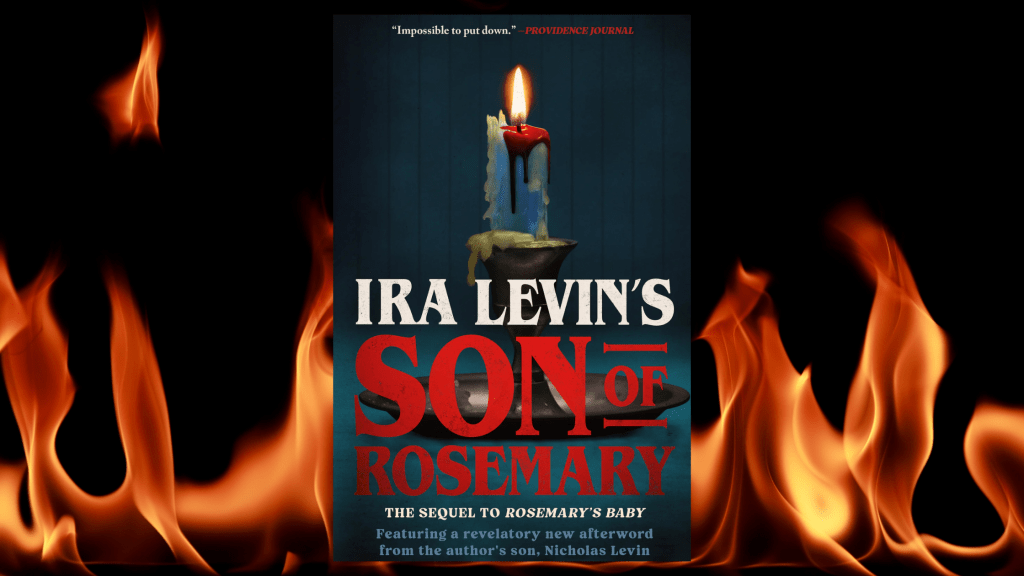
It is interesting that Rosemary’s Baby figures in both the beginning and end of Ira Levin’s career, with Son of Rosemary being his last novel before his death ten years later. In what would now be considered a legacy sequel (by bringing back characters in a modern day
setting), 1997’s Son of Rosemary begins with Rosemary waking up from a twenty-seven year long coma and as well as adjusting to the fact that there will be a new millennium in three months, her child is now one of the most important men in the world. With his
foundation, God’s Children, he has effectively united the world in a ‘cosmic event thirty- three years in the making’ by Satan that Andy intends to use for good (p. 13).
While a similar premise to LWHTRB, Levin understands the strengths of the premise by using Rosemary as point-of-view character and uncertain about Andy’s true intentions. Cliche as it may be, a time-jump coma is a smart way to put Rosemary on the back foot,
something that would be hard to do considering her awareness of the coven. Seeing Andy so well adjusted is both reassuring and unsettling, as he is able to hide his ‘tiger eyes’ with a little ‘black magic.’ As emotional as their reunion is, she knows that he is ‘Satan’s son too, not just hers,’ even if he looks like Jesus, ‘the calendar Jesus’ (p. 17).
In this way, Levin updates the horror of the original where evil can be easily hidden and the occult’s power is in how it can embed itself into normal society. Andy may believe himself to have rejected the coven, but he still performs their ritual in secret as performance rather than actual summoning. His explanation to Rosemary is revealing:
What’s going on here isn’t Satanism. I don’t worship him, believe me. To know him
is to hate him; he lives up to his reputation. This is – trimmings, things I grew up with and
like, that’s all. Those were the only parties and holidays I knew. This isn’t even
witchcraft; we don’t do spells or anything. It’s no more Minnie and Roman’s old-time
religion than – than an office Christmas party (p. 157).
As Rosemary realised when she first encountered the coven, Andy considers Satan’s power to come from belief and all occult trappings attached to him can be separated if used with different intent.
What this ignores is the possibility that Satan doesn’t require summoning if he is already here, as we learn by the end of the novel. But even before this revelation, the world itself is clearly hospitable to him. After the death of one of the few friends she’s made, Rosemary weeps in mourning at ‘the wrenching fact that at the dawn of the year 2000 […] a woman alone still wasn’t safe in the heart of what was supposedly a civilized world capital’ (p. 115). If it wasn’t for Andy’s protection, Rosemary would be similarly unsafe, as vulnerable as she was before. After all, the coven were able to isolate and manipulate her without Satan’s power. With this update, Levin demonstrates that whatever the time period, humans have the power to do evil whether the devil makes them do it or not.
It is a shame then that despite this compelling theme, having started with someone waking from a coma, the novel ends with a similarly cliché narrative twist: that it was a dream the whole time. It ends just before Rosemary’s Baby starts, with Guy and Rosemary receiving a call about a new apartment, suggesting that Rosemary is trapped in some sort of hellish loop. A generous interpretation would suggest that this is Rosemary losing to the devil, but it is still an anti-climactic resolution, suggesting a lack of confidence in its conceits that need to be explained away. In just a few pages, the story renders itself inconsequential and seemingly putting a firm ending to Rosemary’s story, with no room for further interpretation that, of course, failed to be the case.
THE MINISERIES
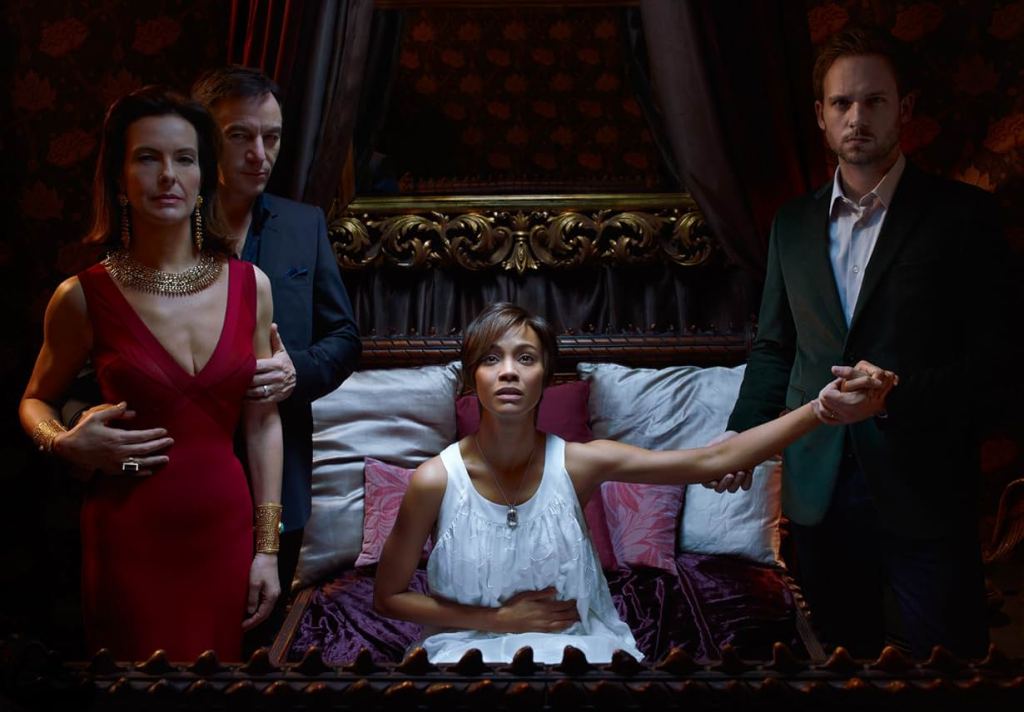
Remaking a horror classic is always a risky task but one that still happens regularly. So come 2014, almost fifty years after the book’s release, NBC produced a two-part series directed by Agnieszka Holland, the first time a woman had directed for the franchise. It
moves the setting from New York to Paris with Rosemary and Guy having to adjust to a new culture on top of the coven. Other updates include Rosemary’s closest friend being a woman of her own age rather than a paternal figure and having access to the Internet, speeding up Rosemary’s uncovering of the coven.
For all of the modern aesthetics, it is still largely faithful to the original story without significantly updating its sensibilities. The transatlantic move for Guy’s new position as a teacher is all the explanation for why Rosemary is basically a housewife now, unfamiliar with French and recovering from a miscarriage three months prior. This traumatic experience affects Rosemary’s pregnancy as she has a constant fear of losing another baby. While offering room for complexity, it is mostly used to provide an alternative explanation for her paranoia, becoming a reductive way to portray her behaviour.
It doesn’t help that the series front-loads the horror with the coven’s occult manipulations being obvious early on, removing any ambiguity or tension. There’s an obvious difficulty in doing a new adaptation when the story is so well known, but shots of the Castavets creepily glancing at each other and stalking Guy and Rosemary takes the focus away from Rosemary’s inner turmoil. Presenting the coven in such familiar genre trappings means that, like in LWTRB, the coven become more generically evil. Even the detail that the Castevets own the apartment building sets them apart as upper-class manipulators rather than over-friendly neighbours.
These changes are understandable as ways to stretch the story out over three hours but these decisions add little to the story. Despite the credit that it is adapted from both Rosemary’s Baby and Son of Rosemary, which would provide the scope required for television, there is no reference at all to the latter except in that it is similarly unsatisfying and empty. The closes resemblance it has to Levin’s sequel is in its desire to explain everything. It introduces a police officer investigating the coven, which further limits
Rosemary’s role, who ultimately dies in one of many Final Destination like set pieces where the coven eliminates threats to their plan. Again, these push the series into familiar horror territory rather than amplifying the tension and discomfort. As such, it serves as a
disappointing demonstration that perhaps there is little more that can be drawn out from Rosemary’s Baby.
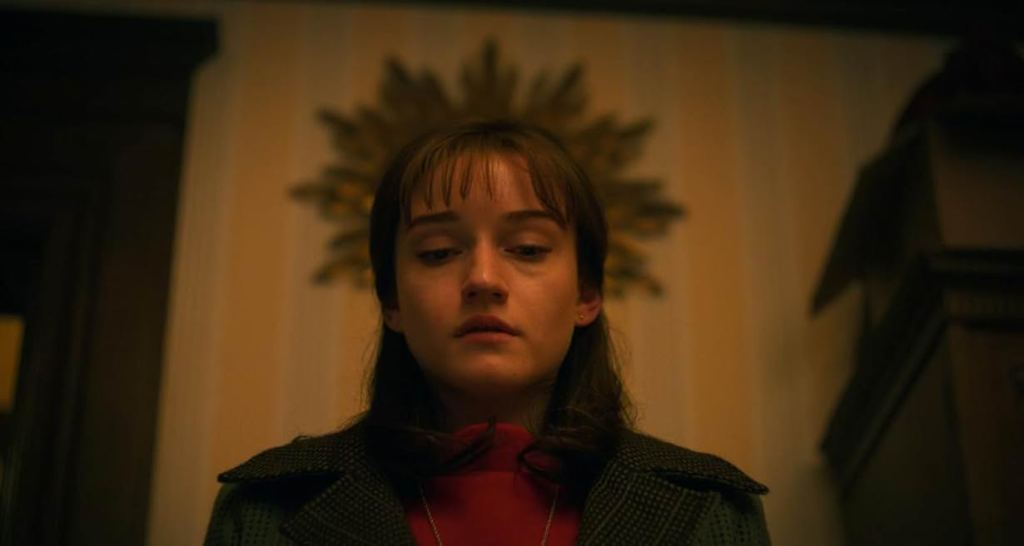
Arguably being the most sensible option when considering a Rosemary’s Baby sequel, Apartment 7A sets itself as a prequel, a subgenre that has knowledge of pre-existing storylines built into its form. We know going in that the coven won’t succeed in creating the Antichrist because they will only do so later. Similarly, we know that the lead, Terry Gionoffrio (Julia Garner), is already doomed having seen how she dies. Such expectations can limit prequels to spinning their wheels for a few hours, but writer and director Natalie Erika James takes on the challenge to remind us this story is about female autonomy via the occult rather than the other way around.
As the first female writers to approach the story, James and Skylar James (along with co- writer Christian White) show how the psychological turmoil manifests physically, notably through Terry’s profession as a dancer. Her career is cut short after a bone-breaking jeté which she is forced to repeatedly recreate at a later audition, literally re-enacting a traumatic incident. Despite this, her desire to perform fuels her and literally becomes her dreams, conveyed in a more stylistic and visually horrifying way than Rosemary’s Baby.
It is also how she expresses her resistance to the coven as the film balances her exploitation with her autonomy. As in the original, Minnie and Roman gradually intrude on the new tenant’s life, but with Terry being a single woman, she has less support around her
to fully resist them but also has less baggage for the coven to use against her. As such, the coven are less direct in their interventions as they will be with Rosemary, only being able to control her through theatrical producer, Alan Marchand. But once she is pregnant, he only has power over her at work leaving her room to investigate the truth.
The final scene thus has a different tone to the ending of Rosemary’s Baby, as Terry enters the coven powerless but is able to use their over-confidence against them. It could be considered cynical that the film effectively redoes the famous climax with Terry instead, but this is a ritualistic ceremony, of course they would repeat themselves. Also, importantly, Terry hasn’t given birth, so she still has some semblance of control of her body, hence the symbolism of her dancing her way out of the apartment window, falling to her death and ruining the coven’s plan. It’s easy to assume that Terry’s death in the original is part of the coven’s manipulation, but as this film demonstrates, there is actually little in either the book or the film to suggest that it isn’t just suicide. Therefore, this reinterpretation allows a small moment of triumph even if we know that it won’t stop the coven completely.
One of the lines that carries through every version of Rosemary’s Baby is one that summarises its key horrifying theme, when Guy explains to Rosemary, “They promised me you wouldn’t be hurt, and you haven’t been really.” It is a devastating line having watched
her suffer through severe physical and mental pain, highlighting what Elaine Scarry describes in The Body in Pain: ‘to have great pain is to have certainty; to hear that another person has pain is to have doubt’ (p. 7.)
In Apartment 7A, Minnie advises Terry that, “It’s not our falls that define us, it’s what we do afterwards,” an allusion to Satan the fallen
angel but also advice that Rosemary and the coven follow – when they fail, they keep on going. It is thus apt that we keep returning to this story about a woman surviving despite everything, and the series is at its best when it remembers this.
Mike Leitch is a writer based in Cardiff and regularly contributes reviews for The Geek Show. He also created and runs the site An Autistic Guide Through Horror, which champions neurodivergent and disabled voices in horror media via reviews, interviews, and articles.
 NightTide Magazine
Leave a comment