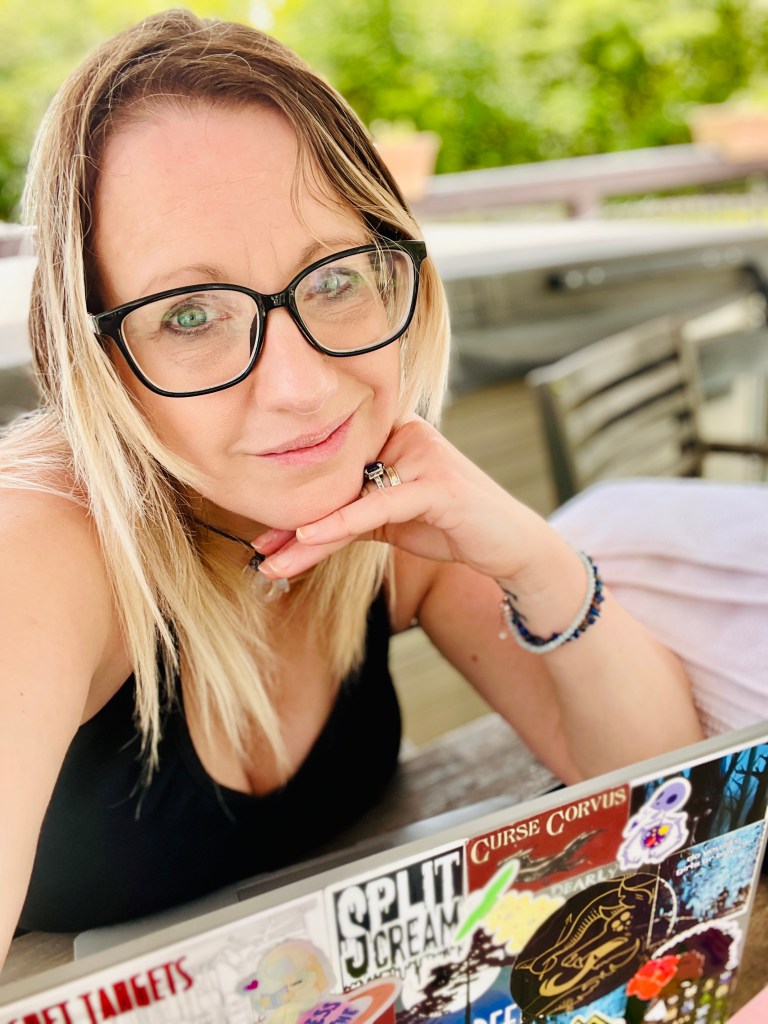
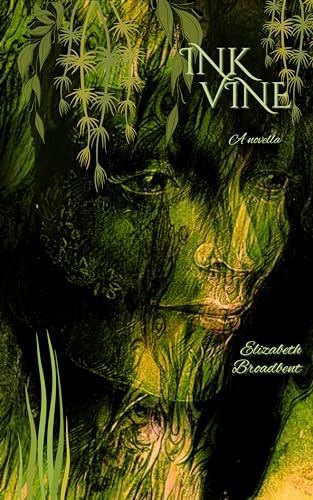
Elizabeth Broadbent escaped the swamps of South Carolina for the Commonwealth of Virginia, where she lives with her three sons, two cats, two dogs, a flock of crows, and a very patient husband. She’s the author of Ink Vine and Ninety-Eight Sabers (Undertaker Books), as well as the upcoming Blood Cypress (Raw Dog Screaming Press, 2025), The Swamp Child (Undertaker Books, 2025), Bluefeather (Undertaker Books, 2026), Tigers of Greater Antarctica (Sley House Publications, 2026), and Breaking Neverland (Sley House Publications, 2026). As a freelance journalist, her work has appeared in places such as The Washington Post, Time, Insider, and ADDitude Magazine.
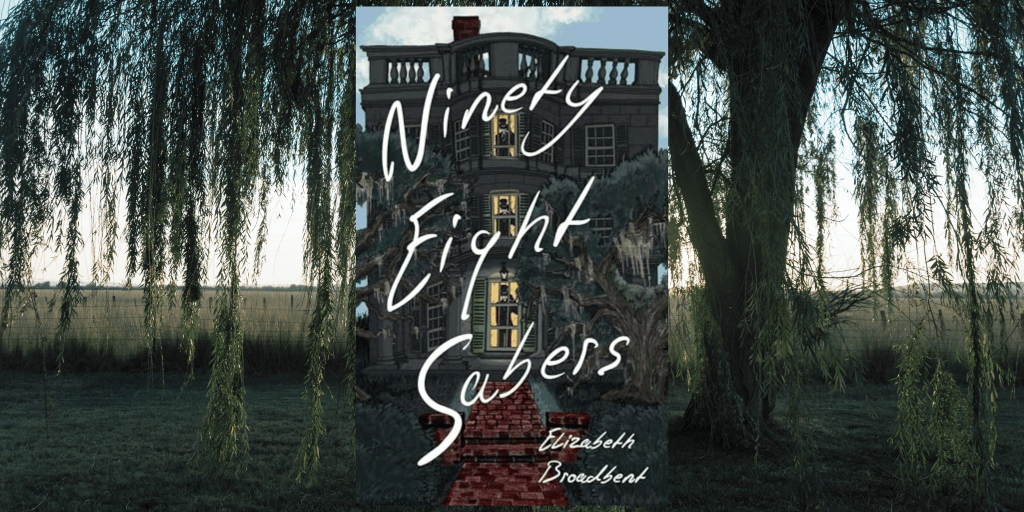
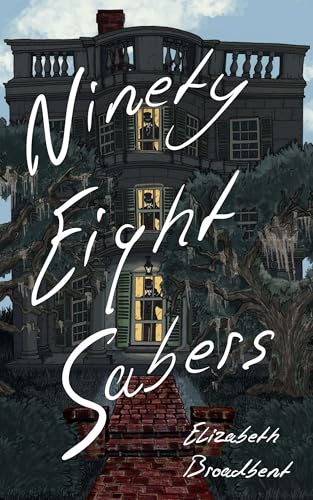
Ninety-Eight Sabers comes out November 29th. Think Arrested Development meets The X-Files: it’s a Southern Gothic novel where reality TV producers try to turn a clan of cousins, forced to return to their haunted family plantation, into witchy Kardashians with Carolina drawl. This goes—well, poorly.
1. What was your first published work?
Other than personal blogs, my first published work was an article called “A Mother’s White Privilege” which went wildly viral on my own blog in 2014, crashing the site with over a million views on a Sunday morning. It was picked up by The Huffington Post, and earned me guest spots on MSNBC, CNN, and NPR’s All Things Considered. Because of it, I ended up with a job as a staff writer for Scary Mommy, the largest parenting site on the web, where I wrote about politics, mental health, and parenting for an underserved, predominantly female population.
2. Is there a story inside that you have seeds of but can’t seem to connect that’s dying to get out?
I have a novel about a girl whose sibling has the stigmata. I have notes about it going back to maybe 2004? I swear I’m going to try to tackle it next, because I think I finally have a handle on what it’s about.
3. How do you handle a rejected story?
I give myself some time to be a little bit bummed and move on. Every story isn’t for everyone, which means that every story isn’t for every editor. So you move on and sub somewhere else. If you have a thin skin, you’re not going to get very far in this endeavor, I think.
4. What does literary success look like to you?
Publishing stories I love that match my artistic vision. Then people read them. Maybe not a lot of people, but some people. I’m happy when anyone reads them, to be honest. I’m writing predominantly for myself, and if people want to come along for the ride, that’s awesome. I think all of us secretly want to be read, but if that’s your main goal, your work will ring hollow.
5. Do you read your book reviews? How do you deal with bad or good ones?
I was always that essayist who read the comments, even when the comments often told me that DSS should take my kids, so yes, I have the unfortunate habit of reading my book reviews. I’m thrilled at the good ones. I tend to ignore the bad ones unless they have a consistent theme. Then I start to pay attention.

6. What is the most difficult part of your artistic process?
Setting down my phone. I have ADHD, and it’s a terrible struggle not to pop from one social media app to another, especially when promo is such an important part of the job. It’ll eat up your writing time if you let it, and it’ll suck all the creativity out of you.
7. As in most times, the truth is stranger than fiction, what has been the hardest scene or chapter you’ve had to write, if you were channeling personal experience?
At one point, I was working on a novel that started on September 11th, and I had to write that morning from the main character’s first-person POV. It was gutting, especially when I had to watch news footage to verify the timeline. Reliving those emotions made that one of the hardest scenes I’ve had to write. I cried and cried. I didn’t realize how much grief I carried about that morning.
8. What inspired your latest work?
Ninety-Eight Sabers was inspired by a lot of things. On a sheerly visceral level, I started it the morning after my father died, and so the novel begins with a father dying. We were estranged, like Truluck Trenholm and his son Sullivan; like the Trenholm kids, I also grew up in an unbearably racist household. About a month before the book went to press, I realized that instead of mourning my father, I’d written a novel, and I broke down crying in my car.
I also wrote Sabers about a year after we moved to Virginia, and I was really missing South Carolina at the time. There was a lot of conflict in those feelings: Why would I miss a place where the tapwater tastes like moss and where we accidentally swam in a radiation spill from the Westinghouse Plant? Where they only removed the Confederate flag from the Statehouse after that tragic shooting—and where Dylann Roof bought those guns two miles from my house? Ninety-Eight Sabers is a love/hate letter to South Carolina, but with a time portal.
9. If you could tell your younger writing self anything, what would it be?
It’s better if you let go and stop thinking about what you should be doing. Do whatever you want. Go nuts. You’ll only hit your best if you’re totally yourself.
10. What’s the best advice you’ve gotten from a fellow writer?
I don’t remember who gave it to me, but always give yourself a place to start every day. Don’t stop at the end of a chapter. Stop at a place you can pick up easily—mid-sentence if you have to. Then you can sit down and easily start again the next day.
11. What is your go-to comfort horror/Sci-Fi book?
I think Absalom, Absalom! counts. I’m always arguing for it as the best gothic novel there is—my Undertaker Books editor, Rebecca Cuthbert, would fight me on that—but that’s the book I want someone to read to me when I’m dying. I drown in the prose. Right now my comfort read—I think it counts as horror?—is Meryn Peake’s Gormenghast. That man can rock metaphor and simile like no one else.
12. If you were to genre-hop, which genres would you most like to try writing?
I’ve done a very little bit of fantasy—a short story—and I’d love to do more. Something with dragons and a very precise system of magic. Lev Grossman’s The Magicians trilogy remains one of my favorites. Maybe I’ll comfort-read that next. He has a line about whales as spellcasters in The Magician’s Land that never ceases to stop me in my tracks: “And there was something else, something down there in the black abyssal trenches of the ocean. Something wanted to rise. The whales were keeping it down.” There’s a story nagging at me there. Maybe I’ll find it one day.
Pre-order Elizabeth’s new book Ninety-Eight Sabers here!
 NightTide Magazine
Leave a comment