
By Leanna Renee Hieber
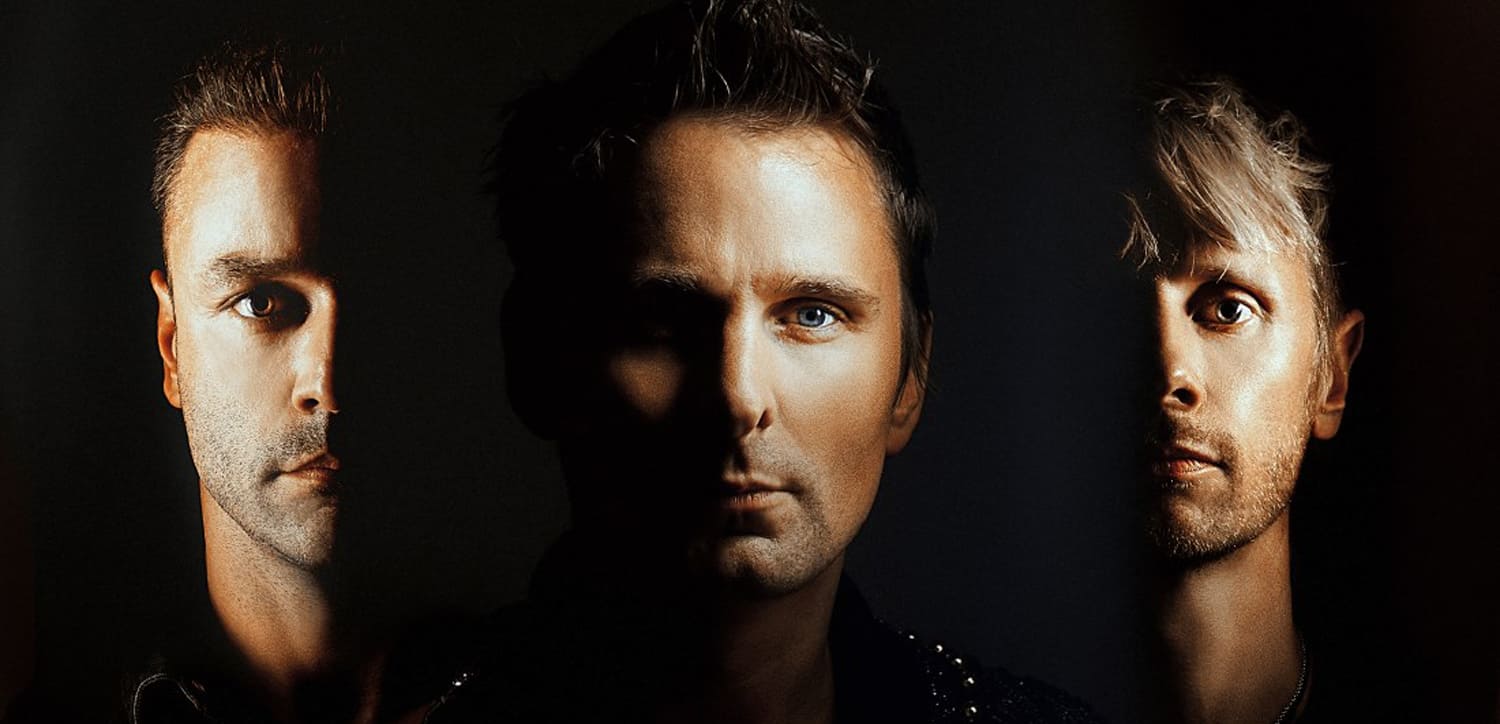
This September marks the 25th anniversary of Showbiz, the debut album from the hard-to-pin-down, expansive, genre-bending British alternative rock band Muse. Showbiz was released on September 7th, 1999 and my life was never the same.

In those days, I was halfway through my BFA in theatre at Miami University in the small town of Oxford, Ohio and I listened religiously to our local alternative rock station 97.7FM, WOXY, “97X… The Future of Rock and Roll” whose tagline became instantly iconic as repeated (many times) by Dustin Hoffman’s Raymond in the film Rain Man, when he hears it on the radio driving through Cincinnati.
As brought to me by the sacred airwaves of the Future of Rock and Roll itself, from the moment I first heard the trill of piano that opens Sunburn, one of the album’s 5 singles, I was obsessed. I gave the call-in lines hell, requesting “Sunburn” or later, “Muscle Museum” and occasionally, “Uno” until I tracked down Showbiz myself, which became one of my most treasured CDs.
My obsession with Showbiz directly mirrored the time I was first able, through my college jobs, to start shopping for my own clothes rather than just wearing hand-me-downs from family that had gotten me through the lean years of my youth. I used the opportunity to shop for loads of crushed black velvet at local thrift stores to become fully, externally goth, a process internally set in motion since falling in love with Edgar Allan Poe at age 9 and starting my own sequel to The Phantom of the Opera at age 12. And Muse was with me through this external becoming.
While Muse wouldn’t qualify as a goth band (“You Make Me Feel Like Its Halloween” from Will of the People (2023) notwithstanding) they are goth adjacent, as a lot of alternative rock of that era and beyond has proved. I love them more today than I did 25 years ago, and that’s entirely due to their deeply varied range of sound, their profound commitment to romantic classical influences like Chopin and Rachmaninov, Matt Bellamy’s heaven-sent and operatically epic lead vocals, the band’s layered, textural, unexpected (and often counter-modal) orchestrations and their very clear shout-outs to classic rock greats while making their own inimitable, sometimes angry but generally melancholic music that more often than not focuses on otherworldly themes.
While their second album, Origin of Symmetry, wasn’t released in the US in 2001, fans imported it readily and that innovative album marked a committed shift into deeper societal and esoteric commentary. Muse is like if the X Files’ Lone Gunman hacktivist conspiracy theorists were an extraordinarily talented rock band with a metric ton of concern about the global military-industrial complex.
I came for the glorious vocals and the killer riffs, I stayed for the corporation-wary anti-war through-lines and learning random things. Here are a few of my favorite tidbits, in no particular order:

Simulation Theory: The album title of their 8th studio album (2018). Simulation Theory has a distinctly Cyberpunk look, sound, and theme. It was only when my partner asked me “You know what Simulation Theory is, right” and I just blinked at him, that buffering wheel turning above my head, and I replied “the Muse album?” and he furrowed his brow and clarified, “their album title is from a real theory; the idea that we’re all possibly living in some superior intelligence’s simulation.” Like the Matrix. Oh. Now I know. Thanks, boys.

MK Ultra – This title of a song from Muse’s 5th studio album The Resistance (2009) reminded me of something from a sci-fi show, so I had to look it up. Oh my GOD from 1953 through 1973 the US government was actively feeding people LSD in hopes of unlocking their psychic power for military usage?! I really did think that was an X-files or a Fringe episode, not actual US history, but it’s true, the project name was MKUltra and it was horrifically torturous. As always, Muse is here to criticize those taking advantage of the vulnerable, as the entirety of The Resistance proves.

Exogenesis – Three Exogenesis: Symphony tracks mark lush, orchestral, and vocal interstitials on the Resistance album. I mean, we all know what genesis means but… Exogenesis is the idea that the origins of human life on this planet began elsewhere and were then deposited or planted here on Earth. Maybe we’re the aliens we met along the way.

Supermassive Black Hole – Sure, I knew about black holes, but I just thought that ‘supermassive black hole’ sounded really cool in the meter of this song featured on Black Holes and Revelations (2006). But it is an actual celestial qualification of 100,000 times (or greater) than our sun’s solar mass. If you hadn’t already been a Muse fan, maybe this song caught your attention when used in the Twilight soundtrack. Three Muse songs have been used in Twilight films (this one, I Belong to You, and Neutron Star Collision). No, they don’t like to talk about it. Yes, it gave them massive exposure to teen girls and emos. I welcome everyone into the love of Muse no matter if they came here through sparkly vampires or through Showbiz.

The Second Law of Thermodynamics – Muse’s album The 2nd Law (2012) refers to The Second Law of Thermodynamics. The album art was heat sensitive on vinyl and represented a map of the human brain’s neural pathways as mapped by the Human Connectome Project. This thermodynamic law states that if no energy enters or leaves an isolated system, ‘entropy will only increase’ and an economy ‘based on endless growth is unsustainable’. Both tracks The 2nd Law: Unsustainable and The 2nd Law: Isolated System utilize soundscapes of various scientific text and soundbites, glitch-hop beats, a sweeping score, news commentators, and more to show how the endless, ravening expansion of capitalism dooms us all to a cold and inescapable annihilation. Goth as hell.

Knights of Cydonia – Where/what is, Cydonia, I wondered, when I first heard one of Muse’s most popular, enduring, and admittedly odd, songs, which closes out Black Holes and Revelations. This weird-west “no one’s gonna take me alive” narrative is set on Mars. Cydonia is one of many poetically named regions of the desert planet. Fun musical trivia: this song pays homage lead vocalist Matt Bellamy’s father, George Bellamy, who was the rhythm guitarist for the 1960s instrumental rock group The Tornados. Their most popular song, Telstar, named for the Telstar communications satellite launched in 1962, used new electronic keyboards in innovative ways, and with its own acid-western feel, you can directly hear the influence in Muse’s Knights of Cydonia as one returns to the mysterious frontiers of outer space, and possibly, alien life.
A few particularly gothy tidbits I’d like to point to in Muse’s discography, things that make me feel like I’m having a fever dream in Whitby Abbey as Richard Wagner and a melancholic Chopin conceptualize rock music: My favorite song on Origin of Symmetry is Megalomania, which features full, roiling, escalating pipe organ. Yes. YES. The stuff of my Phantom-loving dreams, as the lyrics croon about taking off a lover’s mask only to reveal that “underneath, it’s me”?! YES. Then there’s that harpsichord drop over what sounds like a Rage Against the Machine nod at the end of the song Animals (The 2nd Law), which goes really hard in a song all about corporatism eating the world alive. God. And I just have to shout out Drones from the 2015 album of the same name, because who in the hell does a gorgeous, full-round Renaissance madrigal with the lyrics “killed by drones” as an anti-corporate war message? These guys do. And I love them for it, and all the weird sh*t they’ve taught me. Right now, their album Resistance has never been a better soundtrack for the struggles of the next years.
Happy 25th anniversary Muse. Please don’t ever stop, gentlemen; the cosmos wouldn’t be the same without you.

Leanna Renee Hieber is an actress, playwright and award-winning, Barnes & Noble bestselling
author of fiction and Non-fiction for publishers like Tor and Kensington Books. A Haunted
History of Invisible Women: True Stories of America’s Ghosts, co-authored with Andrea
Janes, was a Bram Stoker Award nominee for Superior Achievement in Non-fiction and Leanna
was a Daphne du Maurier award finalist for Darker Still. America’s Most Gothic: Haunted
History Stranger than Fiction, also co-authored with Janes, releases in 2025. Her short stories
have appeared in numerous anthologies such as Queen Victoria’s Book of Spells, on Tor.com and PseudoPod and her essays have appeared in Apex Magazine, Psychopomp, The Deadlands, Nighttide Magazine and more. She is a NYC ghost tour guide and has been featured on TV shows Mysteries at the Museum and Beyond the Unknown discussing Victorian
Spiritualism. https://leannareneehieber.com

Leave a Reply