By Allie Lembo
“I admire its purity.”
Species XX121, also known as the xenomorph in the Alien universe, is a perfect killing machine of a creature. It is impervious to starvation and oxygen depletion, it reaches maturity in less than 24 hours, and its defensive acid burns holes through flesh and steel alike, making a mockery of men and their greatest creations. It is the optimal being; what tech corporations would consider a godsend.
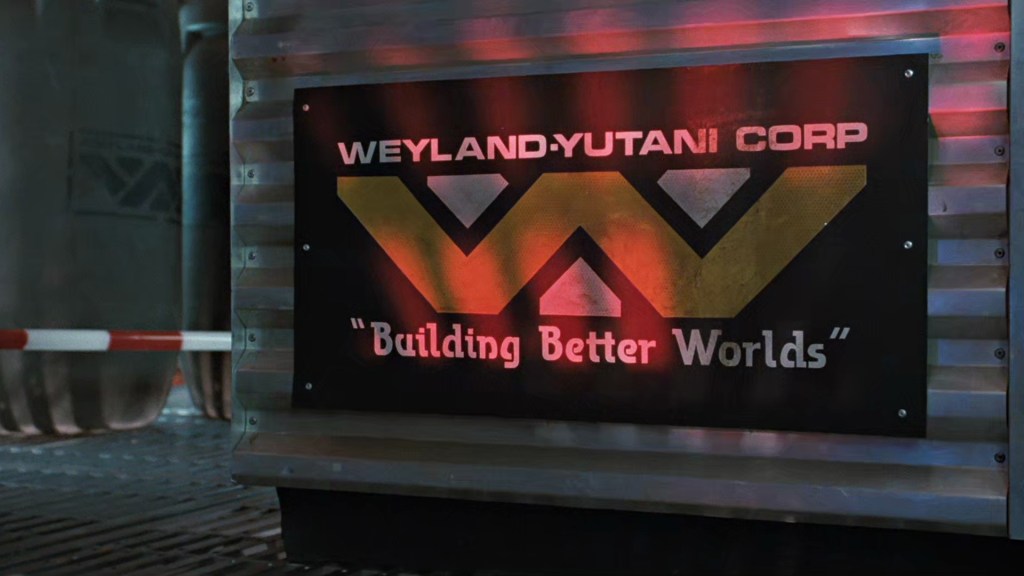
Weyland-Yutani is the tech corporation of the Alien series that serves as its bureaucratic antagonist. In the most recent film, Alien: Romulus, the company’s newest intention comes to light; human beings have been wrung out for work as much as possible and it’s time to give them an upgrade, much like the Weyland-Yutani synthetic persons get on the regular. Likely against their will, or coerced into unfair contracts, humans will merge with the xenomorph to achieve a stabilization that will allow them to maximize efficiency that better serves the company. If the legalities were shifted, it wouldn’t be surprising to hear that as a company initiative coming out of the mouth of a current tech culture CEO.
Tech culture’s obsession with optimization is mirrored in the Alien series, first with synthetics and then with xenomorphs. This current ambition of optimization—developing processes that streamline efficiency—is just the next evolution of the Protestant work ethic that continues to define the workforce today.
Described by the turn of the 20th-century social theorist, Max Weber, the principle is the “ethic of nose to the grindstone for the workers for the maximum profit of the capitalist.” He meant to be disparaging, but his definition was borrowed by those who would benefit from it most as a playbook for workers. That ethic was rooted in the English Puritan belief that working very, very hard would prove that God had given you faith, saving you from eternal damnation. Nevermind that working conditions at that time were a sort of damnation onto themselves with no such thing as environmental protections or safety regulations.

That era also overlaps with the heyday of company towns, sometimes nicknamed exploitationvilles, one of which is home to the Alien: Romulus crew. Planet LV-410, Jackston’s Star, is a mining colony without a sun owned by Weyland-Yutani, where everything, including their food and shelter, is owned by the company. Workers are likely paid with credits to use at company-owned stores instead of cash to save and spend on anything big, like say, a way out. Rain dreams of seeing the sun once her contract is up, but she finds that she is forever indebted to Weyland-Yutani; her contract is only ever extended when she reaches the end.
In the 1800s, company towns promised to provide everything for their employees to help them feel “complete” and therefore, not likely to deviate from the insular community. In addition to food and shelter, towns built entertainment centers like bowling alleys and clubhouses. It’s not unlike the Ping Pong tables, bean bag chairs, and coffee bars of tech giant legends that would trickle down to the millennial start-up workspaces of the 2010s. Consistently placed in lists by Fortune and Glassdoor as the best places to work at that time, companies like Google, Apple, and WeWork used that good PR to promote a culture of devotion. In a perks-driven era, it was reinforced that those offices were what The New York Times called in 2018, “the kind of place you never have to leave.” They offered gourmet food even at dinnertime, laundry services, massages, and gyms on the premises; anything to create the optimal working space so that employees could work really, really hard.
Alien: Romulus’ main protagonist, Rain (Cailee Spaeny), hangs out with her friends and family, playing video games, but she lives in a dark, smoggy, crowded home where she’s woken up to an alarm telling her if she spots symptoms of illness to proceed to the medical bay for examination. Rain’s parents both died of lung disease. She’s roped into escaping Jackson’s Star, but there is a discontent brewing on the ground, the seeds of a revolution of a people exhausted, a people in mourning; there’s a constant drone in the streets of Weyland-Yutani workers yelling into megaphones that they’re all slaves owned by the corporation.
In the mid-1920s, the employees of the towel manufacturing plant in the North Carolina company town of Kannapolis were succumbing to brown lung. The 7-day workweeks of 12-hour days were finally brought to an end when they unionized, plummeting the fatality rate by 30%. Unions grant protections that improve working conditions for all. But this is a horror movie. Rain takes the first out she gets. However, the decommissioned Weyland-Yutani technology that will grant them escape from the corporation forever puts her face-to-face with its greatest evils.
In Alien, the synthetic being is hidden among them, secretly ensuring the success of Special Order 937, the return of the organism for analysis (crew expendable). In Alien: Romulus, the audience is introduced to a modded-out version; Rain’s “brother,” Andy (David Jonsson). “Wey-yu damaged goods found in the trash” likely due to a glitchy stuttering, he’s been reprogrammed with a prime objective outside of the corporation; to do what is best for Rain. He’s also fond of telling the kinds of jokes you’d find on candy wrappers. Unable to do what is best for the company, some would call him broken.

To access the ship and help the group escape, he gains the new upgrade, becoming fully optimized. He is cold, more classically robotic than he or even the other synthetic appears. His motor skills are repaired and there’s a new prime objective; to do what is best for the company. He becomes extremely calculating, analyzing and weighing the risks of every encounter with the creature with his goal in mind.
The details of that goal become apparent as they move through Romulus; the humans are to be upgraded themselves. They are to be injected with Prometheus Fire, the xenomorph goo that will make their fragile bodies, never truly equipped for space colonization, impervious to starvation, oxygen depletion, and the thousand natural shocks that flesh is heir to. Their DNA is to be optimized because it is what is best for the company.
Modern corporate culture has already been preaching optimization of the self. Treadmills and standing desks combine exercise and work. Caffeine consumption to the point of anxiety and rapid heart rate has been normalized. Even achieving the ideal amount of REM sleep is seen as a worthy pursuit in order to return to work rested because that is what is best for the company. It is your job to keep yourself healthy and energized for work; Weyland-Yutani needs bodies in mines.
When Rain is deciding if she should escape or not, she spots a yellow canary in a cage, on its way down to the mines. The birds were once used to detect poisonous gases that were present deep in the Earth, conking out much earlier than the gas would be fatal to humans. The practice was outlawed in 1986, switching to digital readers, but in 2142, it’s the ideal model. Weyland-Yutani can program their synthetics to detect air temperature, but not poison gas? Or is it that they will never bother to extend the optimization of processes to the preservation of people, animals, and the planet?
Optimization typically doesn’t have an end; Tesla doesn’t seek to one day sell a certain number of cars, throw a party, and shut it all down. They, like their competitors, seek to continue building an empire until there is nothing else left and no escape.
One of the side effects of being an empire for an extended timeline is that eventually if there are no worker protections, it will no longer be optimal to treat workers with perks; Google has done away with the massages and the dried mango, the canary in the coal mine of how tech culture is evolving. The perks that drove the work ethic and the opportunity to work very, very hard have now been replaced by an economy that doesn’t value workers and will have them staying for pennies for fear of not working. The artificial intelligence boom promises to aid workers, but its increased capabilities in language and data analysis, although imperfect, are a cheaper solution than a properly staffed workforce. The kitschy prime ethic of Google, “don’t be evil,” was deemphasized from their code of conduct in 2018.
If it weren’t for anti-trust laws, the tech juggernauts would be merging and ascending to Weyland-Yutani’s level of dominance. The mega-conglomerate manufactures synthetics, computers, and spacecraft, but its hubris lies in the research and development of bio-weapons from XX121. Without an end to optimizing, once you’ve conquered the world, the next step is to change what it means to exist in that world. They’ve replicated humans with synthetics, made them immune to exhaustion or disability, and the next step is using the xenomorph to change humans from the inside out. Like the pronatalist movement out of tech hub Silicon Valley, like the eugenics movement, ensuring selective breeding practices for an optimized race will always be the next step for a crowd that likes to play God.

Only corporate diehards could truly believe that the creature’s core elements would improve humans, rather than devour and corrupt humanity. Once formula Z-01 is injected into the test mice in Alien: Romulus, they can perform at optimal levels — for a time. Then, they mutate and die. The injection prolongs the life of the dying, pregnant Kay (Isabela Merced), only to latch onto her unborn child, and grow at the lightning-fast rate of the xenomorph. The offspring is optimized to outer space, able to exist outside oxygen for at least a short time, before its disintegration by an asteroid belt. Like the test subject, the fusion of species leads to suffering and absolute horror. Those unimaginable unethical casualties of breeding the two species will be seen as the necessary steps in the process of creating humanity 2.0.
Take any corporate goal, bring it to the next step, and repeat it, and you will eventually turn it back onto the human workers. Once a company grows large enough to employ them all, they’ll want them all to be better, faster, and more efficient. In the original Alien, even Ash knows he’s been bested. As a mouthpiece for the company, through the synthetic point of view, he reveals his admiration for the xenomorph whose children’s children may eventually even outpace him; “I admire its purity.”
There’s a scene near the end of Alien: Romulus, where Rain and Andy are cornered by the xenomorph with no hope left, so she asks him to tell her some jokes; the same ones he’s been telling her for years. He states, “I don’t understand cloning at all.” She replies, “That makes two of us.” If he was his upgraded self, he could calculate a possible way out.
Instead, they delight in doing a bit; of what they believe to be the last gasp of whimsy before their violent ends. It wasn’t the optimal response, to tell jokes in the face of death. It was just a very human thing to do. The best kind of thing worth doing.

Allie Lembo (she/her) is a writer based in the New York Hudson Valley. She has a degree in Drama and English from Kenyon College in Gambier, Ohio. She’s written about scary movies for Insider, MovieJawn, Popdust, and her weekly substack, Chocolate Syrup. In addition to the horror film obsession, she bakes a lot of banana bread and hangs out with her bulldog mix, Frankenstein. www.allielembo.com


 NightTide Magazine
Leave a comment