

by Stan Wright

Jonathan Glazer’s Under the Skin (2013) presents a striking exploration of gender and power dynamics through its alien protagonist, known in the credits as “The Female” and portrayed by Scarlett Johansson. In science fiction, aliens often embody “otherness,” whether as conquerors, observers, or outsiders with vastly different morals. Under the Skin, however, offers a subtler, more enigmatic alien figure, one who blends into society and begins to develop a fragmented understanding of human behaviors and identities.
At the start of the film, The Female’s actions seem tightly controlled by a group of ominous “motorcycle men.” These silent figures appear to direct her mission and monitor her activities, giving her purpose but restricting her autonomy. As she seduces and “kills” men in a strange black ooze, her encounters are detached and transactional, reinforcing her role as a predatory force. In these early scenes, she lacks empathy, engaging with her victims solely for the purpose of feeding or harvesting them. Her power here is devoid of compassion, and her actions reflect the control that the motorcycle men exert over her. However, as the film progresses, The Female begins to diverge from her mission, and her growing autonomy manifests in subtle moments of curiosity, particularly in her interactions with women and children. This autonomy becomes strikingly evident when she encounters a man with a severe facial disfigurement. Rather than luring him into the deadly black void as she has done with others, she pauses, showing a glimpse of empathy by releasing him. This moment marks a pivotal shift in her character: for the first time, she resists the role she has been assigned, sparing a life instead of taking one. Her refusal to harm the disfigured man signals her awakening sense of individuality and her ability to make moral choices, suggesting that she is no longer simply a tool of the motorcycle men. This encounter disrupts her predatory routine and challenges the foundations of her identity, as she begins to view her prey with a new, complex awareness. By sparing him, she crosses a threshold into autonomy, beginning her journey away from detached obedience toward a fragile sense of humanity—one that ultimately makes her vulnerable in ways she hadn’t anticipated. This scene foreshadows her own struggle with appearance and identity, hinting at an internal transformation and foreshadowing the climax where her own appearance will be stripped away.

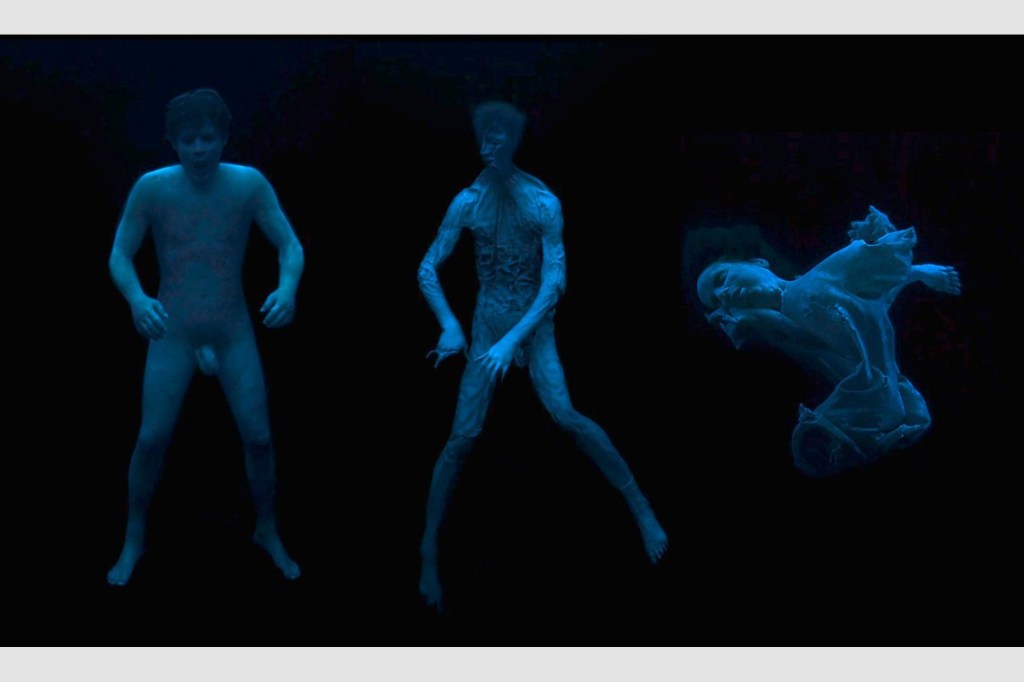

The culmination of these ideas occurs in the final scenes when The Female is pursued by a man in the woods. When he tries to assault her and rips at her human skin, he unwittingly reveals her alien form beneath. As her human “mask” comes away, exposing her true otherness, The Female is ultimately vulnerable and exposed. This peeling away of her skin symbolizes the removal of societal roles associated with gender, beauty, and power—constructs that, until now, she had inhabited fully to achieve her predatory purpose. As she sheds this human disguise, she is left with her core self—a being neither male nor female, human nor entirely alien in conventional terms. This transformation critiques the notion that identity and power are inherently tied to physical appearance. The Female’s power as a “woman” disappears along with her human skin, revealing the fragility of identity based on physical form. As she faces her attacker in her alien state, she loses any semblance of control, highlighting the limitations and vulnerabilities that come with shedding societal expectations. By revealing her otherness, Under the Skin portrays gender identity as both performative and fluid, demonstrating how power structures can be dismantled once outward appearances, which often dictate social dynamics, are stripped away.

In essence, Under the Skin uses The Female’s transformation as a critique of society’s fixation on appearance and its influence on gendered power structures. Her journey suggests that true identity exists beyond the confines of human or gendered physical forms, challenging viewers to rethink how they associate identity, autonomy, and power with the external body. By stripping her of her human disguise, Glazer’s film unveils the vulnerabilities and limitations that come with being seen as “other.” Under the Skin ultimately challenges viewers to question how much of what we consider “identity” is performative, and it serves as a reminder of the fragile and constructed nature of power when it is tied solely to appearances. The Female’s tragic end is not only a revelation of her true form but also an indictment of a world where the power of identity dissolves without the mask society deems acceptable.




 NightTide Magazine
Leave a comment