
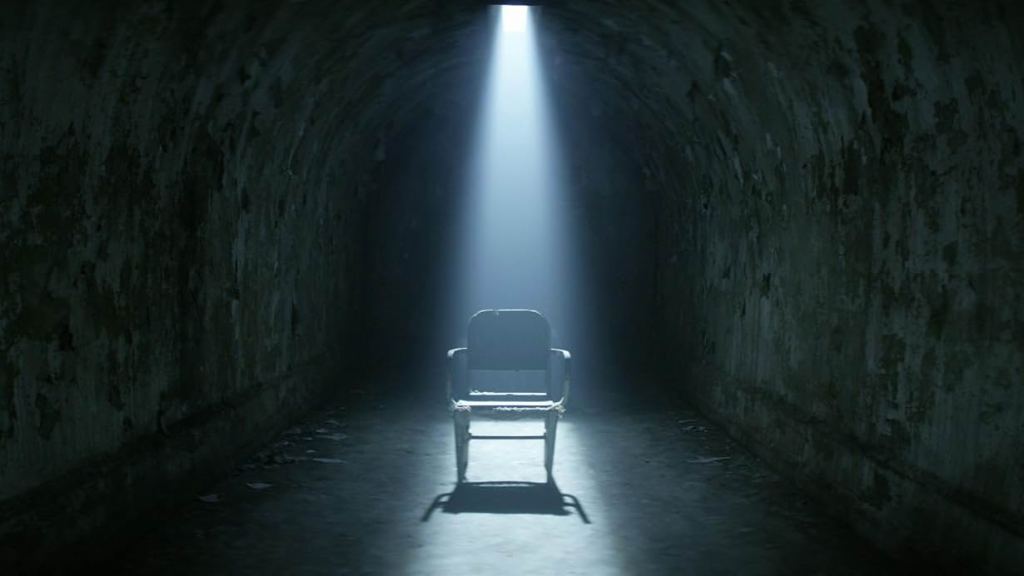
By Payton McCarty-Simas
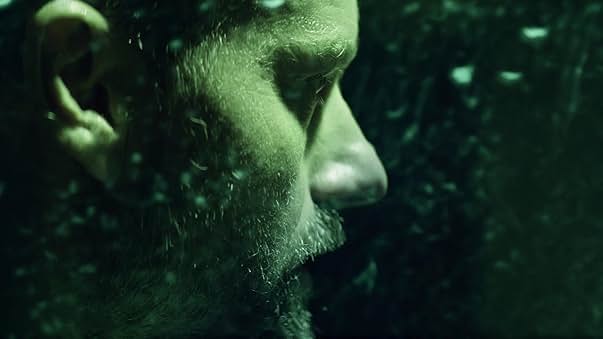
David Prior’s heady, desolate debut horror-thriller The Empty Man brilliantly breathes new life into now hackneyed–– yet rarely fully considered–– philosophies. Based on a graphic novel and blending medieval mysticism, 19th-century philosophy, occultist Theosophy, and modern technological and social alienation using the pulpy strictures of neo-noir, the film is a sweeping, if opaque work that invites repeat viewing. The story is an exploration of the dangers of spiritual self-abnegation, told through layered generic pastiche, self-consciously meditating on Nietzsche’s famous suggestion that “if you gaze for long into an abyss, the abyss gazes also into you” by positing that, in the absence of societal or even mere personal cohesion, a psycho-social power vacuum is created into which the distinction between self and Other may collapse altogether. In an interview, Prior quoted GK Chesterton: “The danger of atheism isn’t that people will believe in nothing, it’s that they’ll believe in anything.” Though it has subsequently become a cult hit, recognized for its cosmic, self-reflexive plotting and eerie, consciousness-expanding tone, The Empty Man’s release at the height of Covid lockdown after years of post-production limbo was the final nail in the coffin of this already deeply strange, overtly ambitious film’s commercial failure. In some ways, this fate is ironically fitting for its New Agey, nihilistic point of view–– as Adam Nayman put it, “If a great cosmic horror movie gets (barely) released in the middle of a global pandemic, and nobody sees it, does it really exist?”
“It’s Not His Head”
While the bulk of The Empty Man follows a former detective James Lasombra (James Badge Dale) as he investigates the disappearance of his niece, Amanda (Sasha Frolova), and its possible connection to what may be a New Age death cult on the outskirts of St. Louis, the first twenty-three minutes stand entirely alone. They constitute a sort of existential short film that, beyond establishing the central mystery of the rest of The Empty Man, also coheres its spiritual themes using the visual metaphor of the psychological (and perhaps preternatural) horrors of being snowbound. Set in the Himalayas in 1995, it hypnotically lures the viewer through the hallucinatory last days of a group of clueless American hikers caught in an abandoned house during an unexpected Nor’wester. It’s a trippy blend of The Blair Witch Project and de rigueur elevated horror stylings, deploying a Nietzschean take on Buddhist philosophy with icy, deadly precision. It’s to this cold open to which I’ll now turn.
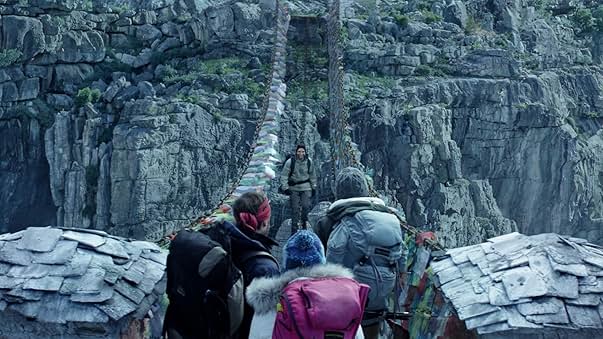
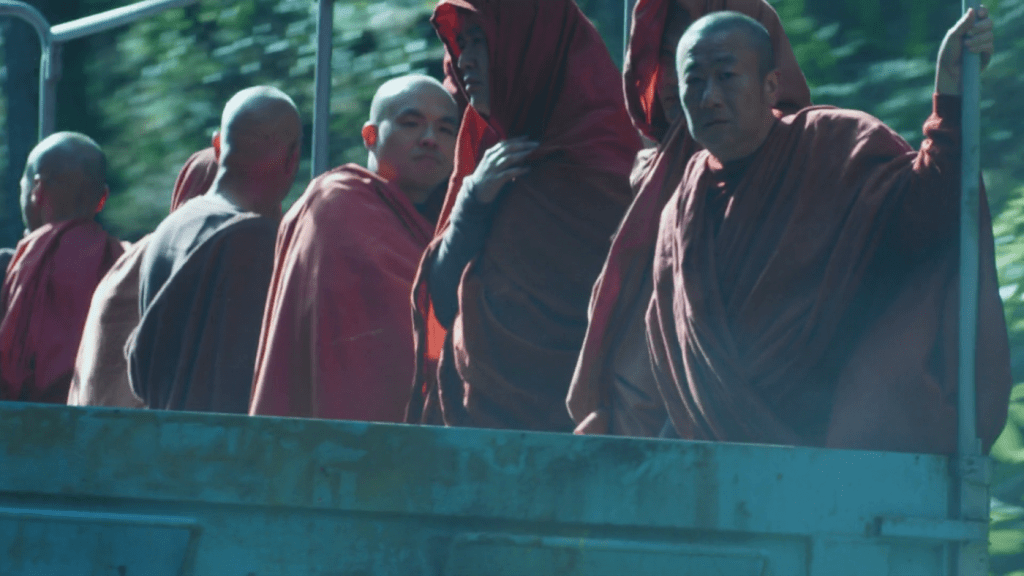
From the first shot of the film, Bhutan’s dryly frigid slopes are immediately, winkingly coded as an alien, “foreign” landscape into which Prior’s doomed quartet of hikers arrogantly blunder: soon into their sojourn, the group sees a cart of saffron-robed Buddhist monks pass by, their faces blank, in a direct nod to the classic extended prologue of The Exorcist. While this shot at first seems exoticizing, as the film progresses and its Nietzschean themes develop, it’s easy to view the monks’ baleful stare at the group as a self-aware form of cinematic reproach. The hikers, two men (Paul and Greg) and two women (Ruthie and Fiona) travel up the mountain largely in silence, their close breathing and the rustling of trees a disturbing counterpoint to the vastness of the arid landscape; they glide past tattered prayer flags in omniscient wide shots, the space itself palpably and menacingly serene. (Prior was David Fincher’s close collaborator in various roles for over two decades, and this connection is evident in the film’s style and play with the genre). As they struggle to ascend, lightning flashes and clouds roil in the distance, the sky’s breadth filling with the ominous, electric presence of an impending storm.
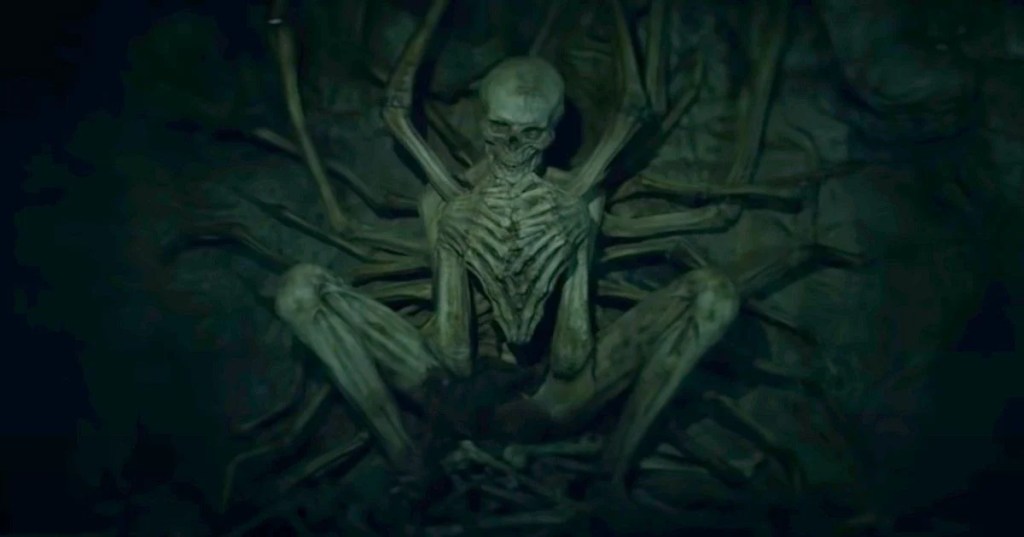
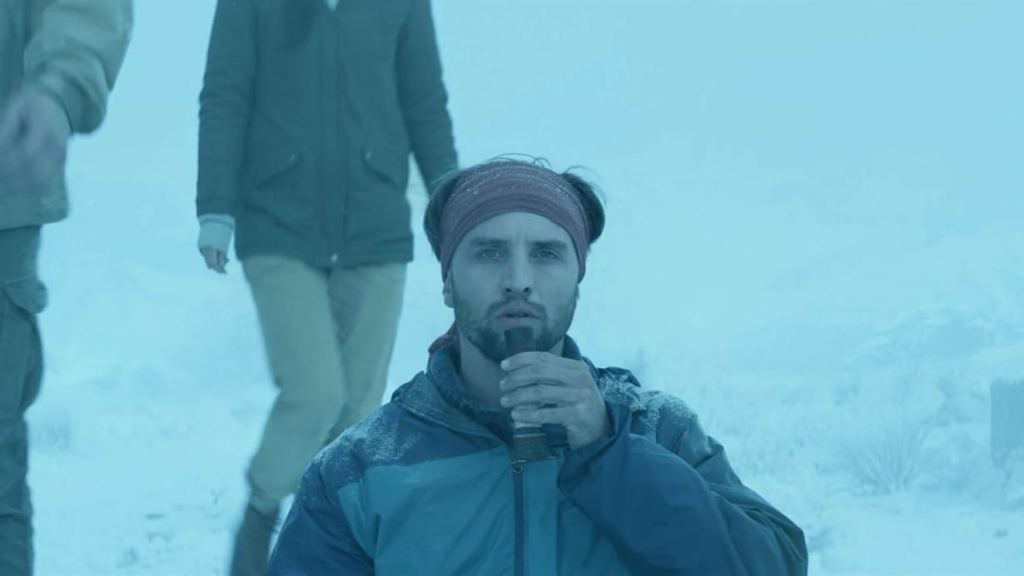
This portentous ambiance quickly breaks and the rest of the cold open takes on a fated, doomed cast. Soon, one hiker, the Biblically-named Paul (Aaron Poole), who sports a monastic-looking, saffron-colored headband, hears a hollow whistling sound no one else seems to catch and, following it into yet another too-still too-wide portrait of the landscape, suddenly falls from sight into a dark, leering crevasse hidden in the craggy folds of the stony ground. His friend Greg (Evan Jonigkeit) rappels down after him and the visual palette is transformed: Darkness consumes all but the center of the frame, where Greg’s flashlight carves out a small space. The negative space around Greg, we immediately sense, isn’t empty so much as teeming with life and anticipation, swallowing the men. As one character reminds another later in the film, black isn’t really the absence of color–– it’s every color in the light spectrum put together. Tiny insects the color of stone squirm in the beam of Greg’s light. The dim band eventually hits Paul, who sits in a lotus position, back turned to Greg facing a wall. Embedded there is an enormous, mutated skeleton, also cross-legged, with many branching arms fanning out behind its ribcage like a spiderweb and a pair of monstrous, many, many-fingered hands intertwined in front of its chest. It seems to stare at Paul, who glares back, frozen and dazed and clearly entranced. A guttural, bone-deep rumbling fills the space (one longs for a theatrical sound system to capture what sounds like a demon clearing its throat, a hollow mountain shifting, a giant enthralled by droning prayer: eeeeeeeeeeeeeeeeeuuuuuuummmmm). A tear falls from Paul’s eye. “If you touch me, you’ll die,” he warns Gregg. The skeleton watches.
“It’s In His Head”
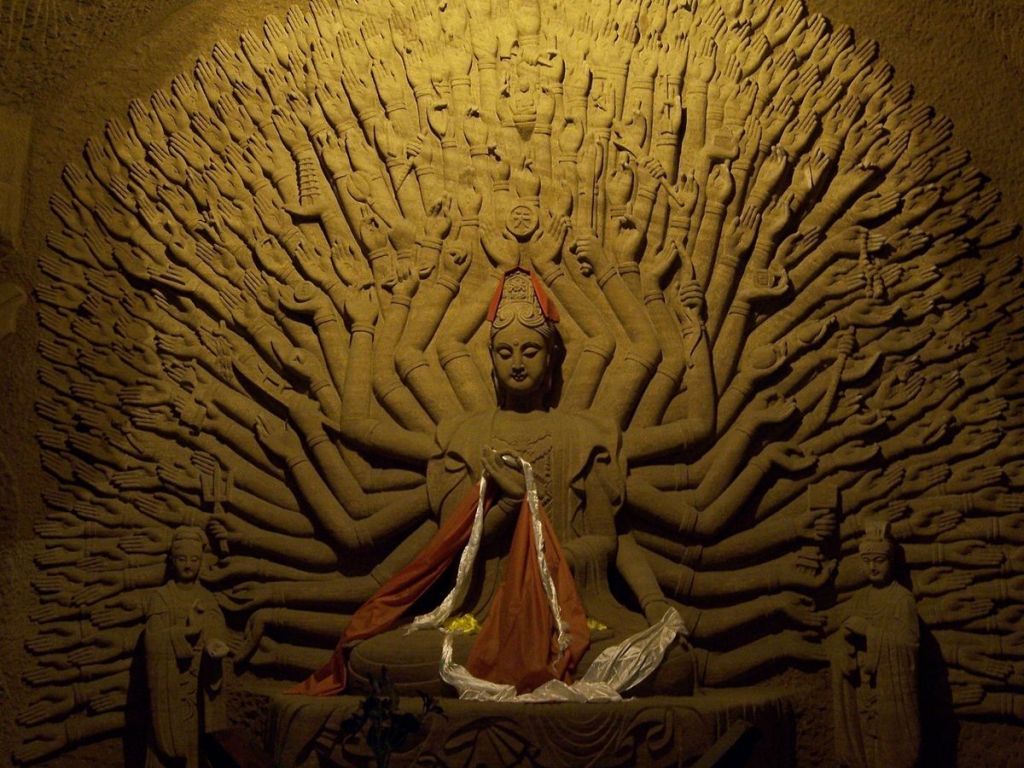
The image of the many-armed giant is a clear evocation of the Himalayan Bodhisattva, a thousand-armed Buddha/god whose disciples call to them to receive compassion and enlightenment–– here, in truly Nietzschean fashion, presented as “dead.” (If this seems like a reach, it’s useful to know that this is the kind of movie that wears its philosophy on its sleeve with arch references like naming the missing Amanda’s school “Jacques Derrida High.”) The deployment of this symbol in tandem with the film’s central use of Nietzsche and, eventually, its play with Buddhist-inspired, quasi-Theosophist occult nihilism (suffice it to say I won’t spoil the plot here, though that may not be entirely possible in the first place) adds another layer to this image. The Avalokiteshvara is sometimes associated with the Heart Sutra (“the form is exactly the void, the void is exactly the form”). The cult that James Lasombra eventually chases believes in Tulpa, or “thought forms,” a Tibetan Buddhist mystical concept (here taken with Cronenbergian literalism) that suggests the manifestation of a being through the mind alone–– as the cultists say, “thought + concentration + time = flesh”–– paired with an embrace of the void. Like the disapproving monks who pass the hikers on their trek up the mountain, the film presents a particular, nihilistic Western appropriation of Buddhist belief as a spiritual curdling (“societal rot” as Prior put it), a passive, New Age embrace of the void, what Nietzsche condescendingly called in The Will to Power a “weak” “Buddhistic tendency, a yearning for Nothingness… This is the European form of Buddhism,” he concludes, “saying No after all existence has lost its ‘meaning.’”
The film’s exploration of a particular kind of Western spiritual desolation and societal disunion is played out in miniature during the cold open’s second half. Greg seals his fate (and the others) when he carries Paul out of the cave and into a house they find on their path back as the storm really begins to brew. The darkness of the cave descends out into the formerly expansive compositions, making the tiny cottage look even smaller than before. They enter the space in a shot that mimics the setup of the cave itself, presciently framed from inside through a small window surrounded by darkness, imbuing the house with the same “dead” sentience as the skeleton below it. The rest of the sequence becomes a kind of haunted house story: they quickly discover the pass is blocked with snow, trapping them; Paul shows no sign of physical illness (besides the webs of old self-harm scars across his wrists) but remains catatonic; as Greg spittingly puts it, like the “I’m so special” suicidal depression Paul clearly struggles with, “it’s not his head, it’s in his head,” associating his seeming possession by the skeleton’s presence with his personal spiritual/psychological despondency. Paul’s girlfriend, Ruthie (Virginia Kull), keeps watch over his body, and the group splinters, leaving each character isolated and vulnerable. Time is measured in progressively more subjective, stilted days punctuated by snow drifts, pale light, random bouts of sleep, and abrupt, ominous title cards. Eventually, Ruthie begins to hear someone approaching through the blizzard, a play on both cabin fever and spirit possession. Stepping out in only her socks, she sees an enormous, wispy black apparition, seemingly made of dark rags. They stare at each other for a long moment; it sprints jerkily towards the house; she flees. These passages evoke the best of snowbound horror, the domestic tensions and unreliable, omniscient POVs of The Shining, the sociological dissolution of The Thing, the black-comic supernaturalism of Ravenous. Without spoilers, the cold open’s dramatic conclusion represents a violent embrace of nonbeing that primes the viewer for the Nietzschean ideas to come in the rest of the film using the mountainous setting to the thematic fullest.
Prior has subsequently directed a handful of episodes of television (notably the best entry of Guillermo del Toro’s Cabinet of Curiosities, “The Autopsy”), but the tremendous commercial failure and steady but nevertheless slow critical reappraisal of The Empty Man has seemingly prevented him from helming major new projects–– at least for now. But as even this cold open alone indicates, the masterful play with genre, intellectual focus, and precise directorial hand on display makes The Empty Man a stunning, chilly debut worthy of follow-up. While the film’s wintery passages take up only a small part of its runtime, the brutal uncompromising landscape and the harsh, blinding depravations the smothering white-out of a nor’wester represents become a foundational psychological and philosophical–– not to mention spiritual–– pillar of the film. The Empty Man is in many ways a “dark night of the soul” as originally laid out by 16th-century mystic St. John of the Cross in the poem for which the phrase is coined: it plums the depths of individuals whose lives are caught up in waiting for their god to fill them with their presence, to give meaning to a void, to validate its meaninglessness–– “I remained, lost in oblivion/My face I reclined on the Beloved./All ceased and I abandoned myself.”

 NightTide Magazine
Leave a comment