By Emma Cole

Some folks are winter folks. They love the cold, and the first snowfall, and winter activities like sledding, skating, and snowboarding. The rest of us, especially the rest of us in Canada, shrink into ourselves as the temperature drops. David Cronenberg’s early works were filmed in Canada, mostly around Toronto and Montreal, and they feel very familiar to me, as someone who lives in the Greater Toronto Area (or GTA). When winter hits, most people are a little excited for the first snowfall of the year. There’s something magical about those first few flakes drifting down from the sky. But by the time winter truly sets in, and the holiday lights grow dim, the bleakness of an Ontario winter begins to wears heavy on your soul. People bundle up and hunker down, eyes on the ground as they tread warily to avoid snow drifts and ice patches. We’re covered in giant coats and chunky knits, barely visible under layers of down and fur and wool, and everyone looks a little less human. All of these elements play into Cronenberg’s The Brood and exacerbate the feelings of anger, isolation, and tension that are already present in the story.
Cronenberg has stated in the past that The Brood is his Kramer vs. Kramer, but more realistic. Though it’s true that Cronenberg was going through a (by all accounts very fraught) divorce at the time he was writing and filming, it’s difficult to speculate just how much of the movie is directly inspired by the events in his personal life. One thing we can say with certainty though, is that, as with his earlier films Shivers and Rabid, the director’s fascination with all things corporeal, and particularly the relationship between the mind and the body, is the central theme of The Brood. And while he is incredibly interested in the inner workings of his characters, and the way humans can manipulate and transform the flesh through experimentation, the explicit, gory scenes Cronenberg is known for are absent for the better part of the film. The winter setting allows for the body to be covered up, to be hidden from the viewer, only to be revealed at crucial points as Frank Carveth, our protagonist, searches for answers about the therapy his wife Nola is undergoing at the Somafree Institute with Dr. Hal Raglan. After an opening scene that gives the audience a glimpse into Raglan’s methods, we find Frank coming to pick up his daughter Candy, who had been visiting his estranged wife Nola. Shortly after they get home, Frank notices Candy has been injured. She’s covered in bruises, bite marks, and scratches, and he worries that someone at the Institute (whether it’s Nola or another patient) is hurting his daughter.
Carveth, played by a staple of the Canadian winter horror genre, Art Hindle (of Black Christmas and endless holiday movie cameo fame) is a rather ineffectual protagonist throughout. His marriage has fallen apart, and his relationship with his daughter Candy is almost nonexistent (he frequently seems to almost forget about her, even when he’s the only one around). The malaise he no doubt feels after being abandoned by Nola (Samantha Eggar) for the therapy sessions provided by the bombastic, charismatic Dr. Raglan (played with the pomposity only Oliver Reed can bring to a performance) seems amplified by the cold around him. He’s constantly shown wearing his beige duffel coat like a suit of armor, walking around the way we do in cold weather here in Canada: hunching our shoulders, trying to make ourselves as small as possible so there are fewer places where the wind can whip you with its stinging gusts (though as with many winter films, he rarely buttons up his coat, a source of much annoyance for almost anyone who’s ever lived in cold climates!). This is no swaggering Kurt Russell in a sombrero in Antarctica—Frank is not that kind of hero.

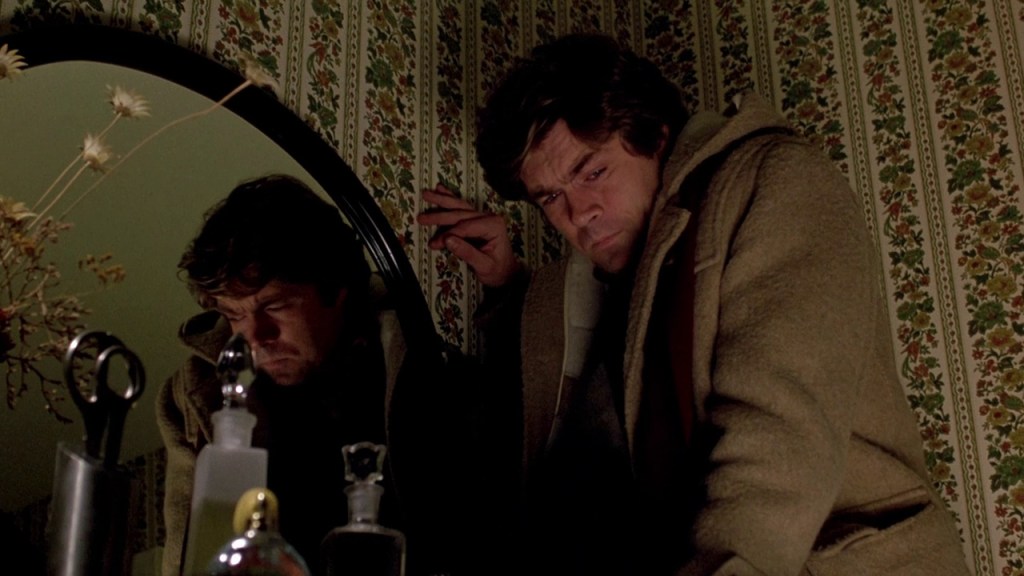
Art Hindle in The Brood (1979)
No, Frank is merely a sad sack of an ex-husband, sorting through the detritus of his relationship and figuring out what to do now that he’s been thrust into single parenthood. Nola, for her part, has been confined to the Institute, for reasons not fully explained (she’s “disturbed,” which perhaps needed less explanation at the time than it does now, I suppose). Her mother Juliana does disclose that Nola has been hospitalized at various points in her life for exhibiting strange welts and other physical symptoms after particularly emotionally painful moments, but no one has seemed to connect the dots between the mind and the body until Raglan comes along. Since the story is told from her ex-husband’s perspective, Nola is given very little grace, and her abusive childhood is virtually ignored by Frank. Dr. Raglan, on the other hand, discovers that that Nola was abused by her mother and neglected by her father, and this abuse is brought back to the surface of Nola’s memories through Raglan’s psychotherapy techniques, which he calls psychoplasmics. The doctor pushes patients to first experience their negative feelings and then transform them into physiological changes to their bodies, so they can be expunged. The imagery, as in most of Cronenberg’s films, is fleshy and grotesque, because, of course, those negative feelings would manifest as horrific growths rather than anything beautiful (I’ve always wondered what would have happened if Raglan had been able to get his patients to experience overwhelmingly positive emotions).

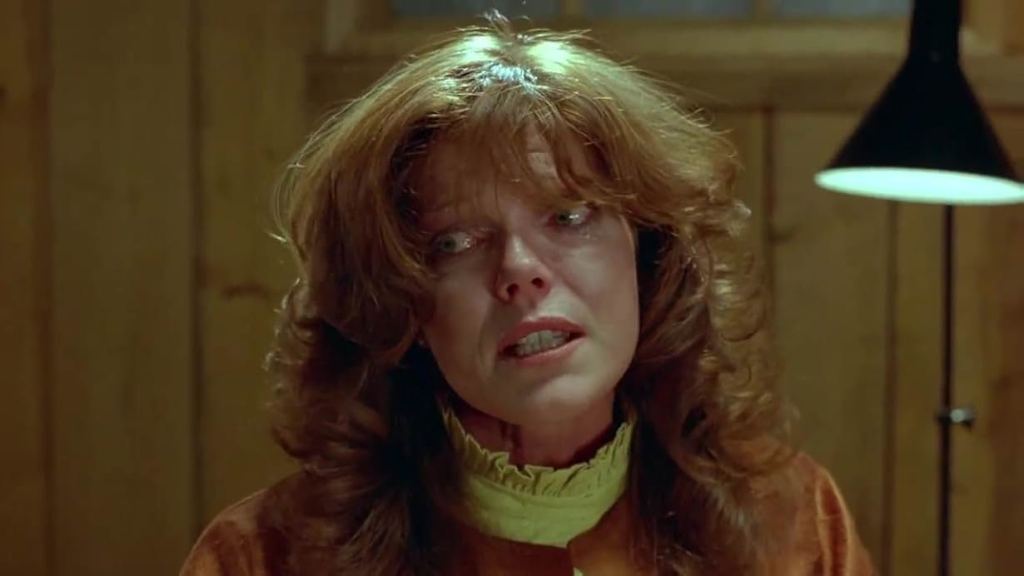
Samantha Eggar in The Brood (1979)
In some patients, Frank discovers that the growths don’t disappear, but instead can induce a type of cancer; one patient, Jan Hartog, has developed lymphoma and reveals his massive throat tumor by unwinding a large towel from around his neck. In Nola, her abuse amplifies the psychoplasmas and creates small, sentient beings (the titular Brood). These strange, blond, childlike creatures are embodiments of Nola’s rage and trauma, and they set out to exact revenge on those who’ve wronged her (or those who she perceives as having wronged her). Since The Brood takes place in the Ontario winter, these small creatures are made even more menacing by their brightly colored hooded snowsuits, which obscure their monstrous appearance and give them cover as they track down Nola’s enemies.
Nola’s lashing out vicariously through her children can be considered as mercurial as the winter weather, but it’s also something Cronenberg equates with the hysterical, emotional, hot-blooded female. Most of the men in the film (certainly Frank for most of the runtime) are quite cold, exhibiting a clinical detachment to their surroundings even in the face of tragedy. Nola, on the other hand, flits through emotions almost as quickly as they arise, going from sadness to anger to fear and back in an instant. Surely some of this characterization is due to Cronenberg’s latent anger at his own tumultuous divorce, but it’s something that comes up in a few of his films: the men here are scientists, investigators, unfeeling and observant. The women are the test subjects, the reactionaries, feeling all the emotions as they’re put through the proverbial wringer. It’s why I believe Cronenberg’s movies, and certainly his earlier work, would hit very differently in a spring or summer setting rather than the bleak and stark fall and winter when he usually situates his stories. Particularly in The Brood, the lack of greenery and growth echoes the lack of growth in Frank and Nola’s relationship. They’re stuck, unable to find a way forward, as the frigidity that surrounds them threatens their own partnership as well as their relationship with their daughter.

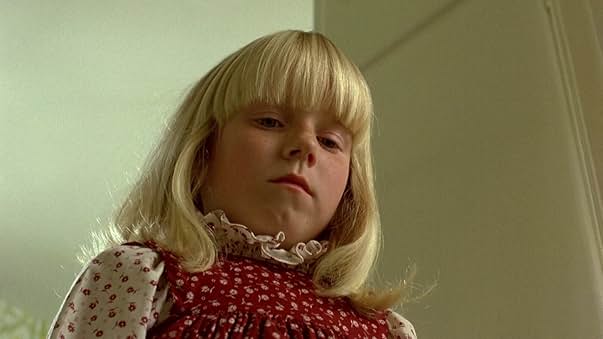
Nuala Fitzgerald (L) and Cindy Hinds (R) in The Brood (1979)
The images throughout the film play with the action of obscuring and revealing, replacing the somewhat remote outdoor images for more intimate violence as the camera moves indoors. Just as the audience is able to literally see more of the characters when they remove their parkas and scarves inside, the camera itself moves closer, from long shots through snowy woods and bare trees to closeups of scared faces and bloody, grasping hands. In contrast to many frigid survival films, the real dread comes when the characters have let their guard down, thinking they’re safe from the elements and from the horrors when they seek refuge inside. The murder of Juliana, Nola’s mother, is a good example of this. She’s in her house, watching Candy and nursing one of many drinks, completely oblivious to the brood creature who’s brought the danger from the outside into the kitchen, breaking into the room through a small door. Candy doesn’t witness the violence, but she does find a dead Juliana, bloodied on the floor. When Frank arrives at the police station after getting the call about the murder, he learns that the police found Candy in a deep sleep, her young mind not prepared to deal with the trauma of the situation. It’s not unlike our tendency to cocoon ourselves when we come in from a particularly blustery cold day; we’re insulating ourselves against the harsh temperatures and buffeting winds. But Candy’s warm place of safety has been violated, and she needs to go deeper into herself to find solace since she’s been left alone.


Susan Hogan in The Brood (1979)
The death of Ruth Mayer, Candy’s school teacher, is another example of the outdoors invading the seemingly safe interior where Candy felt at ease. Ruth is targeted because Nola finds out that the teacher is spending time with Frank after school. She feels threatened by the other woman, who may or may not be interested in pursuing Frank in a more romantic way; Cronenberg never gives her the chance to act before Nola calls the house, and Ruth answers. This time the murder is even more shocking since it takes place inside what should be a completely secure environment for a young child: the kindergarten classroom. The brood children could have easily approached the teacher while she was out on the playground, monitoring the students; it would definitely be easier for them to flee the scene if they were out in the open.
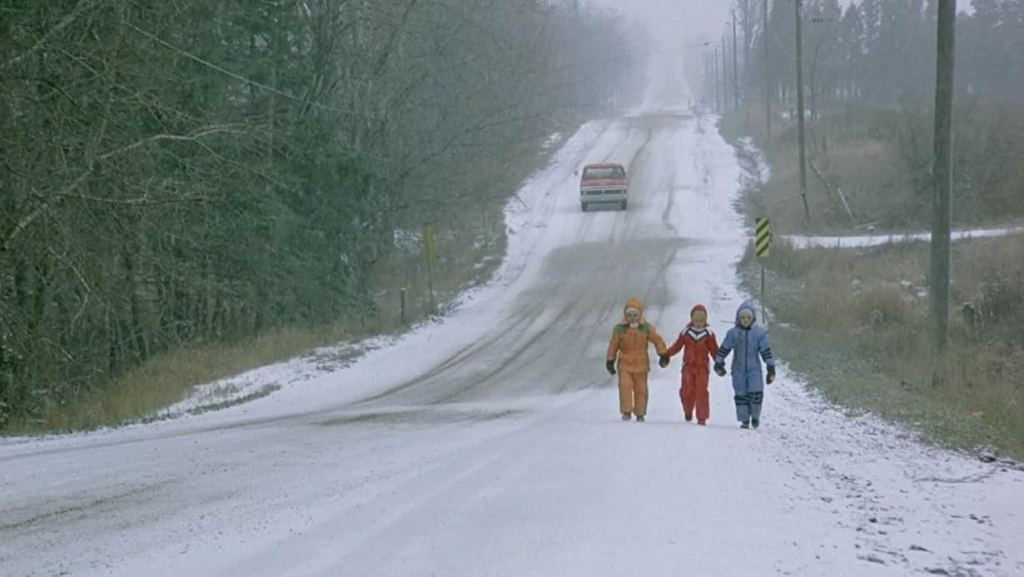
We see the brood watching and waiting on the playground, where Frank drops off Candy. The audience knows they’re lurking, and is anticipating the coming attack. But Cronenberg subverts the expectation, delaying the violence and increasing the tension by shifting the location indoors. As the students shed their winter layers and get ready for the day, Candy is ushered into the bathroom by the two Brood children, hidden from the violence that’s to come. The Brood attacks Ruth, beating her brutally as the kindergarteners watch helplessly then taking Candy with them back to the Somafree Institute. In one of the iconic images from the film, we see Candy walking along a rural road, flanked by the two creatures, all three with their bright snowsuits standing out against the colorless snowy background.
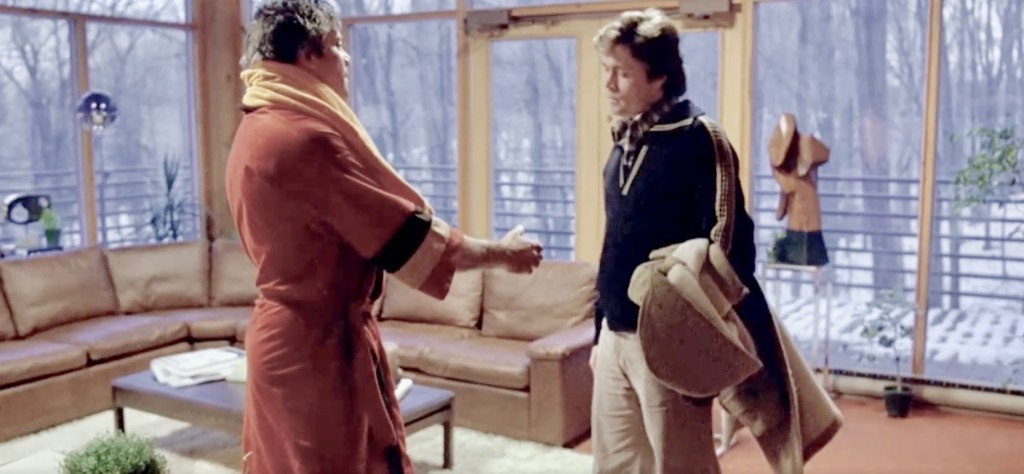

Oliver Reed in The Brood (1979)
There are so many stark images in the film that play with the contrast between cold and warmth. When Frank first goes to visit Raglan, telling him that Candy has been injured while at the Institute, we see Frank, hot-headed and yelling, fully bundled up against the cold with his many layers and winter coat. Raglan, on the other hand, is calm and detached, having seemingly just exited the shower, wearing nothing but a short robe. He stands in front of his giant windows overlooking a wooded area covered in snow, and the coolness of the exterior matches Raglan’s own behavior. The violence may be out there, in the snow and the cold, but Raglan is confident he can keep it at bay by controlling the emotions around him, only unleashing them when he decides it’s appropriate. (Does he practice psychoplasmics on himself, letting his anger or defensiveness grow into welts he can slough off? We’re never given any information about how the doctor discovered this new therapy, but I find it an interesting possibility.)
Much of the violence in The Brood is equated with the cold and outdoors, or rather, the cold seeping into people’s safe and vulnerable spaces. In almost every case throughout the film, Cronenberg shows us a door or window that has been broken as the tension grows before erupting into bloody violence. As Juliana gets up to search the kitchen to find the cause of the disturbance, we cut to the aforementioned small door being hammered open, and the jugs of milk and orange juice being shoved to the floor, smashing and blending into an unappetizing puddle that no one will have the chance to clean up. When Barton, Nola’s father, arrives to deal with funeral arrangements, he ends up at Juliana’s house and stands in the kitchen staring at the outline of his dead ex-wife’s body on the floor. He’s framed by the open door, another indication of the malevolence that has infiltrated the house. Sure enough, it’s not long after this image that Barton is attacked and killed by another small member of Nola’s army of killers, as we cut back and forth to Nola as she realizes in a session with Raglan that her father was never able to save her from her mother’s abuse. We also see the doctor noticing a broken window in the woodshed later in the film, where the brood is kept separate from the rest of the people at the Institute. The violence they’re perpetrating is punctuated by the destruction of the places around them, and it brings to mind the destruction that can come from winter storms: there’s no reasoning with it, and no mercy is given once it hits you.
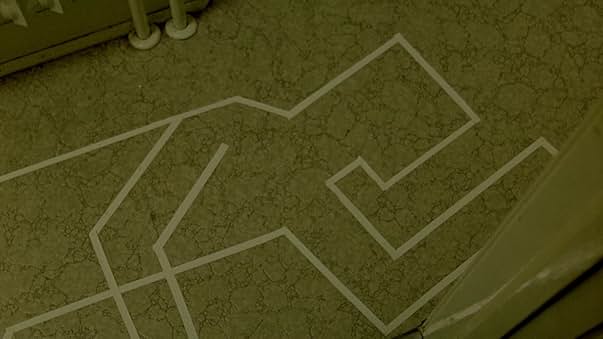

Henry Beckham in The Brood (1979)
The cold winter has a way of isolating people from empathetic interactions that feel much more common in warmer temperatures. The first slightly warm spring day in Canada is tangible; people smile more and start up conversations, shaking off the drudgery of the bleak midwinter. In Cronenberg’s movie, people remain aloof, separate from one another as they protect themselves not only from the frigid climate but from the potential psychic damage they can inflict on each other. Frank and Nola are apart for almost the entire film, with Raglan acting as Nola’s shield until the climax of the film. Frank doesn’t get close to his ex-wife, even as he tells her he wants to work things out. The tension between them, heightened by both Nola’s segregation from society and Frank’s dismissal of his wife’s legitimate mental health concerns, erupts in a violent encounter, when Nola reveals the genesis of the Brood and Frank recoils. Realizing he’ll never accept her for what she is, Nola tells him she’d rather kill Candy than have him take her away. And at that moment, the mostly cool and distant Frank finally sees red and strangles Nola in a terribly intimate, awful scene.
Though the genre certainly has some fine moments that take place in the bright, hot sun (where would we be without summer camp slashers or Ari Aster’s sunlit Midsommar?), for me, winter is where horror really shines. From The Thing to Ravenous to The Blackcoat’s Daughter, frozen horror stories just feel bleaker and Cronenberg’s are no exception. Though The Brood ends with Frank taking his daughter back after dispatching his murderous ex-wife, Cronenberg can’t help but leave us with a small detail that reveals to the audience that nothing is resolved: the closeup on Candy’s arm, showing the beginnings of two tiny welts. The harsh winter scene outside of the car Frank is driving back to civilization reflects the harshness of this final scene: just like winter returns with a vengeance each year, so to does the cycle of abuse and violence return in Candy.


 NightTide Magazine
Leave a comment