By Daniel Roberts

Tired of debating whether Die Hard (1989) is a Christmas movie? (It is by the way.) Well, I have a new one for you.
Is the Christmas classic, It’s A Wonderful Life (1946), a horror film?
Now I know what you’re thinking: “Frank Capra’s postwar masterpiece of sentimental Americana, a horror film?” Dan, you need to put out the Yule log and check your carbon monoxide detector. Well, it’s not carbon monoxide or too much rum and eggnog; it’s just facts. Let me tell you a tale of divine machinations and psychological terror.
A young boy named George Bailey tragically loses hearing in one ear after rescuing his brother from a frozen pond. The young man then saves a family from being poisoned by a pharmacist. He is beaten for his act of courage. Later in life, that same George Bailey faces angry mobs, the loss of his father, the burden of caring for an idiot uncle, and a crow that seems to haunt his every attempt at happiness. Across the street from George’s business sits a villainous devil with a skull on his desk. This devil seems set on destroying George or claiming his soul at the expense of the people of Bedford Falls. In the end, the villainous devil drives George to despair. George abandons his family to jump off a bridge to his death. The only thing that saves George is a mischievous sprite who presents a more horrible world than George could ever imagine. That world is one where his sense of friendship, duty, and heroism is absent and he is hunted in the streets by his former friends. Bailey returns to his family thankful to be alive and is rescued from the devil’s latest plot by his friends. Still, the sinister devil remains, unpunished.
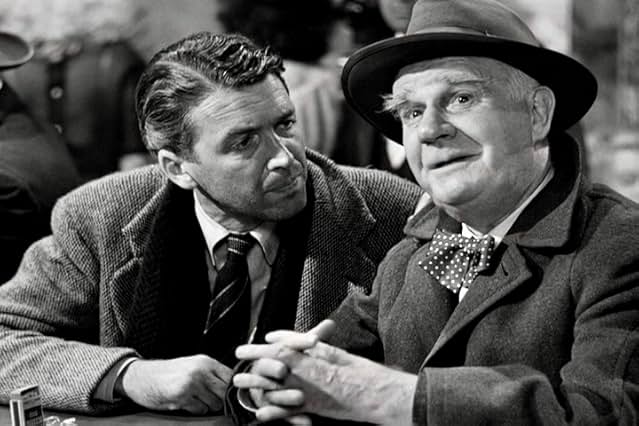
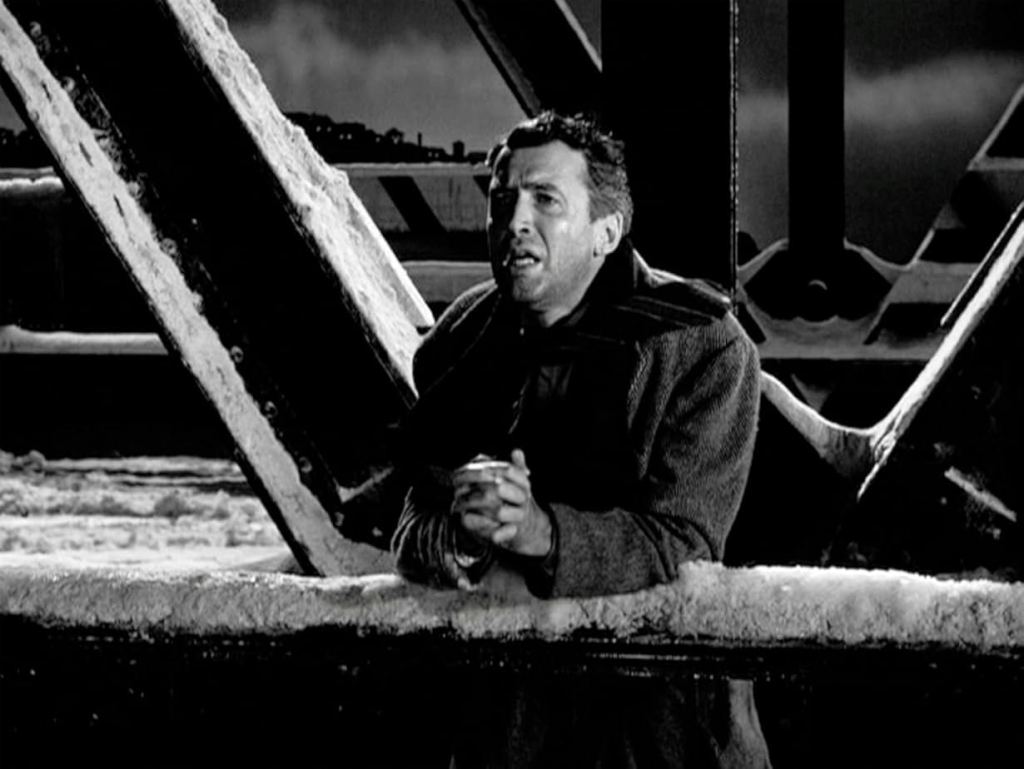
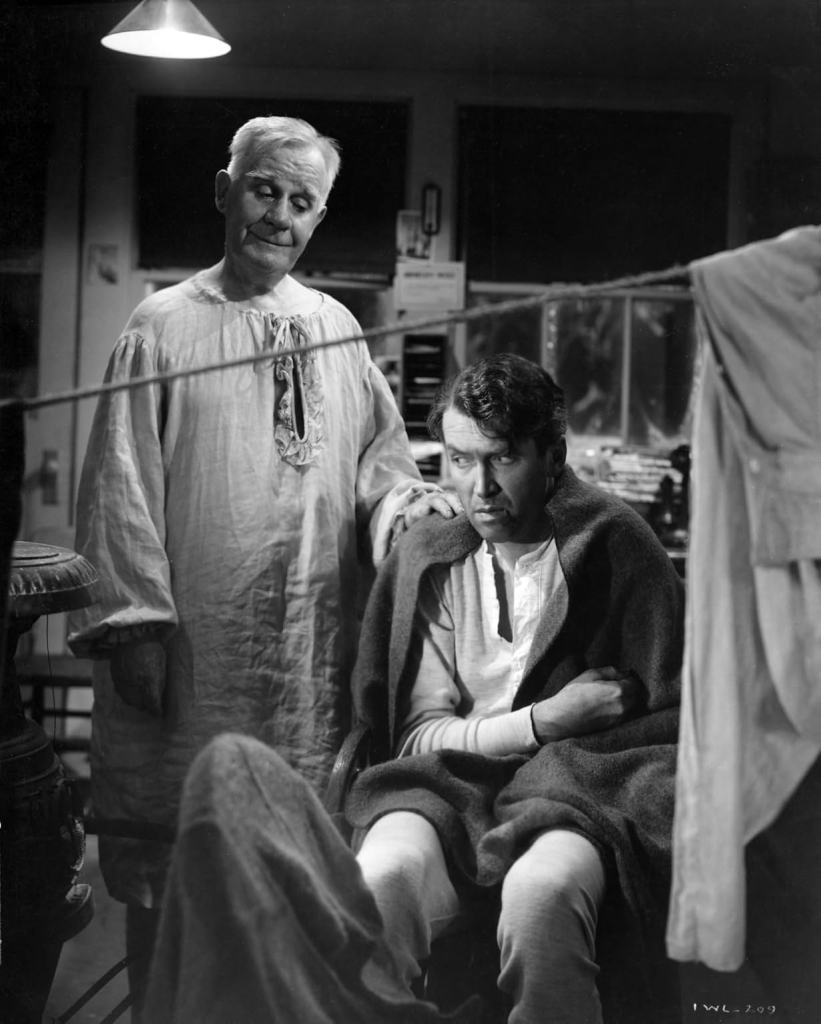
James Stewart and Henry Travers in It’s a Wonderful Life (1946)
Now, if I haven’t sold you on the horror narrative idea, let’s go a little deeper. Get a little meta. It’s a Wonderful Life, was based on the 4,100-word short story The Greatest Gift (1943), by author Philip Van Doren Stern. The Greatest Gift is basically just the third act of It’s A Wonderful Life. The protagonist, George Pratt is about to jump to his death from a bridge when a stranger arrives. This stranger offers Pratt the opportunity to see the world as if he had never been born. Pratt walks around town and discovers the horrible turns his friends and family took without him. He returns to the bridge where he begs the stranger to return his life. He has learned that one’s life is the greatest gift.
Stern, who was Jewish, intended the story as an update of Charles Dicken’s A Christmas Carol (1843), with narrative elements from the biblical story of Job. For those unfamiliar, Job is the story of God inflicting woe and despair on his devotee, Job. God’s intent is to test Job’s faith. After being subjected to horrible pain and grief (poverty, death of his son, horrible illness), Job asks God, “Why are all these horrible things happening to a good person like me?” God rather unsatisfactorily answers, “Who are you to try and understand my plan?” That’s it. That’s the lesson. Horrible things happen. There is nothing you can do about it. The ultimate cosmic horror.
Stern, in an American fashion, decided to end The Greatest Gift on a more positive note. He gives his protagonist agency denied Job. He needed only to learn the lesson of the greatest gift. ‘The greatest gift,’ after all, is life itself. This idea is a reduction of a well-known Talmudic parable from the Sanhedrin:
Because man was created alone, whoever destroys a single life is considered to have destroyed the whole world, and whoever saves a single life is considered to have saved the whole world.
However, Stern’s inspirations were not just biblical. The supernatural and horror elements of suicide, despair, and a strange figure approaching in the dark have a menacing suspenseful quality reminiscent of Edgar Allen Poe. Well, there is a likely reason for this. Before joining the pantheon of Jews who created transcendent works of art that changed Christmas (See: Irving Berlin; Mel Torme; Johnny Marks, Theodore Geisel; Tippi and Neal Dobrosky; the founder of Gimbles Department Store, and on and on), Stern achieved literary fame for producing Civil War histories and annotated short story collections. His most lasting work (aside from The Greatest Gift) was The Viking Portable Poe (1945), a collection of Edgar Allen Poe’s short stories, letters, poems, and essays.
So, I leave it to the reader. It’s A Wonderful Life, a feel-good American classic; or a biblical and Poe-inspired example of divine supernatural horror?



 NightTide Magazine
Leave a comment