By Mo Moshaty
I very much had the opportunity, ability and obsession to talk about the putridness that can sometimes be body horror. I could’ve taken DOZENS of avenues, but when I think of what the pain of transformation and the horror of not being seen as you are, and how, at the whim of another, you can be held captive and dragged to the mat and to hell – my thoughts immediately drifted here. Yes. To the 1982 animated fantasy film that is The Last Unicorn. Is this Peter S. Beagle novel adaptation a horror? Not in the established sense but the horrific themes of body horror and humiliation, suppression, othering, power and possession, and denial of true self and form lie deep within this film.
I first saw this when I was five and if you think my awe and love for it has died down in the 42 years since then, you’d be sadly mistaken. I wanna break this down into three points of body horror entry. The True From, The Mortal Coil, and The Controller.
THE FACTORY ORIGINAL IS NOT SUFFICIENT – THE TRUE FORM
There’s a lot that happens to The Unicorn before she enters the dreaded human form, and it’s a journey paved with characters who either seek to amend the form of others for profit and benefit or those who wish their current form were something much more aligned with the world and their wants. It’s an interesting look at how the true form never seems to be good enough for the task.
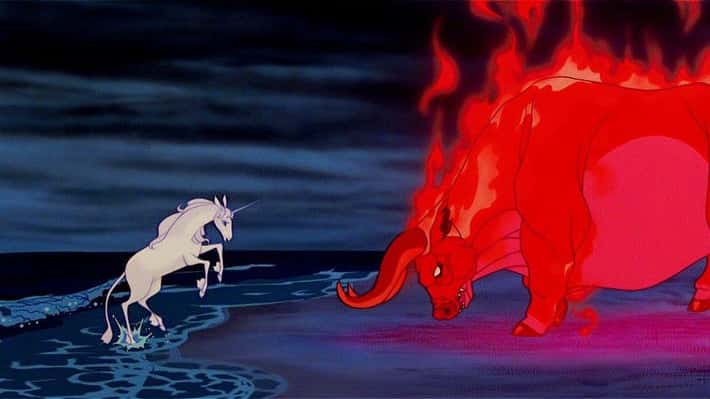
We start off with The Unicorn (Mia Farrow) being ogled by two hunters who converse that she may very well be the last, as The Red Bull, a mysterious and dangerous creature, has driven all the unicorns into the sea. The unicorn, in turn, is puzzled by this; she surely cannot be the only one left, and she decides to go look for the others. The unicorn encounters a butterfly who speaks in riddles and songs. Amid the nonsense, the butterfly also mentions that the Red Bull chased all the unicorns into the sea. Though confused, the unicorn takes this as a clue and sets out to find them.
Now, if someone told me that I was the last of my kind, sure, I’d try to go prove them wrong. Humans are pack animals, and we’re better together, BUT if they told me they were pushed into oblivion by a terrifying source, I’m not your hunter. Sorry, kids.
The Unicorn seeks the others on sheer scientific interest and naivete, and it serves her well until she falls into the clutches of Mommy Fortuna (Angela Lansbury), a cunning witch who runs a carnival of mythical creatures, most of which are conjured illusions. But The Unicorn’s genuine, radiant nature enraptures Fortuna, who traps her with a spell and disguises her as an ordinary white mare, concealing her true identity from prying eyes.
The Unicorn is just another addition to the menagerie at Mommy Fortuna’s carnival, a showcase of mythical creatures that, for the most part, exist only as illusions. Using her magic, she masks ordinary animals to appear as fantastical beings: for example, a simple ape is disguised as a harpy, and a lion is made to look like a manticore. The only truly magical beings in her collection are the unicorn and the horrifying true harpy Celaeno. This act of masking serves as a powerful metaphor for the human tendency to undervalue things in their authentic form. Fortuna simply doesn’t believe the ordinary animals are interesting or valuable enough as they are, so she glamours them to make them “worthy” of attention. This mirrors a societal pressure to alter or “fix” things; be it appearance, nature, or essence—to fit a standard of what’s deemed ‘presentable’. Her decision to disguise The Unicorn as a plain white mare reflects her necessity to harness power and look down her nose on those who don’t realize the greatness of the unicorn. This act of control highlights her constant violation of bodily integrity and serves as a warning about the dangers of tampering with nature and losing oneself to manipulation as the harpy (who is not a glamour but very real and very dangerous) takes Mommy Fortuna’s life. Fortuna’s carnival becomes a space where authenticity is obscured in favor of pageantry, underscoring how often we fail to appreciate the innate beauty and value in things as they are.

A hapless magician named Schmendrick (Alan Arkin) helps to release The Unicorn from her cage with all the magic he can muster, which, for the first time in a lonnnngggg time, something he does actually works. He decides to join The Unicorn in her quest. Subverting main roads in order to not be captured again, the two stumble upon Captain Cully, his common-law wife Molly Grue (Tammy Grimes), and his gang of local thugs and ne’er-do-wells. Schmendrick tricks them with the magical appearance of Robin Hood and Maid Marion, whom an enthused Molly follows into the dark. Molly is dismissed, mishandled, and treated quite poorly – a woman of that time, only of use and never of need, and it’s an easy life to leave; if only there was another option.
Molly realizes Schmendrick’s illusion and the power and incredible beauty of his traveling companion. Her awe soon turns to rage when she realizes her life is more than half over, and she believes in very little fantasy and flights of fancy, her life now littered with sorrow and pain.
“How dare you come to me now, when I am this! Where were you when I was new?”
It’s a powerful set of lines. Molly could have used a bit of magic, wonder, and possibility at a younger age. It may have made her more resilient and less apt to take the emotional and verbal punishment from Cully. Perhaps she would’ve continued believing in her own beauty, possibility, and future. The three travellers set out to find the Red Bull, all for different reasons.
WHERE THE BODY HORROR LIES – The constant manipulation and masking of the natural form. Mommy Fortuna disregarding the worth of the animals and changing them into ‘mythical beasts’ for a buck is not a new put-up job, but it’s an odious one, just ask PT Barnum. It enforces a disturbing narrative that authenticity is never enough. Fortuna’s and the world’s need to reshape for consumerism reflects society’s need to see perfection and not honor imperfection, character, or those who wish not to be labeled or watered down for consumption.
THE MORTAL COIL – THE RED BULL’S PRESENCE AND POWER
The much-feared Red Bull, owned and controlled by the ruling power of the land, King Haggard (we’ll get to this petty fuss-budget in a minute), is a manifestation of Haggard’s quest for domination and conquest. Its oppressive presence and nature of driving the unicorns into the sea, depriving them of their immortality and quiet existence as their true selves, symbolize trying to control nature and the natural order of things.
In their long and tedious journey, they finally encounter the dreaded Red Bull, who seems to be stalking her, knowing she is the last. In a harrowing and desperate attempt to save The Unicorn from its grasp, Schmendrick uses his unpredictable magic to transform her into a human woman. Although it’s spared her life, the transformation fills The Unicorn with grief and despair as she feels her true self slipping away, faster and faster. Trapped in a mortal body, she experiences human emotions like fear and love as she eventually falls in love with Haggard’s son, Prince Lir (Jeff Bridges), and sorrow for the first time, leaving her torn between her immortal identity and the fragility of her new form. Her desperation grows as she realizes she is losing not only her immortality but also her very sense of self.
Schmendrick, Molly, and the Unicorn are drawn to King Haggard’s castle in their quest to uncover the fate of the missing unicorns. Disguised as traveling performers, they gain entry (Schmendrick introducing The Unicorn as Lady Almathea) and discover that Haggard has used the Red Bull to drive the unicorns into the sea, keeping them as his prisoners to satisfy his empty longing for beauty. The unicorns are helpless to fight against it, and as the sea swallows them up, Haggard’s life force grows stronger as he seeks to hold them captive to fill the emptiness inside of himself. He longs to watch beauty whenever it pleases him, and now he can stare out into the sea and take in the beauty of the unicorns for eternity.
“I can feel this body dying all around me.”
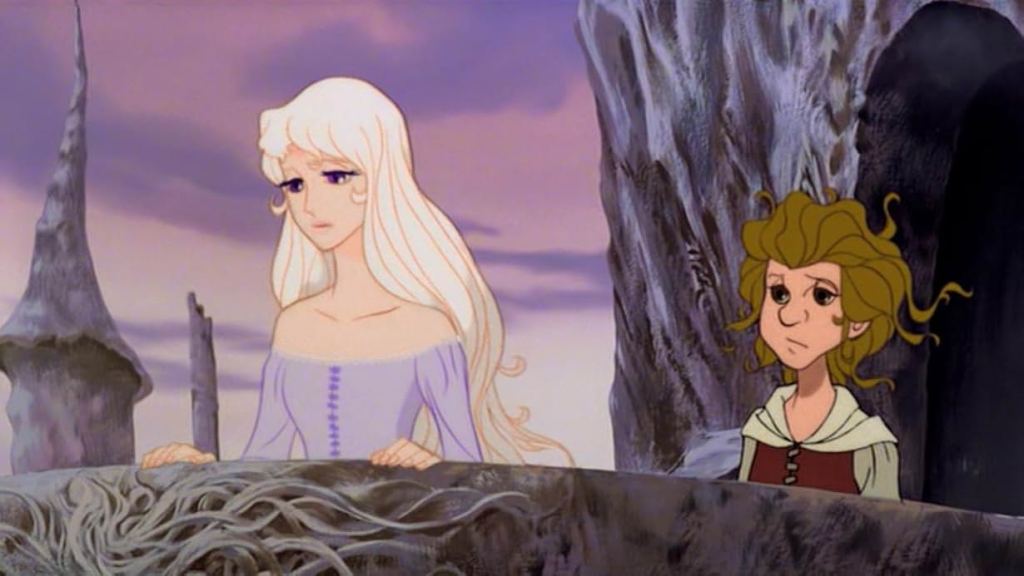
Lady Amalthea’s desperation to get back to her former self is heartbreaking. This ultimate change is wholly traumatic, making her fit into a shape she doesn’t recognize or want simply to keep her safe from danger. Conform or be killed. Speaking absolute bars.
It’s a loss of her identity and innocence. As a being of beauty, grace, and power, she’s gone from her form being shielded to blend in and now to a human, leaving her mental and emotional state altered as well. A weakness takes over her that she’s never felt, an unsettling alienation seeping into her newly acquired human form. Her struggle with a new mortal body isn’t just about the physical discomfort or retraining her limbs, but also the psychological deterioration as she tries to reconcile her new fragility and all the messiness that comes with being human. She’s a prisoner in this shell and in her soul. Devastating stuff. Who would want to be a human if we knew there was a better, less complicated existence somewhere, somehow?
WHERE THE BODY HORROR LIES – The violent erasure of identity and the trauma of not being able to live as your true form or what you feel deeply is your true form. The Unicorn is stripped of her essence and immortality for her safety, yes, but this isn’t a salvation; it’s a violation. Something she neither desired nor wants to keep for eternity. It’s a horrifying compromise she’s had to make, and her grief and alienation reflect the horror of losing control over your own agency, body, and identity, caught between two worlds where she now belongs to neither, all because of an aging old man who wanted to call the shots. Sound familiar??
TO POSSESS AND PINE – THE CONTROLLER
Now, this hoe has caused a ruckus for no other reason than wanting to covet what he cannot obtain naturally or hold of his own. King Haggard’s (Christopher Lee) piece of this body horror puzzle is simple: his body is decaying, betraying, and denying him. His arrogance is reflected in his frail frame, a manifestation of the evil and moral corruption that lies within him. He is old, gaunt, hunched, and sickly, as if his hatred has made him ugly (and I’m sure we can name a few folks off the top of our heads who equate with that message), and his conscience has made him defiant. His desire to trap the unicorns and hold them captive has so much to do with his physical decay, mental state, and emotional eruptions. The unicorn embodies beauty, stillness, and an unattainable ideal, something Haggard could never possess. If he can look out at the unicorns, that all but one belong to him, he possesses something no one in the world has: beauty at his fingertips, immortality swimming in the same waves that crash upon his castle. But it’s in this unreasonable pursuit that his frame is a deteriorating mass of grotesque levels of hatred and obsession. It’s not a new idea, this coveting beauty, talent, grace, and what have you, for the sake of gross possession; that’s what I think makes this story so compelling.

We’ve seen it in The Phantom of the Opera, where the Phantom, disfigured by a fire (we’ll put this in the tiresome camp of those with facial differences being the easy villain), kidnaps Christine so that her beauty, soul, mind, and talent only belong to him. In The Birthmark by Nathaniel Hawthorne, a scientist becomes so obsessed with removing a small birthmark from his wife’s face because he wants her to be perfect and will not accept otherwise. The Oval Portrait by Edgar Allan Poe finds an artist trying to render his wife in paint so perfectly that it steals her life force, and she fades away as the painting comes to life. Wanting, needing, desiring perfection and not being able to obtain it makes people go mad; look at our billion-dollar plastic surgery industry.
In a climactic confrontation, Amalthea regains her true form as The Unicorn after she’s outed by the drunk skeleton played horrifically hilarious by Rene Auberjonois, freeing the other unicorns from The Red Bull’s control. They rise from the sea, overwhelming the Bull and escaping Haggard’s grasp, restoring balance and reclaiming their freedom as Haggard falls violently into the sea.
WHERE THE BODY HORROR LIES – Haggard’s decaying body is the penance paid for the attempt to trap, covet, and attain beauty at any cost. His obsession with The Unicorn has overpowered his mind, turning him into something monstrous and stripping away any beauty he may have had. As we know, hate ages you…HARD.
As I said, choosing a horror film would have been a bit easier, but this film dives so much deeper than its dreamlike animation and talking trees with boobs. It isn’t just about the physical; it’s about the psychological and emotional toll of losing one’s agency, autonomy, identity, and sense of self. That inner struggle between what the world wants to see and living our truth. The trauma of being forced into a form strips away our essence; what makes us, us. I couldn’t help but want to make a case for this film today, and it may not be grotesque and bloody and gag-inducing, but it’s a wonderful exploration of self-worth in a world that demands conformity.

 NightTide Magazine
Leave a comment