
By Dr. Krista Collier-Jarvis
In the far north of Turtle Island (North America) resides a creature that Sean Qitsualik-Tinsley (Mohawk/Scottish) and Rachel Qitsualik-Tinsley (Inuk/Scottish/Cree) claim are both feared and revered by Inuit communities. There are variations in the spelling of its name depending on the region, such as Qalupalik, Qallupilluit, and Qallupiluk, but for the sake of this discussion, focusing on the work of the Qitsualik-Tinsleys, let’s use the latter.

Each tale of the Qallupiluk contains slight variations, but generally, the story goes that the Qallupiluk is a “blood-thirsty sea-dwelling shape-shifter” as Brandon Kerfoot calls it, or a kind of “chimera” according to the Qitsualik-Tinsleys. It lives in the sea just below the ice floes, and when children wander too closely to the water’s edge, it emerges from between the cracks and grabs the child, placing them in its amautik, the hooded parka that Inuit women often wear. The Qallupiluk then returns to the depths of the sea where they consume the lifeforce of the child. We cannot call the Qallupiluk a “monster” per se, as this term does not translate in the Inuktitut language; however, the root word of “monster,” monstrum, meaning “to warn,” bespeaks the function of the Qallupiluk as a cautionary figure, deterring children from wandering too close to the edge of the ice floes.

Many of these tales take the form of children’s literature, such as Putuguq & Kublu and the Qalupalik! by Roselynn Akulukjuk and Danny Christopher, with illustrations by Astrid Arijanto, and The Orphan & the Qallupilluit by Neil Christopher, with illustrations by Jim Nelson. However, authors such as the Qitsualik-Tinsleys, who grew up with these stories, are adapting them for adult readers with their short graphic story, “The Qallupiluk: Forgiven.”
Before delving too deeply into such a discussion, it’s important to briefly position myself in relation to this research. I’m Indigenous, but I have no official communal affiliation with the Inuit community. I have spent time in Iqaluit working with Inuit storytellers, so much of my knowledge stems from this experience. Each storyteller I met during my time in the community shared with me that the figure that frightens them most from their culture is the Qallupiluk, so this figure has much to tell us about how fear functions in the northern Arctic landscapes.
Ice Floes
In early 2024, twenty fishermen found themselves trapped on an ice floe on Lake Erie. While reporting the incident on WTOL 11 o’clock news, Meteorologist Matt Willoughby stated that “no ice is ever safe ice,” suggesting that ice represents a very particular idea of safety or lack thereof. Between the twentieth century and today, news reports of human strandings on ice floes went from nearly nil to a report every few weeks. Reasons, of course, are primarily related to the rapidly increasing effects of climate change; according to the World Wildlife Federation, the Arctic is now warming twice as fast as anywhere else on Earth. Laura Hancock from WWF predicts that by 2040, the Arctic may be entirely devoid of ice. It is no wonder, then, that the Arctic is a prime setting for horror stories.

Getty Images: https://abcnews.go.com/International/tourists-trapped-canadian-ice-floe-back-land/story?id=19495216
Tom J. Hillard, speaking of “Gothicized representations of nature, [argues that] ecocritics stand to learn a great deal by looking seriously at the long history of unsettling and horrific depictions of the natural world” while Simon C. Estok asserts that “the more we talk about representations of nature, the more it becomes clear that there is a need to talk about how contempt for the natural world is a definable and recognizable discourse (what we may call ‘ecophobia’).” As such, folkloric figures who are born in particular places, such as the Qallupiluk, embody shifting cultural anxieties and their accompanying horrific depictions about the environment.
Climate change, though, has always been—albeit, in the contemporary sense, functioning at a rate that the human species has not previously witnessed and cannot seem to adequately adapt, thus resulting in higher rates of ecophobia and climate change anxiety. It seems that we don’t fear climate change itself so much as we fear the land changing. What I mean by this is that we have constructed, through colonial binary thinking, the land as a fixed and stable space in opposition to water as a fluid and unstable space. Indigenous thinking seeks to dispel this binary and to unsettle the ways in which ecophobia is rooted in contempt for the natural world.
Turning to the Qallupiluk is one such way in which we might achieve such an undertaking. Alex Soop claims that “Indigenous stories and the supernatural go hand in hand,” noting that while each nation and community have their own unique stories, “Common among them is they have big fear factors, but also important lessons to be learned.” Stories of the Qallupiluk today are an Indigenized take on ecophobia with the figure’s shape-shifting qualities, its fluidities if you will, and its association with neither land nor sea but rather with that in-between, transient space—the ice floe.
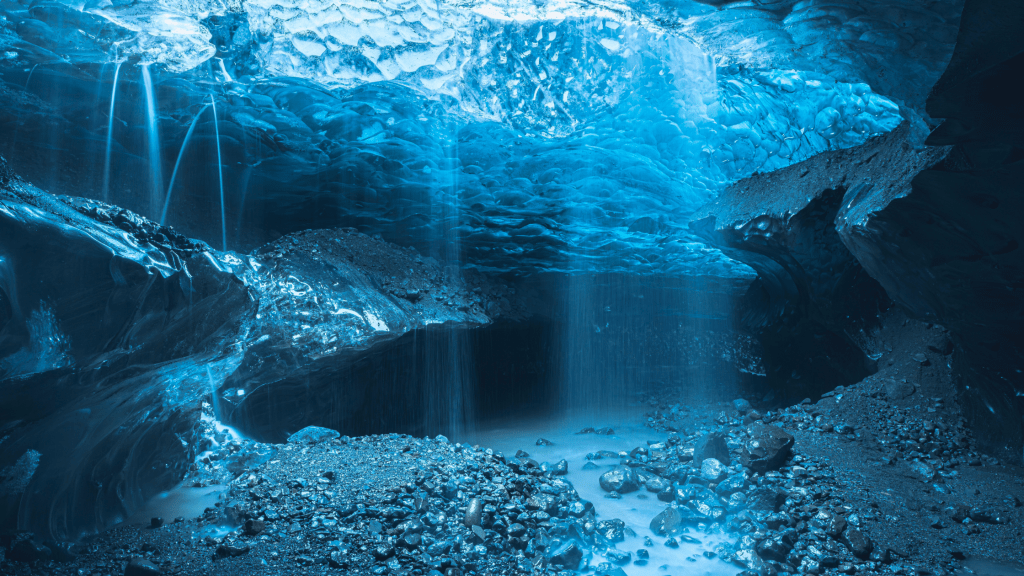
Ice floes are curious fragments. Materially, they masquerade as land that is always threatening a return to a possible watery origin. They are constantly becoming and unbecoming. And, once they do so, they may leave virtually no traces of their former ice-floe selves. Unlike their larger cousins, the icebergs, or the vast depths of the sea itself, ice floes seem to be simple and unfrightening. Perhaps this is partly why they have eluded the Gothic imaginary for the most part.
One well-known example of a Gothic ice floe is, of course, in Mary Shelley’s Frankenstein when Robert Walton discovers Victor Frankenstein floating upon an ice floe in the Arctic Sea. While sailing northward, Walton writes of “the floating sheets of ice that continually pass us, indicating the dangers of the region to which we are advancing,” but these do not, on their own, cause “dismay” amongst him and his crew.
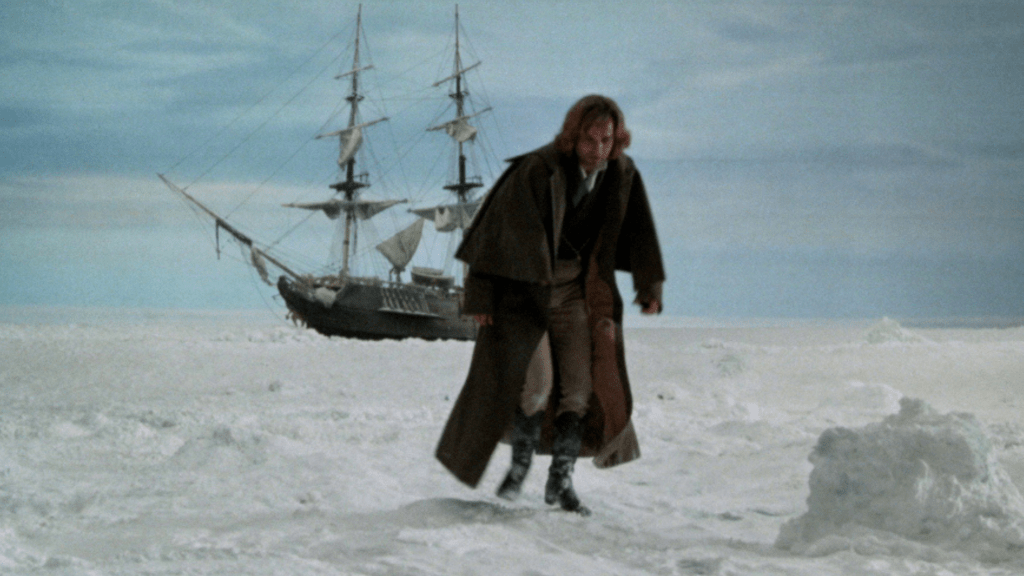
On the 31st of July, 17— something, their ship is temporarily stayed by “vast and irregular plains of ice” whereby they behold Frankenstein’s creature passing by and becoming “lost among the distant inequalities of the ice.” In this moment, ice masquerades as a kind of stable land as, even though it is overlaid by irregularities, it is vast and distant and seems to contain no edges. In fact, Walton and his crew feel rather trapped, awaiting a break in the ice so that their ship may continue.
By comparison, when they later meet Victor Frankenstein, he is plagued by “nearly frozen” limbs, and is “dreadfully emaciated by fatigue and suffering.” Upon his ice floe, he is on the “brink of destruction,” as Walton calls it. Frankenstein signifies a lack of belonging in the harsh Arctic environment in contrast to his creature’s seamless ability to travel upon it. In Walton’s descriptions though, the ice floes are dwarfed by the “dangerous mysteries of the ocean” and “icy climes” of a “land surpassing in wonders,” precisely due to its “undiscovered solitudes.” The Arctic for Walton is, he admits, “untamed yet obedient.”
Inuit storytellers know otherwise: the Qitsualik-Tinsleys admit that they wrote The Qallupiluk: Forgiven “to illustrate a sort of cosmological thinking particular to Inuit culture—a mystical tradition if you will, that is not unlike the Arctic itself: barren to the superficial eye, yet filled with riches for those willing to fix a deep and non-judgmental stare.” Slabs of ice for Indigenous peoples are not a barren Romanticized northern paradise, but rather give way to what C.C. Loomis claims to be “somehow vaster, more mysterious, more terrible than anywhere else. . . almost super-natural. . . sometimes stunningly beautiful, sometimes terrifying, often both.”
The Qallupiluk: Forgiven
Michelle Burnham notes how Gothic narratives by Indigenous peoples “represent Native American contributions to – but also Native American interventions in – American Gothic.” Since 2010, there has been a rise in collections of said contributional interventions, such as Anoka: A Collection of Indigenous Horror (2011; Shane Hawk); Ajjiit: Dark Dreams of the Ancient Arctic (2011; Tinsley and Qitsualik); Never Whistle at Night: An Indigenous Dark Anthology Collection (2023); Whistle at Night and They Will Come: Indigenous Horror Stories (2023; Alex Soop); Midnight Storm, Moonless Sky: Indigenous Horror Stories (2022; Soop); Taaqtumi: An Anthology of Arctic Horror Stories (2019), Zegaajimo: Indigenous Horror Fiction (2024; Nathan Niigan Noodin Adler and Kateri Akiwenzie-Damm), and Moosebumpz: Scary Stories from the Rez. The rise of these transIndigenous collections speaks volumes, pun intended, regarding the role that traditional Indigenous stories play in horror.

Burnham argues that Indigenous Gothic narratives are “overturning the kinds of possessive acts (possession by ghostly spirits, but also possession of material land) established by the Gothic tradition.” In reference to traditional Inuit stories, Tinsley and Qitsualik claim that they “are simply further evidence of the genius of pre-colonial Inuit; evidence of minds whose connection to essential forces, such as the Land itself [with a capital “L”], have spawned high spiritual thought.” Their story, The Qallupiluk: Forgiven, which can be found in both Ajjiit and Moonshot: The Indigenous Comics Collection Volume 1, is a graphic reimagining of the traditional tale, where the Qallupiluk embodies the unpredictability of ice and dismantles the colonial binary of water and land, ensuring that the environment is a prominent and fluid character in the story.
The Qallupiluk: Forgiven follows the Qallupiluk as it leaves the “water’s sheltering darkness,” pulling “its seething flesh in tighter” to resemble a human. Its transformation is posited as both natural and supernatural as “the Strength of the Land reshaped the Qallupiluk according to the latter’s will,” yet its transformation is imperfect: “The chimera paused, reaching one hand in the back of it, to check for a hood: this, too, was ill-wrought, being vast and sacklike and more than a little lopsided.”
In this new, yet old, imperfect form that seems, like the ice floes, to constantly be at risk of unbecoming, it steals an Angakkuq or shaman from a nearby Inuit village, mistaking it for a child. The Angakkuq is the descendent of a former victim of the Qallupiluk and punishes the creature by forgiving it for its previous transgression. As such, the Qallupiluk is sent back to the watery depths to face the wrath of Nuliajuq, the Deep Mother. This, however, is a worse punishment for the Qallupiluk, who admits, “I am destroyed […] The Mother cannot forgive me. I have slain the whales for pleasure, and the seals for sport. And they are her children.” Even as the Qallupiluk seems to be this supernatural figure of nightmares and bodily transgressions, it is bound by balanced entanglements with other creatures. Its punishment at the hands of Nuliajuq is further becoming and unbecoming whereby its transformations are either permitted or restricted by the ways in which it treats other creatures.
Figures like the Qallupiluk disrupt Western and colonial constructs of species hierarchies and status quo. As such, the Qallupiluk is not an Other merely to be destroyed; it is, as Amy Gore might say, a “site of subversion,” and its stories can “contribute to healing” for Indigenous peoples. Part of its healing potential stems from its uncontainability within borders and boundaries. For example, as the Qallupiluk makes its way toward the village, its “flesh had grown dark and piscine, stretched across spinous fins like those of the kanajuq, or sculpin fish.” Even as it traverses the land, its form threatens to return to its watery beginnings. And, when the Qallupiluk discovers that the child it carries is an Anggaquk, the Anggaquk begins to sing in the Inuit tongue, resulting in an ice crack solidifying and trapping the Qallupiluk’s foot. The language contains the power to transform the land itself. Like the ice floes, which drift, become, and unbecome, resisting, as they do so, any attempts at structuration and colonisation, the Qallupiluk demonstrates that there are some things in this world that can never be fully colonised. The fact that the Qitsualik-Tinsley’s call the Qallupiluq a “chimera” is a further example of this.
Chimera
Chimera comes in two forms: the multispecies monster of Greek mythology and the human condition whereby two kinds of genetic material exist within one body. In both cases, the chimera signals a multiplicity rather than simply a transformation. For the Qallupiluk, this could suggest that the figure never completely sheds one form when it turns into another. For example, in The Qallupiluk: Forgiven, “The Qallupiluk detested the very feel of form since shape meant discipline” (45). In the case of the Greek chimera, its form is simultaneously and yet never fully lion, goat, or snake. It is always in a state of becoming and unbecoming.
I would also like to turn attention to a less-used definition of the term, “chimera” though, which is an unrealized dream. Just as the ice floes resist colonisation, the body of the Qallupiluk as chimera cannot be inscribed with colonial dreaming, and even though the story opens with its dreaming of taking form and capturing a child for itself, these dreams remain unrealized.
On the contributions of Indigenous voices to horror, Stephen Graham Jones explains that “telling ourselves stories about the world being bigger than we thought […] that’s really kind of saying to the so-called settlers that, hey, yeah, so you took all that land you could see. But what about all this other territory you don’t even know about.” Unlike the arctic seafaring adventures that characterized nineteenth-century European writings, such as Frankenstein, tales of the Qallupiluk do not embody the “cult of manliness” that Douglas Kerr argues “sustained” Victorian “patriarchy” and “masculine heroism and adventure in the domains of war, empire, and exploration.” This drives Walton in Frankenstein as he hopes to discover a “passage near the pole” or “ascertaining the secret of the magnet.” Contact with the Qallupiluk, though, is not predicated on exploring too far or too deep or plundering the Earth’s resources, but about understanding that the ice floes can never be conquered or tamed or even completely understood. Instead, these stories ensure that the land itself resists colonial inscriptions. Kerfoot, for instance, sees Tinsley and Qitsualik’s use of “Land” with a capital “L” as “an expression of sovereign power.”
So, to conclude, ice floes, after all, were never designed as spaces upon which humans were meant to stay for any length of time, as ice floes constantly risk unexpected transformation underfoot. In response to a 2013 human stranding in Nunavut, for instance, Major Steve Neta, who responded to the stranding, claimed that it was “a fluid situation,” referring to the fact that things can change unexpectedly during a rescue operation on the ice. However, for Inuit communities, tales of the Qallupiluk are not about fearing the instability of the ice, but rather about revering how the Land [with a capital “L”] always ebbs and floes.

 NightTide Magazine
Leave a comment