By Siân Pearce
“The most uncomfortable feeling is the feeling not even of the thorns, which of course are painful, of the roots at the bottom of your stomach”1
Introduction
It is not known when humans started telling scary stories, but a brief look at most cultures’ folklore suggests it was probably very shortly after humans started telling stories at all. The purpose of scary stories is itself a fascinating discussion, but what is clear is that while humanity’s appetite for a good fright might wax and wane it never leaves us: where there are stories – there are scares.
In this article I would like to talk about the relationship between a particular type of communal storytelling: ‘Table Top Role Playing’ (‘TTRPGs’) and ‘horror’. Starting from the birth of TTRPGs (art form?) in the 1970s, I will briefly touch on the horrors that were imposed upon players during the Satanic Panic of the 1970s and 1980s. However, I will concentrate on the relationship the hobby has with the horror story genre, as a great deal has already been written during that unfortunate period. I will end by considering the challenges providing safe scares poses for modern Games Masters (GMs).2

In the beginning – the Deep Magic
The tabletop role-playing game developed out of wargaming, which has been around in various forms since the 17th century,3 and which itself boasts a connection to classic horror through devotee Peter Cushing4. Originally this hobby concentrated on the reenactment in miniature of realistic battles and armies, but in the 1960s and 70s, more fantastic elements started to be included – matching the revival of interest in the works of writers such as JRR Tolkien and CS Lewis,5 and in 1971 Dave Arneson created BLACKMOOR which focussed on individual interactions6 in a fantasy setting, though still heavily focussed on combat. In 1972 Arneson met Gary Gygax, a committed wargamer at Gygax’s event GenCon and their collaboration would lead to the creation of DUNGEONS AND DRAGONS in 1973. The fantasy setting of the game from the start included ‘scary’ themes and monsters – orcs, dragons, evil necromancers, etc – in 1975 Gygax himself unveiled TOMB OF HORRORS, a module designed to be more deadly to player characters than any written at that time7. It might though be argued TOMB OF HORRORS continues to lean more towards a ‘fantasy’ rather than ‘horror’ setting8. Other settings were also quickly developed, encompassing stories from the Old West to Watership Down rabbit warrens.

Time to become Bothered
The Satanic Panic built on anti-cult panics that had developed during the 1970s but found its true footing with the publication in 1980 of MICHELLE REMEMBERS, the now infamous and entirely discredited satanic child abuse “memoir”.9 Over the next 10 or so years it would implicate music, books, films, and toothpaste as tools of Satanic influence. In 1982 Irving “Bink” Pulling took his own life and his mother, Pat Pulling laid the blame firmly on his interest in DUNGEONS AND DRAGONS10. Pat Pulling found others who felt their children had been similarly affected and formed BADD: ‘Bothered about Dungeons and Dragons’ in 198311. The game had also been dishonestly linked to the disappearance of James Dallas Egbert in 1979 – the private detective working on the case, William Dear, admitted later that he felt the myth of obsession with the game was better for Egbert’s family than having the truth of his struggles with his sexuality to become public.
The powers ascribed to Dungeon Masters during this time are astounding – going from financial extortion to the summoning of actual demonic entities12. Eventually, however, the targets of this panic would move away from TTRPGs to other subjects such as Pokemon13,Harry Potter14 and Monster energy drinks15. Undeterred, however, TTRPGs were searching for their own form of darkness.

Eldritch Horrors and Worlds of Darkness
In 1982, while the focus was firmly on DUNGEONS AND DRAGONS, Chaosium released CALL OF CTHULU, using the Basic Roleplaying System originally developed for the fantasy game RuneQuest. This allowed players to experience the madness of HP Lovecraft’s world firsthand16. By 1998 it was into its fifth edition, demonstrating the appetite among players for a darker style of play.17 The 1990s were arguably a halcyon period for teen horror – LOST BOYS (1987) had made vampires cool again, and no playground was without its share of Point Horror books being passed around. In 1991 White Wolf Publishing released VAMPIRE: THE MASQUERADE (VTM), the first publication using their World of Darkness system18. VTM demonstrates some of the difficulties in experiencing horror in this way. Themes of manipulation, control, and violence have been openly part of the game since its inception and vampirism has always had links with sexual violence19. In 2007 game designer Emily Care Boss wrote about the concept of ‘Bleed’ – where the themes in roleplay start to merge with players’ lives outside of the game, with a recognition that safety tools might be needed to strengthen the boundaries between player and character, though VTM has continued to be criticised for a lack of safety tools as well as an incorporation of real-life oppression as in-game lore20.
‘Horror wants to do things to your body’21– Questions of consent for DMs and Players
Horror, like its cousins comedy and erotica, seeks to elicit a physical response in its consumer. TTRPGs are not unique in eliciting emotional responses – one can cry in a game as one cries at a sad book or film, and that should not be considered in itself a matter for concern. However, the improvised and collaborative nature of the activity means that players may find themselves in situations they are unprepared for or do not feel that they can easily escape from. The quote at the start of this essay is from a popular ‘actual play’ YouTube series where the player took on a Sleeping Beauty-style character and was asked to decide how she would approach the task of freeing herself from the briars that had grown around and into her body, as her fellow players react with a mixture of revulsion and glee.

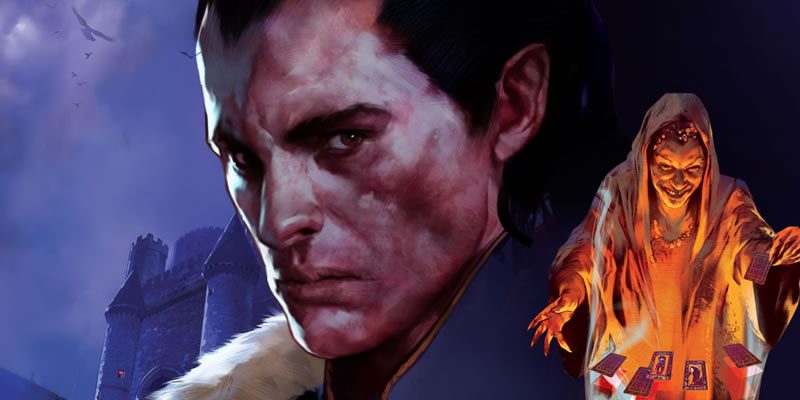
In addition to the question above, in the past few years, questions have been raised as to whether some subjects are simply not appropriate to be included in this type of play. Fantasy has long had a problematic relationship with several issues – such as racism22 or sexual violence23. One of Dungeons and Dragons’ most popular modules CURSE OF STRAHD, released in 2016, has attracted controversy for both its portrayal of the Vistani (a Romani-type people) and the (sexually) predatory nature of the main villain the vampire Strahd von Zarovich. Whilst publishers have attempted to deal with some of these issues in newer editions, there has been pushback from sectors of the community.
This pushback has also extended to innovations designed to create a more comfortable gaming experience – such as the use of consent sheets (indicating what players do and do not wish to experience in a game), content warnings, and safety tools. The 2024 Dungeons and Dragons players handbook suggests the use of the ‘X’ gesture as an ‘emergency stop’ if a player needs a line of plot or roleplay to end. It is often suggested that these tools are unnecessary as people generally know how to behave in public, sadly, some themes – such as the victimisation of women to aid a (male) character’s development remain story tropes. As a DM I have been confronted without warning with sexual violence being injected into stories by players, including one occasion where a player wrote that he was conceived via a rape, but his character did not know about it – implying that I might want to incorporate this into the game. It was at that point that I introduced an explicit prohibition of any sexual violence in my games, including backstories. Does all of this mean that we cannot run horror games at all? I do not believe so. However, just as delivering a good scare on-screen involves more than throwing a bucket of fake blood at someone, good roleplay horror takes skill and care. Sometimes it will be a maggot-infested corpse, other times a haunted ragdoll with too many teeth (one of my finest creations, if I do say so myself). We have to think about what makes a scare ‘good’ – there are a variety of theories about what humans ‘get’ out of consuming horror24, but part of the attraction is clearly that experiences can be had in safety. Safety is subjective, and just as there are those who search the darker corners of the internet for the most intense scares, there will always be tables catering to those who want the most no-holds-barred gaming experience. However, we as a community need to decide whether those tables should be embraced as part of the great tapestry of TTRPGing, or viewed as unacceptable in this new era of role-play.

- The Times of Shadow (2022) ↩︎
- The person who ‘runs’ or directs the story that the players are experiencing – for Dungeons and Dragons they were originally, and to a certain extent still are known as ‘Dungeon Master’. Other systems have also used terms such as ‘Storyteller’. Despite there being many women who refer to themselves as D/GMs the term ‘Dungeon/Game Mistress’ has never gained any real traction. The term here is used with acknowledgement of these issues.
↩︎ - Joseph Laycock, Dangerous Games: What the Moral Panic over Role-Playing Games Says about Play, Religion, and Imagined Worlds (University of California Press 2015).
↩︎ - Peter Cushing (1956) ↩︎
- Laycock (n 4). ↩︎
- Charlie Hall, ‘Vampire: The Masquerade Courts Controversy Once Again, This Time over “Bleed”’ (Polygon, 16 November 2023).
↩︎ - Coleman Gailloreto, ‘D&D: History Of The Tomb Of Horrors (& Why It’s The Ultimate Challenge)’ (ScreenRant, 31 January 2021).
↩︎ - No real attempt will be made here to specifically demarcate the boundaries between fantasy and horror, there is of course overlap
↩︎ - Kier-La Janisse, ‘Introduction: Could It Be…Satan?’ in Kier-La Janisse and Paul Corupe (eds), Satanic Panic: Pop-cultural Paranoia in the 1980s (2nd edn, FAB Press 2018).
↩︎ - Alex Gagné, ‘In Defense of Imagination: Canadian Youth Culture and the Dungeons & Dragons Panic in Canada, 1980–1995’ [2024] Games and Culture 15554120241276931.
↩︎ - Gavin Baddeley, ‘Dicing with the Devil: The Crusade against Gaming’ in Kier-La Janisse and Paul Corupe (eds), Satanic Panic: Pop-cultural Paranoia in the 1980s (2nd edn, FAB Press 2018).
↩︎ - Laycock (n 4). ↩︎
- Kieran Fisher, ‘Remembering When “Pokémon” Caused Satanic Panic’ (Film School Rejects, 13 May 2019).
↩︎ - Ernie Rea, ‘BBC Radio 4 – Beyond Belief – Uncovered: The Religious Symbolism of Harry Potter’ (BBC)
↩︎ - Monster Energy Drinks Promote Satan, Says Woman in Viral Video’ ABC7 Los Angeles
↩︎ - James Carl, ‘Welcome to His Nightmare: Lovecraftian Horror Inspires Great Gaming’ [1998] The Duellist.
↩︎ - ibid. ↩︎
- James D Fielder, ‘The Monsters Among Us: Realism and Constructivism in Vampire: The Masquerade’ in Damien K Picariello (ed), The Politics of Horror (Springer International Publishing 2020)
↩︎ - Renae Franiuk and Samantha Scherr, ‘“The Lion Fell in Love with the Lamb”: Gender, Violence, and Vampires’ (2013) 13 Feminist Media Studies 14.
↩︎ - Nicholas King, ‘The Controversies of White Wolf’ (Gamers, 2022) ↩︎
- ‘The Exorcist (All of Them) Review Halloween Special!’
↩︎ - Cecilia D’Anastasio, ‘D&D Must Grapple With the Racism in Fantasy’ Wired
↩︎ - There are ongoing and complex debates regarding the use of ‘race’ in particularly fantasy roleplay and how in-game racism is included, particularly in a hobby which is dominated by white players, this is outside of the scope of this article
↩︎ - Shelby Bradford and Priyom Bose, ‘The Neuroscience of Thrills: Why Do We Like Horror Movies?’ [2024] The Scientist Magazine. ↩︎
References
Baddeley G, ‘Dicing with the Devil: The Crusade against Gaming’ in Kier-La Janisse and Paul Corupe (eds), Satanic Panic: Pop-cultural Paranoia in the 1980s (2nd edn, FAB Press 2018)
Bradford S and Bose P, ‘The Neuroscience of Thrills: Why Do We Like Horror Movies?’ [2024] The Scientist Magazine <https://www.the-scientist.com/why-do-some-people-enjoy-horror-movies-72181> accessed 3 January 2025
Carl J, ‘Welcome to His Nightmare: Lovecraftian Horror Inspires Great Gaming’ [1998] The Duellist <http://archive.org/details/duelist-22> accessed 30 December 2024
D’Anastasio C, ‘D&D Must Grapple With the Racism in Fantasy’ Wired <https://www.wired.com/story/dandd-must-grapple-with-the-racism-in-fantasy/> accessed 3 January 2025
Dempsey M, Dempsey P and Pulling PA, Dungeons and Dragons – Witchcraft Suicide Violence (1985) <http://archive.org/details/dungeons_and_dragons-witchcraft_suicide_violence> accessed 30 December 2024
Fielder JD, ‘The Monsters Among Us: Realism and Constructivism in Vampire: The Masquerade’ in Damien K Picariello (ed), The Politics of Horror (Springer International Publishing 2020) <https://link.springer.com/10.1007/978-3-030-42015-4_6> accessed 30 December 2024
Fisher K, ‘Remembering When “Pokémon” Caused Satanic Panic’ (Film School Rejects, 13 May 2019) <https://filmschoolrejects.com/pokemon-satanic-panic/> accessed 30 December 2024
Franiuk R and Scherr S, ‘“The Lion Fell in Love with the Lamb”: Gender, Violence, and Vampires’ (2013) 13 Feminist Media Studies 14
Gagné A, ‘In Defense of Imagination: Canadian Youth Culture and the Dungeons & Dragons Panic in Canada, 1980–1995’ [2024] Games and Culture 15554120241276931
Gailloreto C, ‘D&D: History Of The Tomb Of Horrors (& Why It’s The Ultimate Challenge)’ (ScreenRant, 31 January 2021) <https://screenrant.com/dungeons-dragons-tomb-horrors-history-hardest-deadliest-module/> accessed 3 January 2025
Hall C, ‘Vampire: The Masquerade Courts Controversy Once Again, This Time over “Bleed”’ (Polygon, 16 November 2023) <https://www.polygon.com/tabletop-games/23962341/vampire-the-masquerade-bleed-controversy-explained> accessed 30 December 2024
Janisse K-L, ‘Introduction: Could It Be…Satan?’ in Kier-La Janisse and Paul Corupe (eds), Satanic Panic: Pop-cultural Paranoia in the 1980s (2nd edn, FAB Press 2018)
King N, ‘The Controversies of White Wolf’ (Gamers, 2022) <https://vocal.media/gamers/the-controversies-of-white-wolf> accessed 30 December 2024
Laycock J, Dangerous Games: What the Moral Panic over Role-Playing Games Says about Play, Religion, and Imagined Worlds (University of California Press 2015)
‘Monster Energy Drinks Promote Satan, Says Woman in Viral Video’ ABC7 Los Angeles <https://abc7.com/monster-energy-satan-drink-devil/392023/> accessed 30 December 2024
Peter Cushing (1956) <https://www.youtube.com/watch?v=BGag8Qllgnw> accessed 30 December 2024
Rea E, ‘BBC Radio 4 – Beyond Belief – Uncovered: The Religious Symbolism of Harry Potter’ (BBC) <https://www.bbc.co.uk/programmes/articles/55dDCXmFKwVYyTZf1zRPpK/uncovered-the-religious-symbolism-of-harry-potter> accessed 30 December 2024
The Times of Shadow (2022), Dimension 20, Dungeon Master: Brennan Lee Mulligan <https://www.youtube.com/watch?v=0_RiOyVMOCE> accessed 3 January 2025
‘The Exorcist (All of Them) Review Halloween Special!’, Horror Vanguard, <https://soundcloud.com/user-317910500> accessed 30 December 2024
 NightTide Magazine
Leave a comment