
By Cullen Wade
“You must have been so afraid, Cassie…then you saw a cop.”
-Lt. McCrae (Tom Atkins), Maniac Cop (1988)
**CW: Mentions of racialized and gendered violence, sexual assault, domestic violence, and harassment.
Introduction and Definitions
The slasher genre is ideologically anarchist.
This might seem counterintuitive, given the conventional view of slashers as morality plays punishing naughty teenagers, but that interpretation is superficial. Most slashers interrogate, rather than reinforce, main-street values and hierarchies, and their violence stems from the powerful abusing their privileges. We can clearly see the slasher’s anarchist slant in its portrayal of a group that represents both the state and authority more broadly: the police.
The slasher film and the institution of policing have something major in common: both are rooted in violence. To anarchist author Kristian Williams, “The police represent the most direct means by which the state imposes its will on the citizenry. […] The threat of violence is implicit in every police encounter.”1
For the purposes of this essay, a slasher movie is a horror film in which a human antagonist stalks a group of people over a short period and murders them in sequential set-pieces, with minimal use of firearms, in consequence of a past misfortune. This should cover 99% of the films I’ll mention here. Edge cases will come up, but you’ll just have to trust me. My intent is not to get into the taxonomical weeds.
One person who doesn’t fear those weeds is Jim Vorel of Paste Magazine, who takes pains to precisely define the slasher. While I’d quibble with some of his inclusions (like “slasher killers don’t have realistically human motives”), one of his criteria is crucial for us: “[Slashers] rarely follow police or detective investigations.”
This distinction helps separate the slasher from its cousin the giallo, but gialli are far from the only horror subgenre to routinely center hero cops. Writing for Horror Homeroom, Sara McCartney argues that a “sense of skepticism […] characterizes the bulk of horror’s attitude to the police” since the 1970s. But in the last half-century, cops have saved the day against zombies, werewolves, cryptids, aliens, demons, and hundreds of serial killers. To say that horror, broadly speaking, has a problem with cops is not defensible.
The slasher’s relationship to policing, though, is different, and McCartney affirms that the subgenre “cemented the horror cliché of the useless cop”. Hero cops are not unheard of in slashers, but you’d be hard-pressed to find one that validates the institution of policing. Instead, in McCartney’s words, “the slasher […] is a rare piece of counter-programming to the lessons so many of us were taught.”
Far from just depicting officers as individuals doing a job (poorly), the slasher zooms out to condemn law enforcement as a social structure that does more harm than good. Even well-intentioned cops can’t escape the gravity of the broken system they’re beholden to. To demonstrate this, we’ll unpack five slasher archetypes, each of which represents a different failing of law enforcement: the unhelpful cop, the obsessed cop, the cop dad, the cop love interest, and the killer cop. Along the way, we’ll see how slasher cops pose a particular danger to marginalized people.
Counter-examples exist, some of which I’ll mention. I do not claim to cover every slasher movie. But I hope to convince you that these trends are too common to be coincidence or imitation—that instead they are key to the subgenre’s ideological project.
911 Is a Joke
The most common cop in slasher cinema is what John Kenneth Muir calls “the archetype of useless authority.”2 They disbelieve protagonists, underestimate threats, jail innocents, and arrive too late to help. If any of that sounds familiar, perhaps you live in a place where many crime reports go uninvestigated, and most investigated crimes go unsolved; 3where 1 in 25 death row inmates is wrongly convicted; where most women have no confidence in the police to protect them from gendered violence. A place like, for instance, the United States or the United Kingdom.
The police do not stop crime. That’s not even their purpose. Per Williams, “the police exist to control troublesome populations […] This task has little to do with crime, as most people think of it, and much to do with […] the preservation of existing inequalities.” 4With this in mind, I’d like us to think beyond “worthless cop.” Instead, I propose the term “unhelpful.” When the police don’t serve our protagonists’ interests, let’s not lose sight of whose interests they are serving.
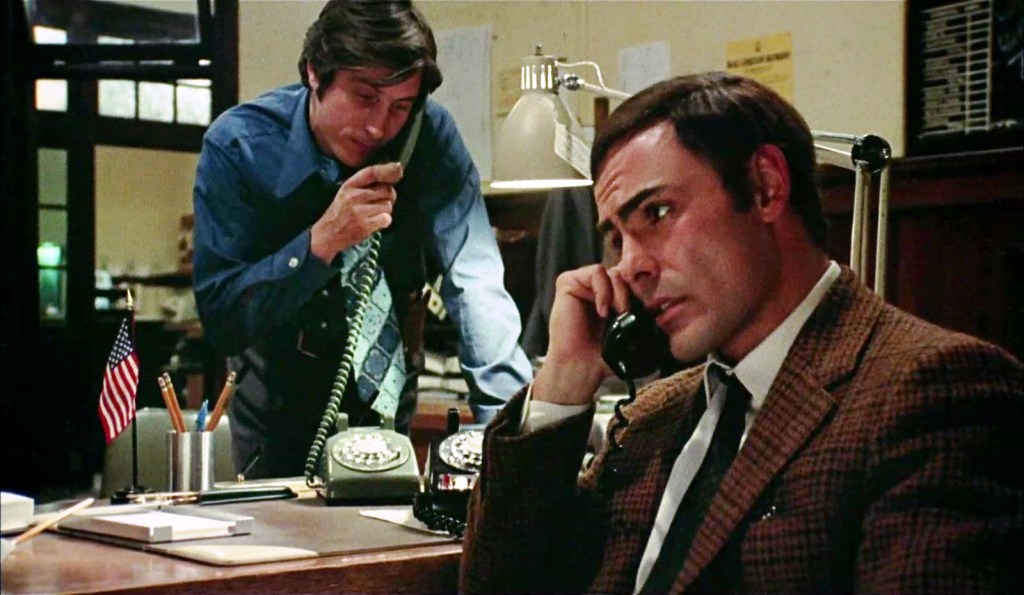
It’s practically impossible to list every unhelpful slasher cop, so a few notable examples will suffice. Black Christmas (1974), often considered the first pure slasher, is deeply skeptical of police. When two young women and an older man report Clare’s disappearance, Sergeant Nash shrugs, saying she probably ran off with a boy. (The cops of 1987’s Slumber Party Massacre II give the same condescending response.) It’s only after her boyfriend bursts into the station demanding an explanation that the case is taken seriously. Nash is particularly bumbling, but the other cops don’t fare much better in the film’s lens. Upon being assured they are safe with a policeman outside, Phyllis responds with a sarcastic “Sure.” When the cops finally realize the sorority house is in danger, they arrive too late to help. The final girl has already handled herself.
Real-world civilians, especially women, often struggle to be taken seriously. In the UK, most domestic abuse victims must call the cops at least twice before action is taken. Despite the fact that only a fraction of sexual assaults are reported, police deem 20% of those reports “unfounded.” In a 2020 study interviewing Canadian sexual assault victims, “The overwhelming message [was] the sense that the police judged them and, therefore, did not believe them.”
In Valentine (2001), Detective Vaughn blusters his way into the story with extravagant confidence about catching the culprit, only to end up with his head in a koi pond—but not before sexually harassing a character named Paige. Sadly, Paige’s story is not unique, either in the slasher canon or in real life. As many as 2 in 5 young women have been sexually harassed at the hands of law enforcement.5 Vaughn’s unprofessional boundaries, combined with his snide, paternalistic attitude toward the women he is supposed to be helping, resonates with Valentine’s themes of male possessiveness and entitlement.
Low-Speed Pursuits
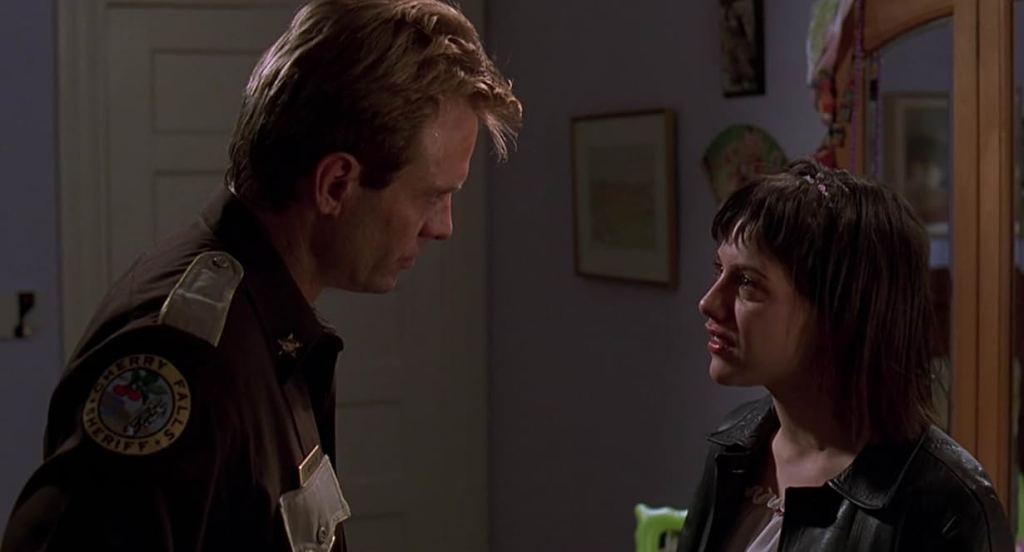
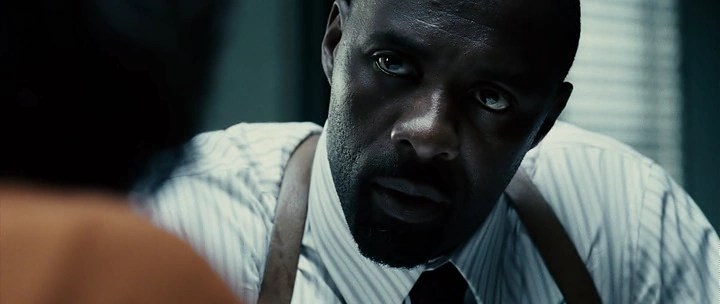
The meta-slasher Behind the Mask: The Rise of Leslie Vernon (2006) calls our next archetype the “Ahab.” “As in Captain Ahab, the guy whose singular intention was to chase Moby Dick,” a killer says. “It’s usually […] somebody who’s picked up on what we’re doing and wants to stop us.” Dead Tone (2007) is a film painfully aware of racism, both overt and microaggressive. In it, Detective John Criton sets out to catch a decade-dormant murderer he believes has resurfaced. Along the way, he makes indefensibly classist statements like, “People who have jobs don’t live in trailers,” so it’s not surprising when he bursts in at the climax and shoots the film’s Black protagonist dead as he raises an axe to dispatch the white murderer. This too-close-to-home outcome also occurs, without the racial element, in Cold Prey III (2010), where the Ahab Sheriff Stølen shoots the final girl as she defends herself, proving that not even Norway is safe from trigger-happy cops and their snap judgments.
Those examples notwithstanding, the Ahab is actually more likely to save the day than other slasher cop varieties. Successful Ahabs include John Clifford from When a Stranger Calls (1979), Detective Winn from Prom Night (2008), and Arlo Baines from Boo (2005). But Clifford has retired into private practice, and Baines is working outside his official capacity. These men do good despite their connection to law enforcement, not because of it.
It’s also noteworthy that two of the above-mentioned heroic Ahabs, Winn and Baines, are Black. In fact, Black cops seem to have higher success rates in slasher movies than their counterparts of other races. Campus cop Reese in Urban Legend (1998) and Detective Mike Norris in Child’s Play (2019) help defeat the antagonists and survive their respective movies. This aligns with a slasher tendency to portray minoritized cops as a virtuous corrective to their predominantly white and male institution. Cherry Falls (2000) ends with Deputy Mina dispatching the killer and taking the reins of a kinder, gentler police force after the death of the sleazy Sheriff Marken. There is a less pleasant side to this tokenizing, though, as Black cops like Officer Reitz of Dr. Giggles (1992) often sacrifice themselves to save white protagonists. Still, despite being antithetical to the slasher’s overall abolitionism, this tendency to portray minority cops as generally better humans can be read, at least superficially, as progressive.
Of all the slasher movie cops on this list, the Ahab is furthest from reality. More than half of U.S. murders remain unsolved. The numbers are even smaller for cases that go cold. As of 2011, fewer than 10% of police agencies had cold case departments, and no more than 5% of those cases were ever cleared. The Ahab cop becomes even less realistic when you consider that in several states, at least a quarter of police officers leave the profession after fewer than two years. The NYPD turnover rate jumped by 42% between 2021 and 2022. Compared to the unhelpful cop trope, the undeterred detective doggedly pursuing a years-old case is pure fantasy.
Parental Authority
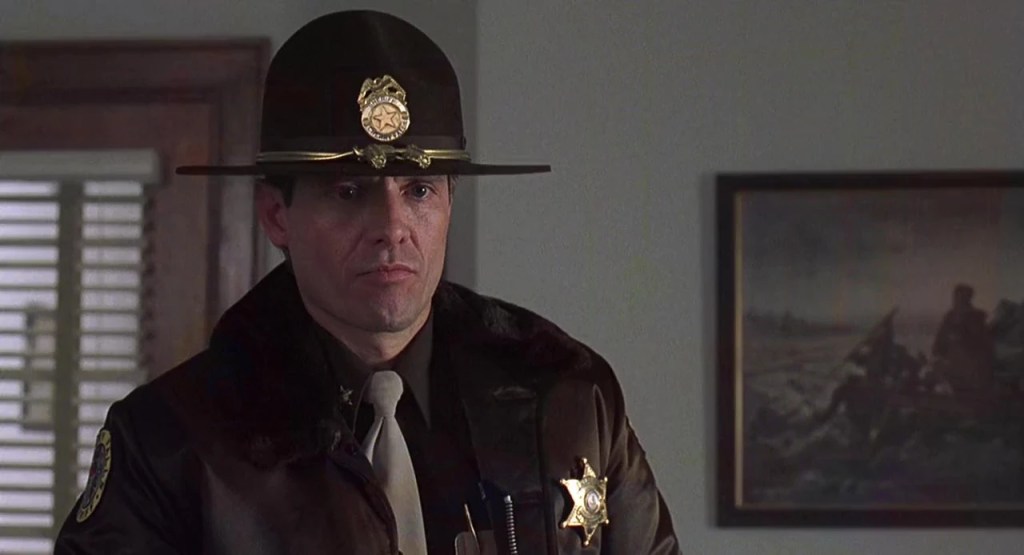
Perhaps due to the influence of Halloween (1978), teen slashers often give characters police officers for parents. This character tends to be the final girl ever since A Nightmare on Elm Street (1984) where, as McCartney points out, Nancy Thompson’s dad worsens the situation by refusing to listen to her, and by jailing the innocent Rod. The stubborn Sheriff Garris, father of Megan in Friday the 13th Part VI (1986), follows the exact same pattern.
Now that we’re in the family sphere, it’s time to discuss domestic violence. While the oft-quoted figure that 40% of cops are guilty of spousal abuse has been reasonably called into question, evidence points to violence being rampant in cop families. One study found that about 160 police officers per year were arrested for domestic violence between 2005 and 2011. Analyst Alex Roslin estimates police officers are 15 times more likely than the average person to be domestic abusers.
Another cop dad is Sheriff Brent Marken of Cherry Falls, who also fathered the film’s murderer as a participant in a young woman’s gang-rape. Though he professes remorse over the assault (once he is found out) that doesn’t stop him from having—ahem—poor boundaries with his teenage daughter. Another member of the Cherry Falls squad, the above-mentioned Deputy Mina, is sexually harassed by a colleague who suggests they “infiltrate” a sex party together.
Sometimes the older cop relative is a sibling rather than a parent. Millie, the final girl in Freaky (2020), has a cop sister named Charlene, who follows the stubborn playbook of Sheriffs Thompson and Garris to the letter. Whenever Freaky’s police show up, they manage to worsen the situation. Hellbent (2004), one of the first notable queer-themed slashers, follows Eddie, who is stalked by a killer targeting gay men. Eddie’s deceased father and older sister are both police officers, and he was on the same path until his training was derailed by an injury that left him with a prosthetic eye. Despite his disability—symbolic of another oppressed status that alienates him from the force—he still idolizes cops, working at the station and wearing his dad’s uniform as a Halloween costume. The cop cosplay has limits, though: after being attacked by the slasher, Eddie tells his sister it “would ruin” him if the police treated the incident as a gay-bashing. Eddie, despite his love of law enforcement, knows and dreads the ridicule that would ensue if he were thought of as the victim of a hate crime. Even the most likable of slasher cop relatives can’t help but be tainted by the institution they represent.
I Love a Man In Uniform
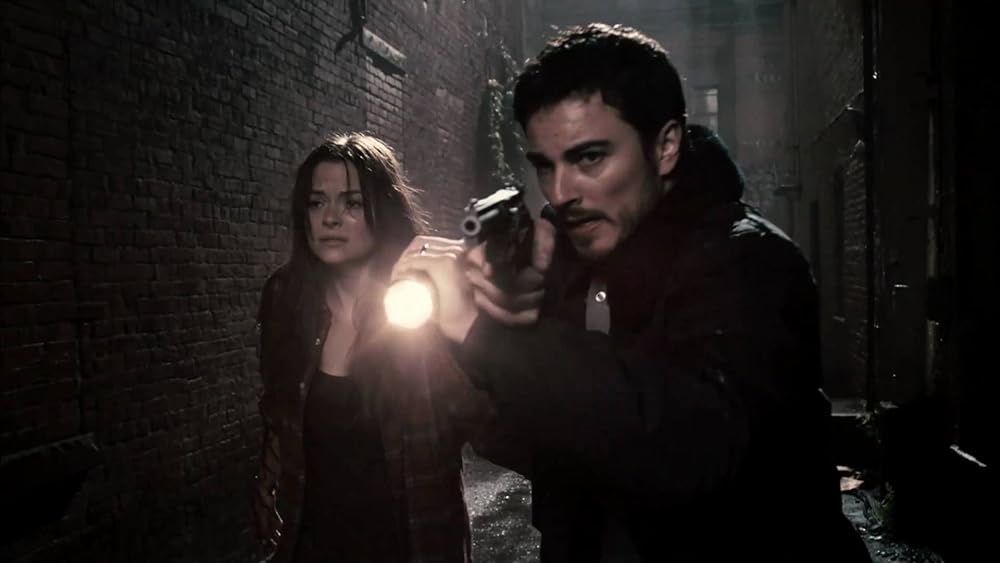
Often, the killer and a cop find themselves on two sides of a love triangle. He Knows You’re Alone (1980), The Prowler (1981), Uncle Sam (1996), and Halloween Ends (2022) all feature women who dump killers for cops, or vice versa. The most interesting deployment of this trope is My Bloody Valentine (2009), where Sarah must choose between her husband, the volatile Sheriff Axel, and her old flame Tom, whose sudden disappearance drove her into Axel’s arms before he reappeared as a deranged killer. Axel cheats on Sarah and is violently jealous of Tom when he tries to reinsert himself into her life. His cowardice is demonstrated in a prologue scene where he chooses to flee rather than rescue Tom from an attacker.
These scenarios are consistent with the real-life correlation between cops and domestic violence. Many people who leave abusive relationships find themselves in new abusive relationships later on. In the words of trauma-informed psychotherapist Joanna Potkanska, “We tend to remain in patterns that are familiar to us.” With frequent romantic dilemmas involving murderers and police officers, the slasher film subtly blurs the lines between two types of dangerous men.
Interlude: A Word About Dewey
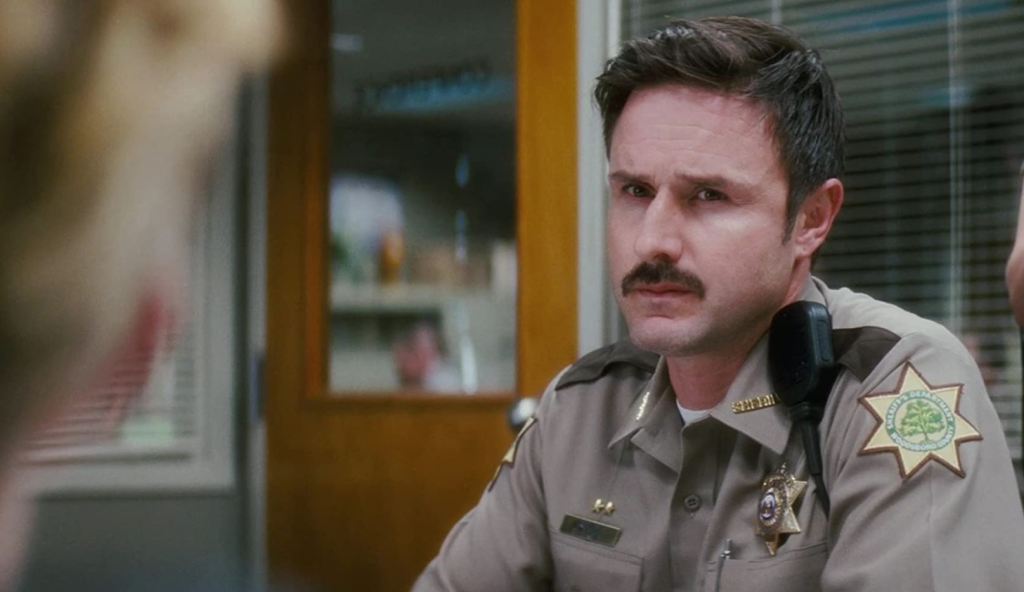
Fan favorite Dewey Riley, of the first 5 Scream films, is a slasher cop bingo card: comic bumbler, older relative, love interest, and grizzled Ahab. He has investigated, arrived late, had hunches both wrong and right, and heroically sacrificed himself to save the protagonists (only after leaving the force), but one thing he has never done is stop the killer. Dewey is not a corrective to the overall patterns examined here—just an unusually likable example of them.
Cop Killer (Better You Than Me)
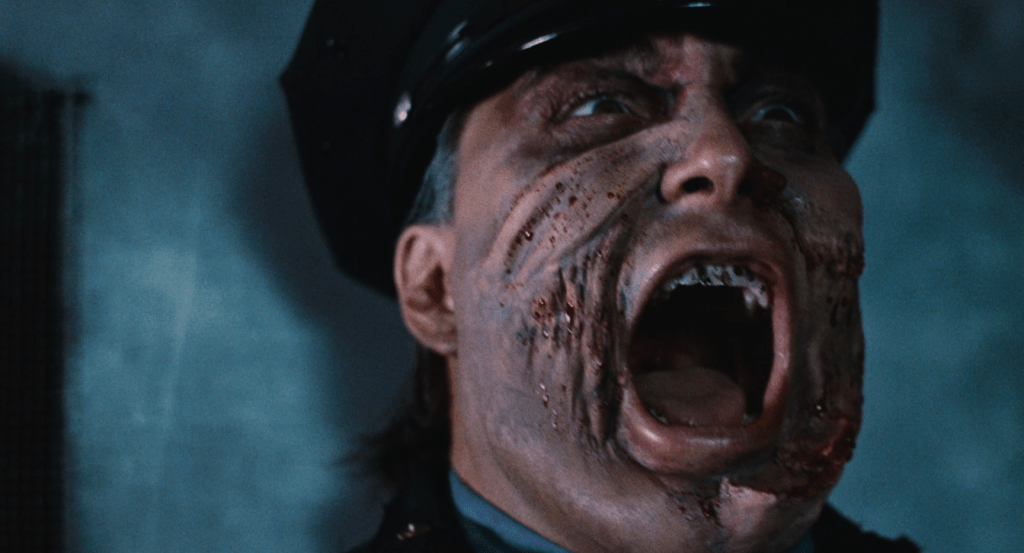
Slasher movies with killer cops come in two flavors: whodunits where the culprit is a surprise, and films where we know the killer is a cop from the start. The former type plays on the (naive) notion that a supposed protector being the killer will come as an ironic shock. The latter group, which includes The Ranger (2018), both Psycho Cops, and the Maniac Cop franchise, shows the slasher genre at its most honest and plausible.
I’ve argued elsewhere that by emphasizing the slasher’s symbolism, we risk over-allegorizing a film convention that has power in its literalness. It’s a privileged position to think a film like Maniac Cop (1988), where a pretextual traffic stop ends in an innocent’s death at the hands of police, is farfetched.
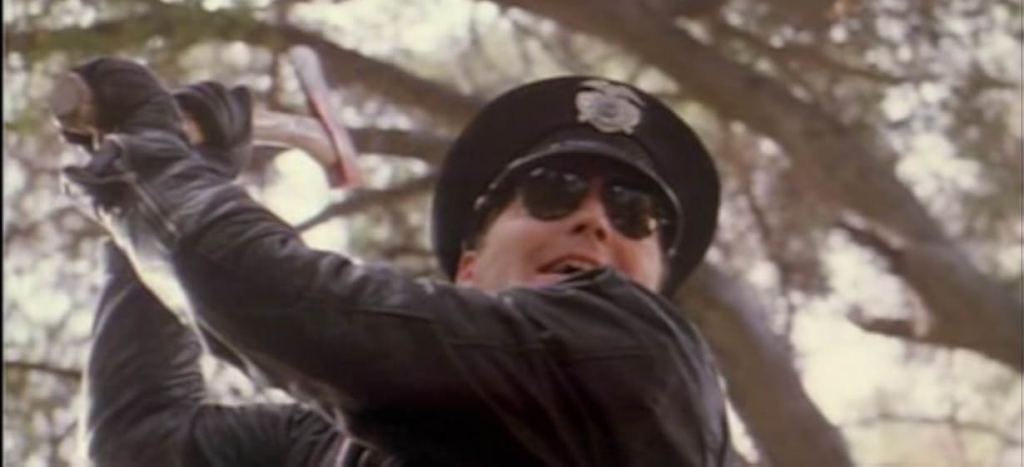
Early on, Psycho Cop (1989) captures the anxiety ordinary people feel in the presence of police. Despite being law-abiding yuppies who presumably have nothing to fear, the characters are still on edge due to the lurking officer of the law. A police radio chatters a stream of reports from civilians freaked out by creepy cops. Whether all these cases are attributable to the titular psycho cop, or whether they hint at a broader problem, is unclear. Later, implicit trust in the police becomes the protagonists’ undoing. Characters spend their final breaths telling their murderer how relieved they are to see him. Real-world news is full of stories about people killed by officers from whom they sought help—often whom they themselves summoned. Ironically, the police state forces us to turn, in our terror, to the very people who created it.
Don’t think, though, that skepticism of cops will protect you from their crosshairs. The Ranger’s punk rockers are contemptuous of law enforcement. Although the film does not explicitly attribute it to his race or sexuality, the homicidal forest ranger seems to single out Jerk (the group’s lone Black, queer member) for special cruelty. When Jerk runs to a convenience store for help, he is wary of encountering the ranger but still believes he will assist him. The ranger immediately accuses Jerk of trying to rob the store, and then says his job is to “keep the trash out of the woods.”
Years before the Mollen Commission exposed the breadth of NYPD corruption, the Maniac Cop films were already considering how state overreach could be contributing to the crime problem, at a time when the status quo was pushing for more cops, more enforcement, and more latitude.6 Maniac Cop 2 (1990) closes with its “hero,” Detective McKinney, rhapsodizing about “every time we pull a trigger and it feels good,” before admitting, “there’s only that much difference between a cop and a maniac cop.”
Psycho Cop Returns (1993) ends with a brazen set piece where a diverse group of bystanders beats down the psycho cop in the street to stop him from assaulting the final girl. In an explicit inversion of the Rodney King case7, the moment is captured on videotape, but instead of provoking outrage, the mob is celebrated for their service to the community. It’s a feel-good ending in a genre not known for them, a display of mutual aid’s power, and a validation of the anarchist slogan, “We protect us.”
Conclusion
As I said earlier, I disagree with Vorel’s take that slashers lack “realistic human motives.” It’s more accurate to say that slasher motives are human motives exaggerated—sometimes not by much. But Vorel is getting at the idea that slasher killers exist outside ordinary society. Their extravagant looks and superhuman or supernatural attributes suggest that they live somewhere just beyond our understanding.
Alex S. Vitale’s The End of Policing describes law enforcement’s self-image: “Police often think of themselves as soldiers in a battle with the public rather than guardians of public safety.”8 In other words, cops see themselves in opposition to, not as part of, our communities. They’re told that the same rules do not apply to them. By highlighting their unhelpfulness, self-mythologizing, systemic rot, tendency to worsen situations, inclination toward abuse, and outright hostility, the slasher subgenre systematically dismantles law enforcement, reflecting the anarchist view of policing as an anti-social institution.
We do not need to exclude the police from normal human society—like slasher killers, they have excluded themselves.
Chronological Film List Associated with this Article:
- Black Christmas (1974)
- Halloween (1978)
- When a Stranger Calls (1979)
- He Knows You’re Alone (1980)
- The Prowler (1981)
- A Nightmare on Elm Street (1984)
- Friday the 13th Part VI: Jason Lives (1986)
- Slumber Party Massacre II (1987)
- Maniac Cop (1988)
- Psycho Cop (1989)
- Maniac Cop 2 (1990)
- Dr. Giggles (1992)
- Psycho Cop Returns (1993)
- Scream (1996)
- Uncle Sam (1996)
- Scream 2 (1997)
- Urban Legend (1998)
- Cherry Falls (2000)
- Scream 3 (2000)
- Valentine (2001)
- Hellbent (2004)
- Boo (2005)
- Behind the Mask: The Rise of Leslie Vernon (2006)
- Dead Tone (2007)
- Prom Night (2008)
- My Bloody Valentine (2009)
- Cold Prey III (2010)
- Scream 4 (2011)
- The Ranger (2018)
- 1. Kristian Williams, Our Enemies in Blue: Police and Power in America, Third edition (AK Press, 2015), Part 1, chap. 5, Kindle. ↩︎
- John Kenneth Muir, Horror Films of the 1980s (McFarland and Company, 2007), 24 ↩︎
- 3. Alex S. Vitale, The End of Policing (Verso, 2017), Chap. 2, Kindle ↩︎
- Williams, Our Enemies in Blue, Foreword. ↩︎
- Andrea J. Ritchie, in Williams, Our Enemies in Blue, Introduction. ↩︎
- Todd S. Purdum, “Politics of Police Strength; New York City’s Demands for More Officers Raise Questions About How to Use Them,” The New York Times, September 13, 1990, https://www.nytimes.com/1990/09/13/nyregion/politics-police-strength-new-york-city-s-demands-for-more-officers-raise.html
↩︎ - 7. Williams, Our Enemies in Blue, Part 1, chap. 2.
↩︎ - Vitale, The End of Policing, Chap. 1.
↩︎




 NightTide Magazine
Leave a comment