
By Dayna Nofke

“Roses are red/violets are blue/one is dead/and so are you,” reads the hand-written Valentine card attached to a lace-bedecked chocolate box, one example of the horrifically romantic iconography in 1981’s My Bloody Valentine.
Produced at the inception of the burgeoning eighties slasher boom, The film stands out among the slew of similarly-positioned contemporary slasher films because of its unique blend of genre elements. I posit that textual analysis of My Bloody Valentine reveals that, beneath its surface-level adherence to the conventions of the slasher subgenre, it displays a unique mix of genre syntax that renders it a more progressive film via Robin Wood’s “return of the repressed.” (Wood 1983, 84) My Bloody Valentine leans into elements of both slashers and 80s/90s teen class-clash romance films, a subgenre that had its genesis in the early 1980s, when, according to Shary, “… studios began making movies that indicated an increasing contempt for and suspicion of wealth.” (564.) My Bloody Valentine positions its characters’ encounters with youthful rebellion and romantic interludes, and – importantly – male friendships as an escape from the confines of its hyper-masculinized and economically depressed setting, the mining town of Valentine Bluff.
My Bloody Valentine is a particularly interesting subject of study considering the film’s longevity, evidenced by its continued engagement with horror fans. As of 2024, film fans can purchase a wide variety of licensed My Bloody Valentine merchandise, a small sampling of which includes a themed board game (Stop a Killer Games) a novelization of the film, t-shirts, jackets, hats – even coffee mugs. Kenny Caperton of OnSet Cinema, a company specializing in on-location horror and cult film experiences, hosted a sold-out 2023 My Bloody Valentine location tour and Valentine’s Day party at the film’s key shooting locations and genre stalwart Quentin Tarantino has cited the film as his favorite slasher. All this despite an overwhelmingly hostile contemporary critical response and MPAA mandates that forced the producers to make substantial cuts to the film’s blood-drenched murder scenes in the service of an R rating.1
Despite this slasher film’s continued relevance with horror movie fans and, more notably, its socially conscious class-based themes, academic discourse on the film has been notably absent. The mentions of the film sprinkled in a few articles are brief and dismissive.
Here, I’ll propose that My Bloody Valentine is a text that merits further study, in that it embodies a unique blend of genre conventions that render it a meaningfully socially-conscious slasher film that stands out from its contemporaries in its attention to class-based dynamics and their relation to heteronormative love. I propose that the two primary components that distinguish this film from its slasher contemporaries, positioning it as a progressive slasher film via linking it semantically and syntactically with films of the class-clash teen romance genre. It achieves this in two ways: firstly, by focusing heavily on heteronormative romance and the iconography of love and the choice to emphasize the emotional lives of its characters over graphic sexuality and nudity. Second, My Bloody Valentine’s deployment of syntactical elements predicated on social and economic class. Taken together, these two components inform every aspect of the film, transforming it from a slasher revenge tale to a film that explores how young people trapped in a cycle of poverty turn to love and friendship as their means of rebellion against these constraints.

The setting, the mining town of Valentine Bluff, is a unique location inseparable from both of these components, a place that serves as a stark contrast between the dreariness of the industrial town (both visually, the setting awash in the blacks and grays of the coal industry and figuratively, in the film’s bleak tone) against the cutesy symbolism of romantic iconography (hearts, cupids, red and pink.)
Contrast this with the standard-issue suburban slasher setting in which place does not inform character; any one of these small town/suburban settings may easily substitute for another. To wit, Halloween’s (1978) fictional town of Haddonfield lulls viewers into a sense of safety precisely because it is vanilla blandness and quiet make it interchangeable with any other picket-fenced neighborhood. Valentine’s Bluff throws us off-guard immediately, immersing us into a geographically and socially unfamiliar setting that gives voice to the Rust Belt and the relentless nature of intergenerational poverty.
Of course, we can make no mistake; My Bloody Valentine is a slasher through and through. Director George Mihalka has never asserted the film’s reach extends beyond that genre but has often commented upon his interest in presenting a film that was that offered something more to its audience than its contemporaneous slasher counterparts while staying true to the genre’s bloody conventions, stating, “I believe the film speaks to people who like their films to have a little more depth of characterization, subplots, and atmosphere. Let’s not forget that the film is not about Ken-and-Barbie suburban babes and hunks; it’s about the human condition, working-class hardships, friendships and betrayals, love triangles, the revenge of the workers against the bosses, the loss of jobs and the bleak future of the young American working class—and of course some of the most original and unexpected scenes of horror and violence.” (Gingold.)
To that end, the film establishes its slasher “street cred” early, following in the footsteps of its predecessors, Halloween, and Friday the 13th by opening the film with a kill.

Two miners, outfitted in head to toe black, enter the cocoon of a darkened mine shaft. The first of the pair removes the miner’s respirator to reveal a mane of shiny blonde hair. She unzips her coveralls, smiles, exposing a lacy white bra and a diminutive heart tattoo. The other miner, still obscured beneath his outfit, dispatches the woman with the tool of his trade… a pickaxe right through the heart bisects the woman’s heart tattoo. Her mouth hinges open, letting loose with an ear-splitting SCREAM that gives way to the title card, the words MY BLOODY VALENTINE floating across the screen in white font with red hearts in place of the two Os.
This opening ticks off the standard slasher boxes, as defined by Carol Clover. The, “… victim is a beautiful, sexually active woman; the location is not-home, at a Terrible Place; the weapon is something other than a gun; the attack is registered from the victim’s point of view and comes with shocking suddenness.” (Clover 1992, 192.)
From here, however, the film diverges to cut to an ensemble of characters preparing for an upcoming Valentine’s dance. The killing has given way to a full-throated celebration, the red of the victim’s blood now a box of red-foiled Valentine decorations. A heart festooned banner hangs across a lonely downtown intersection. Townspeople, our young mining protagonists, and the older residents unpack Valentine’s decorations side by side.
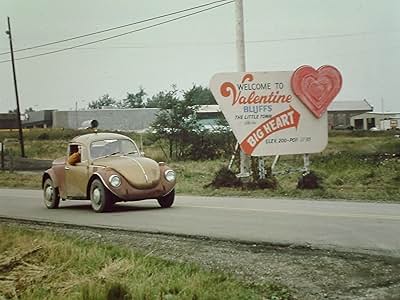

The town mayor opens the neatly-folded bit of card stock affixed to the top of a lace bedecked heart-shaped box. He smiles as he reads, “It happened once, it happened twice.” Abruptly, his face drops. Quaking, he turns to his companion, the grizzled police chief, to choke out the final line, “Cancel the dance or it’ll happen thrice.” The mayor opens the box to reveal – gasp! – a bloody human heart. The police chief steps on the gas, peeling off the road to gun his mud-spattered truck back to town.
Subsequent scenes introduce our protagonists – ersatz final girl Sarah and her ex and current boyfriends, T.J. and Axel (respectively) and their group of friends, a veritable who’s who of horror film archetypes that include Howard (the joker), Hollis (the buddy/ funny man), Sylvia (the funny one), Patty (the sweet, cute one) and several others. We are introduced to the hard and dirty life of the miners; we see them covered in black dust, breathing through heavy respirators, lugging equipment, and showering off after a long day below ground.
The friend group retires to the town bar to unwind, where bedraggled war vet-come barkeep Happy recounts My Bloody Valentine’s villain origins story. He warns the kids to cancel their plans for a Valentine’s dance.

Two supervisors in the mine shaft guffaw, elbowing each other. They leave their posts at the mine early. Concerned only with getting to the town’s Valentine’s dance, they fail to check the methane levels in the mine. We witness the dance through a halcyon gaze, a sea of red decorations. Girls in swirling dresses drinking punch. The supervisors laugh, while – down below – an explosion rocks the mine. Townspeople dig, bits of wood and rock giving way to the sight of the sole survivor, Harry Warden. Wide-eyed, pale face caked with blood and dirt; he gnaws on a fellow miner’s arm.
Harry Warden exacts revenge, dispatching the supervisors with a pickaxe, and goes on to murder more. He warns the town via poetry, to never hold another Valentine’s dance. Predictably, when a new Valentine’s Day tradition is reinstated twenty years later, the murders start up again. Town matriarch Mabel is killed via a gruesome tumble in her own laundromat’s dryer, forcing Valentine Bluff’s leadership to cancel the dance and prompting the young protagonists to organize their own celebration at the mine’s union hall. The night before the party, and unbeknownst to the young protagonists, Happy the bartender, meets his fate at the end of the murderer’s pickaxe.
Once the Valentine’s Day party starts, the kills come fast and furious. Throughout the seven prior kills (Harry Warden’s work) and the new-era kills (those committed by a mysterious killer we assume to be Harry but who is ultimately revealed to be Sarah’s current beau, Axel), a total of 16 bodies. The film culminates in a fight to the death between the final girl, Sarah, T.J., and Axel, who – buried beneath mining rubble – makes his way out to loudly proclaim, “Be my bloody valentine, Sarah!” before disappearing into the depths of the mine shaft.

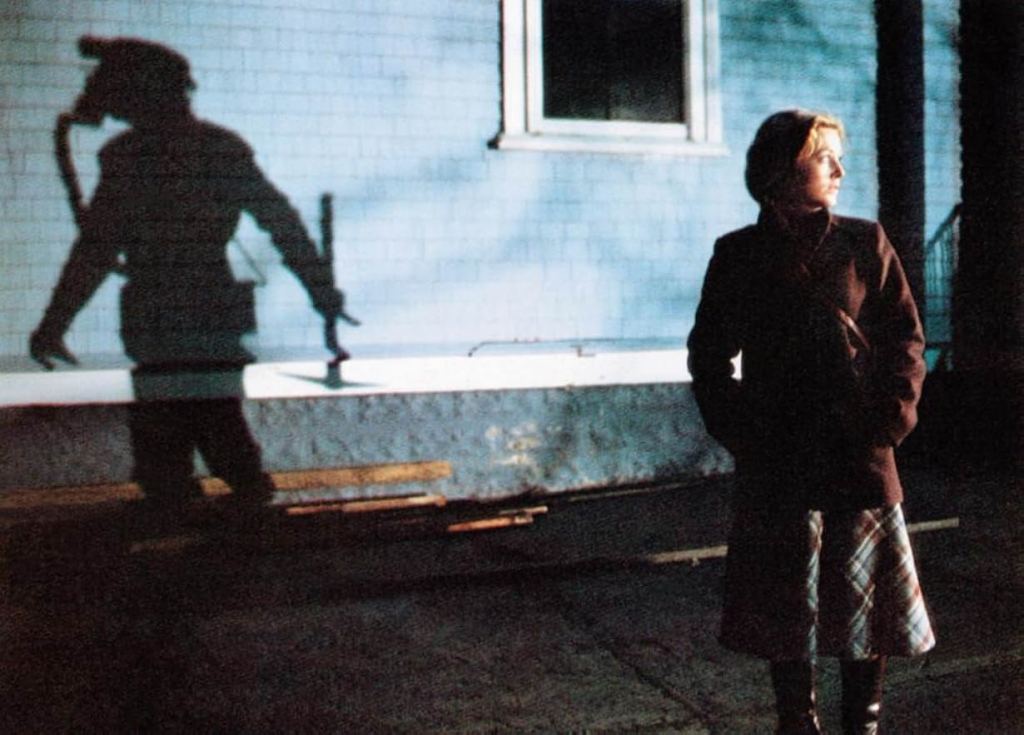
Sarah, a painfully blonde every-girl stands against the backdrop of a rocky lakebed, her back to former boyfriend TJ, hands steeled deep in pockets steeled against biting wind. TJ lays a hand on her shoulder, entreats her to listen. He wants her back. She explains that she’s moved on, that his unexplained disappearance – him having left in search of a life beyond the confines of their mining town – left her confused, alone.
Horror is far from a sexless genre. A Freudian view of horror, as espoused by academic Robin Wood among others, positions the genre as an expression of repressed sexuality. Slasher films are, as a whole, a sexually-charged sub-genre, with nudity and sex scenes.
as an expected component. Canon slashers like John Carpenter’s Halloween, which opens on the murder of Michael’s sister, while she sits topless at her vanity brushing her hair in post-coital bliss, leave no room for the machinations of love or romance. Other slasher contemporaries like The Prowler, Friday the 13th, and Prom Night proffer similar levels of sexual content and female nudity, with female victims who are dispatched of while in a total or partially-unclothed state.
These sexually-charged slasher films stand in stark contrast to the approach to love and romance in My Bloody Valentine. The film shares many syntactic and semantic points with its neighbor-slashers, including a decidedly heteronormative bent. There are misogynistic moments, such as the cast of young male miners serenading a bar waitress with an ode to her virginity. The comments are convey the truth of the hyper masculinized social setting but never approach sexual explicitness. Indeed, the closest that My Bloody Valentine comes to nudity is the white-bra opening kill scene; the ensemble cast’s sexual yearnings ultimately culminate in nothing more than partially clothed makeout sessions. While slasher films in the mold of Friday the 13th pick off half-clothed female victims with gleeful abandon, often saving the most drawn-out or brutal means of murder for its female victims, My Bloody Valentine’s kill scenes – the money shots – are “equal opportunity,” with males and females alike being stalked and offed in similarly fully-clothed states.
Rather than leaning into graphic sexuality and nudity, My Bloody Valentine focuses on romantic allusions and its characters’ emotional states. The Valentine’s dance lead-up and decorating scenes could be truthfully described as “cute,” the type of scene that could appear in any teen or young adult romance film, with girls discussing their dresses while unpacking red-drenched heart pillows and cupid silhouettes and joking with their boyfriends. The color red figures prominently in these scenes and, indeed throughout the film; the heavy use of the color stands out an obvious choice in stark contrast to the industrial landscape’s grays and browns, appearing in everything from the aforementioned decorations to the sheriff’s scarf, Mabel’s cardigan, Sarah’s best friend Patty dress, T.J.’s turtleneck, the town’s welcome sign, and more.
My Bloody Valentine is also unique in that it gives attention to the romantic lives of its older characters, suggesting that grandmotherly Mable harbors a secret crush on the middle-aged town sheriff. Including these clear flirting moments in the film, again signals the director’s interest in a chaste, emotionally-driven type of love, portraying it as a way to transcend the barren landscape and find moments of joy.
In a similar vein, films of the teen class-clash romance genre focus on the protagonists’ emotions with limited overt sexual content. A few contemporaneous examples include Pretty in Pink (1986), which heavily features protagonist Andy’s relationship drama and inner turmoil, exploring how she functions with not only her love interest but also her father and male and female friends. Similarly, Valley Girl explores friendships and wrong-side-of-the-tracks romantic interests through the eyes of its female protagonist. In both aforementioned teen films, the female protagonists are determined to carry on, albeit with a tear in their eye. To quote Andy (Pretty in Pink), on her decision to go to prom solo after being unceremoniously ghosted by date Blaine, “I just wanna let them know they didn’t break me.”
Similarly, My Bloody Valentine’s protagonist, Sarah, finds herself confused and heartbroken over ex-boyfriend T.J.’s abrupt departure from town. The son of the town’s mayor, a position that places him in only slightly better social strata than that of his mining compatriots, T.J. explains that he had to leave town to make it on his own. Torn between TJ and her new boyfriend Axel, Sarah weathers their behavior – both of them kind and caring or demanding in turn. Throughout, she exercises her agency, discussing her feelings with best friend, Patty, and with each of the men, waving them both off with a dismissive, “I just don’t care anymore!”

Sarah more closely resembles the protagonist of a teen class clash film than she does the traditional slasher final girl, who Carol Clover (220) famously describes as a boyish character whose unavailability or disinterest in sex renders her morally superior to other female characters, earning for herself the right to fight the killer and survive. In contrast to Clover’s Final Girl models – including, among others, Halloween’s Laurie Strode, A Nightmare on Elm Street’s Nancy, and Texas Chainsaw 2’s Stretch – whose interests, mannerisms, and even names render them satisfactory male surrogates for a presumed female audience, Sarah is decidedly female and exhibits independence and agency throughout. As the girl at the center of a love triangle, she does not exhibit the ‘moral superiority’ that Clover suggests earns a final girl her right to survive.
Rather, Sarah blends into the group, joining in discussions about love and the slightly off-color banter that the group engages in during the bar scene. She is both “one of the boys” in the freeness and playfulness with which she interacts in her male/female friend group and, simultaneously, immersed in the world of her girlfriends, particularly best friend Patty, with whom she shares discussions about her feelings about Axel and T.J., among other things Sarah does not wear comfortable clothing fit for running, ala Laurie Strode’s jeans and button-down or Sidney’s soft flowered t-shirts, instead opting for pencil skirts, fitted dresses, flowing blouses, and hats; her face is fully made up, and her hair is blown-out blond.
Yet, despite her final girl status, the marketing for My Bloody Valentine did not focus on her, instead favoring an overview of the friend group and the town in posters and trailers. A viewer watching the 1981 trailer for My Bloody Valentine would have a hard time deciphering the identity of the final girl.
Interestingly, Paramount’s official film trailer teased a more sexual film than audiences would get, prominently featuring bits of the opening kill’s bra-clad victim. (Again, the only hint of skin to be seen anywhere in the film.) Simultaneously, the trailer also dug into the romantic iconography, with hearts and valentines throughout, featuring the quippy voiceover, “In this town, on Valentine’s Day, everybody loses their heart.”
Despite the contemporaneous perception of the slasher audience as largely or fully male, the advertising suggests that Paramount understood this film’s potential to appeal to the assumed proclivities of both a male and female audience by marketing to both the implied sexuality and a romantic subplot. R. Nowell notes that, where scholars had traditionally examined slashers through a psychoanalytic lens that viewed them as “formulaic, excessively violent… fashioned to satisfy the misogynist fantasies of male visitors to grind houses and fleapits,” (117) his examination of the films and marketing strategies demonstrates that “marketers actually went to extraordinary lengths to make early teen slashers attractive to female youth.” While My Bloody Valentine was marketed as a slasher, the design of the logline, the trailer, and the movie poster with its heart-bedecked iconography all promised something beyond, something different – and more emotionally resonant – from contemporary slasher fare.
Class Consciousness and Class Clash
The cutesy heart-shaped iconography of the fictional mining town’s welcome sign serves as an ironic diversion from the location’s desolation. Valentine Bluff is a barren place, both in the literal sense of its rocky, colorless landscape and in the dearth of opportunities available to those therein. Protagonist T.J. is the son of the mayor/owner of Haniger Mines. As such, the other young miners regard him as someone who enjoys a level of privilege despite his working beside them. The film does not comment on T.J.’s situation; it is unclear whether he is being punished for having previously left town in search of better opportunities or whether his father has assigned him as a regular miner as a matter of principle. Mayor Haniger is clear in his distaste for T.J.’s decision to leave Valentine’s Bluff in search of something better. In response to a character noting that T.J. doesn’t seem very happy to be back in the mines, the Mayor replies, “Well, that’s too bad. Nobody told him to go out to the West Coast. It’s not my fault he couldn’t make it on his own. But now that he’s back, he’s my son and he’s working in the mine.” Even the mayor’s son is unable to escape the town’s stifling confines.


Class Consciousness and Class Clash
The cutesy heart-shaped iconography of the fictional mining town’s welcome sign serves as an ironic diversion from the location’s desolation. Valentine Bluff is a barren place, both in the literal sense of its rocky, colorless landscape and in the dearth of opportunities available to those therein. Protagonist T.J. is the son of the mayor/owner of Haniger Mines. As such, the other young miners regard him as someone who enjoys a level of privilege despite his working beside them. The film does not comment on T.J.’s situation; it is unclear whether he is being punished for having previously left town in search of better opportunities or whether his father has assigned him as a regular miner as a matter of principle. Mayor Haniger is clear in his distaste for T.J.’s decision to leave Valentine’s Bluff in search of something better. In response to a character noting that T.J. doesn’t seem very happy to be back in the mines, the Mayor replies, “Well, that’s too bad. Nobody told him to go out to the West Coast. It’s not my fault he couldn’t make it on his own. But now that he’s back, he’s my son and he’s working in the mine.” Even the mayor’s son is unable to escape the town’s stifling confines.
T.J. is a young man caught between two classes – that of the miner and of the mayor’s son – neither of which offers him any sense of a future. On the one hand, the other young miners regard him with suspicion. After all, he is, within this world, one of the “haves” while the other miners are the “have-nots.” T.J. experiences the pressure of being expected to carry on the family business; it is a foregone conclusion that he will continue to work in the mines as his father and his father’s father had before him. In this way, T.J. stands in for both social strata in the “class clash” component of this film. It is, perhaps, his inability to escape his circumstance of straddling both worlds that drives him to leave the town of Valentine Bluff. He never expresses a direct goal or reason that he left both the town and Sarah behind, rather, it is a general desire to escape – a running-from, rather than a running-to. During a scene in which Sarah and T.J. walk around an isolated gray lake, T.J. explains to her that he wasn’t certain why he thought he could make it somewhere else, but that he had to go somewhere.
The film’s young protagonists are very much centered in the present. There is nothing beyond the end of the day, when the miners, caked head to toe in black dust, head for the showers. There is “locker room talk;” the young men discuss the upcoming Valentine’s Dance and who they’ve got their eyes on. The banter is mild, with a reference to a young man “grappling with Gretchen” and another one calling out that it is going to be a “hot night tonight!”
T.J. ‘s friends – Axel (his former best friend), Hollis (his buddy), and Howard (the clown) – do not seem to understand why he would leave Valentine Bluff. None of them appear able to comprehend anything beyond the days in the mine and the nights spent out at the bar, playing with knives, and drinking beer.
My Bloody Valentine is a working-class film in both the semantic and syntactic sense. The plot is predicated on the disdain and negligence of the “haves” (the mining supervisors responsible for killing several of their employees) for the has-nots and focuses on the intense desires of the young miners to escape their oppressive workaday life, if only for one night of partying.
Contrasted with other slashers that feature teens in suburban settings (be that an actual suburb as in Halloween, a middle-class summer camp trip as in Friday the 13th, or the suburban high school in Prom Night), My Bloody Valentine centers itself squarely in a working-class universe. All of the characters, save for the two supervisors killed after the mine explosion and Mayor Haniger, are coded as working class. The sheriff drives a beater truck that’s seen better days. Mabel is the owner of a serviceable but run-down laundromat. Sarah’s walk home takes her past a string of neglected clapboard houses, some with boarded windows. The town barkeeper is a grizzled old war veteran. There is nothing portrayed in this film that lives beyond the confines of the town that the filmmakers have dropped us in.
This world of Valentine’s Bluff is an isolated place, from which we – and the characters – cannot see any other. Save for the characters’ discussion of T.J. ‘s ill-fated trip to “the west” there is no discussion of leaving the town, of doing anything, or being anywhere else. There is a sense that nothing better exists beyond the town’s borders, that this is the characters’ immutable destiny, and one it is not worth fighting against.

Thus, in place of the seemingly unattainable goal of leaving, the characters in My Bloody Valentine set their sights on temporary escape via the mechanisms of youthful rebellion and romantic interludes. The idea of youthful rebellion in the form of a secret party appears in numerous iterations in both slasher and class-clash romance films. A small sampling of horror films that prominently feature a secret or unsanctioned party include Night of the Demon, Return of the Living Dead, Prom Night, Hell Night, Talk to Me, and Sweatshop.
A similar pattern plays out in teen class-clash romances, in which the secret party is most often one that takes place in the house of one of the “higher class” teens, whose parents are out of town or otherwise indisposed. These parties are portrayed as
debauched free-for-alls with out-of-control teenagers drinking, destroying property, and otherwise completely disrespecting the (rich) parents’ belongings. In Pretty in Pink, rich kid protagonist Blaine confronts his friend, fellow rich kid Steph, at a party at the latter’s mansion. He accuses Steph of only caring about money, to which Steph replies, “I don’t give a shit about money. Would I do this to my parent’s house if I cared about money?” A few of many class-clash romance films that include an unsanctioned party at a parent’s home include Footloose, Sixteen Candles, Valley Girl, and Can’t Buy Me Love.
In the case of My Bloody Valentine, the protagonists’ desire to hold a party against the warnings of town elders appears to be more about the actual party and the social experience than the show of wealth that parties in class-clash romances typically revolve around. The miners’ party is a simple set-up, with decorations, music, and cheap beer and is held in the Haniger mine union hall and later, the actual mine shaft, rather than a mansion. The difference in these locations also speaks to the idea of lower-class solidarity; holding the Valentine’s party at the union hall is inclusive and a reminder that all the main characters stand on equal status. The same status binds the members of the group together, as demonstrated by the easy camaraderie that allows the males in the group to share their feelings, as demonstrated in a scene in which T.J., Hollis, and Axel interrupt their junkyard hangout to discuss their feelings about Sarah and about the rift in friendships that occurred as a result of T.J.’s abrupt departure.
In addition to the plot and character points, the production design and aesthetic choices cement the working-class feel of the film. The production design stresses earth tones, drab, rocky landscapes, the gray of machinery and industrialization, and the dirty darkness of the mine location. The only bright/primary color that is seen consistently throughout the film is the color red, which, as mentioned earlier, turns up in various costume pieces and Valentine’s Day decor. This aesthetic choice echoes that of the class-clash teen romance Pretty in Pink, in which a similarly drab, rust-belt landscape is punctuated by the protagonist’s monochromatic pink room and wardrobe; again, the bright colors provide a clear signal of the character’s desire to break away from the environment – and the social strata – that surrounds them.
My Bloody Valentine’s soundtrack incorporates a score that veers off the synth-based slasher track to dig into country-infused orchestral arrangements. Composer Paul Zarza also wrote and performed the bluegrass “Ballad of Harry Warden,” which recounts the villain’s origin tale in a traditional country/Appalachian style.
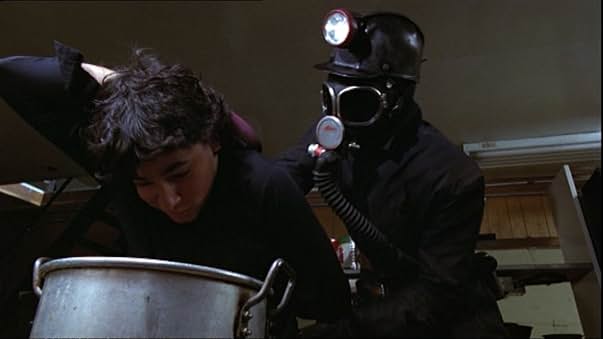
Even the “money shots,” the gory kills that punctuate acts two and three of the film at a steady rate, are related to the mining world. The weapons are common objects symbolic of economic class. The opening kills from Harry Warden are conducted with the miner’s tool of choice, the pickaxe. Later movie kills both those that are perpetrated by Harry’s impersonator Axel) occur at the party and in the mine, with the killer using a pot full of hot dog water (a lower economic status food), an auger drill (industrial tool), an exposed shower head in the miner’s locker room ( a reminder that the miners are never fully clean), and a nail gun (industrial/construction tool.) Mabel is killed with Harry Warden’s trademark pickaxe and then sent for a spin in the hot cycle of one of her launderette’s dryers, this location also speaking to a lack of access to in-home laundry machines.
My Bloody Valentine as Progressive Slasher
The combination of the semantic and syntactic elements that tie My Bloody Valentine into two opposed genres – slasher and class-clash romance film – position it as a progressive slasher film. The original villain (Harry Warden) is presented as an, if not entirely sympathetic, at least understandable villain, his killing spree powered by a desire for revenge against the “haves” whose disdain and lack of empathy for the film’s “have-nots,” led to a deadly mining accident. The hubris of the young people who elect to ignore Harry’s warnings speaks to the desire to forget this tragic past and move forward, while Harry – and the audience – know that not a thing has changed, that the rich and the mine supervisors care no more in the present than in that past in which Harry lived. They do not realize that the same tragedy could just as easily befall them.
The presentation of an ambiguously sympathetic villain working in the service of the proletariat aligns with Robin Wood’s definition of a progressive film (1983 ) as does the ending, which leaves us with killer Axel running free and the remaining characters left in the same economic and social position as when the film began.
This choice of ending stands in stark contrast to class-clash romances, in which the “poor kid” gets the rich person of his dreams, and things are tied up into a nice bow. Thus, by Robin Wood’s definition, we might be less inclined to consider a class-clash.
romance a progressive film; its problems are too easily solved. My Bloody Valentine instead asserts that horrible things happen, and redemption or solutions will not be found in the space of the film’s events. My Bloody Valentine lives firmly in the space of the present with no eye towards a brighter or changing future and regards the youthful rebellion at its centerpiece as but a temporary escape from a bleak existence.
Similar to class-clash romances, My Bloody Valentine urges us to look into the dynamics of, and our relationship with, social class and how it affects all aspects of life (and death) including who and how we love.
Sources
Altman, R., “A Semantic/Syntactic Approach to Film Genre,” Cinema Journal 23.3 (1984), 6-18
Clover, Carol J. Men, Women and Chainsaws: Gender in the Modern Horror Film. Princeton NJ: Princeton University Press. 1992.
“Falling in Love Again, My Bloody Valentine, Sunday Lovers, the Last Metro, 1981 – Siskel and Ebert Reviews.” 2019. Siskelebert.org. August 24, 2019. https:// siskelebert.orgp=7329.
Gingold, M., “Exclusive Interview: George Mihalka’s Bloody Valentine Present.” Fangoria, https://www.fangoria.com/original/exclusive-interview-george-mihalkas bloody-valentine-present/. Accessed April 27, 2024.
Jaffe, I., Hollywood Hybrids: Mixing Genres in Contemporary Films (Chicago: Rowman and Littlefield, 2008)
Nowell, R. “There’s More Than One Way to Lose Your Heart”: The American Film Industry, Early Teen Slasher Films, and Female Youth. Cinema Journal 51.1 (2011), 115-140
Shary, T. , “Buying Me Love: 1980s Clash-Class Teen Romances,” Journal of Popular Culture 44.3 (2011), 563-582.
Wood, R., “The American Nightmare: Horror in the 70s” in Hollywood from Vietnam to Reagan…and Beyond (NY: Columbia UP, 1983, 2003), 63-84
Films Cited
- Footloose (1984)
- Friday the 13th (1980)
- Halloween (1978)
- Hell Night (1981)
- My Bloody Valentine (1981)
- Night of the Demon (1980)
- Pretty in Pink (1986)
- Prom Night (1980)
- Prowler (1981)
- Return of the Living Dead (1984)
- Sixteen Candles (1984)
- Sweatshop (2022)
- Talk to Me (2023)
- Valley Girl (1983)
- It should be noted that a January 2009 Lionsgate DVD release of the film included the cut-for- content scenes which consisted of 9 additional minutes of graphic footage culled from the deaths of several victims (male and female alike), including, Hollis, Patty, Howard, Mabel, Happy, Dave, the opening kill (unnamed woman) and the flashback scene in which the unnamed mine manager dies. ↩︎


 NightTide Magazine
Leave a comment