

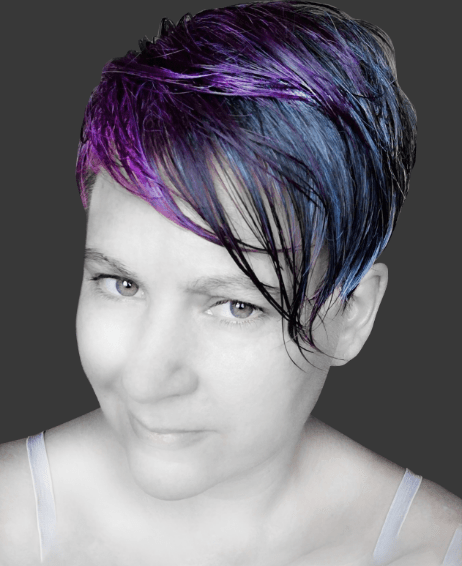
A born drifter with plenty of dark stories, childbirth is the closest thing to eldritch Koji has experienced. Now she finds herself strangely settled in Bulgaria with two kids, a cat, and a whole lot of responsibility. She writes about things mothers see from the corner of their hearts and all varieties of human relationships — with each other, with technology, and with the greater universe. Her work has appeared in Clarkesworld, Apex Magazine, Daily Science Fiction, and elsewhere. In addition to Casual, she has an erotic folk horror novella out and a noir cosmic horror novella forthcoming.
What was your first published work?
My first acceptance was with 50 Word Stories in 2018. They published a micro of mine called End Chanting about coming to terms with trying to change to fit your lover’s ideals and then being left anyway. I had originally started writing novels in 2016 but struggled to get any attention. I joined a writing group and switched to micros and flash in 2018 to grow my skills, and this first acceptance felt like a major win for me even though it was for an unpaid micro. It felt like, finally, someone else valued my work. Since then, there’s been a steady development from micro to flash to shorts, then novellas, and now, finally, a full-length novel.
Is there a story inside that you have seeds of but can’t seem to connect that’s dying to get out?
There are a few! I’ve been working on a dual timeline novel about a sex worker, time travel, and a dragon god for the past few years, but it has been really difficult to get right. I was a sex worker in my early twenties, but my experience was not the classic brothel experience you’d read about in most sci fi or fantasy. It was more dive-bar strip clubs and the occasional deal negotiated on Craigslist. It’s been difficult to align my own experiences of sex work with how its represented in speculative fiction and very difficult to create something that feels authentic while fitting into genre expectations.
How do you handle a rejected story?
Honestly, at this point I’ve received so many rejections that they rarely bother me anymore. It helps that I’ve gotten to know some slush readers and editors, and I understand that a lot of rejection is because of fit with a publication or limited space. That said, anytime I get feedback with a rejection, I do stop submitting that story for a while and see if the feedback makes sense with my vision and if there’s any way I can strengthen it. If a story I feel strongly about gets around five rejections, I might take it back to my critique group and see if there is anything I can make more clear or impactful. Critique is super important to my writing process, and I’m very grateful to those I get to trade critique with.
What does literary success look like to you?
I used to define literary success as being able to sustain myself financially with my work, but I feel that possibility is mostly gone. The authors who do sustain themselves financially often supplement their writing with editing or classes — which I completely respect, but isn’t for me. So I’m starting to redefine success for me. I think now my definition of literary success is simply to have people discussing my books. Even if that’s just one hundred people who buy a book and ten who discuss it, that’s success to me. It means I am contributing to the world and shaping society, even if it’s in a small way. I’d love to continue writing and publishing books for the next twenty years.
Do you read your book reviews?
How do you deal with bad or good ones?I know I shouldn’t, but I do. Up until now, I’ve been lucky to mostly get positive or neutral reviews, although I’ve gotten low ratings without reviews. I have a small group of writing friends who I can share any anxiety or frustration about reviews with. We take turns supporting each other through good news and bad, allow a bit of venting, and remind each other to just keep writing rather than focusing on reviews. Having that group to share privately with is essential to my mental health.
What is the most difficult part of your artistic process?
I get very frustrated with my lack of time to write. I started writing seriously while I was on maternity leave, which is two years in Bulgaria, and I had a lot of time to write or think about writing. Now I’ve returned to work and a full time job in addition to two children leaves little time for writing. I am the type who wants to write for hours each session, and I really struggle to write in small chunks of time. Editing a half hour here and there is easier, but drafting is difficult unless I can set aside a 2-4 hour block of time. Because of this I’ve really slowed down compared to where I was a few years ago.
Casual (Tenebrous Press 2025)
CASUAL managed her depression and anxiety, stabilized her mood, and helped her get pregnant; but new laws forbid her from using the device when she’s sole caregiver for her infant, so Valya needs to detox before giving birth. The full-blown panic attacks have her considering a controversial clinical trial that would place a tandem implant in her unborn baby and allow Valya to keep hers active. Her only options are to attempt solo parenting without CASUAL, or install a minimally tested device in her vulnerable child.
CASUAL is a stark and cutting glance at a near future that looks uncannily like our present, exploring themes of bodily autonomy and the struggle for mental health in a world increasingly divided.
Cover Art by Cristina Bencina

As in most times, the truth is stranger than fiction, what has been the hardest scene or chapter you’ve had to write, if you were channeling personal experience?
A lot of Casual was based on my personal experience, and writing it was sometimes feverishly cathartic. There is one scene in the book where Valya destroys a t-shirt that she had kept for years, not remembering the dark significance of the shirt but not being able to part with it. Although the childhood trauma Valya experienced and what I experienced are not a 1:1 parallel, the t-shirt in the story is the exact t-shirt that I kept in my own desk drawer until I went off to university. I think that’s the one scene that I cried while writing, and it affected me for several days after.
Overall, though, I wouldn’t say that the writing was difficult — it just poured out of me — but the editing was difficult because then it was me trying to take some very raw, personal things and twist them so that they could be understood and accepted by others. In some ways I think when we draw on our personal experience, we risk the “dream effect” — where we think our dreams are significant and interesting, but those hearing them are bored out of their mind because they don’t have the context behind them. As authors we have to bridge the gap between our own experience and the literary experience of the reader that allows them to take a moment and apply it to their own life or wider society. Perhaps the hardest part in the process was seeking publication. I put the manuscript aside for years because I didn’t think anyone would want to read something so personally mine, and it was a really difficult manuscript to get rejections on. I’m super grateful to Tenebrous for taking a chance with it.
What inspired your latest work?
Casual was mostly inspired by my mental health issues that were exacerbated by my first pregnancy. Bringing a new life into this world brought my childhood issues (that I thought I had dealt with in my early twenties) back into sharp focus, and I experienced a lot of anxiety throughout my first pregnancy and the first two years of being a mother. I’ll admit I was also watching a lot of Black Mirror when I wrote it. The neural technology in it was inspired by an article I read about Deep Brain Stimulation used to treat depression.
If you could tell your younger writing self anything, what would it be?
If I could give my younger self advice it would be to start with shorts — they give you more room to experiment and try different techniques that will make writing novels much easier. And, most importantly, find a small, regularly critique group. Not just people who you exchange stories with, but people who you hang out with regularly (online or in person) and discuss techniques and other people’s writing. While the former can be helpful for individual stories, a real writing community will help you figure out publishing, help you through the difficult times, and make you grow as a writer.
What’s the best advice you’ve gotten from a fellow writer?
The best advice I’ve gotten from a fellow writer is to write the next thing. Don’t get bogged down with reviews or sales or rejections. Keep writing.
What is your go-to comfort horror/Sci-Fi book?
I know there are some problematic things about Orson Scott Card, but Ender’s Game has always been a comfort book that I can read over and over again. There is something about the children taking on adult responsibilities that chokes me up, and especially now, it makes me question the way humanity uses individuals as tools under the notion of progress or safety.
If you were to genre-hop, which genres would you most like to try writing?
I do genre hop! I mostly stick to sci fi and horror, but I’ve written poetry, CNF, erotica and fantasy. The first book I wrote (trunked for now) was actually a middle grade fantasy and the second (also trunked) was a contemporary YA about a suicide cult. I don’t have much interest in writing outside of speculative genres. For example, reading romance is a lot of fun, but I can’t imagine writing it.
Pre-order is available through Tenebrous Press here, and learn more about Koji’s work here!
NightTide Magazine is committed to uplifting indie horror presses and authors because we understand the challenges of marketing in an industry dominated by legacy publishers. Independent voices are the heart of horror’s innovation, pushing boundaries and exploring narratives often overlooked by mainstream outlets. At NightTide, we strive to amplify indie voices, ensuring that authors and presses get the recognition they deserve. We spotlight horror creators from underrepresented backgrounds, bringing fresh, vital perspectives to the genre. By championing independent horror books, films, and art that break new ground, we make sure innovative voices aren’t lost in the industry’s mainstream noise. Above all, we believe horror belongs to everyone, fostering an inclusive space where diverse creators can shape the genre’s future.

 NightTide Magazine
Leave a comment