My road to horror academia has been a long and winding one. From just being incredibly eager to find any chance I could to speak about the correlation of Mental Health and Horror back in 2016 blossomed into something I never could have expected. Three dozen speaking engagements later including several keynotes, we’ve landed here, at NightTide Magazine where I’ve had the opportunity to carve out a little academic corner with all of you. To those who’ve contributed to this segment, I’m forever grateful. To those who read, share and submit, my undying thanks.
Now it’s time to put this little corner into motion. I bring you our first virtual symposium:
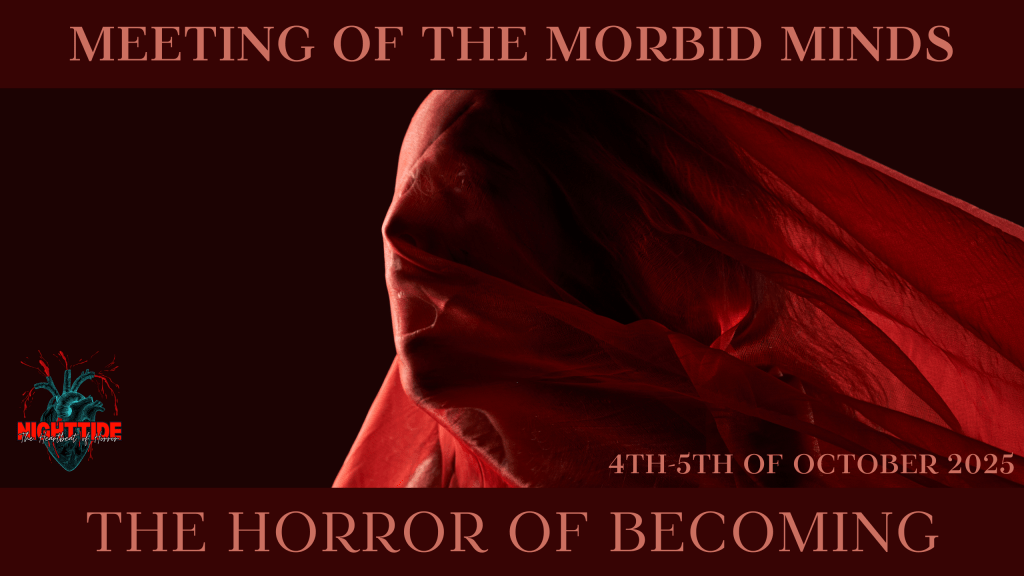
NightTide Magazine’s Meeting of the Morbid Minds: The Horror of Becoming
At NightTide, we understand that horror is not just a genre, it’s a lens through which we can explore the deepest fears of transformation, identity, and the unknown. I’m so thrilled to announce NightTide Magazine’s Meeting of the Morbid Minds: The Horror of Becoming, a virtual academic symposium dedicated to delving into the subgenres of horror that challenge our understanding of fear and existence.
Taking place October 4th and 5th, 2025, from 3 PM – 8 PM GMT, this virtual event will celebrate the deeper side of horror analysis and criticism reflecting NightTide’s commitment to elevating diverse voices and fostering critical conversations in the genre. Horror academia is essential to understanding how fear, folklore, and transformation shape our cultural narratives, and our symposium provides a platform for scholars, critics, and creators to explore these complex themes.
Call for Abstracts
We are now accepting abstracts (up to 300 words, not including your bio) until May 18th for 20-minute talks on the following topics:
The Monstrous Mind: Psychological Horror and the Fear of the Self – Examining how horror narratives explore madness, trauma, and the blurred lines between reality and delusion, forcing audiences to confront the terrifying instability of the human psyche.
Folk Horror and the Fear of the Outsider – Investigating the tension between modernity and ancient belief systems, isolation, and communal horror through eerie traditions and the unsettling power of folklore.
Cosmic Horror and the Limits of Human Comprehension – Unpacking the existential dread of vast, unknowable forces, where horror stems from confronting realities beyond human understanding, and knowledge itself becomes a curse.
Body Horror and the Politics of Transformation – Exploring how bodily mutation, disease, and loss of autonomy serve as reflections of societal anxieties surrounding identity, sexuality, and technological intrusion.
As we confront these subgenres, we ask how horror acts as a mirror to the human experience, revealing the terrifying processes of transformation that challenge the self, the body, and the mind. NightTide Magazine’s Meeting of the Morbid Minds is dedicated to these intellectual explorations, offering a space for analysis that goes beyond the surface of horror’s deepest fears.
Submit your 300-word abstract to nighttidemag@gmail.com by May 18th, 2025. Please have your subject line state: The Horror of Becoming – Your Name. Document format should be doc., doc.x, or pdf.
We’re excited to hear from voices both new and seasoned, and we’re here to support you every step of the way. Your voice and perspective are valuable, and we want to ensure that your ideas are given a platform.
Not Sure How to Write an Abstract? We’re Here to Help!
We understand that writing an abstract can seem like a daunting task, especially if it’s your first time submitting to an academic event. Don’t worry, what matters most is your passion for horror and your unique perspective. Whether you’re an experienced scholar or a newcomer to academic writing, we encourage you to share your ideas! An abstract is simply a concise summary of what you want to talk about, and it’s a great opportunity to showcase your thoughts, ideas, and research in an accessible way.
1. Title of Your Presentation
Your abstract should begin with the title of your presentation. This should clearly convey the central theme of your talk in a succinct and engaging way.
2. Abstract Body (Up to 300 words)
Your abstract should offer a brief overview of the topic you plan to explore, with an emphasis on the academic lens through which you’ll be examining the subject matter. Keep the following points in mind:
- Introduce the theme: Provide context for your chosen subgenre (ex: psychological horror, folk horror, cosmic horror, body horror) and explain why it’s significant to the discussion of transformation and fear in horror.
- Outline your argument or research focus: Clarify the central argument or point of exploration. What unique perspective or analysis are you offering? What makes your approach stand out in the broader conversation about horror?
- Key themes or questions: Highlight any key themes, questions, or concepts you’ll be addressing. For instance, you might explore the psychological disintegration of characters, the role of isolation in folk horror, or how bodily mutation reflects societal anxiety.
- Connection to the subgenre(s): Link your argument to one or more of the symposium’s topics (Psychological Horror, Folk Horror, Cosmic Horror, or Body Horror). Demonstrate how your talk will fit within the broader framework of The Horror of Becoming.
3. Relevance to the Symposium
Why is your topic a good fit for The Horror of Becoming? In one or two sentences, explain how your presentation ties into the overall theme of transformation, identity, and fear in the horror genre.
4. Speaker Bio (Optional)
Include a brief biography (2-3 sentences) about yourself, highlighting your relevant experience, academic background, or professional involvement with horror studies. If you have prior speaking experience, mention it here.
5. Contact Information
Ensure that your full name, institutional affiliation (if applicable), email address, and any other relevant contact details are included. This is crucial for follow-up.

 NightTide Magazine
Leave a comment