By Mo Moshaty
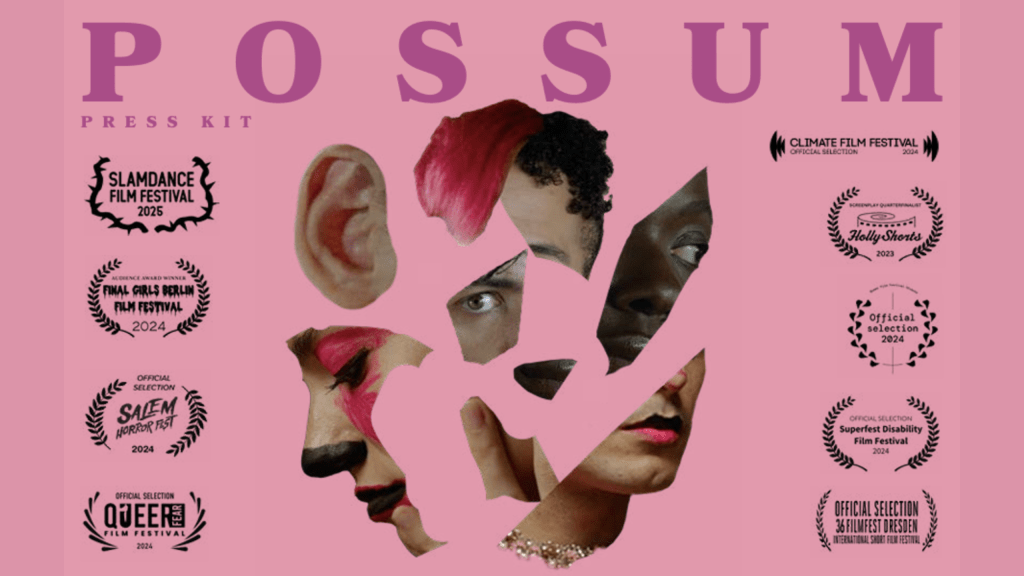
POSSUM (2024)
When the leader of an artist residency kills the possum that’s been eating their cauliflower, the residents come to a shocking consensus.
Written by: Daisy Rosato and Sophie Sagan-Gutherz
Directed by Daisy Rosato
Produced by Jackie Monoson
POSSUM weaves class, gender, disability, and community dynamics into a striking fusion of theater, dance, and puppetry. NightTide sat down with creators Sophie, Daisy, and Jackie on their organic collaboration, balancing serious themes with accessibility and inclusivity, exploring the power of blending art forms and a hint at a possible expansion to the “Possum” universe.
Mo Moshaty: Can you tell me about what brought all of you together? Have you worked on anything previous together, or you just knew that was going to be a nice, greased wheel and an easy production?
Daisy Rosato: Yeah. Sophie and I have known each other for a long time, since we were teenagers. We’ve done a small amount of creative work together, nothing super serious, and we’re romantic partners. We’re usually each other’s first or second readers when we write. That’s how this project came to me, through Sophie. We needed a more experienced producer because self-producing in indie filmmaking is what it is, but you need someone highly skilled at the craft. We reached out to different people, and one of our queer indie filmmaker connections from college introduced us to Jackie. We didn’t know Jackie before POSSUM, but when we talk about that first interview, it felt like an instant click. I felt like Jackie must have been someone I already knew in our community but had somehow forgotten because the conversation was so easy and we were completely aligned. I’ll let Sophie tell the anecdote about when we did our homework on Jackie, there was one particular moment when we knew: Okay, this is our girl.
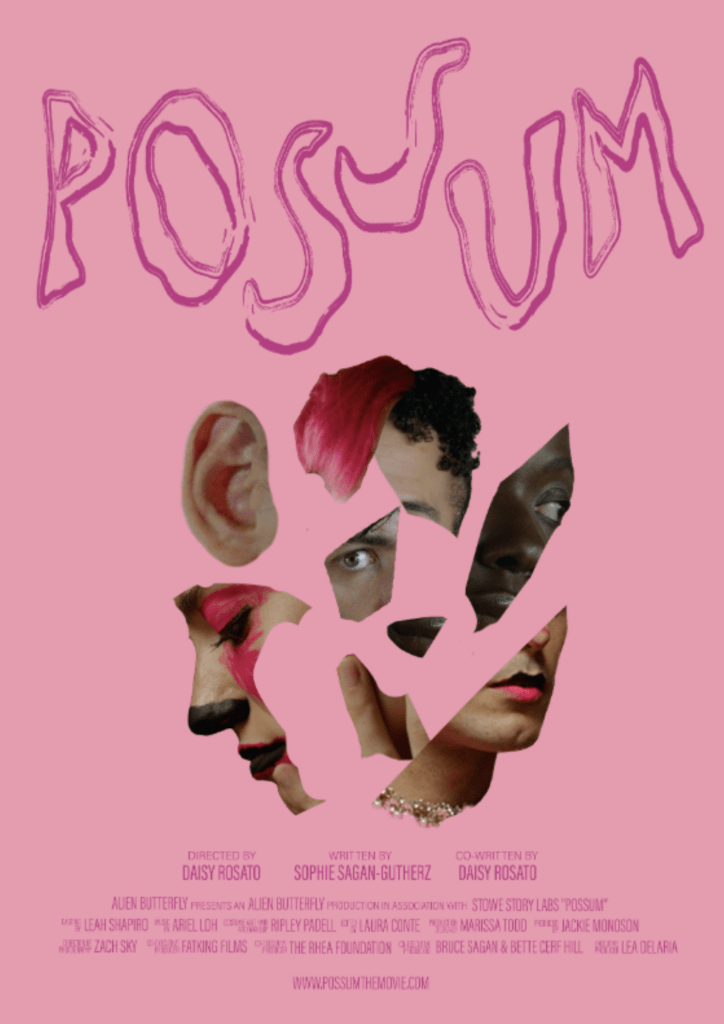
Sophie Sagan-Gutherz: I think what really excited Daisy and me is that we’re cross-disciplinary artists—we come from theater and also love to dance, clown, sing, and just be cuckoo. Jackie’s background in the visual art world really excited us. She’s also an extremely skilled graphic designer who created a lot of our social media and designed our poster. She’s incredibly multi-talented, and on her website, she made this gorgeous video of two pubes falling in love. When I saw that, I just thought, Sign, sealed, delivered—I’m yours.
Jackie Monoson: For me, joining these two was just as emotional and exciting. I was connected to them through a friend and colleague—someone I had worked with on set—who mentioned, Yeah, there’s this queer horror project you might like. And I was instantly intrigued. Then I Zoomed with Sophie and Daisy, and I thought, Can I also be friends with the people I really want to work with? Everything just happened so organically. Apart from being incredibly talented in so many different areas of film and art-making, Sophie and Daisy are also two of the most empathetic, compassionate, and kind people. We started working together, and we’ve been learning and growing with each other ever since. It’s an honor to work in an industry that, unfortunately, isn’t always forgiving. But being able to build such a beautiful community, one that Sophie and Daisy had already cultivated through theater and film, has been incredible. We brought together so many different departments through their connections and mine, and watching everyone meet and collaborate, not just the three of us but the whole team, has been so special.
I feel incredibly grateful. It was truly fortuitous that my friend connected us, and here we are.
MM: Here we are. I always love hearing how the “band” comes together, it’s fascinating to see how everyone’s influences show up on screen. Sophie, what you said about being very theatrical and artsy, especially with movement, really stands out. In indie film, those elements are so essential, especially when, as Daisy mentioned, you’re working with a tight budget, wearing multiple hats, and self-producing. It’s always inspiring to hear how all these pieces come together to create something as unique as Possum.
I’d love to dive into the themes and inspirations behind the film. From the very beginning, just watching the possum walk along, it’s clear that class, gender, and disability are central themes. What sparked the idea to weave those elements together? And how did the death of the possum become the catalyst for the story? How did it all begin?
SSG: Yeah, great question. I’ve been in many art spaces, some better than others, and some have revealed artists to be hypocritical, obsessed with purity and righteousness, trapped in black-and-white thinking. That, combined with my fascination with people’s views on veganism and secondhand stories I’d heard, led to the idea. The notion that someone could become so enraged over a living thing getting food that they’d be driven to a fit of rage and kill felt both heightened and absurd, yet also funny.
Making the possum a puppet intentionally amplified that absurdity while also creating an exciting visual slasher moment. And historically, I’ll say it, men kill.
MM: It’s well documented, absolutely.
SSG: So portraying a complicated, lovable, yet problematic man committing this act was a fascinating entry point for me.
MM: Yeah, I’ve heard similar stories, people from affluent backgrounds “playing poor,” exaggerating their struggles for the sake of an aesthetic. What I love is how distinct each character’s reasoning and perspective are. Annabella is neurotic, borderline narcissistic, desperate to be included to the point of hysteria. Tilly just wants to stay out of it. Blaze and Hadley always have sharp, unique takes on whatever’s happening in the compound. But Pinecone is especially fascinating, he’s passive during the campifire game, saying one thing and setting off chaos, yet he’s the one who ultimately commits the act and has to deal with it. It’s an intense arc in such a short span of time. What was the most challenging part of directing Pinecone’s journey throughout the story?
DR: Yeah, he definitely has the most extreme arc. But given the film’s runtime, every character was a challenge in some way. They’re all a bit clownish and exaggerated, so the real challenge was giving the actors the freedom to ground their performances, helping them see parts of themselves in their characters, recognize their flaws, and either adjust or lean into them. Pinecone is especially interesting. He’s passive in a space where he’s the minority, yet in terms of power dynamics, he holds the most privilege, this is his family’s land. When he’s alone, his aggression feels both misplaced and uninhibited, rage that may stem from many things. But with the possum, there’s no resistance, no one to fight back. It’s animalistic.
What excited me most was shifting the conversation from why he did it to what do we do now that he has? That lets the audience engage rather than search for answers we may not have. On a human level, everyone is capable of acts of violence—we’re conditioned not to act on them, just as we’re conditioned toward kindness. Some people are more attuned to empathy, others just follow learned behaviors. Pinecone’s aggression felt like something that could naturally surface. With Misha, our actor, we focused less on why Pinecone does it and more on what it feels like to do it—taking that leap. People sometimes commit terrible acts without fully understanding why, just as they do extraordinary good without explanation. This is one of those tragic, instinctual moments.
SSG: We’re exploring a man’s violent impulse, but across the board, we envision continuing this story, with potential for all the characters to experience violent moments.

MM: It was fun to watch everyone figure out what to do after the violence, especially with different characters’ perspectives. It was a great opportunity to address issues like trans rights, disability, health insurance, morality, and microaggressions in a nuanced way. The challenge was tackling these topics without feeling heavy-handed, and I think we managed to balance it well, especially when Blaze addresses losing health insurance. It was important to give each character a chance to express their struggles within the conversation.
SSG: As a writer, I try to tackle big issues, but it’s difficult to avoid didacticism. For example, I find it hard to portray misgendering in writing without it feeling cliché, so many stories focus just on pronouns when there’s much more to explore. Trans microaggressions often stem from people struggling to dismantle their binary thinking. There was a level of trust in this project since many of the actors were close friends, Misha and Michelle were cast in roles I wrote for them, and Annabella is also a very close friend. That trust allowed us to have tough conversations from the start without lingering too much, which was important.
MM: The film flowed naturally, allowing each character to voice their concerns and reasoning about the possum. A standout moment was the “I could be trans” line, highlighting someone who sees themselves as progressive but remains unaware of their own language and privilege. We’ve all known people like that, who center themselves even in shared struggles. That felt very real. The opening, with intertwined bodies, beautifully set up the communal aspect, while the editing style shifted between theatrical fluidity and sharp cuts, enhancing the absurdity. Was that a planned choice, or did it develop organically during filming?
DR: The opening was an amorphous piece in post with our editor, Laura Conte. We knew the feeling more than the visuals but always planned for the dancing to start the film. It does the heavy lifting, setting the social dynamics, enmeshed behaviors, and the proximity of this world, both metaphorically and in the specific setting of a performance and dance residency. Dance improv requires trust, but that trust is fragile. One bad apple, or a surface-level trust, creates an opportunity for danger. The goal was to establish that energy, showing what could happen at this level of intimacy and emotionality. The intercutting between the possum and the dancers set the landscape, making the possum part of the world, almost invisible yet always present. We felt that out in the beginning, with sound design playing a crucial role in building toward the title sequence. Working with Laura and our sound designer on that section was incredibly fulfilling.
MM: The film is gorgeous, funny, and tackles important issues without being heavy-handed, which I really appreciate. What stood out most was its eerily cult-like feel. Despite being out in nature, the space feels isolated, trapping these personalities together. It reminded me of Survivor or The Traitors, where group dynamics create tension and material. Was there a specific location, story, or experience that inspired this kind of community?
DR: Definitely. From a director’s standpoint, Midsommar was a major reference, not just for its cult aspects but also for the intense group mentality. Having been in theater rooms and companies that felt cult-like at times, with a kind of one-mind thinking, that was a key inspiration. All the actors come from theater, so it was a great way to ground them in shared experiences.
SSG: Yeah, it’s funny you mention Traitors because they’re big fans, and we’ve been watching it post-POSSUM, so it’s exciting to see that dynamic continue. On a personal level, both Daisy and I have been in toxic theater environments that demanded morally wrong things from us, which definitely influenced the film. From a writing perspective, I’m drawn to ensemble storytelling, mostly in playwriting but now in filmmaking and screenwriting as well. There’s a real delight in character dynamics and group babble, it’s almost easier to say the wrong thing in a tight-knit group because the buzz and excitement push boundaries. You put five people in a room, and naturally, someone’s an enemy, someone has a crush, someone’s annoying that day, it’s inherently theatrical.
MM: I love how confined and isolated it feels, letting all these characters and their flaws and idiosyncrasies boil over into the discussion about what to do with the possum. My last question, because I don’t want to keep you too long, is for each of you. Since you come from different standpoints and wear so many hats, and because the film has such a unique voice, especially for queer viewers and viewers with disabilities, what are you hoping the audience takes from it? And Sophie, you touched on this, any plans to expand this world?
SSG: I identify as physically disabled, sometimes apparent, sometimes non-apparent, whatever that means. That can be complicated. Since Possum, I’ve been on a huge disability journey. It was very important to me because there’s often a singular portrayal of disability on screen—typically a white person in a wheelchair. While that’s a valid experience, when it becomes the only representation, it gets complicated, especially from an intersectional standpoint. For me, being trans and disabled are intrinsically linked, it’s all about the body. I know for Black disabled people, intersectionality is just as crucial. POSSUM was, in many ways, an experiment, our first short film on such a large scale. We really tried to practice what we preached. I hope people see that in the film and, in talking to us, understand that we did our best to create an accessible and sustainable set. When I say sustainable, I mean both monetarily and emotionally—time and energy are money, and for the disabled community, spoons are just as valuable.
Now, I’m in so many more spaces where these discussions are happening, why do we need 12-hour set days? The film industry has no entry point for disabled people because the lowest position, PA, expects you to be a “runaround” person. But what if you can’t run? It raises a lot of questions. Beyond having disabled people on screen, I want them to keep making films, because leadership and diverse perspectives are essential, whether or not the film is about disability.

JM: Both Sophie and Daisy encapsulated perfectly what I would want people to take away from this film, so I’m just going to repeat some of what they’ve shared with me before, things we’ve all learned together. One of them, I think it was Sophie, said something a while ago about the film: for as funny and specific as it is, it never feels like it has inside jokes. It’s incredibly welcoming and inclusive. And I think that’s so hard to write and direct. When I read the script, I felt that too, this openness, which relates to what Mo said about not being heavy-handed with huge, complex themes. It’s about telling a story that’s intersectional and nuanced without hammering the audience with ideas.
I think the writing, which felt grounded in real-life conversations, and the chemistry between the actors created a curious and safe space on set. And that’s something I’d encourage other creatives to consider—whether their audience feels welcome in the story. It’s crucial. Behind the scenes and in its art form, Possum was an incredibly inclusive project. Another lesson I’ve learned, particularly from Sophie, is that if you make something more accessible for one person, it becomes accessible for everyone. Accessibility helps everyone once you start engaging with it. That’s been huge for me, both on a production and post-production level. Lastly, something exciting for me is the combination of different art forms, which Daisy and Sophie also touched on. Coming from theater and introducing puppetry, I love mixing media, even though it’s a difficult balance. The challenge is exciting. What’s great is that none of these art forms felt like they were competing to tell the story. Daisy and Sophie had so much history and investment in different arts, and bringing them together was gratifying. I think it’s so fun to introduce artists working in completely different media. I’d encourage more people to mix and match, let different art forms shake hands.
MM: Are we going to see more Pinecone? Are we going to see more more Tilly, more Annabella? More animals facing unfortunate ends?
SSG: Just talking to you is such a lovely revisiting of this story. So much of what you’ve said is extremely poignant, and it makes me rethink the film in a few ways. I think we’ve just realized these characters are so delicious that it would be an insult not to expand on them.
MM: Have you given any thought beyond Slamdance, or are you just enjoying the moment?
DR: I think we’re entering Slamdance after completing a year’s worth of the festival circuit, which is interesting. It’s not always typical, but we applied to Slamdance the year before and didn’t get in. I was hoping Slamdance would be our premiere, and it might end up being our final festival, still to be determined. But I’m excited about it. On a personal level, it’s a helpful subversion of the story I tell myself about filmmaking, artistry, and success. It’s also given us time to better understand ourselves, the film, how it’s received, and to experience the festival circuit together, which has been such a dream over the past year. Of course, I’m personally nervous about Slamdance, it’s the biggest one, whatever that means, but I’m more excited than nervous. Film festivals are endlessly fun, exciting, and inspiring, so I’m just focusing on that. We were talking yesterday about the other films we’re going to see, and I’m just really excited for that.
Find more about POSSUM the movie here!
POSSUM‘s Slamdance Screening Dates
Unstoppable Block 2
Sunday, February 23rd, 9:30am
Location: Panasonic LUMIX Theater
AND
Monday, February 24th, 1:30pm
Summer & David Theater


 NightTide Magazine
Leave a comment