
By Kristen A. Leer

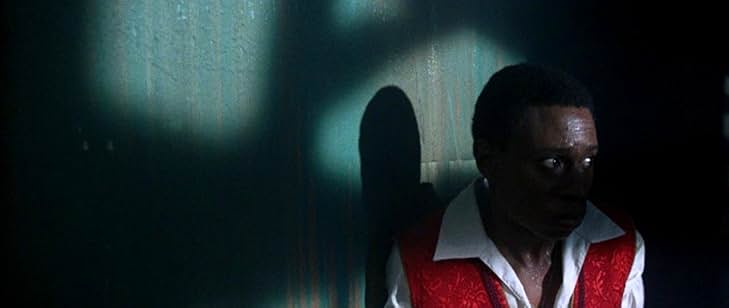
When beginning to watch Night of the Demons (1988) you wouldn’t expect this film to contribute much to the already established stereotypes and narratives in the 1980s golden age of horror. With its poor acting, off-color jokes, hypersexualized young women, toxic young men, and low-budget effects, this film initially aligns with critics’ views of seeing the film as a “convergence of stereotypes…and cliches” (Harrington, 1988). Under the impression that this was just another stereotypical, low-brow horror film, I had it on in the background–only to be unexpectedly struck by the character of Rodger. To my knowledge, Rodger, has not been widely discussed in conversations about Black representation in horror, despite his role challenging many of the genre’s established tropes. Black men, particularly in the 1980s horror, were often sidelined, reduced to racial stereotypes, or killed off early. However, I focus on Rodger in Night of the Demons to demonstrate how his character subverts these stereotypical roles and expectations. At the same time, his survival highlights the extreme lengths Black men must go through to not only make it to the end of the film but also to pave the way for better representation in contemporary horror.
Stereotypes are simplified and often unfair beliefs about a group of people. Films frequently utilize stereotypes to exaggerate certain characteristics for narrative progression and to establish character dynamics. However, these portrayals often disproportionately target marginalized groups, placing attitudes about them within and outside of the film at risk. Early horror films established that Black men rarely made it to the end, even when positioned as sidekicks or moral guides. Night of the Living Dead (1968), despite its groundbreaking approach to racial representation, ultimately adhered to the trope of Black male demise. As horror entered the 1970s and 80s, Black men became more visible in the genre but for a price, they became more depicted as hypermasculine and aggressive, reinforcing the “threatening Black male” stereotype. As well, because horror films were often dominated by white casts, Black characters were frequently reduced to the role of the “token Black friend.” These characters were given little depth or development, existing primarily to be killed off early–often to establish the severity of the threat–or to sacrifice themselves for white characters. Notably, Dr. Robin Means Coleman in Horror Noire (2nd edition, 2023) and The Black Guy Dies First (2023) (co-authored with Mark Harris) notes that the emergence of the “Black guy dies first” stereotype has some misunderstandings. It often happens that they die first or early on, but in alignment with movies like Alien (1979) and The Thing (1982), it cannot be that he always is the first to die because Black men’s death is strategically used to demonstrate, “if the monster beats that guy, then that monster must be a true badass.” The documentary Horror Noire (2018) extends Dr. Coleman’s writings, she notes, “We are finally seeing a number of movies where Black people are on the big screen…the momentum is going to continue and maybe in the 80s, we’re going to get these representations right. Exactly the opposite happens.” So where does Rodger fit in this larger discourse on Black men’s representation and stereotypes?
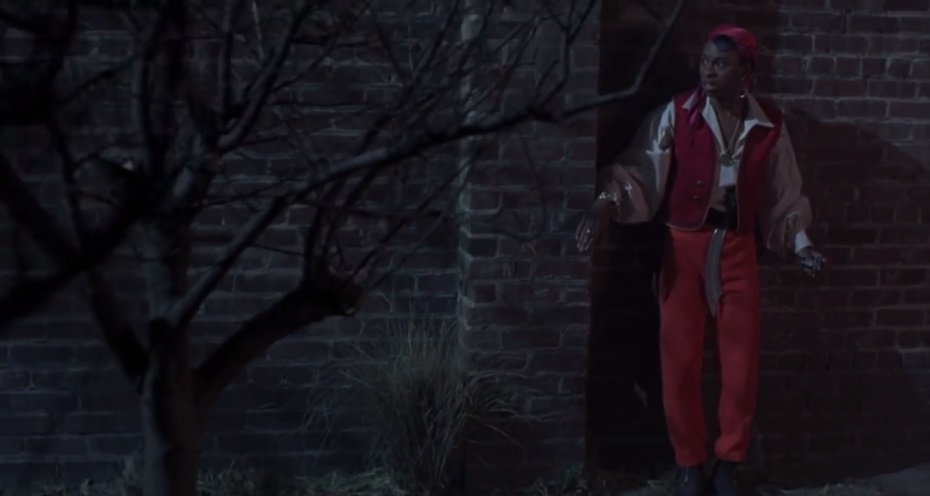
Night of the Demons (1988) focuses on a classic narrative where young, naive, and disruptive teenagers decide to spend their Halloween in a haunted abandoned, mortuary. As the teens come together, they decide to do a seance as a party game in which everyone shown in the shattered mirror foreshadows who will become a victim of the demons’ possessions. Judy and Rodger are the two not shown in the shattered mirror. As the night proceeds, the demons possess each friend not only distorting their personalities to be sexual and aggressive but also physically mutilating their bodies in grotesque ways. Though this film hails from several horror movies such as Friday the 13th (1980), Evil Dead (1981), A Nightmare on Elm Street (1984), and more, Rodger challenges many tropes in the horror genre, particularly in the 80s.
Rodger is one of the main survivors of the Final Girl character Judy. Additionally, Rodger’s personality isn’t rooted in aggression but he is allowed to show a range of emotions that indicate his vulnerability such as crying, being scared, and being cautious about the environment around them. What also is a huge stereotypical break that Rodger exhibits is his self-preservation rather than self-sacrificing. He is consistently separating himself from the group, which in many horror films is an indicator that they will be killed, but for him, it’s allowing his survival to be more intact compared to his peers. This subverts the brave but doomed trope imposed on Black characters that often is utilized for the sacrificial role they have for the white main character. However, what is important, and even comica,l is how when it comes down to Judy and Rodger he is consistently leaving her when a new demon blocks their way. Even going as far as saying, “You won’t get me” then jumping out a window.
There are several additional scenes in which Rodger’s personality and characteristics not only become clearer but challenge other horror dynamics that often are imposed on Black men. Black people in horror films are often considered a sidekick to a particular individual (Scream 2, 1997) or group (A Nightmare on Elm Street 3: Dream Warriors, 1987) who are primarily white. Rodger in the beginning is introduced as a sort of sidekick to the vulgar Stooge, who consistently calls his female peer, Helen, a bitch, and forces Rodger to do things he doesn’t want to. For instance, after hearing a strange noise in the hallway Stooge drags the scared Rodger down the hallway with him. Rodger screams off camera but regroups with his peers unharmed but frightened, someone even commenting, “You’re white as a ghost,” a crude joke to mimic not only Rodger’s frightfulness but skin tone. Nevertheless, despite these tensions put on Rodger he prioritizes his self-preservation through forms of faith. He avoids being fearless and instead expresses his fearfulness leading him to rely on practices of faith, such as acknowledging how his father as a preacher, taught him to know whether a situation is good or bad for him to be in. And being in this haunted mortuary was a bad situation. This personality difference from other representations of Black men in horror films not only provides depth to Rodger’s character but positions him to be in places of survival.
Many scholars have noted that there are distorted portrayals imposed on Black men that stereotype them as a threat not only to white men but also to white women. They are often depicted as obsessively desiring and attempting to claim white women, reinforcing the perception of them as dangerous. However, Rodger, is not hypersexualized to desire a white woman, but that doesn’t stop him from trying to help them. The hypersexualization of the young women is quite clear from the beginning of the film, even with Judy being structured as a Final Girl, who typically has a naive virginal aspect to her which is even cued even with her costume being from Alice in Wonderland, is provocatively shown to the camera even if the male characters in the film don’t see her in such a state. Nevertheless, that doesn’t stop depicting the white young boys exhibiting a desire towards these hypersexualized young women, which often leads to their death specifically in intimate acts. When Rodger is focused on one of his female peers it is in an attempt to not only get himself out first but allow them to join. That is what is important is that his motivation isn’t to get them out first like the token Black friend would but to allow his self-preservation to come before theirs. Additionally, if the young women are joining him their emotional needs don’t take priority over his as Rodger, in a way, holds them to an expectation that often other characters don’t.
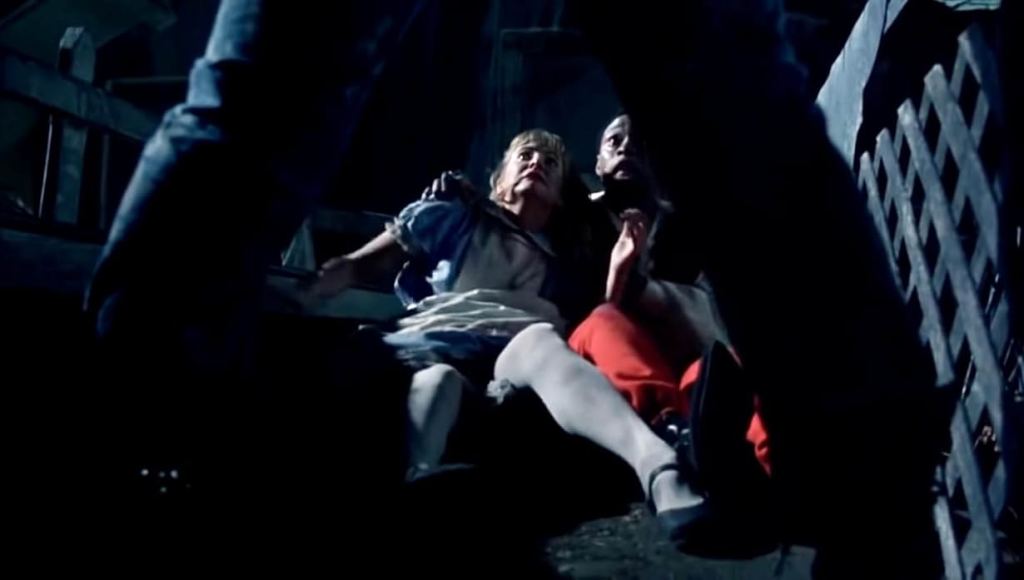
When Rodger first attempts to leave, Helen, joins him, and though is beginning to give up and say “We’re all dead,” he addresses her, “Are you going crazy on me, girl?!” Though the demons take Helen away from Rodger in the later part of this scene, that doesn’t stop him from trying to find a way out. This leads Rodger to reunite with Judy and Sal, the assumed “bad boy,” an edgy love interest for Judy. Sal serves a particular purpose to not only subvert the good boyfriend that Judy comes with to the party, where he isn’t reliable despite his assumed good nature, but also to demonstrate how Judy cannot be rescued by her white male peers. This is evident when the three of them are confronted by one of the demons and Rodger immediately runs away while Sal is trying to get Judy to run. Once they do so they end up at the top of a roof where Judy falls off hanging on the edge. Though Sal attempts to save her and fight off the demon that leads to his demise. Though Judy is still on the edge, crying, and being frail Rodger doesn’t leave his position to go help her but instead tells her what to do. Judy cries, “I can’t do it,” Rodger with the same tone he had with Helen responds, “Come on, woman, do it!” Rodger addressing his female peers like this shows a detachment of desire from them which subverts the stereotype of Black men wanting and obsessively desiring white women (e.g., Candyman [1992]). This is a continuous pattern where Rodger is willing to help those around him only if they are willing to help themselves.
This reinforces Judy’s having to think on her feet and stop freezing when confronted with the demons. When in the crematorium room Judy can repay Rodger, who now is crying, praying, and relying on Judy for comfort, by transforming a gas tube into spewing fire that stalls the demons from getting at them. Rodger runs with Judy throughout the house but now is caught up with running into demons but that doesn’t stop him from putting his life before hers, if she stalls he runs without her. And even when they are cornered, Rodger creates an exit. After throwing himself out the window when Judy and him are cornered, Judy looks at him baffled not necessarily because he is okay exclaiming, “I’m alive!” but because he left her. At the beginning of this final climactic scene, they realize the only way to get out of there is to climb over a brick wall that surrounds the house, and Judy’s fragility comes back into play. The only way they can climb up the brick wall is by a wire that cuts through their hands. Judy’s not able or wanting to tolerate the pain but Rodger endures the pain prioritizing his survival over temporary pain. Nevertheless, he remains at the top of the brick wall still making himself available to her, but once again he is willing to help as long as she is willing to help herself. Judy’s self-preservation and desire for survival are put to the test. Judy keeps calling out to him, “Help Rodger help,” he holds her accountable, “Climb, girl, climb!” As Judy pulls herself up with the wire, despite the pain, and hangs on despite the demons pulling her down she can reach for Rodger, securing her survival with him.
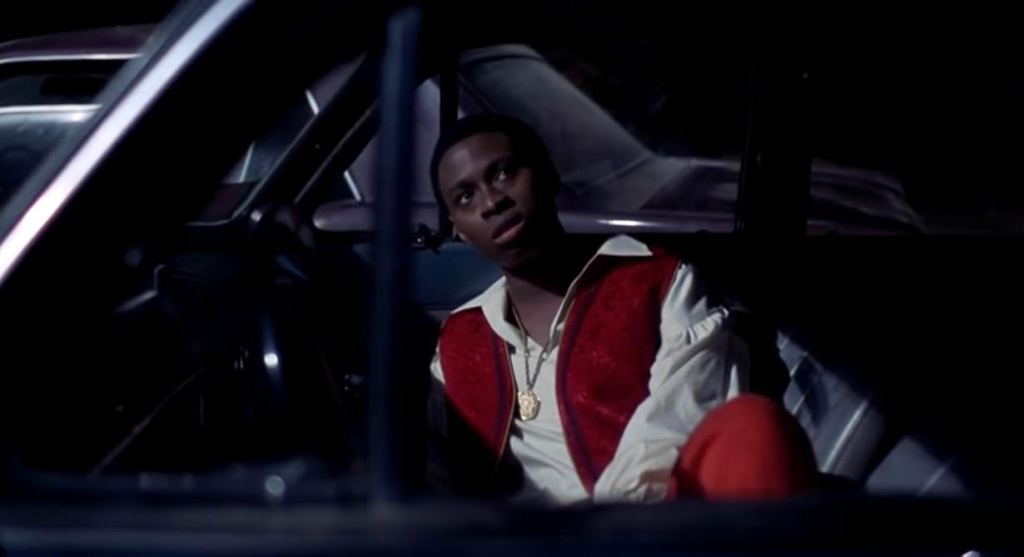
Despite Night of the Demons (1988) providing space for Rodger to exist and survive in a horror landscape that rarely afforded this to his predecessors, his character subverts several stereotypes that allow him to prioritize his survival and challenge established horror tropes, such as the Final Girl. However, despite these subversions, the film ultimately lacked influence on broader horror discourse, particularly regarding Black representation at the time. For instance, reviews and critiques rarely commented on Rodger overlooking his unique portrayal. The film’s heavy reliance on more traditional horror stereotypes clouded the more subtle subversion happening simultaneously with Rodger and Judy. Additionally, while Rodger’s character was more nuanced than many Black male figures in horror, his racial identity was never explicitly explored, limiting his potential impact on Black horror discourse. While Night of the Demons allows Rodger to challenge stereotypes, it fails to revolutionize Black representation in the genre. Given its status as a cult film rather than a mainstream success, its impact remained limited as evident in the following horror movies that came after Night of the Demons and still place Black men in reductive stereotypical roles. However, as independent and cult horror films continue to be revisited and analyzed within contemporary discourse, there is potential for Rodger’s role in challenging horror stereotypes to gain wider recognition.
References
Harrington, R. (1988). “Night of the Demons” (R). The Washington Post.
https://www.washingtonpost.com/wp-srv/style/longterm/movies/videos/nightofthedemons.htm
Means Coleman, R. R. (2023). Horror Noire: A History of Black American horror from the 1890s
to the present. Routledge.
Means Coleman, R. R., & Harris, M. H. (2023). The black guy dies first: Black horror cinema
from fodder to Oscar. Saga Press, an imprint of Simon & Schuster, Inc.




 NightTide Magazine
Leave a comment