
By Marc L. Abbott

In horror, the black man dying first or not making it to the end of the film had become a trope all on its own. Many films from the 70s and 80s especially had black male characters offed before the end credits, leaving us all feeling a bit deflated as we left the theater or shut off the VCR and returned the film.
In the late eighties, however, a shift began to happen where we started to see black male characters survive the horrors set before them. But in some instances, the characters that they did play were either a tad bit over the top or fueled by fear in making their decisions which meant we saw them running much of the time. Not to say that action wouldn’t have been what many of us would do, but it became part of the trope. The ideology that running, rather than approaching the situation tactfully and surviving, by doing so, also appeared to be one-sided. Run and live or try and fight but you then sacrifice yourself and get killed.
If we take a step back and look at this from a wider perspective, black males in those roles were not the main characters. That’s to say, the story was not built around them. They were either the friend of someone in the group, a coworker stuck in the situation, or just part of the ensemble. They could be expendable. But at the same time, they were always the crowd favorite, the ones everyone talked about after the movie. So, there was a desire to see black characters leading the charge and in 1991, we got it from a true master of the horror genre.
Upending Tropes
Wes Craven of A Nightmare on Elm Street fame wrote and directed The People Under the Stairs. For maybe the first time, we were given a horror film that not only had a strong cast with POC but the story itself tackled issues dealing with urban plight, gentrification, racism, and, in its own way, putting an end to a trope about black characters. Even if Craven didn’t intentionally craft it to be this way, it’s easy to equate these elements to the film
If you’re not familiar with The People Under the Stairs, it’s a departure from the standard monster film in that the monsters are real people. Two white, wealthy, greedy, and hateful brother and sister (They refer to one another as Mother and Daddy but in the credits are listed as Woman (Wendy Robie) and Man (Everett McGill)) who commit two separate atrocities upon society.
The first is by getting POC to sign leases for apartments in a rundown tenement that they cannot afford. Once the people can’t pay rent, they immediately evict them with no care for their plight.
The second, and possibly even more devious, are the victims mentioned in the title: children they snatched up off the street or kidnapped and brought into the home to force them to live a “perfect life” only to be mistreated when they don’t live up to expectations. Forcing them to live in the basement, starving them, and forcing them to resort to cannibalism, they become forgotten beyond the walls of their estate. Coupled with the abuse of a young girl named Alice whom they claim to be their daughter.
Rather than go into the disturbed antics of the brother and sister, here we’re going to look closer at the protagonist and see how in this film, he beats the odds of becoming just another cinema statistic in a horror film.

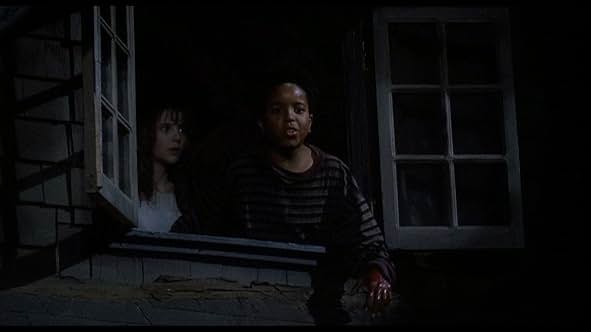
Enter Poindexter aka Fool (Brandon Quintin Adams), a 13-year-old black youth whose family has fallen victim to the sibling’s tenement squaller. His family is poor. His mother is sick, his sister is barely holding it together, and on his 13th birthday, he becomes the man of the house. It’s also on this day they are told they have missed the rent and are going to be evicted. As often in single-parent homes where mom is the breadwinner, when she can’t work, the young man of the house assumes the role of provider. But what can Fool do at 13 years of age?
When he learns from his sister Ruby’s (Kelly Jo Minter) boyfriend, Leroy (Ving Rhames), that there may be an answer to their financial woes he’s all in. Turns out the siblings have a stash of rare coins in their home and Leroy and his partner plan to steal them. They cut Fool in for a percentage if he agrees to help and like the dutiful son, he does. But once Fool and the others breach the house, they become victims of the sibling’s wrath and homicidal tendencies.
It’s at this point, that Wes Craven gives us a Black lead who is not only young but is smart, cool under pressure, and a tactician.
Fool does what no other male character of color has done in horror. He doesn’t panic or start aimlessly running around. From the moment he and Leroy are set upon by the sibling’s dog, he keeps his head about him. Leroy quickly becomes the Black supporting character but, unlike his predecessors in other horror films, his actions are very much that of an adult opposite a child. His overzealousness in going into a situation and not heeding the warnings of a child costs him his life. From that moment on, with the help of a young girl who is being held prisoner and a boy named Roach, also a victim of the sadistic treatment of the siblings, we are cheering for Fool as he outsmarts and outmaneuvers the homicidal owners in their maze of a home.
The structure of The People Under the Stairs’ formula seems designed to go around the tropes of the Black character that we are used to seeing. The story tackles issues that have affected the black community for decades stemming from systemic racism to housing issues created by slum lords. Greedy white people who live far from the issues they have created in quiet tree-lined neighborhoods where they hoard their money. This backdrop sets a different tone than what we’re used to because it sets the tone for a horror story grounded in everyday life for some people. He then combines this with a set of analogies and symbolism that almost perfectly encapsulates the horror universally.
In Fool’s world, much like the real one, he is forced to grow up fast while confronting the violence that is perpetuated towards him. This stems from the poverty created and reinforced by white people whom Wes cleverly names in the cast as Man and Woman. Pitting Fool up against The Man is in many ways a mirror image of how Black males have labeled their battle with the system. The man, in this case, isn’t just perpetuating violence, but he is also hoarding money and relying on the monsters he created to do his bidding. Fool must fight against all these odds to get back the wealth that has been stolen from his community.

Alice as a Mirror to Societal Fears
Alice (A. J. Langer), the girl that The Man and The Woman don’t want Fool anywhere near, is more than just a character locked up by these creepy siblings. To them, she represents purity and innocence. They’re terrified that Fool, a young Black boy, might “corrupt” her. The word “corrupt” carries a lot of weight with it, tied to old racist stereotypes that suggest Black men, especially young ones, are dangerous or morally bad, especially when they interact with white people. The villains, who’ve built their whole home around racist and oppressive ideas, see Alice as being especially vulnerable because she’s white. The thought of her forming any kind of bond with Fool shakes up their control over her and, by extension, their power. In their twisted world, Alice’s innocence has to be protected, and the idea of her connecting with someone like Fool is a direct challenge to their authority and standard of practice.
The film really shows how the Man and Woman’s blind rage is their downfall. They’re so caught up in their irrational, emotional fear that they can’t think clearly or make smart decisions. Instead of being strategic, they act impulsively, just trying to keep Fool away to protect their messed-up world. But Fool? He doesn’t react out of anger. He keeps his head cool and thinks things through, using his smarts to outwit them. Their blind rage makes them miss the fact that they’re being played. They’re too busy hating on Fool to realize their own hate is what’s going to bring them down. He also knows he cannot be reactive like the adults and arbitrarily put himself in harm’s way just to protect Alice. This is often a trope device used to kill off the black character in movies (Parker trying to save Lambert in Aliens comes to mind). This trope is broken as Fool takes the lead and pushes forward with Alice in tow on their way to freedom rather than him throwing himself between The Man and her to help her get away. And Fool does make it out but without Alice.
Another trope is broken going into the third act in that if the Black man is going to make it to the end, there is almost a good chance he won’t make it to the credits. That some insurmountable force is going to stop him just moments before it’s all over. Although prior to The People Under the Stairs, Craven broke that trope with Kinkead in Nightmare on Elm Street 3: The Dream Warriors (which he developed and wrote) this is different because of the real-world setting.
It’s not long after his escape and promise to come back for Alice, that Fool returns alone despite being told not to go back without help. For a moment we forget that Fool knows this house like the back of his hand. He knows how to avoid the boobytraps and can maneuver through the walls and out of secret exits. He’s familiar with key areas of the house that Alice and Roach showed him. The tactician he has become gives him the wherewithal to lure the Man to where he wants to go. Essentially Fool is making the rules now.

In the final moments, often the crucial moments for a Black character in a horror movie of this type, Fool sets free the People Under the Stairs who in turn go after the Man and Woman and exact their revenge for their cruelty towards them. Fool’s battle with the Man may be physical, but it’s mental and symbolic. It’s here he wins the battle, symbolically taking down the oppression that was built into the system.

Marc L. Abbott is an award-winning African American writer from Brooklyn, NY.
Initially drawn to fiction as a student, he self-published his debut novel, A Gamble of Faith, in 2004 after adapting it into a successful stage play. He later published the YA novel The Hooky Party (2007) and the children’s book Etienne and the Star Dust Express (2012).
In 2013, Marc transitioned to horror, a lifelong passion sparked by his father. His short stories have appeared in acclaimed anthologies, including the Bram Stoker-nominated New York State of Fright. He co-authored Hell at the Way Station, winning two African American Literary Awards, followed by its sequel Hell at Brooklyn Tea (2021).
Dedicated to crafting original monsters and terrifying narratives, Marc aims to expand the genre’s future. A Moth Story Slam Grand Slam winner, he also curates the Brooklyn storytelling series Maaan, You’ve Got To Hear This!.



Leave a Reply