
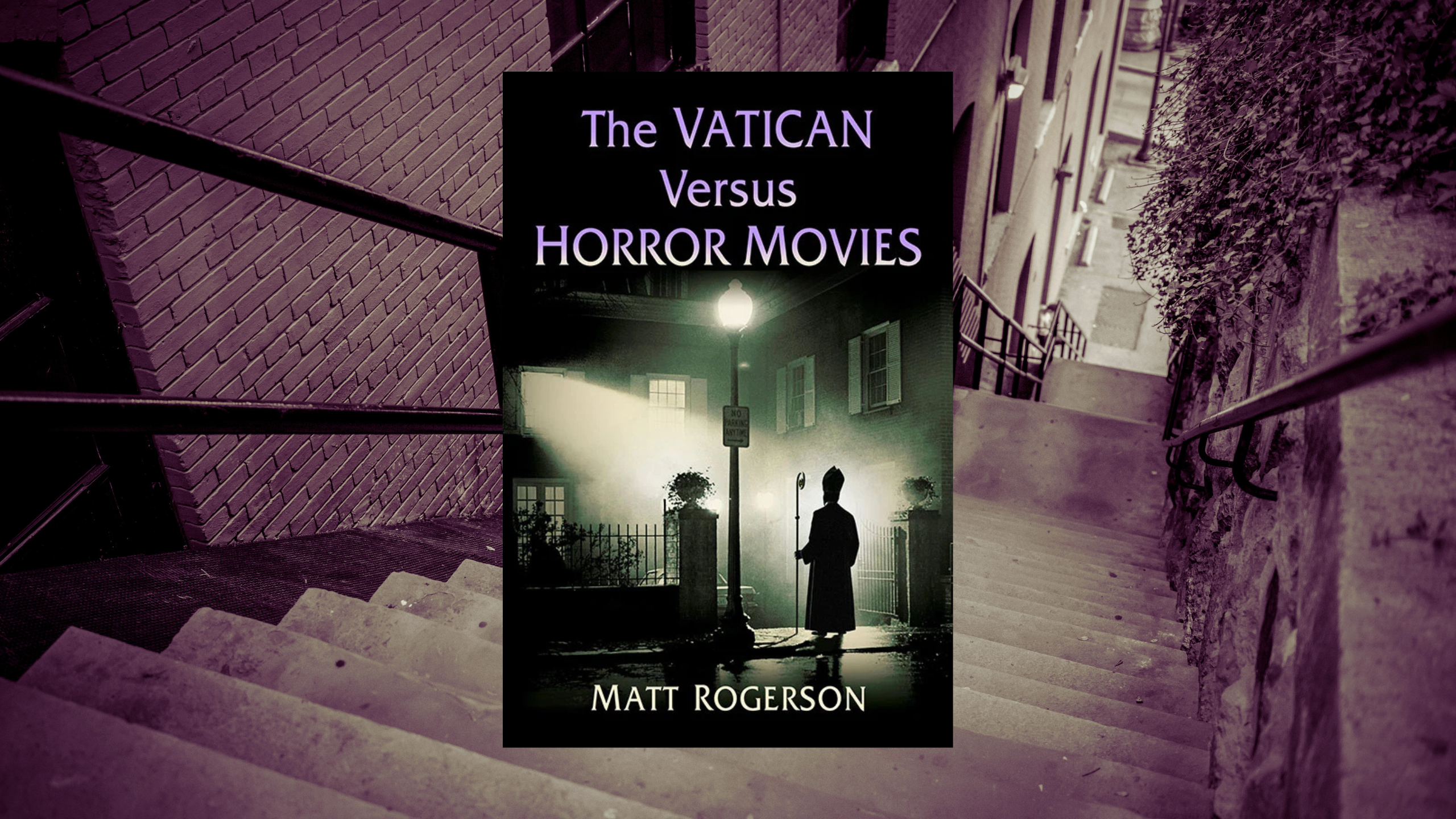

The Vatican Versus Horror Movies ⭐️⭐️⭐️⭐️⭐
by Matt Rogerson
Since public audiences were first introduced to the medium of film in 1895, the Catholic Church has sought to impose its will on the distribution and exhibition of movies. These activities include the fortnightly publication of the Segnalazioni Cinematografiche, which passed Catholic moral judgment on every film released. In this pamphlet and in other settings, no set of filmmakers has invited the ire of the Vatican as much as those working in the genres of horror and exploitation. At times, filmmakers have responded in kind, attacking the Catholic church directly and indirectly, presenting clergy as outright antagonists and shining a light on the Vatican’s crimes past and present, including its collusion with fascism.
Translating the judgments of the Segnalazioni Cinematografiche into English for the first time and juxtaposing them with film content and social and historical context, this book presents in full the cultural conflict between the Vatican and horror movies.
If you thought the Catholic Church’s biggest battle was against sin, think again. Turns out they have always been waging war on horror films, and The Vatican Versus Horror Movies dives deep into their cinematic crusade. The book unearths decades of the Vatican’s moral panic over film, courtesy of the Segnalazioni Cinematografiche, their very own film review journal. Think Rotten Tomatoes, but with more guilt.
Author Matt Rogerson wasn’t planning to write about Vatican film criticism; they were researching Italian horror maestro Lucio Fulci when they stumbled upon mentions of the Segnalazioni Cinematografiche. The Vatican’s reviews were obscure, untranslated, and, let’s be honest, screaming for a wider audience. What began as an academic curiosity quickly turned into a full blown investigation, leading Rogerson to hunt down these elusive journals like a film scholar Indiana Jones. The result? The relevant study of how the Catholic Church has tried to control cinematic narratives for nearly a century.
Reading through these reviews, one trend becomes glaringly obvious: the Vatican cares less about on screen blasphemy than it does about films criticizing the Church itself. Sure, The Exorcist got a pass for portraying a heroic priest battling Satan, but Ken Russell’s The Devils? Condemned outright for daring to suggest that the church wasn’t exactly a paragon of virtue. Similarly, Pier Paolo Pasolini’s Salò, a grotesque but searing indictment of fascism and its church-aligned power structures, got a Vatican takedown that practically foamed at the mouth. Meanwhile Lucio Fulci’s City of the Living Dead, where a priest’s suicide triggers the biblical apocalypse? Just a brief mention, mostly to grumble about the gore. Priorities, right?
One of the book’s juciest revelations is the Vatican’s selective outrage. Take Nunsploitation film works like Flavia the Heretic and The Nun of Monza, which the Church condemned for the historical inaccuracies while conveniently sidestepping the real life abuses that inspired them. The book carefully tracks these contradictions, showing how the Vatican’s film critiques often say more about their institutional anxieties than about the movies themselves. The Vatican Versus Horror Movies connects the dots between the Vatican’s long history of film censorship and more modern moral panics, such as Britain’s infamous Video Nasties era. Turns out the church had a hand in that too, because when evangelical conservatives and Catholic moralists join forces, horror films tend to get banned (and then become even more appealing). With sharp analysis and dark humor, Rogerson highlights how these patterns of suppression continue to shape horrors and genre cinema today.
Despite the heavy subject matter, the book remains engaging and accessible. Rogerson’s background in health research lends the work an analytical rigor: hypotheses are formed, evidence is tested, and conclusions are drawn with scientific precision. But unlike some dry academic texts, this one knows how to entertain. The humor is biting, the examples are juicy, and the insights are significant. For horror fans, film scholars, and anyone fascinated by the strange bedfellows of religion and censorship, The Vatican Versus Horror Movies is an essential read. It’s a wild, well researched and a frequently hilarious ride through decades of Catholic outrage, one that ultimately reveals just how much power the church has tried to wield over the stories we tell and the stories we see. And if history has taught us anything, it’s that the more you try to suppress horror, the more it thrives. Amen to that!
The Vatican Versus Horror Movies can be purchases through McFarland & Co Inc. here or wherever your favorite books are sold!


Mo Moshaty is an acclaimed horror writer, lecturer, and producer whose work combines visceral storytelling with the psychological insight of her Cognitive Behavioral Therapy background. She has lectured internationally, including as a keynote speaker at Nightmares from Monkeypaw: A Jordan Peele Symposium (Prairie View A&M), No Return: A Yellowjackets Symposium (Horror Studies BAFSS Sig), The Whole Damn Swarm: Celebrating 30 Years of Candyman (University of California), and with the Centre for the History of the Gothic (University of Sheffield). Mo has also presented at the BFI, Miskatonic Institute of Horror Studies, and Final Girls Berlin Film Festival’s Brain Binge on women’s trauma in horror cinema, Cine-Excess on The Creepy Kid Horror Subgenre and Mother/Daughter Trauma in Horror, and Romancing the Gothic on Cosmic Horror’s Havoc on The Body Electric Her short film, 13 Minutes of Horror: Sci-Fi Horror, won the 2022 Rondo Hatton Classic Horror Award for Best Short Film. As a core producer with Nyx Horror Collective, Mo co-created the 13 Minutes of Horror Film Fest and partnered with Shudder in 2021 and 2022, while also establishing a Stowe Story Labs fellowship supporting women creatives over 40+ in horror. A member of the Black Women in Horror Class of 2023 and featured in 160 Black Women in Horror, Mo’s short fiction appears in A Quaint and Curious Volume of Gothic Tales (Brigid’s Gate Press) and 206 Word Stories (Bag O’ Bones Press). Her debut novella, Love the Sinner, was released July 5, 2024, with Clairviolence: Tales of Tarot and Torment released in October 2025. The first of her five-volume non-fiction series, The Annex of the Obscure: The Afterlife, will be released in 2027 from Tenebrous Press. As the Editor-in-Chief of NightTide Magazine and founder of Mourning Manor Media, Mo champions marginalized voices in horror. Under her leadership, NightTide plans to launch a film festival in 2028, furthering her mission to reshape the genre through inclusivity and representation.

Leave a Reply