By Mo Moshaty
“By the pricking of my thumbs, something wicked this way comes…”
This line, spoken by the witches of Macbeth, oozes dread and foreshadows inescapable doom. It captures the creeping horror of fate closing in, whether through supernatural spirits and ghostly madness (Throne of Blood), psychological collapse (The King is Alive) or brutality and bloody revenge (Titus). Let’s take a look at how Willy Shakes inspired some horror finery.

1. Throne of Blood (1957) – (inspired by Macbeth)
Akira Kurosawa doesn’t just adapt to Macbeth, he exorcises it. In Throne of Blood, he strips it down to its bare bones and resurrects it as a spectral waking, shaking nightmare, plotted through the fog-choked void of feudal Japan. If Shakespeare’s witches cackle and taunt, Kurosawa’s eerie forest spirits are something far more sinister. They’re cold, detached and cosmic in their indifference. They aren’t playing a game; they are the game, and Taketoki Washizu (Toshirô Mifune), our Macbeth stand-in, is doomed the moment he rolls into their domain.
The horror here isn’t just supernatural, it’s existential. Kurosawa’s landscape is alive, but not in a benevolent, cheery, Disney way. The mist drenched forest feel like an endless limbo, a place where fate slithers into the cracks of reality and puts it in a chokehold. The vast, barren landscapes don’t just trap Washizu physically, they drown him in isolation, making his descent into paranoia all the more suffocating for him and the audience. There’s no castle banquets or regal courts, just an endless and indifferent world swallowing him whole.
The finale, the kind of horror scene that crawls into your brain and refuses to leave, is one of cinema’s most unnerving death sequences. Washizu doesn’t just die, he becomes a grotesque pin cushion of fate. His own men, in a moment of pure Shakespearean irony, unleashed a storm of arrows upon him, turning their once great leader into a writhing, punctured husk. Real arrows were used on set barely missing actor Toshirô Mifune, which explains his genuinely panicked, animalistic flailing (think Edward Woodward Wicker Man awe but with genuine concern of being stabbed to death). By the time he finally collapses, he is less a man and more a grim warning: you can’t fight fate, but fate always shoots first.
You can watch Throne of Blood (1957) on MAX

2. The King is Alive (2000) – (inspired by King Lear)
Of all the Shakespearean horror riffs, Kristian Levring’s The King is Alive might be the most psychologically brutal. Not because it’s full of supernatural entities but because it traps its characters in the most horrifying force of all: the slow, rotting decay of the human mind.
Stranded in the desert after their bus breaks down, because fate is a playwright with a cruel sense of humor, a group of travelers (Miles Anderson, Romane Bohringer, David Bradley, David Calder, Bruce Davison, Brion James, Peter Khubeke, and Vusi Kunene) decide to (why not?) pass the time by staging King Lear. For the funsies…aaaaand because nothing says we’re all going to die quite like a tragedy about power, madness and the collapse of identity. But as hunger gnaws and thirst claws at their bodies, the line between performance and reality begins to blur. They aren’t just acting out Lear, they’re living it and that’s where the real horror begins.
The desert, like the desolate blasted heath, becomes an infinite void, stripping away pretense, civilization, and sanity. There’s no shade to hide from the sun. There are no walls to contain the madness. It just spills out, unchecked. The psychological horror creeps in slowly, and like heatstroke hallucinations: trust erodes, alliances crumble, and betrayals turn fatal. Themes of power and identity become grotesquely real, as hunger transforms people into desperate, volatile creatures; their minds peeling apart layer by layer like sun scorched flesh. There’s your gore!
The real kick in the pants? By the time we reach the end, identity is a joke. The characters aren’t even people anymore. They’re specters, hollowed out by suffering, haunting the sands like forgotten phantoms. Shakespeare’s tragedies often revolve around the inevitable. But here, inevitability isn’t just a narrative device. It’s a slow suffocation and a psychological unraveling so complete that the very concept of self becomes meaningless in the end. There is no king, there is no Kingdom. Just sand and silence.
You can watch The King is Alive (2000) on Prime Video

3. Titus (1999) – (inspired by Titus Andronicus)
Saving a personal favorite for last because it’s just too delicious of a film to not speak about in any arena.
If Shakespeare’s Titus Andronicus is the Elizabethan equivalent of a grindhouse revenge flick, then Julie Taymor’s Titus is that, but with the volume cranked up to a deafening operatic wail of madness, grotesquerie and surreal horror…or 11 for my Spinal Tap fans.
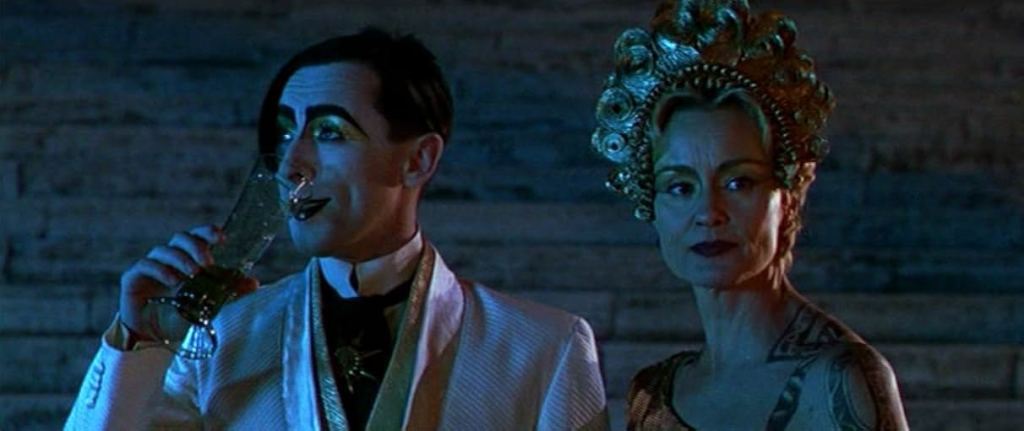
It isn’t just a film, it’s a fever dream of violence, one where time is a meaningless construct. Horror is both psychological and visceral, and vengeance isn’t just enacted, it’s worshipped, dissected, and served up on a silver platter, sometimes literally. With a stacked cast with the likes of Anthony Hopkins, Jessica Lange, Laura Fraser, Alan Cumming, Colm Feore, Jonathan Rhys Meyers, Harry Lennix, Matthew Rhys and Constantine Gregory – you literally CANNOT lose.
Taymor doesn’t confine the heart of Titus to any single era. She throws everything into a blender and lets it churn out a nightmarish postmodern wasteland. Roman soldiers march along Fascist officers, motorcycles rev through ancient ruins, and gladiatorial bloodbaths unfold under the glare of stark fluorescent lights. It’s as if history itself has suffered a psychotic break, mirroring the way the characters spiral into pure, unfiltered barbarity.
And let’s chat about that barbarity, shall we? Shakespeare’s play is already a parade of disfigurement, dismemberment and dehumanization, and Taymor refuses to flinch. Lavinia’s (Fraser) brutal assault is depicted in a deeply unsettling, delirious sequence where bloody tree branches reach out like grasping hands, pulling her into the abyss. When we see her afterwards, her hands hacked off, her tongue ripped out, blood staining her pale dress; she is no longer a character but a walking, grotesque symbol of suffering that the camera lingers on with unbearable intimacy. And she’s a particular favorite of mine when I speak about women’s trauma and horror cinema because…damn.
But the real horror of Titus isn’t just the gore, it’s how gleefully everyone leans into it. Anthony Hopkins plays the titular general like a Shakespearean Hannibal Lecter, grinning with lunatic delight as he plots his infamous revenge. The cinematic banquet where he slaughters Tamora’s (Lange) sons, bakes them into a pie and feeds them to her before revealing the truth isn’t just grotesque, it’s operatic; a horrifying culmination of Titus’s descent from noble general to a man so consumed by vengeance that he becomes the monster he sought to destroy. The film revels in the absurdity of its own violence, playing it as both tragedy and pitch black comedy. The sheer theatricality of it all: the Shakespearean monologues delivered with operatic grandeur (I’m looking at you, Cumming), and characters revelling in cruelty like it’s performance art, creates a sense of grand nightmare spectacle. Titus isn’t content to let its audience sit comfortably. It drags you into its psychotic carnival of blood, brutality and bombast, forcing you to confront just how thin the line is between justice and annihilation.
By the end, no one wins. No one survives intact. The play’s infamous body count piles up, leaving behind nothing but the echoes of screaming, the taste of iron in the air, and the slow, sinking realization that vengeance isn’t just a dish best served cold; it’s a gaping maw that devours everyone at the table.
You can watch Titus (1999) on Prime Video



 NightTide Magazine
Leave a comment