
By Dan Roberts
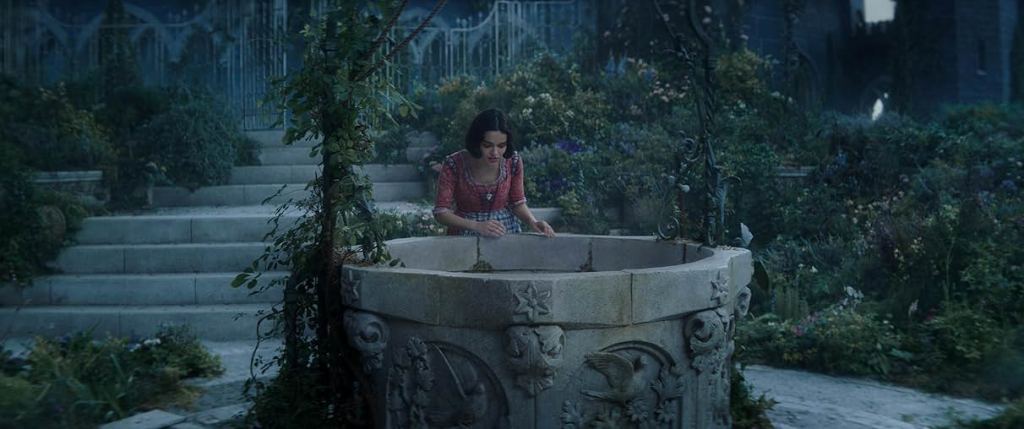
I took the daughter and the wife to see Snow White (2025). It was okay for children – probably too long. I found the acting wooden and the pacing tedious. However, the new songs were quite delightful. My wife has been listening to them—so, compliments to Disney on the music – and – on the terror.
For the uninitiated, Snow White, or Sneewittchen, is a terrifying folk-tale of jealousy, attempted murder, treachery, and revenge. The Brothers Grimm codified the contemporary narrative in the early 19th century. The protagonist is a fair princess with “skin as white as snow, lips as red as blood, and hair as black as ebony.” This princess, named Snow White, is persecuted and made a servant by her jealous stepmother, who also happens to be a witch. The stepmother is vain and obsessed with her own beauty. Her vanity is reinforced by a magical mirror which regularly reports that she is the “fairest in all the land.” Then, Snow White reaches marital age, at which point, the mirror declares the upcoming princess soon to be the fairest. To stop Snow White’s ascension, the jealous Queen orders the royal huntsman to take Snow White into the woods and murder the teen.
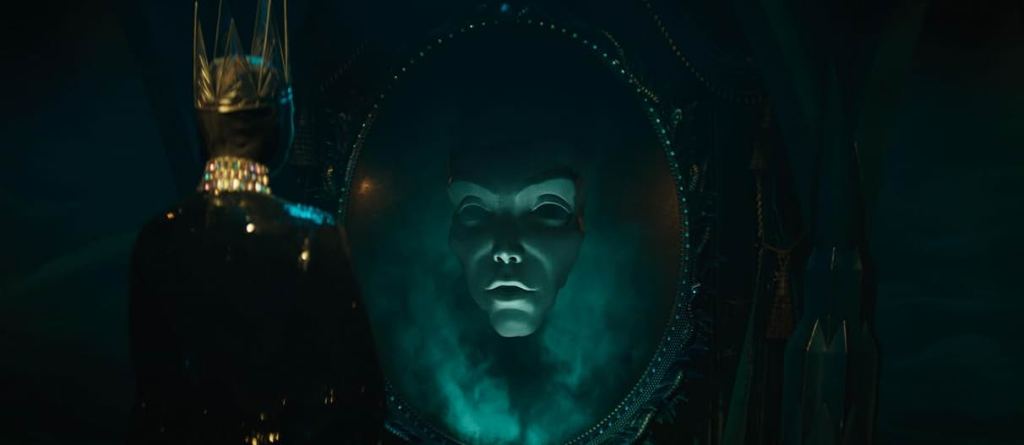
As is customary in Christian mythology vanity and jealousy and self-worship are obviously treated as evil. The Queen’s vanity and usurpation of the rightful heir, Snow White, are inherently tied together. Her corruption is redoubled with the forced servitude of Snow White, whose beauty shines through regardless. The very existence of a rightful heir, and a beautiful one, threatens the Queen’s vainglorious rule.
This is of course the ‘hero’s journey,’ the reclamation of aristocratic status, but applied to a young lady, rather than a usurped prince. Snow White is a woman. She doesn’t fight, she remains demure, beautiful, chaste, and amenable to services and labors of the “fairer,” sex. Her innocence saves her from machinations.
Biblical allegory takes over at this point in the story. The huntsman takes pity on Snow White. Here, the Huntsman chooses an animal’s life over that of the princess, like when God steps in to save Isaac. He kills the boar instead of the princess and returns to the Queen with the animal’s liver and lungs (sometimes it is the heart).
Snow White flees to the woods where she finds a home filled with seven dwarfs. There, her kindness, beauty, and cleaning services are rewarded with room and board and loyalty. But, the mirror sees through the huntsman’s ruse. It reports Snow White’s location to the Queen. The evil witch concocts a series of elaborate ruses to poison Snow White. Her most successful is a poisoned apple. It becomes lodged in Snow White’s throat. The princess goes into an eternal sleep. Her loyal dwarves find her and are devastated. They place her in a glass coffin because she’s eternally asleep, not dead, and still beautiful and not a rotting corpse.
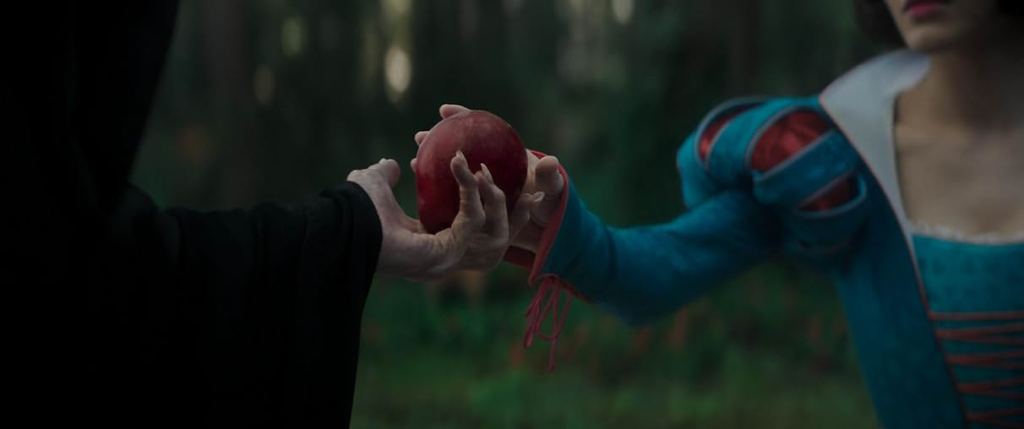
Apples are known for doing horrible things. The most horrible being imparting humanity with an understanding of good and evil and getting us ejected from the Garden of Eden. This is a slander of course, because technically, the original “fruit from the tree of knowledge,” was probably not an apple, but a fig or pomegranate. Adam and Eve start eating the apple later in the Roman world. There, the Latin word “malus,” which means both “bad” and “apple,” probably contributed to the association. Since then, the apple has become synonymous with unholy temptation. It is the type of thing that would imperil a beautiful young maiden.
A prince comes along the next Spring. He falls deeply in love with Snow White’s beauty and innocence and accidentally dislodges the piece of apple from her throat (an early instance of the Heimlich, I guess). Snow White wakes, she marries the prince, and the evil Queen is forced to dance herself to death wearing red-hot iron shoes at the wedding. This is fairly standard for pre-2000 German folklore.
Ironically, it was Walt Disney’s Snow White and the Seven Dwarfs (1937), that introduced the prince kissing the unconscious princess. Disney got this from Romeo and Juliet, and to reinforce the relationship he front-loads Snow White’s meeting the prince at the beginning of the story. He also has the evil Queen by lightning strike. Still, he kept a lot of the other stuff.
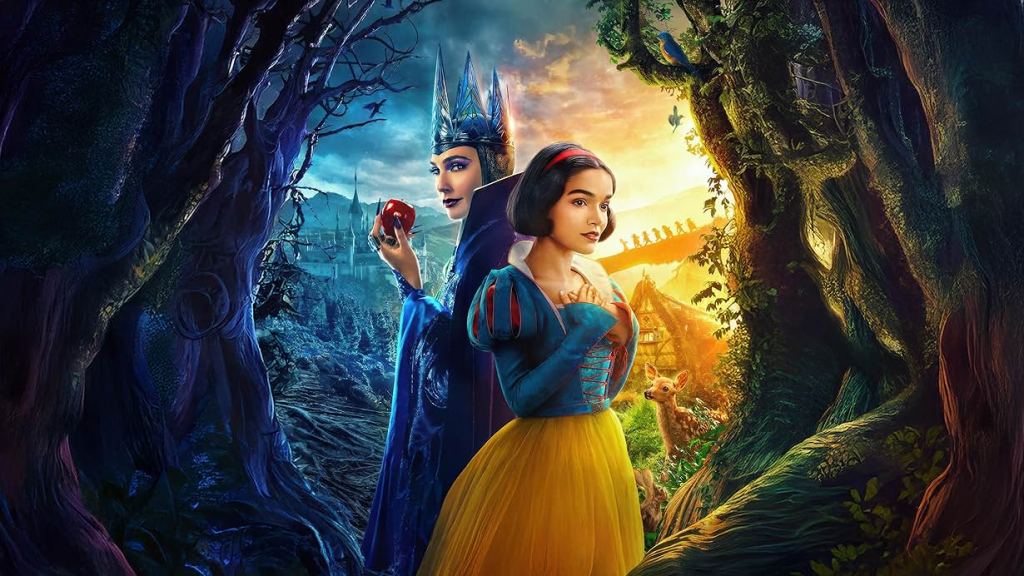
Disney’s most recent Snow White (2025) leaves out the dead animal organs, the ritual sacrifice, the singing footwear, and the standard Christian folkloric rewards for women to remain demure. So, you’d think it wouldn’t be scary.
Still, my daughter had her first Snow White nightmare. I had hoped it was from Gal Gadot’s transformation into a grotesque scheming witch. I previously lamented the loss of one and only Wicked Witch of the West (See: My Previous Article) to Wicked (2024), and hoped we got a new wicked witch. Unfortunately, it wasn’t the witch, but the apple(!) and Snow White’s descent into a permanent slumber that precipitated the nightmare.
It turns out, that even if you take out all the other stuff, for a child, the prospect of going to sleep and not waking up remains a terrifying possibility.
So, kudos to the folks at Disney. Although you tried hard to nerf a terrifying story of human sacrifice and resurrection, you captured and sold a work of existential dread, and just in time for Easter!

 NightTide Magazine
Leave a comment