An Exploration of The Menu, House of Spoils, and What You Wish For
By Sarah Anne Stubbs
Have you ever taken a trip because you heard about a great restaurant that could change your life? If so, you’ve experienced a phenomenon known as destination dining. According to Bon Appetit, “Destination dining is a form of entertainment, where the restaurant visit brings as much magic as traveling for a Taylor Swift or Beyoncé concert or staging a selfie in front of a landmark. Restaurants and cafés are among the first lines of cultural exchange, where diners can experience cuisines in different contexts with new interpretations.” (Robinson) One of my most formative memories is traveling through Northern California with my sister Jessica and dining at restaurants like Chez Panisse and The French Laundry. I was 13 and likely too young to truly understand how special these restaurants were (and still are). Yet, it changed me. Food became more than just something you eat, it became an experience.
When looking at destination dining through the lens of gastro horror, there are a few movies that come to mind: The Menu, House of Spoils, and What You Wish For. One could even make a case for Motel Hell being a precursor. After all, leaving with some of Farmer Vincent’s Famous Fritters isn’t an experience anyone is soon to forget. Heck, even Scooby-Doo has a spooky case that features destination dining in Scooby-Doo and the Gourmet Ghost. As time has moved on, so has what we consider a destination experience. Social media and influencers have made an industry that was already fairly elitist even more so because FOMO sells and fills seats. Now we are starting to see these experiences reflected in gastro horror.
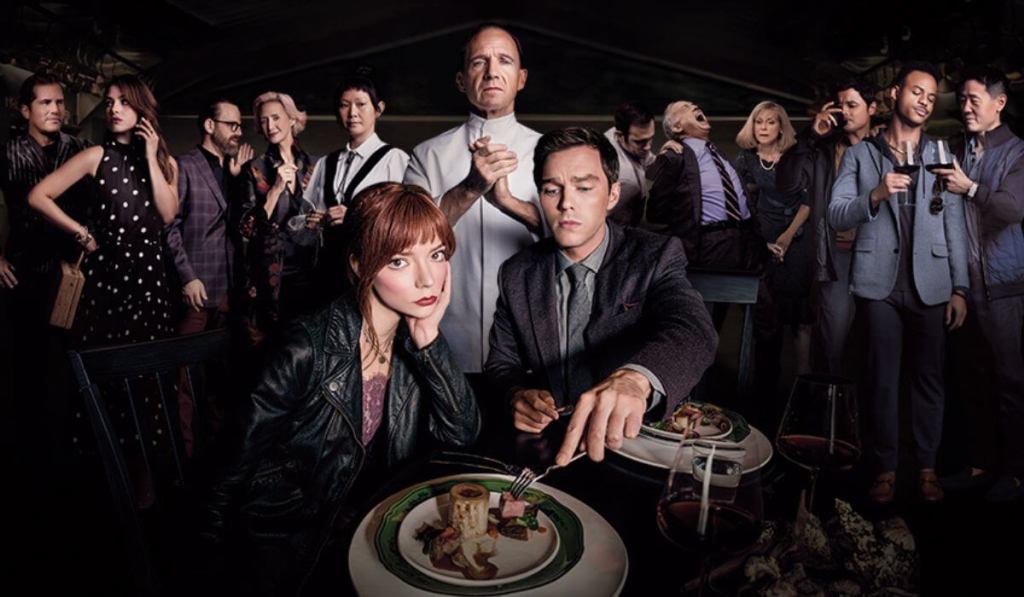
In The Menu, Hawthorn was created to evoke the very best of a global fine dining destination. According to the production notes, “the production team used several famous restaurants as inspiration for the set design as well as the dishes themselves, including the now-closed Swedish restaurant Fäviken, helmed by chef Magnus Nilsson, the acclaimed Catalonian restaurant El Bulli, envisioned by chef Ferran Adrià, Thomas Keller’s French Laundry located in Sonoma, and the work of René Redzepi, chef of Danish destination restaurant Noma.” Similarly, according to House of Spoils co-director Bridget Savage Cole, “it was always a destination dining experience that was crucial to the story. Noma and Blue Hill in upstate were early inspirations.” (Searchlight Pictures)
In addition to Noma being an inspiration, The Menu and House of Spoils have a shared connection to Dominique Crenn. She was a consultant on The Menu and is mentioned in House of Spoils. Her restaurant, Atelier Crenn, is a Michelin-starred restaurant that is considered one of the foremost dining destinations.
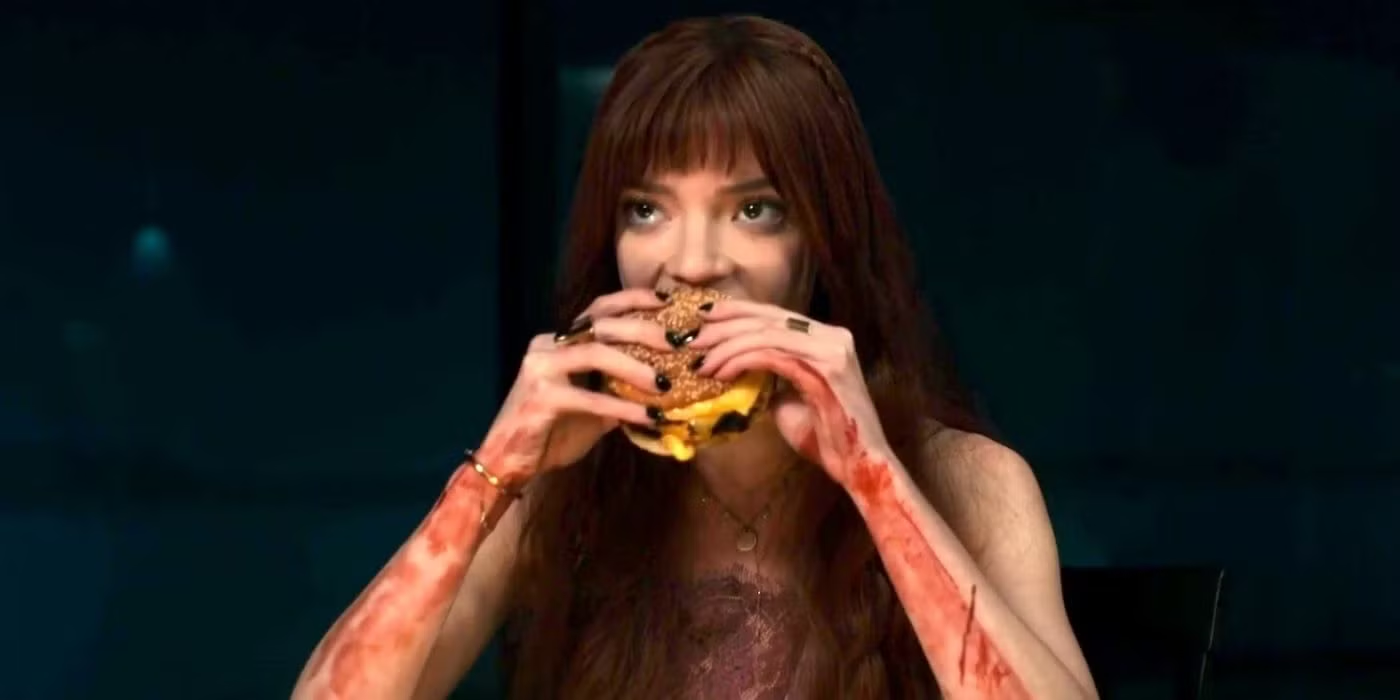
A bit different but in the same vein, you have What You Wish For. Instead of a specific restaurant, the film features the elite traveling to different destinations to be cooked for by a private chef. Early in the film, Jack tells Ryan, “a lot of rich people, they just want an extraordinary experience. Director Nicholas Tomnay explained further that “the idea of showing how the wealthy at that level seem to seek novelty (like space exploration) became very appealing.” This difference, as well as the cannibalism, sets this film apart from the other two.
Additionally, each film had other inspirations as well. Will Tracy, the screenwriter for The Menu, shared a story in the production notes about how, just like the characters in the film, he took a boat to a fancy restaurant on a nearby private island. “I’m a bit claustrophobic, and as we sat down to eat, I saw the boat that dropped us off leaving the dock,” Tracy recalled. “It was a small island. And I realized, ‘Oh, we’re stuck here for four hours. What if something goes wrong?’” (Searchlight Pictures)
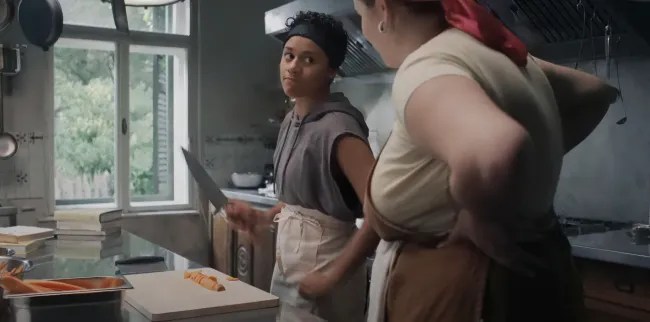
Bridget Savage Cole recollected about the experiences that became influential to the writing of House of Spoils, “while we aren’t exactly in the financial bracket to be hitting Michelin starred restaurants all the time, we both drew from exceptional dining experiences we have had as well as opportunities we’ve had to work in exceptional restaurants as well. We would talk about “transcendent bites,” or moments where we remember food creating transcendent experiences for us, pulling us into the present and leaving us vibrating at a new level; the same feeling we may get experiencing exceptional art or music. When I was fresh out of college, I worked as a waitress in a fine dining restuarant in Bar Harbor, Maine called ‘Havana,’ and I still remember joining a staff tasting for this one dish, it was a pork chop over a plantaine and pancetta ragout, I had never realized food could be that elevated and it’s a bite I can almost taste today. I remember another experience in Mexico City, I was working on a commercial and somehow lucked into an agency dinner at Pujol, I still remember how magical each course tasted. Their 5-year-old mole…delicate amuse bouches, even a course with tree ants, I felt like each course heightened my senses and brought me truly into the present moment, and it was downright holy.”

I asked What You Wish For director Nicholas Tomnay about whether or not he had his own experiences with destination dining that influenced the film, and he replied, “No, not really. I love going to restaurants. I do a lot of cooking at home for my family, so wherever I have the opportunity to go out to a nice restaurant, I’m very happy. Someone skilled in cooking for me is a luxury I enjoy.” This reflects a lot in the film, given that Ryan/Jack cooks for the guests in a way that anyone would consider a luxury, cannibal or not. Yet, when we first see his cooking prowess, he is cooking an omelet for himself. Something most folks would feel comfortable cooking for themselves at home.
All three of these films use destination dining as a means of exploring the common theme of elitism. In The Menu and House of Spoils, we have investors and wealthy elite using their status to control the creative natures of Chef Slowik (The Menu) and Chef (House of Spoils). Both chefs end up pushing back on this with satisfying results in both cases. Furthermore, those who are fortunate enough to dine with both don’t truly appreciate the blood, sweat, and tears (both literally and figuratively) that go into the meal being served to them. The investors don’t care about those in the kitchen and will overlook what those folks gave up. They only care about the bottom line.
House of Spoils also addresses the misogyny, another form of elitism, in the restaurant industry. Chef (who, interestingly enough, is never given a name) constantly has to work harder than anyone else. When she tells her executive chef, Magnus, that she plans on going out on her own, she’s told that she’s a good soldier, not a good boss. This industry standard is interesting considering that a favorite line of misogynists is that “women belong in the kitchen,” yet this is not true when power is involved. When male chefs are tough, they are a “strong leader” yet when a woman behaves similarly, they are a “bitch.”
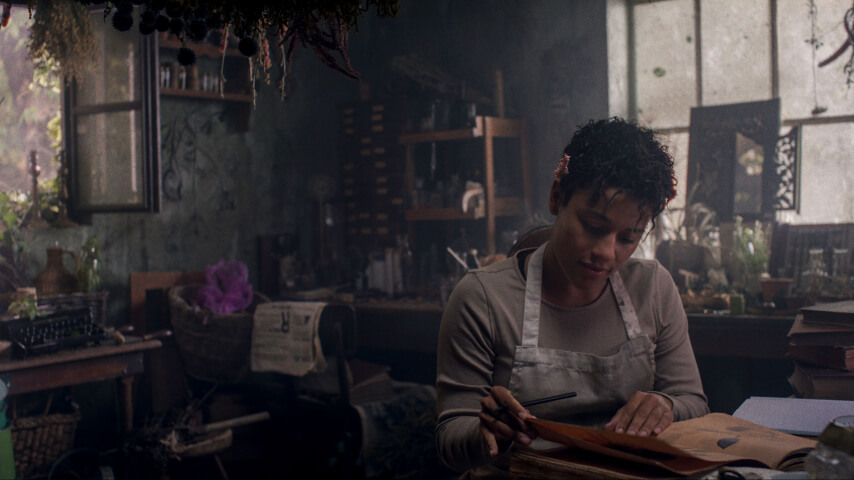
What You Wish For plays with the idea of the novelty of the wealthy traveling to consume those they deem “less than” (versus consuming the talent of others). Tomnay said, “Imogene makes a speech to Ryan, justifying how she sleeps at night, and also as a sort of creed for how the agency ( the corporation in the film) can do what they do in the name of profit. Eating the poor to please the rich felt like a good metaphor for that moment. That’s also why the film ends the way it does. I wasn’t interested in invoking these ideas, of greed and envy and corporate profit, and have it ‘all work out in the end’. That felt very wrong to me. That felt like a sedative.” The idea that these people see their cannibalism as justified because it “helps the local economy” and “kills less people than labor jobs” feels like a step further than the justification we see for cannibalism in Motel Hell where Farmer Vincent claims that he’s helping the overpopulation of the world by reducing the populus and creating a sustainable food source. When the ethics of playing God come into question, his own elitism shows when he replies, “I’m not trying to play god, I’m just helping out.”
As someone who has watched the dining scene evolve over the last decade and was actively involved in creating food content, I think these films all have a lot to say about the impact of FOMO and influencer culture. Consumerism of the 1980s looks like child’s play compared to today, as we see when we compare all of the films discussed here. To engage more with these films, I’ve created a list on Letterboxd of the films that the filmmakers have mentioned were influential to them. (Sorry Nick) The films mentioned in this article are favorites of mine already, but like a good amuse bouche, seeing what came first only enhances your experience.
Works Cited
Robinson, Jamila. “How Destination Dining Transforms Travel.” Bon Appétit, 18 March 2025. 22nd April 2025. <https://www.bonappetit.com/story/how-destination-dining-transforms-travel>.
Searchlight Pictures. “The Menu- Production Notes.” 14th November 2022.



 NightTide Magazine
Leave a comment