Childhood trauma follows you everywhere. Writer/Director Paul Etheridge’s ‘The Other’ tackles trauma, societal expectations on women and the danger living inside of all of us.
Unable to conceive, a couple seeks to build a family with a young orphan, survivor of a tragic childhood. But their act of love turns to horror when they realize the violence in their foster’s past has returned to destroy the new family.
You know we love a creepy kid….and a creepy mom…and a dad forced to figure it all out. So thank Writer/Director Paul Etheridge for The Other!
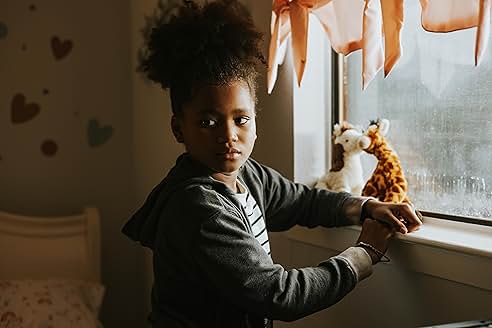
When 11-year-old Kathelia (Avangeline Friedlander) arrives at the home of her new adoptive parents, Robin (Olivia Macklin) and Daniel (Daniel McTee), the house feels pristine but unmoving. Its a place where time hasn’t so much passed as been held at arm’s length. Kathelia, a Black child left mute by the loss of her biological family, enters a white suburban home thick with unspoken expectation, a space where a multi-cultural adoption is treated as a neat solution to grief.
Daniel greets her with a careful distance, unsure how to appropriately deal with her silence, while Robin overcompensates, her early warmth quickly sharpening into urgency. When Kathelia doesn’t “settle” into the life Robin has imagined, something in her begins to fray. Macklin plays Robin’s descent like a woman possessed (haha!). Her conviction that Kathelia is “not right” turns into a fixation that something else, something older, might be living inside her.
The film lingers on unsettling details: Robin standing too long at Kathelia’s doorway, the way objects in the house are never moved, Daniel catching fragments of whispers when no one is speaking. Kathelia’s occasional utterances in a strange voice are never explained, keeping the audience consistently disquieted.
Daniel’s quiet bond with Kathelia becomes the film’s heartbeat, though he is often in the dark himself. Etheridge avoids answers, leaving shadows where explanations might be. The question is not whether something is inside Kathelia, but whether it has always been there and whether death, for some, is less an ending than an uninvited return.
Mo Moshaty
Mo Moshaty is an acclaimed horror writer, lecturer, and producer whose work combines visceral storytelling with the psychological insight of her Cognitive Behavioral Therapy background. She has lectured internationally, including as a keynote speaker at Nightmares from Monkeypaw: A Jordan Peele Symposium (Prairie View A&M), No Return: A Yellowjackets Symposium (Horror Studies BAFSS Sig), The Whole Damn Swarm: Celebrating 30 Years of Candyman (University of California), and with the Centre for the History of the Gothic (University of Sheffield). Mo has also presented at the BFI, Miskatonic Institute of Horror Studies, and Final Girls Berlin Film Festival’s Brain Binge on women’s trauma in horror cinema, Cine-Excess on The Creepy Kid Horror Subgenre and Mother/Daughter Trauma in Horror, and Romancing the Gothic on Cosmic Horror’s Havoc on The Body Electric Her short film, 13 Minutes of Horror: Sci-Fi Horror, won the 2022 Rondo Hatton Classic Horror Award for Best Short Film. As a core producer with Nyx Horror Collective, Mo co-created the 13 Minutes of Horror Film Fest and partnered with Shudder in 2021 and 2022, while also establishing a Stowe Story Labs fellowship supporting women creatives over 40+ in horror. A member of the Black Women in Horror Class of 2023 and featured in 160 Black Women in Horror, Mo’s short fiction appears in A Quaint and Curious Volume of Gothic Tales (Brigid’s Gate Press) and 206 Word Stories (Bag O’ Bones Press). Her debut novella, Love the Sinner, released July 5, 2024, with Clairviolence: Tales of Tarot and Torment released in October 2025. The first of her five volume non-fiction series: The Annex of the Obscure: The Afterlife, will be released in 2026 from Tenebrous Press. As the Editor-in-Chief of NightTide Magazine and founder of Mourning Manor Media, Mo champions marginalized voices in horror. Under her leadership, NightTide plans to launch a film festival in 2026, furthering her mission to reshape the genre through inclusivity and representation.



 NightTide Magazine
Leave a comment