In Italy’s happiest village, a haunted teacher discovers dark secret behind weekly gatherings where locals seek healing from a teenage boy’s embrace. His quest to save the youth reveals the sinister nature of a community hiding behind joy.
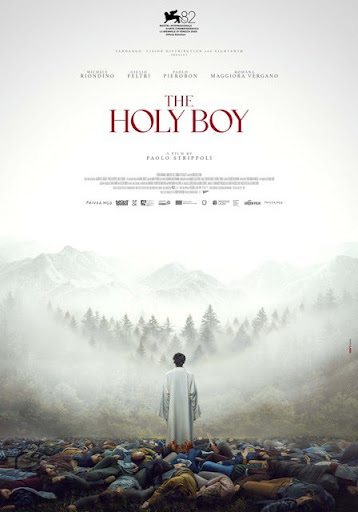
Italy’s happiest village is haunted, though not by ghosts. In Paolo Strippoli’s The Holy Boy (La valle dei sorrisi), the specter is grief itself. After a catastrophic train crash wipes out half the population, the survivors of Remis find a peculiar balm: weekly gatherings to embrace a teenage boy named Matteo (Giulio Feltri). His arms offer what pills, prayers, and time cannot, a momentary reprieve from absence. It’s no wonder the townspeople line up like Shake Shack.
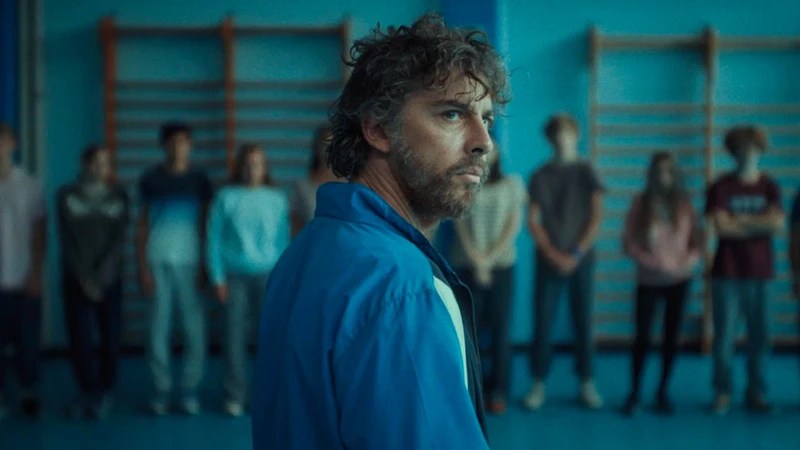
At first, teacher Sergio (Michele Riondino) watches with disdain. He sees hysteria where others see healing, sycophants where others see disciples. But then he too accepts Matteo’s embrace, and what follows is less a conversion than a slow erosion. Once touched, grief feels both sharper and easier to bear, like a wound that begs to be pressed again. The danger isn’t just that Sergio joins the cult of comfort, but that his intimacy with Matteo threatens the delicate choreography of denial the entire town depends on.
Strippoli, co-writing with Jacopo Del Giudice and Milo Tissone, places this unraveling in a valley of perpetual smiles. Sunlight spills across cobblestones, laughter hums in the background, and yet the happiness looks airbrushed, strained. The film’s horror doesn’t come from shadows lurking in corners but from touch itself, an embrace that soothes, consumes, and repeats until there’s nothing left but need. Matteo’s father Mauro (Paolo Pierobon) gladly exploits the boy’s status, basking in the reflected glow of a son mistaken for a saint. Even Michaela (Romana Maggiora Vergano), the barkeep who tries to offer Sergio joy the old-fashioned way, leads him first to Matteo’s arms. In The Holy Boy, grief isn’t an individual affliction. It’s a communal faith.
Horror has been circling grief for decades now, as if each filmmaker is trying to solve the riddle of mourning with genre tools. Jennifer Kent’s The Babadook (2014) told us grief can’t be destroyed, only fed and kept at bay. Ari Aster’s Hereditary (2018) suggested grief is an inheritance we can’t escape, passed down like cursed family heirlooms. Danny and Michael Philippou’s Talk to Me (2023) turned grief into a party drug, letting teens chase lost loved ones through a possessed hand, and let’s not forget Bring Her Back (2025), where the boundaries of body, spirit and torture are constantly pushed for the promise of a reincarnated embrace. Each film underscores the same truth: we’ll do almost anything not to feel the full weight of absence.
Where The Holy Boy diverges is in scale. Most grief horror traps us in the isolation of the mourner. Strippoli asks: what happens when an entire community conspires to forget? The answer is unsettling: grief doesn’t vanish, it metastasizes. Matteo’s embrace becomes less about healing and more about erasure, a narcotic ritual that binds everyone in complicity.
This is the sly brilliance of The Holy Boy: it suggests consolation itself can be monstrous. The film refuses the neat arc of “acceptance” we’re taught to crave. Instead, it lingers in that dangerous middle ground, where sorrow is smoothed over, not processed. The smiles in the valley are masks stretched taut, and beneath them, grief is ravenous.
In the end, Strippoli asks us to fear what we’ll sacrifice for the illusion of relief and perhaps most chillingly, he shows us how dangerous consolation can be when it becomes a creed.
Mo Moshaty
Mo Moshaty is an acclaimed horror writer, lecturer, and producer whose work combines visceral storytelling with the psychological insight of her Cognitive Behavioral Therapy background. She has lectured internationally, including as a keynote speaker at Nightmares from Monkeypaw: A Jordan Peele Symposium (Prairie View A&M), No Return: A Yellowjackets Symposium (Horror Studies BAFSS Sig), The Whole Damn Swarm: Celebrating 30 Years of Candyman (University of California), and with the Centre for the History of the Gothic (University of Sheffield). Mo has also presented at the BFI, Miskatonic Institute of Horror Studies, and Final Girls Berlin Film Festival’s Brain Binge on women’s trauma in horror cinema, Cine-Excess on The Creepy Kid Horror Subgenre and Mother/Daughter Trauma in Horror, and Romancing the Gothic on Cosmic Horror’s Havoc on The Body Electric Her short film, 13 Minutes of Horror: Sci-Fi Horror, won the 2022 Rondo Hatton Classic Horror Award for Best Short Film. As a core producer with Nyx Horror Collective, Mo co-created the 13 Minutes of Horror Film Fest and partnered with Shudder in 2021 and 2022, while also establishing a Stowe Story Labs fellowship supporting women creatives over 40+ in horror. A member of the Black Women in Horror Class of 2023 and featured in 160 Black Women in Horror, Mo’s short fiction appears in A Quaint and Curious Volume of Gothic Tales (Brigid’s Gate Press) and 206 Word Stories (Bag O’ Bones Press). Her debut novella, Love the Sinner, released July 5, 2024, with Clairviolence: Tales of Tarot and Torment released in October 2025. The first of her five volume non-fiction series: The Annex of the Obscure: The Afterlife, will be released in 2026 from Tenebrous Press. As the Editor-in-Chief of NightTide Magazine and founder of Mourning Manor Media, Mo champions marginalized voices in horror. Under her leadership, NightTide plans to launch a film festival in 2026, furthering her mission to reshape the genre through inclusivity and representation.
Mo Moshaty
Mo Moshaty is an acclaimed horror writer, lecturer, and producer whose work combines visceral storytelling with the psychological insight of her Cognitive Behavioral Therapy background. She has lectured internationally, including as a keynote speaker at Nightmares from Monkeypaw: A Jordan Peele Symposium (Prairie View A&M), No Return: A Yellowjackets Symposium (Horror Studies BAFSS Sig), The Whole Damn Swarm: Celebrating 30 Years of Candyman (University of California), and with the Centre for the History of the Gothic (University of Sheffield). Mo has also presented at the BFI, Miskatonic Institute of Horror Studies, and Final Girls Berlin Film Festival’s Brain Binge on women’s trauma in horror cinema, Cine-Excess on The Creepy Kid Horror Subgenre and Mother/Daughter Trauma in Horror, and Romancing the Gothic on Cosmic Horror’s Havoc on The Body Electric Her short film, 13 Minutes of Horror: Sci-Fi Horror, won the 2022 Rondo Hatton Classic Horror Award for Best Short Film. As a core producer with Nyx Horror Collective, Mo co-created the 13 Minutes of Horror Film Fest and partnered with Shudder in 2021 and 2022, while also establishing a Stowe Story Labs fellowship supporting women creatives over 40+ in horror. A member of the Black Women in Horror Class of 2023 and featured in 160 Black Women in Horror, Mo’s short fiction appears in A Quaint and Curious Volume of Gothic Tales (Brigid’s Gate Press) and 206 Word Stories (Bag O’ Bones Press). Her debut novella, Love the Sinner, released July 5, 2024, with Clairviolence: Tales of Tarot and Torment released in October 2025. The first of her five volume non-fiction series: The Annex of the Obscure: The Afterlife, will be released in 2026 from Tenebrous Press. As the Editor-in-Chief of NightTide Magazine and founder of Mourning Manor Media, Mo champions marginalized voices in horror. Under her leadership, NightTide plans to launch a film festival in 2026, furthering her mission to reshape the genre through inclusivity and representation.

 NightTide Magazine
Leave a comment