
By Julian Singleton

By the summer of 2004, the “J-Horror” phenomenon had reached critical mass. Hideo Nakata was directing Hollywood’s The Ring Two; Takashi Shimizu was remaking his own Ju-on as The Grudge; and Taka Ichise, producer of both, unveiled J-Horror Theater: an omnibus uniting the genre’s leading figures. Coupled with his pre-sale of remake rights abroad, this marked the first time “J-Horror” was explicitly packaged in Japan as both brand and canon–one nearly two decades in the making, primed for global export. And yet, when asked about the term’s origin in an interview, Ichise shrugged: “Maybe I saw it written somewhere and took to saying it because it’s handy…it was somebody else’s creation. I have no idea whose, though.”
Ichise’s candor exposes the genre’s strangest paradox: how could a movement so internationally visible and successful lack an origin story for its own name? As Michael Crandol argues in Ghost in the Well, the label encodes this ambiguity in its very construction–pairing an exonymic “J” for Japan with the imported loanword horā to suggest both global consumption and local specificity. Yet despite a clear canon and worldwide reach, no one has definitively proven whether the label first appeared in Japan or abroad.
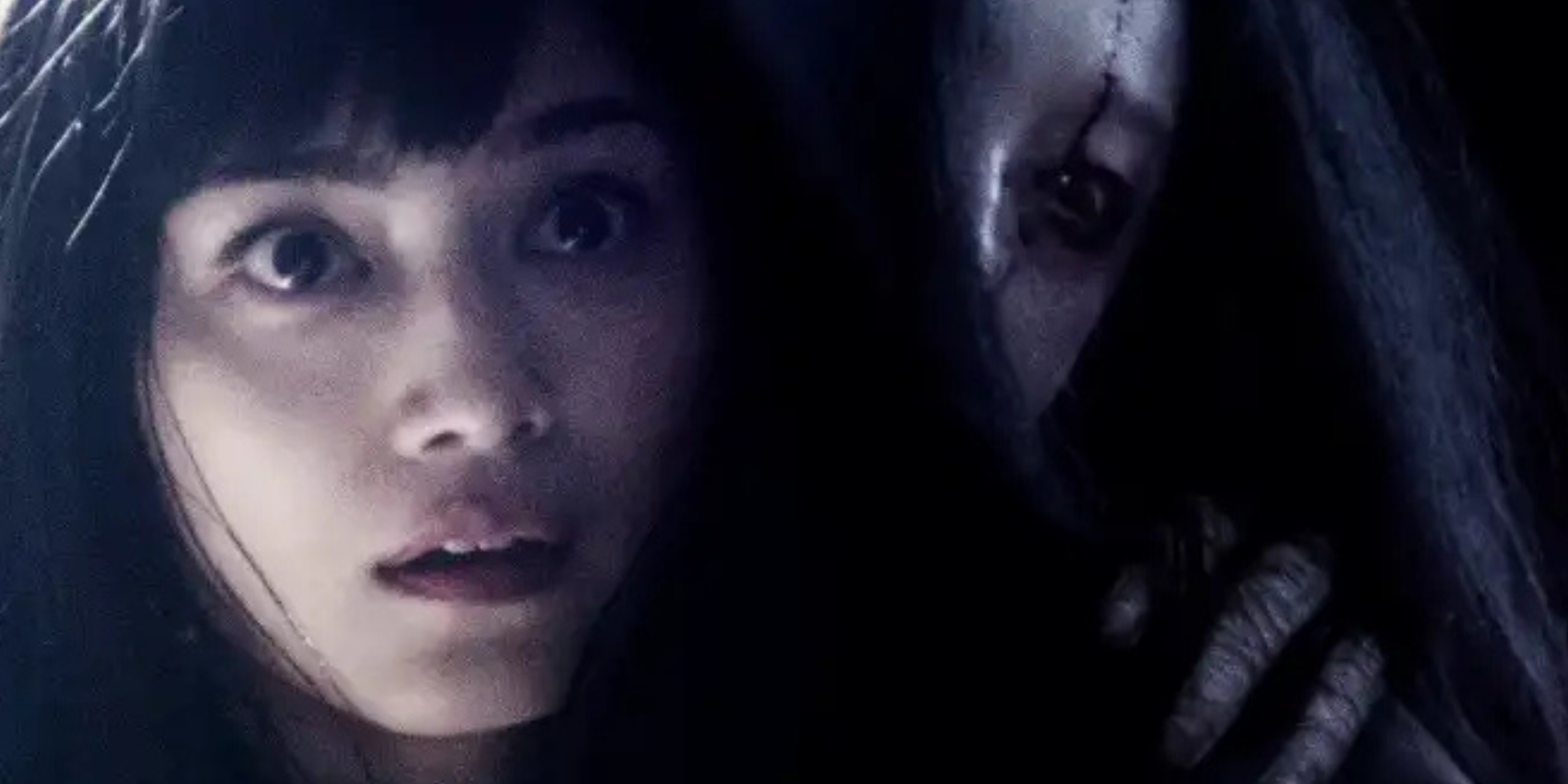
Still, “J-Horror” conjures instant images: Sadako crawling from her well, Kayako dragging towards petrified victims. Words, like these ghosts, defy language and location, stirring fear and meaning wherever they appear. For a genre rooted in viral toshi densetsu—urban legends spreading like curses—“J-Horror” likewise carries an etymology as elusive as its specters. Retracing its history becomes a linguistic treasure hunt, revealing how words migrate, mutate, and accrue power, haunting collective memory much like the ghosts they name.

Distribution
Crandol’s exonymic reading of “J-Horror” and Ichise’s savvy branding suggest the label functioned less as a natural descriptor than as a reactive marker, framing and isolating both what came from Japan (Ring, Ju-on) and what emerged abroad (The Ring, The Grudge). But the production notes for the film that ignited the Hollywood remake wave complicate this view: DreamWorks’ 2002 notes for The Ring already call both Nakata’s Ring and Kōji Suzuki’s novel “J-Horror.” If borrowed, the phrase positioned The Ring as the crystallizing moment of a genre whose name was already circulating with some cultural weight. But if awareness of “J-Horror” was still limited before The Ring, who first introduced the term into the lexicon—and who held the authority to make it stick?
For many Western fans coming off The Ring and The Grudge, the real gateway into Asian horror was a logo: Tartan Video’s black-and-yellow “Asia Extreme.” Between Nakata’s Ring and Takashi Miike’s Audition, the UK distributor built a brand synonymous with rebellious danger—a dubious promise that anything stamped “Asia Extreme” would deliver “cultural hand grenades” beyond Western norms. Paired with Media Blasters’ U.S. “Tokyo Shock” label, it’s no surprise that fan forums and horror outlets (Buscher, Fangoria) still circulate the urban legend that these distributors allegedly invented the phrase “J-Horror.”
The myth makes sense: for most English-speaking audiences, early access to Asian horror at large was almost entirely mediated by these labels. Under Asia Extreme, Tartan bundled canon entries like Dark Water alongside Korean provocations from Park Chan-wook or Kim Ki-duk. More narrowly, Media Blasters’ Tokyo Shock packaged together Thai and Korean oddities like Red Eye and Art of the Devil. Together, they collapsed diverse national cinemas into one “extreme” package—reinforcing the idea that J-Horror was as much a marketing category as a cultural one, an exotic brand designed to pop on shelves.
Yet the record tells another story. Outside of J-Horror Theater releases, neither distributor used the term before 2002. In fact, Tartan’s sole other mention came in 2005, when Tartan USA president Tony Borg criticized how “most horror films released in the U.S. are improperly named ‘J-Horror’ even when they are Korean.” Far from coining the phrase, distributors seem to have adopted a vocabulary already in circulation.
Still, distributors’ blanket-style marketing carried a lasting double edge. As Chi-Yun Shin notes, Asia Extreme and similar labels reinforced a Western gaze of the East as “weird and wonderful, sublime and grotesque.” Even without explicitly using “J-Horror,” such branding reshaped its meaning in the West: a catch-all for supernatural Asian horror, stripped of cultural context and recast as a commercial signifier.
This semantic blurring was emblematic of larger trends. By the late 2000s, films like Hong Kong’s The Eye and South Korea’s A Tale of Two Sisters were swept into the fading J-Horror remake boom; even Thailand’s Shutter was relocated to Japan for its U.S. remake under J-Horror Theater alumnus Masayuki Ochiai. In the process, “J-Horror” itself grew elastic—encompassing decades of Japanese horror far beyond Sadako’s well or the Ju-on house. Distributors may not have coined the term, but their marketing ensured that for Western fans, J-Horror meant something broader—and blurrier—than it ever did in Japan.


Codification
Such elasticity points toward another cinematic point of entry: critics and festivals tasked with framing this “new wave” of Japanese horror. Tom Mes, co-founder of Midnight Eye, traced the label’s first major usage to a January 2002 Film Comment feature by Alvin Lu. In conversation, Lu credited his editor Chuck Stephens for introducing the term into his work; Stephens, in turn, recalled borrowing the phrase for a 2001 PULP review of Uzumaki (of which Lu, circularly, was Editor-in-Chief) from the “fanboy shorthand” of cult zines like Asian Trash Cinema. None claimed ownership, but their deployment legitimized “J-Horror” in print at the same moment DreamWorks marketed it as already familiar.
Festivals reinforced the frame. Fantasia 1999 and Rotterdam 2000 grouped films like the Ring cycle and its Korean remake The Ring Virus alongside Cure, Audition, Gemini, and Shikoku, often under alternate banners such as “Japanese Horror Revival” or “Kadokawa Horrors.” As Ring screenwriter Hiroshi Takahashi notes in The J-Horror Virus, Japanese audiences still understood these films by directors—Miike, Kurosawa, Nakata, Tsukamoto—rather than by genre. Echoing Ichise’s own admission, Virus documentarian Jasper Sharp recalls that many filmmakers “weren’t aware they were operating in a genre…because the label didn’t come from Japan,” and that Ichise only pursued J-Horror Theater after recognizing foreign demand.
Through critics’ legitimization and festivals’ curation, audiences learned to view a constellation of otherwise disparate films not as isolated works but as a branded wave: the phenomenon we now call “J-Horror.”

Definition
Alongside festival success, “J-Horror” also flourished in digital shadows. Early forums were Petri dishes for cult terminology: I first encountered the word on Ringworld and the IMDb boards, where “what should I watch next?” threads unfolded amid the scarcity of accessible titles. Jasper Sharp recalled much the same to FANGORIA, remembering when “the term was coined on an English-language Internet forum,” later clarified as the dormant MHVF.net.
Much of that early web has since vanished. Ringworld, the IMDb boards, and Usenet survive only in fragments for amateur archivists to piece together. Yet those fragments reveal a crucial pattern, and perhaps the earliest English usage of “J-Horror.” After Ring’s landmark Western debut at Fantasia 1999, alt.horror threads lit up. On November 1, 2000, a user named Latte Thunder wrote: “While everyone into J-Horror is gushing over the zombie mayhem that is Junk, I think Wild Zero is a far better movie.” Within a year, the term resurfaced in debates over films like Entrails of a Virgin: “They just don’t make movies like this in America—Uninhibited sleaze and violence.”
As Tom Mes later noted, “J-Horror” at first encompassed anything Japanese and horrific—from Ring’s subdued shocks to pinku-violence splatter. It was less a genre than a pragmatic shorthand for fans cobbling together watchlists. Alvin Lu’s widespread 2002 Film Comment feature may have shifted the term’s meaning, pinning it to a narrower original canon of atmospheric, supernatural shinrei-mono-eiga like Ring and Ju-on. After DreamWorks’ Ring remake that fall, Mes speculates the label may even have been “reimported” back into Japan—offering a convenient frame for a cycle already seen domestically as winding down after box office disappointments like Kiyoshi Kurosawa’s Pulse. By then, what began as messy fan jargon had hardened into a recognizable global brand.
But codification carried costs. In his 2005 essay “The Death of J-Horror,” Nicholas Rucka argued that the label’s fan-forged origins sowed the same reductive impulses later magnified by zealous distributors. A clarifying shorthand soon ossified into a framework that forced together films resistant to categorization. With its “whiff of Orientalism,” the term became an outsider’s narrative—flattening distinctions within Japanese cinema while dragging in other Asian traditions as collateral.
I agree that overuse of the label fueled market saturation, with derivatives and remakes of long-haired yūrei crowding global screens. Yet Rucka’s framing misses a crucial complication: the “J-” prefix itself carries a distinct cultural history in Japan, and evidence suggests “J-Horror” appeared in Japanese media even before it circulated in Western fan spaces.

J-Origins
Even before the rise of a new horror wave, Japan had already embraced the “J-” prefix as national branding. As Lindsay Nelson notes, labels such as “the mobile phone company ‘J-Phone’ and the term ‘J-Pop’ for Japanese pop music” were part of a broader strategy to market Japanese products and culture with a sleek, export-ready identity. Jasper Sharp echoes this, observing how the Western surge of “J-Horror” coincided with the global boom in J-Pop-ularity.
Via email, film historian Noriaki Miyamoto traces this branding impulse back to the privatizations of the 1980s under Prime Minister Yasuhiro Nakasone. Public entities like Japan Tobacco (JT) and Japan Railways (JR) reemerged with streamlined, global-facing names, a logic that spilled into national culture. Alongside J-Pop, the J-League gave soccer teams cosmopolitan identities, and J-Bungaku tagged a youth-oriented literary style. As Tom Mes elaborates, “J-” connoted modernity and cosmopolitanism—deliberately fashionable, even “non-Japanese” in effect. From this perspective, the exonymic logic that Michael Crandol identifies in Ghost in the Well looks less like an Orientalist imposition than an extension of domestic self-branding. Horror films, in this reading, simply joined Japan’s expanding arsenal of cultural exports. To reduce “J-Horror” to Western fan shorthand risks erasing these local histories that shaped how the label traveled, adapted, and stuck.
Translator Jim Rion pointed me to how critics like Kosuke Hishinuma and Kentaro Muramatsu highlight Takenori Sento’s 1993 production initiative J-MOVIEWARS as a key precedent. By tying contemporary genre films under the same slick “J-” banner, Sento modeled how cinema might align with other cultural branding. Muramatsu even points to Hideo Nakata’s Joyûrei (1996) as “a horror movie in the ‘J-’ label,” and “that [J-Horror] came from horror works within the J-movie competition of J-Movie Wars.” Yet as Hishinuma and Miyamoto stress, neither Joyûrei nor Nakata’s later Ring (released alongside Spiral) was marketed as J-Horror, instead leaning on taglines like “Dual Horror Shock.” While no smoking gun connects J-MOVIEWARS to J-Horror, these precedents help explain why Japanese media and audiences naturally gravitated to the “J-” tag once a new horror wave demanded categorization. And, as Miyamoto reveals, emerge it did.

Miyamoto’s archival work traces the first scattered uses of “J-Horror” in Japan across 2000–2001. Magazines such as Eiga Hiho and FLASH EXCITING used the phrase variably—sometimes dismissively, sometimes tentatively—when describing films like Uzumaki and Tomie. Others paired it with promo terms like “wasei horror” (domestic horror), especially around Kiyoshi Kurosawa’s Pulse and Séance. But the first breakthrough might have come on February 10, 2000, with the publication of the Latest End-of-Century New Horror Encyclopedia. This hybrid magazine-book—or “mook”—used the heading “J.HORROR MOVIE” to group recent Japanese horror films. The term’s appearance may have been sporadic within the text, but its placement on the opening page shows it entering official media vocabulary. To date, this is the earliest confirmed Japanese usage of “J-Horror” to categorize these films.

Resistance
Even absence of earlier evidence, J-Horror’s Japanese application was less an organic self-designation than an external tag imposed by critics and publishers. Screenwriter Hiroshi Takahashi compares this to the French Nouvelle Vague—a catchy press invention rather than a filmmaker’s creed. In interviews, he emphasized that neither he nor his peers ever used the phrase “J-Horror.” Promoting Marebito, Takahashi explains that his circle called them “true ghost story style” (shinrei jitsuwa) films, tied to toshi densetsu urban legends. He also resisted claims of cultural uniqueness, pointing instead to Western influences like Robert Wise’s The Haunting. Only after these films gained traction abroad did “J-Horror” retroactively filter back into domestic discourse.
As both Takahashi and Miyamoto suggest, the media’s hunger for a marketable label appeared to shape the contours of the J-Horror movement itself. The term became the frame through which domestic critics, foreign distributors, and eventually the Japanese industry itself curated and exported these films once international attention surged. Whether coined in fan forums or institutional marketing offices, “J-Horror” gave the genre a name even as its filmmakers worked to define the movement. Rooted in Japan’s broader “J-” branding culture, “J-Horror” was a simultaneous label for national self-branding, global marketing shorthand, and a convenient—if flattening—critical category. Its power only deepened as Western culture sought to codify the genre.

Transference
The term’s transnational path remains ambiguous—whether fashioned into English by Western fans or exported from Japan alongside the films. But via DM, Yūrei: The Japanese Ghost author Zack Davisson argues the direction matters less than the ecology that made the label inevitable. Just as “giallo” carries native descriptors for Italian horror into American English instead of, say, “I-Horror,” “J-Horror” reflects Japan’s own precedent for prefix branding. Regardless of whether Western fans borrowed the term from J-Pop or encountered it directly in Japanese promo materials, “the presence of it in Japanese pre-dating J-Horror specifically referencing Japanese-made entertainment can give a high level of probability for transference.” Miyamoto concurs, suggesting a user like Usenet’s Latte Thunder “might have found “Jホラー” in some Japanese magazine.”
We can piece together a probable chain of adoption. Japan’s broader “J-” branding logic laid the groundwork; “J-Horror” surfaced domestically—or was mirrored abroad—from cultural tags like J-Pop. International festivals such as Fantasia and Rotterdam spotlighted films like Ring under alternate descriptors. English-speaking fans then popularized “J-Horror” online as shorthand for all Japanese horror, from Ring to Entrails of a Virgin. Critics and outlets like PULP, Asian Cult Cinema, and Film Comment narrowed its scope to the supernatural horror championed by its creators, dually granting it critical legitimacy. Finally, Japanese producers capitalized on the label during the remake boom, even as the J-Horror cycle itself was already waning.

Lingering Ghosts
I can’t help but follow Hiroshi Takahashi’s lead in tying “J-Horror” to the toshi densetsu that inspired him and his contemporaries. This etymological ping-pong shows how words, like urban legends, gain power not through ownership but through circulation. Each competing origin story reveals a deeper struggle over who gets to define new ideas: history or trend, marketer or fan, critic or creator, home country or foreign importer.
Perhaps this very ambiguity is why J-Horror endures. As Michael Crandol observes, the term is hybrid: at once self-assertion and outsider’s lens, deliberate and accidental, clarifying and flattening. “J-Horror” coheres precisely because it embodies contradiction—cosmopolitan nationalism, modern folklore, universal otherness—that transcends both commercial packaging and cultural borders. In the footsteps of its ghosts, J-Horror unsettles by refusing a single stable identity.
What remains undeniable is the word’s power. “J-Horror” doesn’t merely describe a cycle of millennial films; it names the very process by which those films were shaped, canonized, and remembered. Names don’t just record history—they create it. They guide conversations, fix memories, and redraw the map of cultural importance. Following this linguistic thread recalls not only the films themselves but also the audiences, critics, distributors, and industries that continue to frame and reframe them.
“J-Horror” endures as a diabolically concise phrase, transforming horror cinema into an unlikely ambassador laden with the cultural baggage of those who wield it. Like the genre itself, the label is rife with contradictions: tradition and modernity, familiarity and uncanniness, control and chaos.
Perhaps it is only fitting that “J-Horror” has no single origin story. Like Sadako climbing from a television, the word was unstoppable once seen—and impossible to forget.
SPECIAL THANKS


Julian Singleton is an Austin-based film critic with a borderline irresponsible love of storytelling in all its forms. In 2024, he recorded the audio commentary for Arrow Video’s debut Western release of Noroi: The Curse (2005). When not indulging in awards-season speculation or curating Letterboxd lists, he enjoys chipping away at his ever-growing watchlist and discovering new favorites from around the globe. He currently writes for Cinapse and serves as the producer of the YouTube video essay series “Back of the Shelf.”



Leave a Reply