
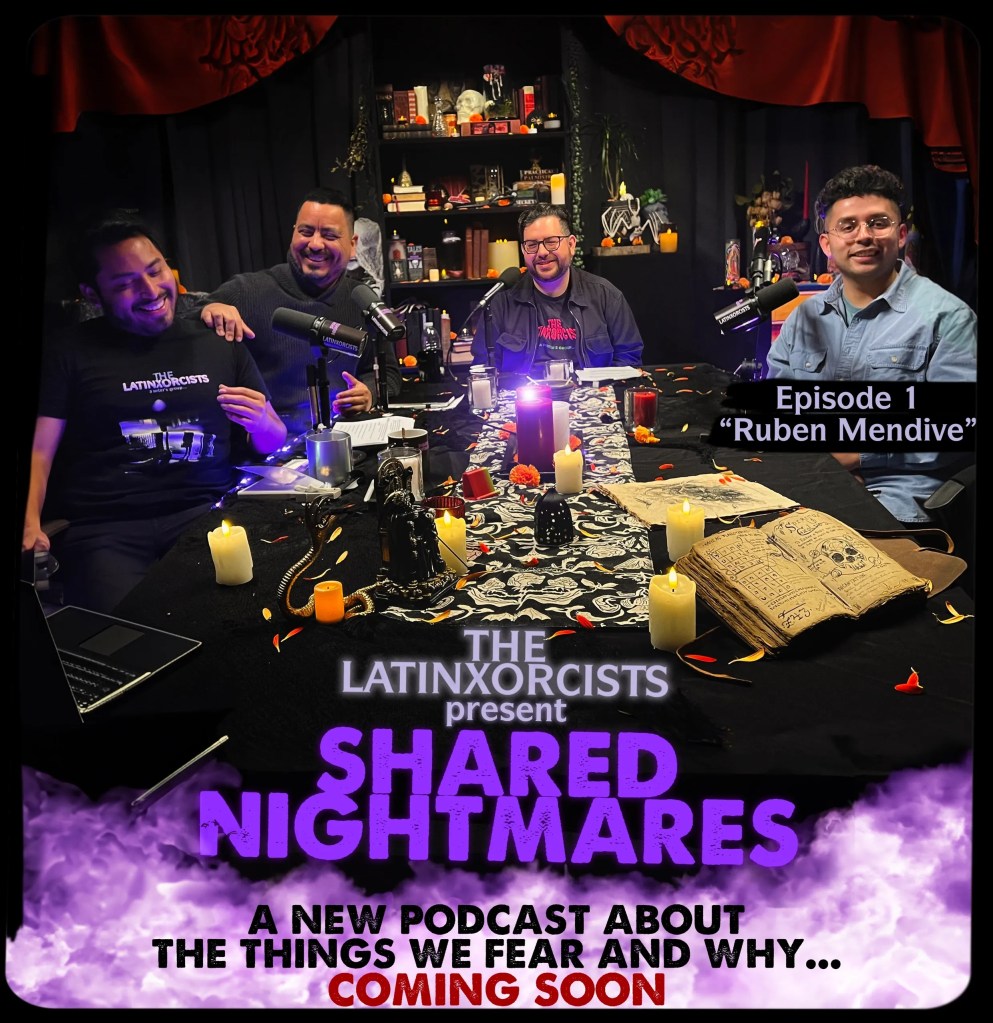
Horror has always carried the weight of cultural memory, but too often the stories that emerge on screen leave behind the voices of those who know fear, and resilience, most intimately. Enter the Latinxorcists, a collective of Latinx horror and genre screenwriters committed to exorcising erasure and amplifying fresh perspectives. With roots spanning Catholic mysticism, award-winning indie filmmaking, and a dedication to diversity in Hollywood, members like Jose Vicente Chavez, Ricardo Martinez, and Alfredo Hernandez are proving that horror isn’t just about monsters, it’s about reclaiming narrative power. To learn more about their mission, Alexandra Dos Santos, a horror fiction and screenwriter, sat down with the group to talk about their inspirations and the haunted spaces they’re determined to fill with stories of their own.
Alexandra Dos Santos: To start off, what is LatinXorcists?
Jose Chavez: The LatinXorcists is a Latino-driven horror/genre writer and filmmaker community. We workshop two to four scripts every month, and we make sure to prioritize new members. Our aim is to connect Latino horror writers with executives in Hollywood, preparing them for those conversations. Our overall mission is to increase visibility of Latinos in the horror and genre space within Hollywood.
Ricardo Martinez: LatinXorcists is a Latin horror screenwriters group. We workshop two horror scripts a month and the only requirement for any submission is that 1: they are of the Latino/a/e or Hispanic diaspora 2. That the scripts are horror or genre. We read these scripts and give comments to make them better FOR FREE. We are one of the ONLY Free script-reading services out there.
ADS: What inspired you to create it?
JC: In 2019, I was accepted into the NHMC Series Scriptwriters Fellowship. In this program, I learned a lot about the industry and specifically how to write a TV pilot. I was the only horror writer in the group, so when the program ended, I struggled to find fellow Latino horror writers. It only got worse during COVID, so in 2022, I decided to make my own Latino horror group. I founded it with Ricardo Martinez and Alfredo Hernandez, and ever since, we’ve grown into something I never even thought possible.
RM: In 2020, I started working on a horror project, The BloodStone, and I had a really difficult time finding people in the film industry to actually read my script, despite having tons of friends and colleagues who loved horror. It was hard to break into the industry as an unrepped Latino writer with no direct family connections, and the only avenues or organizations that did exist for new filmmakers didn’t read horror. The existing filmmaker programs had often ignored genres like sci-fi or horror. I say had, because I think, in part thanks to our group, many of them have evolved and opened up to genre submissions.
ADS: How important do you think a writer’s identity is when telling a story?
JC: Incredibly important! I think we should be pulling from our stories and traumas and finding exciting and beautiful ways to express those things. Horror storytelling can be incredibly personal and vulnerable, because the writer is expressing what makes them scared, and it shapes into something universal. I teach a horror short film class, and I always have the participants write down something that scares them. That’s the best place to start.
RM: Our stories are a culmination of everything that we are and everything that we’ve seen. It’s impossible to turn your voice off, even on a project ‘for hire’ or when working on somebody else’s project. Our identity is our superpower; it’s what makes our voices and contributions unique.
ADS: What do you think makes for a good script critique?
JC: This is a great question and something that I fixate on when we do our monthly LX Zoom meetings. Giving creative notes is extremely difficult because I don’t want to hurt the writer’s feelings, but I also want to give them constructive criticism. It is the only way we will get better. The fact is, executives don’t necessarily have time to worry about every writer, and so they might give harsh criticism, and as writers, we need to toughen up a bit. The best notes are ones that try to understand what the writer is going for and frame the note in that regard. It’s not our story, they are the ones who have to do the work. So, making the note exciting and understandable from their point of view. In terms of receiving the note, the writer shouldn’t take every single note, but rather notice the points and page numbers where they are happening. Those places should be addressed, in whatever fashion they want to.
RM: Good criticism is helpful criticism. I’m most interested in giving helpful criticism to a writer. Helpful criticism, for me, comes when a reader gives an honest, first impression of a script. Criticism doesn’t need to be tempered, filtered, or even instructional; it just needs to explain how somebody felt while reading the work- and why. A reader can be helpful when they explain why they specifically felt a certain way. We try to be extremely specific in our notes – even down to the words, phrasing, context, etc – and that includes whether we lose focus or laugh while reading a script. We all have our own unique perspectives, and some work speaks to us and some of it doesn’t. That’s okay. My job is just to be honest and clear about my reactions to a story. In writing, I place a high importance on first impressions. Nothing can ever replicate that first read and first reaction, and it mirrors how most people will experience your work. I always couch my criticism or response to writing as just…my feelings about it. There’s no math or exact science to criticism. I just hope that my notes, as someone who has read a ton of scripts and edited a bunch of tv shows, is helpful…
ADS: What are some challenges faced by Latinx creators in the film industry?
JC: To boil it down even further, there isn’t enough Latinx executives in our business to really champion our stories. Most executives want our Latinidad to be the entire show, when all we want is the same freedom that other shows have, while letting our Latinx characters show some nuance.
RM: Latin filmmakers face the same challenges that every other group faces, except that, in addition to these problems, we often don’t have nepotism or networking connections to fall back on for support. In other words, it’s very common for new Latin or Hispanic filmmakers to have zero personal connections to the film industry. The truth is that even after decades of effort, we are still heavily underrepresented in Hollywood, despite having integral roles in films since the creation of the medium. This has a huge impact on an industry built on connections and past work references. You can’t become a film executive at a studio if you can’t even be considered for entry-level positions. Most of us don’t have an uncle who’s a producer, casting agent, etc. We aren’t ingrained at all levels in this industry yet to offer each other these opportunities or work referrals. Even so, once we are working in the film industry, we often struggle simply to be considered for work. Despite a lot of good intentions and effort made these past few years, there still exists a bias in many circles. In a lot of these circumstances, we don’t have somebody to vouch for us at higher levels. There just aren’t that many Latinx creatives in positions of power throughout the older and bigger film studios. That dynamic is changing, but diversity in management is a relatively new idea, and a lot of that progress has been lost recently.
ADS: What are some themes, motifs, tropes, or other similarities you find prevalent in Latinx horror?
JC: Not necessarily in horror, but a lot of things are disheartening, like having Mexican drug dealers in the story, or the stereotypical sexy Latina. The film industry is also fixated, maybe even fetishizing the immigrant story with the Latinx community. While I love and appreciate a good immigrant story, I think there are so many US-born Latinos whose stories are never told. There’s a reason why “Selena” is one of the most popular Latino films: It’s based on this idea of being U.S.-born and also Mexican. As for Latinx horror, Catholicism is very prevalent in Latinx horror and I think it’s something that is very universal. The Exorcist is one of the biggest horror films of all time, so I just think that there’s a space for us in the horror space.
RM: The horror community is filled with Latinx creatives and fans, but that term is so big and broad that it encompasses too many different types of people. It’s impossible to find a consistent style, theme, or movement without at least limiting the term to either Mexican Americans or Puerto Ricans etc. So many Latinx creatives have contributed to or made horror films in the past, and they are all so varied and different. Imagine the work of two Mexican creators, Guillermo Del Toro or Issa Lopez… both are Mexican writer/directors, and yet they’re styles and subject matter are so different, and it changes wildly from project to project.
ADS: What advice do you have to Latinx creators who feel disconnected from their heritage?
JC: Embrace that disconnection! That disconnection is what makes us unique. Anything that is particularly unique can resonate in a universal capacity. I used to hate Tejano music growing up. When my grandma would put it on the radio, I would only want the pop station on. But now when I listen to it, I’m reminded of those days and I love that music so much. Lean into that disconnection, but also have a curiosity of who we are and where we come from.
RM: You can only be the person that you are. There are no rules for how we navigate these complex cultural identities, and don’t let others impose their expectations on you. Whenever or however you choose to honor your heritage is your choice. Nobody knows the correct way to be a Latinx (Latino,Latina, Latine, or Hispanic). We are all trying to figure out how to do this. Don’t be too hard on yourself.
ADS: Who are some Latinx screenwriters and directors we need to check out?
JC: Jose Nateras just had his first written feature premiere a couple years ago now. Maggy Torres-Rodriguez is a great up and coming writer and director. Brandon Burkhart is also a fantastic comedy writer as well. David Aguilar is an incredible Chicano TV writer and film director.
RM: We’ve had so many amazing creatives pass through our group! I am currently a big fan of Vic Velasco, Gerry Maravilla, and Verner Maldonado. We also read a really great script recently from a new writer out in New Jersey, Edgar Aquino Huerta. Obviously, as a Mexican, I have to share the love for my compadres, the Three Amigos: Alfonso Cuaron, Alejandro Innaritu, and Guillermo Del Toro – but I am sure most are already familiar with their work.
ADS: What are some of your favorite Latinx horror films? What do they do well?
JC: “Santa Sangre” directed by Alejandro Jodorowski is my favorite Latinx horror film. It does everything well, but particularly the imagery. The story is very “Psycho” but with a circus spin to it. It can only be seen to be believed.
RM: I think I often return to Guillermo Del Toro’s work, but Pan’s Labyrinth, Hellboy, and The Shape of Water are just beautiful. I loved Issa Lopez’s: True Detective Night Country, Fede Alvarez’s Don’t Breathe and Alien Romulus.
ADS: Any success stories from the group to share?
JC: Brandon Burkhart went on to write for The Tonight Show w/ Jimmy Fallon. Maggy Torres-Rodriguez currently writes on the new season of Dora the Explorer. Eleni Rivera went on to write for Blizzard Entertainment on Diablo IV and Overwatch. Marcos Soriano was on the Blacklist with his script Ayiti: The Last Days of Paradise.
ADS: How would you like to see LatinXorcists grow?
JC: I would love to see it become something similar to what Jordan Peele is doing with Black horror and become a MonkeyPaw sort of branding. Ultimately, I want to create a horror database so studios and executives can come to us and ask us for a Latinx writer with a specific background. Right now, we have over 200 members, and we only want to keep growing.
RM: I want to see The LatinXorcists continue to grow our connections and partnerships so that we can begin to produce our own projects. It’s a challenging time for a lot of businesses out there, but horror is evergreen. I think there’s specifically a lot of room for horror TV shows and horror vertical shows.
I would love to be able to build an incubation program with actual financial backing. We have a great bank of scripts that have already been workshopped in our group, and I would love to see some of them finally get produced.
ADS: Why is a group like LatinXorcists important now?
JC: As you can see with the ICE deportations and our current administration, simply existing as a Latinx individual is terrifying. Now more than ever we need to share our stories and be given the opportunity to resonate with the American and Latin American audience. I promise that if we put out our bloody, horrific, insanely cool Latino stories out there, people will watch them.
RM: I love what Jose said. I will add that The LatinXorcists is one of the few FREE script reading services in Hollywood. We are one of the only places that a new filmmaker can get live, actual human feedback on their script FOR FREE. And because of our accessibility and our emphasis on horror and scifi, we can find writers and filmmakers that don’t normally get a chance to be read. Think about that. A single mom living in Michigan can have a nightmare, write a terrifying story, and send it in for us to read. We are the only avenue actively looking for the next Mary Shelley.
ADS: Anything else you’d like to add?
JC: If you’d like more information on joining The LatinXorcists, please visit our website, latinxorcists.com or our IG @latinxorcists. Don’t be shy and reach out!
RM: Jose and Alfredo are great co-founders. I literally would not have been able to accomplish any of this without their support and feedback.
The Latinxorcists are a collective of Latinx horror and genre screenwriters dedicated to reclaiming overlooked stories and amplifying fresh perspectives in cinema. With members like Jose Vicente Chavez (spiritually charged horror rooted in his New Mexican upbringing), Ricardo Martinez (award-winning filmmaker and editor for Netflix and Vice), and Alfredo Hernandez (writer, director, and diversity advocate in Hollywood), the group blends cultural memory with fearless storytelling. Guided by advisors Laurel Pérez-Fuksa (Warner Bros. Television) and Jesse Nicely (Cashmere Agency), they unite to sharpen their craft, challenge erasure, and bring new voices to the genre.
Learn more at latinxorcists.com or follow on Instagram @latinxorcists.
Alexandra Dos Santos (@gingerstabs) is a writer and educator living in Queens, NY. Her work has appeared in Vol. 1 Brooklyn, Electric Lit, Lithub, Maudlin House, Gayly Dreadful, and The Latino Book Review. Her writing centers on spiritual horror. You can find her work at alexandradossantos.com


 NightTide Magazine
Leave a comment