
By Ray Walton
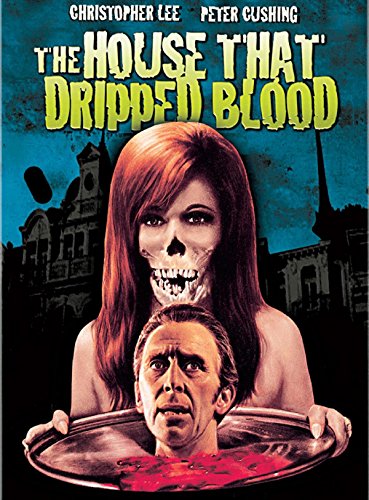
The House That Dripped Blood (1971) Director: Peter Duffell ⭐️⭐.5
A bad-luck mansion has a dreadful history where all its owners have died a mysterious death. A Scotland Yard investigator sets out to investigate the cases related to the mansion.
Released in 1971 by Amicus Productions, The House That Dripped Blood belongs to a cycle of British anthology horrors that favored mood, irony, and short-form unease over sustained terror. Written by Robert Bloch, whose work often oscillated between psychological dread and abrupt supernatural turns, the film presents four separate stories linked by a single house where previous occupants have vanished.
Anthology horror thrives on variation, but it also risks tonal imbalance. In this case, the house functions less as an active presence and more as a narrative container, holding stories that move between grounded anxiety and sudden supernatural escalation. The result is a film that prioritizes atmosphere and curiosity over cohesion, inviting viewers to settle in for texture rather than resolution.
When it comes to the Amicus anthologies, I do not expect any of them to reach the heights of Tales From the Crypt. And while I love Psycho, my experience with Robert Bloch’s short stories has been mixed. Many of them, including the tales here, build effectively but end abruptly, often with payoffs that feel unsatisfying or underdeveloped.
That unevenness is present across all four stories. Several take sudden turns into the supernatural without much warning, and while that approach works in some Bloch adaptations, such as Asylum, it feels off here. I would even argue that the house itself has very little to do with the stories. The disappearance of its occupants feels more coincidental than thematically connected.
The tone shifts constantly. Some segments feel grounded in reality, while others lean fully into supernatural territory, making the collection feel disjointed rather than deliberately varied. I found myself wondering whether these stories might have worked better under a different wraparound or framing device.
That said, if you are willing to turn your brain off, there is still fun to be had. At the very least, the film is worth watching for the sheer novelty of seeing Christopher Lee genuinely afraid of a little girl.
Why tonight?
Because some winter watches are about texture rather than answers.

 NightTide Magazine
Leave a comment