
By Mo Moshaty

NightTide keeps an eye on opportunities for horror writers and scholars, especially those whose voices deserve a louder place in the genre.
Writers drawn to horror’s messiest, most unsettling corners may want to take note of a new call for submissions from 1428 Publishing for an upcoming edited collection titled Embracing the Abject: Exploring Abjection in Cinema.
The collection builds from philosopher and psychoanalyst Julia Kristeva’s concept of the abject: the visceral human response that emerges when boundaries collapse: between self and other, order and chaos, the body and what threatens to undo it. Horror cinema has long lived in this uneasy space, where the familiar becomes contaminated and the body itself can feel unreliable.
In film, the abject often appears through sensory disruption and bodily transgression. The call highlights examples such as:
- Visual: blood, excrement, vomit, urine, flies, maggots
- Auditory: squelching, gagging, buzzing insects, dental tools, knives sharpening, splattering
- Touch: dirty sink water, sewage, picking scabs, ripping fingernails, rotting food, swallowing foreign objects
- Pain: broken skin, broken bones, childbirth, bites, surgery, popped zits
These examples are meant to point toward the kinds of visceral reactions abjection provokes, though contributors are encouraged to explore the concept broadly across horror and cinema.
Abjection lives where the body refuses to behave — where boundaries blur, identities destabilize, and horror reveals what society tries hardest to cast out.


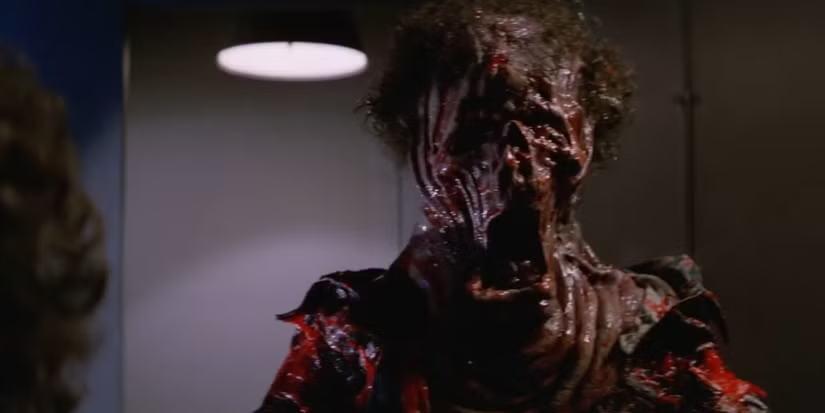
What makes this collection particularly interesting is its focus on power and transgression. Rather than treating abjection solely as repulsive or shameful, the editor seeks work that examines how characters, and audiences, embrace abjection, using it to challenge social boundaries or reclaim identity.
The volume is also actively seeking diverse perspectives and lived experiences, especially from:
- Indigenous and First Nations writers
- Writers of Colour
- Ethnic and religious minority writers
- Women and LGBTQIA+ writers
- Disabled writers
- Refugees and writers living in poverty
For those new to academic-style submissions, the process is fairly simple. Contributors should send:
- A 250-word abstract outlining their proposed chapter
- A short bio, and if available, a link or example of previous work
Submissions should be sent to 1428publishing@mail.com, with a deadline of 29 May 2026.
For NightTide readers working in horror criticism, film analysis, or cultural studies, this call offers an opportunity to explore one of horror’s most provocative ideas: the moment when what society rejects, expels, or fears begins to reveal something deeply human.
Sometimes horror isn’t about what stands outside the body; sometimes it’s about what refuses to stay there.

Mo Moshaty is an acclaimed horror writer, lecturer, and producer whose work combines visceral storytelling with the psychological insight of her Cognitive Behavioral Therapy background. She has lectured internationally, including as a keynote speaker at Nightmares from Monkeypaw: A Jordan Peele Symposium (Prairie View A&M), No Return: A Yellowjackets Symposium (Horror Studies BAFSS Sig), The Whole Damn Swarm: Celebrating 30 Years of Candyman (University of California), and with the Centre for the History of the Gothic (University of Sheffield). Mo has also presented at the BFI, Miskatonic Institute of Horror Studies, and Final Girls Berlin Film Festival’s Brain Binge on women’s trauma in horror cinema, Cine-Excess on The Creepy Kid Horror Subgenre and Mother/Daughter Trauma in Horror, and Romancing the Gothic on Cosmic Horror’s Havoc on The Body Electric Her short film, 13 Minutes of Horror: Sci-Fi Horror, won the 2022 Rondo Hatton Classic Horror Award for Best Short Film. As a core producer with Nyx Horror Collective, Mo co-created the 13 Minutes of Horror Film Fest and partnered with Shudder in 2021 and 2022, while also establishing a Stowe Story Labs fellowship supporting women creatives over 40+ in horror. A member of the Black Women in Horror Class of 2023 and featured in 160 Black Women in Horror, Mo’s short fiction appears in A Quaint and Curious Volume of Gothic Tales (Brigid’s Gate Press) and 206 Word Stories (Bag O’ Bones Press). Her debut novella, Love the Sinner, was released July 5, 2024, with Clairviolence: Tales of Tarot and Torment released in October 2025. The first of her five-volume non-fiction series, The Annex of the Obscure: The Afterlife, will be released in 2027 from Tenebrous Press. As the Editor-in-Chief of NightTide Magazine and founder of Mourning Manor Media, Mo champions marginalized voices in horror. Under her leadership, NightTide plans to launch a film festival in 2028, furthering her mission to reshape the genre through inclusivity and representation.
Leave a Reply