
By: Michele Schultz

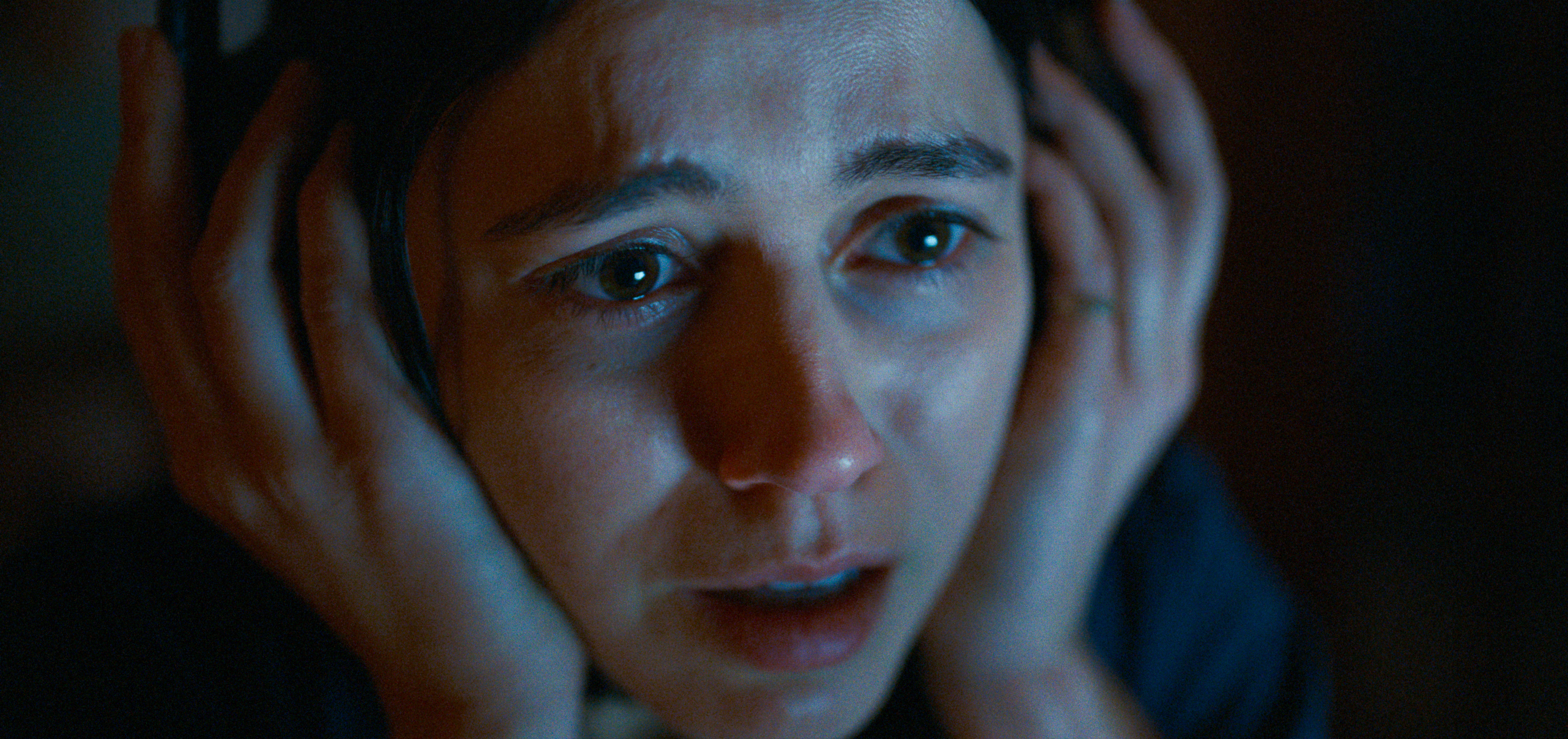
A24’s Undertone stands out in the crowded horror landscape by exploring modern obsessions with hauntings and digital investigations. The film follows a paranormal podcast host, Evy, who is tormented by chilling recordings, tapping into the emerging “haunted media” genre that reflects today’s cultural fascination with capturing the unseen through platforms like YouTube and podcasts.
In a conversation with horror author Mary Beth McAndrews about her book on the film Paranormal Activity, we also discussed the relationship between found-footage filmmaking and technology.
The Frequency of Found Footage
The sensory experience offered by Undertone makes it clear in its promotional material that it’s the “scariest” film we’ll ever listen to. The film demands our attention both visually on screen and auditorily in the theater, as well as to the “skeleton in the closet” about to come out.
However, a key aspect of the screening of Undertone is the prevalence of found footage, not only in horror cinema but specifically within the film itself. The main character, Evy, spends the first act discussing the recently received footage, expressing doubts about its authenticity. This invokes memories of the “overnight in haunted locations” videos we find on YouTube or TikTok, along with similar episodes of reality TV that pose the question: “What was that? What are we hearing that occurred in the video or in real time during an episode?”
The concept of “haunted media” has its roots in the horror lore of our current medium. Undertone revealed in the third and final act shows Evy, the podcast host, reconciling her situation with the media and technology surrounding her within her safe space. The film signifies a transition to the era of the Waveform, suggesting that hauntings now reside in device metadata rather than within the physical walls of a house. Although “haunted media” often refers to found-footage works that question the context of their origin, it illustrates how strange experiences occur in the locations YouTube ghost hunters explore, regardless of whether the hauntings occur during the recording.
In niche reality television formats, this differs because of a larger camera crew and various elements that amplify reality in editing to attract viewers. Films like Undertone and earlier works use technology within the found-footage horror context, addressing the idea of ghosts haunting our media. This links the evolution of cultural spiritualism, from the Ouija board to the Digital Audio Workstation (DAW).
Beyond the Jump Scare: How does A24 differentiate this from the “saturated market”?
By combining sound and visuals often used in paranormal films, spike an introduction of a sudden visual shock accompanied by a loud sound. In Undertone, the radio style allows listeners to “hear” sounds that correspond to a specific “frequency,” enhancing awareness of the auditorium and fostering a sense of vigilance.
In the film’s moments, the narrative focuses on a solo podcast host as it removes the “safety net” of a secondary character in the third act. Although Undertone does not fully distinguish itself from the saturated market, it effectively incorporates elements of the existing ghost-hunting niche found in other media. The film blends found footage and haunted themes, creating an exhilarating rush that heightens alertness to jump scares.
While the film does include jump scares, it expands upon this concept by building tension not only through flickering lights or noises from other rooms. For instance, suspense arises from the feeling of isolation when there’s no one to talk to; instead of a co-host, we are merely listeners, which makes the haunting experience profoundly isolating. Rather than a consistent stream of jump scares, the narrative immerses us in a YouTube (or reality-television) ghost-hunting show that spends an overnight at a haunted location.
“The found footage subgenre lends itself to authenticity! Yeah, we know it’s not real, but you can kind of suspend disbelief,” McAndrews said how the genre’s style has been adopted on social media platforms like TikTok, blurring the lines between performance and reality, emphasizing the double-edged sword of modern content creation, where the accessibility of tools has led to a crowded market. “I think the digital age has made it so much easier for people to create! I also think it’s made it harder for people to have their work discovered because there is such a saturation of this kind of content.”

The Modern Haunting: From Niche to the Creator Economy
The intent behind proof and the evolution of paranormal investigation content present a fascinating journey, initially driven by a desire for discovery and affirmation. This genre has shifted from the reality-television format to a complex digital landscape shaped by YouTube creators and social media influencers. Historically, the paranormal investigation niche began with programs like “Ghost Hunters,” which debuted in 2004 and aimed to legitimize ghost hunting through methods and equipment.
Over time, this niche expanded the paranormal genre, diversifying significantly with shows like “Ghost Brothers,” signaling a shift toward content that emphasizes entertainment and personality. This featured large-scale production techniques combined with a commitment to bring attention, all while remaining within a niche focused on exploring the ethereal.
The rise of YouTube marked a critical turning point in this genre, as the platform allowed individual creators to produce their own paranormal content, often with a more casual, relatable approach. This shift gave rise to the idea of “parasocial paranormalism,” where viewers develop a personal connection with creators who portray themselves as investigators or experiencers. These niche channels exemplify this trend, transforming paranormal investigation into entertainment. In this context, the investigator is not just a researcher, a digital persona— a content creator whose personality enhances the conspiracy of haunted locations and unexplained phenomena.
The setup is evident in Undertone, which offers an abysmal insight into how investigation becomes its own content. The essence of contemporary paranormal content no longer lies solely in uncovering mysteries but in capturing and sharing experiences for online audiences. The act of investigation intertwines with storytelling, spectacle, and audience engagement, blurring lines between genuine inquiry and curated entertainment. This is reflected in the film’s broader societal shifts, where digital platforms transform how we perceive and consume experiences, creating a “verified” scope.
The documentation in this landscape adopts a modified “found footage” style, unlike past horror films such as The Blair Witch Project, which relied on the illusion of discovered, lost camera footage capturing real events. Modern paranormal content often takes a different approach.
Undertone resembles radio-listener or audience-participation models, inviting viewers into an experience they can verify or engage with, even if they are not physically present. This approach in the film immerses the audience, transforming the screening into a listening experience. In today’s digital environment, paranormal investigation has evolved beyond a mere genre; it has become a social phenomenon rooted in a desire for confirmation and community.
As creators experiment with various formats—like live streams, interactive feeds, and immersive storytelling—they continue to define what it means to investigate and experience the unexplained. This shift is somewhat illustrated in the film, showing how deeply intertwined paranormal content is with the creator economy.
Ultimately, the transition from niche television shows to a creator-driven digital economy exemplifies how modern paranormal investigation adapts to cultural and technological changes. It reflects a broader desire for connection, entertainment, and validation, driven by the digital age, which values personal stories, spectacle, and the pursuit of mysteries—both real and constructed. This dynamic landscape continues to grow, blending traditional ghost hunting with new media technology and defining the nature of haunting in the modern world, as shown in Undertone.
The evolution of paranormal investigation and its integration into digital culture are particularly relevant to Undertone, which opened in theaters on Friday, March 13, 2026. A24 has established a reputation for producing thought-provoking, innovative horror films that often explore the boundaries between reality and perception, much like the modern paranormal content discussed here. Undertone aims to reflect the current cultural landscape by intertwining themes of uncertainty, digital influence, and the psychological nuances of terror, resonating with how audiences engage with the ghost-hunting format.
The film’s relevance lies in its potential to examine the impact of the digital age on horror narratives, echoing how content creators transform investigation into spectacle and personal storytelling. Just as online paranormal media blurs the line between fact and fiction, Undertone may explore similar motifs—questioning what is “real”, investigating the influence of media on perception, and delving into the collective obsession with haunted mysteries. A24’s signature approach to subtle, layered storytelling incorporates elements of the parasocial relationships forged online, portraying characters who are both investigators and digital personas, embodying the interface between reality and curated experiences. Furthermore, “Undertone” serves as a meta-commentary on the modern horror landscape, highlighting how technology shapes the understanding of ghostly encounters.
Undertone reflects the aesthetics and themes prevalent in digital paranormal culture; the film echoes deeply with those accustomed to screens and social media. For instance, the film also critiques the voyeuristic tendencies associated with this digital obsession, questioning whether the pursuit of haunted actualities is ultimately a quest for significance or collective affirmation.
The expansion of paranormal investigation is relevant to Undertone, underscoring a broader cultural shift. It emphasizes how horror continues to adapt by integrating new media forms, as it’s addressed in A24’s Undertone. The film signifies this space by not only portraying ghostly horror but also by exploring the complex relationships among media, technology, “belief,” and “truth” in our current culture.

The Intersection of Digital Culture and Traditional Folklore
The theories explored in the film Undertone suggest that silicon and cloud storage share concepts similar to those discussed by ghost-hunting channels on YouTube that investigate haunted locations. The intersection of digital culture and online folklore ignites both curiosity and skepticism, fueling exploration of ghost investigations popularized by niche reality television.
Undertone addresses the blending of digital culture and traditional folklore, particularly when Evy questions everything in the recordings. This resonates with interviews conducted by reality-television (or YouTube) paranormal investigators, who gather local legends about the location before the investigation.
Undertone signifies the concept of the ghost in the machine by examining how the film uses technology—such as glitches, bit-crushing, and compression—as a modern representation of a ghostly presence intertwined with perplexing myths. When considering the mythology of recording, Undertone can somewhat be compared to works like The Ring (1998) and Pontypool (2008). While The Ring centers on a viral image of a dark-haired woman drenched in water emerging from a well, “Undertone” focuses on the auditory frequency revealed in the film’s final moments, which connects to the entities encountered by reality television (or YouTube) ghost-hunting channels during their investigations.
Cultural Landscape: Why the Paranormal Matters
The quest for significance in an era dominated by AI and deepfakes reveals that “haunted locations” offer an experience that cannot be replicated by synthetic sources, providing a genuine, biological adrenaline rush. Meanwhile, A24 films frame grief as something lived and ongoing, altering perception rather than simply motivating it. In Undertone, the “enigmatic recordings” are tied to Evy’s personal history, raising the question of whether, by capturing everything, our departed loved ones ever truly leave us or merely fade into background noise.
Undertone delves into this idea when Evy poses off-the-record questions about her own life, which motivates not only reality television but also YouTube ghost-hunting shows. This pursuit is not driven by clicks or the desire to create content; rather, it stems from a deep curiosity and skepticism about the metaphysical aspects of the other subjects involved.
It’s not merely about why the paranormal is significant; it also examines how this specific subgenre relates to other horror subgenres within the broader media landscape. The intrigue lies not in the fact that Undertone is a found-footage horror film, but in its connection to the online ghost-hunting community, shaped by the early efforts of paranormal investigators who laid the groundwork in this domain.
Tuning into the Void
Undertone does not define a new era; instead, it offers an interpretation of the found footage formula that has permeated both indie and mainstream cinema. The film diverges from the narrative of a haunting, which often accompanies ghost investigations. Rather, it invites viewers to reflect on the complicity in the haunting experience, suggesting that we have unwittingly welcomed these spectral presences into our lives. The film places us in the shoes of both earlier ghost hunters and contemporary figures populating YouTube’s extensive landscape of paranormal content.
Throughout Undertone, a chilling pursuit of capturing the dead for entertainment mirrors the growing focus on spectral narratives in popular culture. This fixation raises deeper questions about our need for proof and our ever-evolving relationship with the metaphysical, often driven by our overwhelming desire to document the inexplicable. What Undertone adeptly explores is the blurring of reality and fiction; the film does not merely present ghostly phenomena as isolated events to be dissected, but how we actively view these hauntings through the frameworks of understanding.
One evocative scene from Undertone features a haunting audio recording that strongly connects to the realm of internet horror investigative sleuths. This moment resonates deeply with contemporary culture, as it reflects the rise of amateur paranormal investigations online. In Undertone, tap into this zeitgeist: the do-it-yourself investigations and narratives shared through social media platforms. The film serves as a commentary on how technology has transformed the ghost-hunting landscape, shifting from a domain limited to experts wielding specialized equipment to one where anyone armed with a smartphone can explore the macabre and morbid.
A24’s marketing strategy employs “lo-fi” social media teasers that artfully blur the lines between fiction and reality. This approach aligns with the film’s thematic core, enforcing the idea that the phenomenal intertwines with our lives, as seen through our screens. The film’s aesthetics and vernacular of grassroots horror, Undertone, capture the audience’s attention, inviting viewers to question “What is real?” and “What is crafted for entertainment?” The deliberate use of low-fidelity production in both the teasers and the film mirrors the often sought-after by vloggers and amateur ghost hunters, further immersing the audience in the eerie ambiance that Undertone aims to convey.
Moreover, the incorporation of found footage as a narrative device emphasizes how interlaced our collective memories and references have become with the genre. Just as earlier works in the genre sparked discussions about the legitimacy of hauntings and evidence, Undertone wakes this dialogue, framing hauntings not merely as disruptions of life but as part of the fabric of reality. The film pushes us to confront “belief”, perception, and how the surroundings of anything ghostly inform our societal norms and apprehensions.
At its core, Undertone is a harrowing yet insightful exploration of contemporary ghost hunting and the metaphysical anxieties reflected in our modern lives. The film beckons us to question our relationship with the unknown, our insatiable thirst for narrative in the face of death, and the outcomes of turning haunting experiences into consumable content. As the line between fiction and reality is blurred, Undertone stands poised to pinpoint how we engage with the unseen, urging us to consider not just what we are willing to hit record but what we invite into our existence in the process.

Part of the approved Cherry Picks critic community, with span across independent-run digital publications. Past experience includes contributions to FanSided’s entertainment and lifestyle verticals, notably Culturess, 1428 Elm*l, and TripSided. Journalistic roots began as a City University of New York (CUNY) undergraduate student journalist.
Armed with a signature in theatrical data analytics and out of home (OOH) marketing measurement. Outside of the digital editorial newsroom and after hours, reporting on culture continues.

Leave a Reply