
By Mo Moshaty
There’s a particular kind of woman horror keeps returning to.
The one who knows too much. The one who sees too clearly. The one who, when pressed hard enough, begins to use that knowledge in ways that make everyone around her deeply uncomfortable. Good for her!

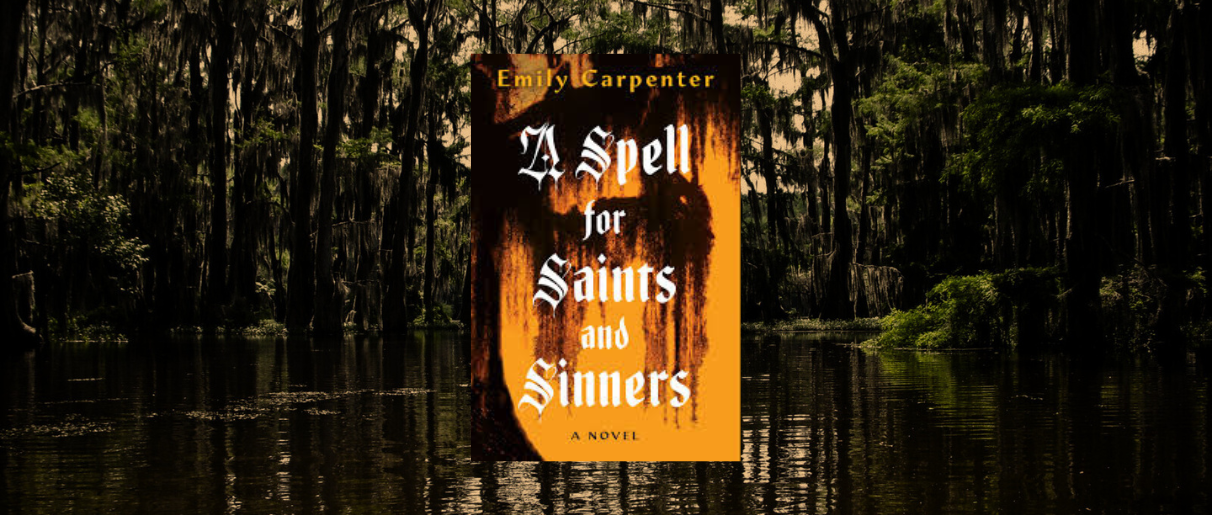
In A Spell for Saints and Sinners, Emily Carpenter draws us into a Savannah that feels less like a setting and more like a slow, watching presence: lush, haunted, and deeply invested in who gets to belong. Here, power moves quietly through old money, social ritual, and the kind of reputation that cannot be bought, only absorbed.
At the center is Ingrid White, a woman navigating inheritance in its most complicated form. Not just property, but expectation. Not just legacy, but a warning. What begins as performance, reading, intuition, playing a role others are eager to believe, shifts into something far more precarious as Ingrid is pulled deeper into a world where access is everything, and truth is negotiable.
What Carpenter threads in is the tension between belief and utility. When a woman’s insight becomes useful, it is welcomed. When it becomes inconvenient, it is questioned. And when it begins to grant her power, it must be explained away entirely.
Below, we’re sharing an exclusive excerpt from A Spell for Saints and Sinners, ahead of its March 31, 2026, release, a novel that lingers in the uneasy space between intuition and accusation, where the cost of being right may be far greater than the cost of being silent.
An Excerpt of A Spell for Saints and Sinners – © Emily Carpenter 2025
In the small parlor where she did her readings, she sprayed the marble-topped table with
lavender oil cleaner and wiped it down. The wrought iron door of the small anteroom was still
propped open to the sidewalk—something she’d done earlier that morning when she’d been
feeling optimistic about the river of abundance that was—definitely, absolutely, finally—flowing
her way.
But this was the new Savannah, and optimism didn’t pay the bills here. Not like it had in
the old version of the city—that quirky Shangri-la tucked away on Georgia’s coast, which had
been her grandmother Edie’s home. In the mid-nineties a wildly popular book came
out—Midnight in the Garden of Good and Evil, usually referred to by the locals as “that
bestselling book”—and changed all of that. The book, then the movie, built a kind of mythos
around the town, one of cheerful transgender cabaret stars, reckless gigolos, and murderous
debutantes, and it drew tourists from all corners of the earth to it like a magnet. But the book was
never a complete picture of the city. And now, the true artists, the provocateurs of this town,
didn’t command the main stage. They’d been swept off the streets and into the gutter to make
way for the real show: money.
The new Savannah was buffed, shiny, corporate, and ridiculously expensive. A
postmodern, gentrified, Airbnb- and Uber-infested playground whose rents were now out of
2
reach for many of its own citizens. Savannah was the plain girl who had, after getting her glow-
up, immediately dropped all her weird friends.
There were still pockets of the old city left, but there was no telling how long these places
would last; from time to time, an old restaurant or shop would quietly shutter its doors, only to be
replaced by a Moe’s or Jersey Mike’s or simply a placard that read <SC>AVAILABLE.<TXT>
Downtown was all Urban Outfitters, Hilton Garden Inns, and Starbucks. It made Ingrid glad
Edie had lost her grip on reality before having to witness it.
And now, the vultures were circling Ingrid. If she wanted to keep her small corner of
Savannah intact—her house and the psychic business she operated out of it—she’d have to
somehow figure out a way to pay the property tax bill that was coming due next month. She was
many thousands of dollars shy of having the full amount, and things weren’t looking good. Even
after she’d sent Miles out with more flyers.
Ingrid walked out to the sunny sidewalk and glanced up and down the street. There was
no one in sight. She looked at the chalkboard sign that proclaimed MISS EDIE’S PALM AND
AURA READING in careful chalk calligraphy letters. Her grandmother had done business on
this street, in this same town house that faced what used to be Calhoun Square but was now
Taylor Square, nearly every day for more than fifty-five years, and been able to easily pay off the
mortgage on the place back in the eighties. She had been a fixture in Savannah for decades. Now
it seemed like no one remembered her.
Five years ago, when Edie got sick, Ingrid had taken over the business. It had been a
struggle to convince Edie’s regulars to entrust their psychic needs to an eighteen-year-old, but
she’d managed to replace the clients who left with new ones. And then, two years ago, Edie died.
She left her granddaughter the town house, free and clear of any encumbrances. But Ingrid was
3
young and financially untrained, and had been ignorant of the ever-inflating size of the property
taxes levied on the well-located house. The realization had been a shock.
The small amount of cash Edie left her had been eaten up in that first year on a new
furnace, foundation repair work, and the taxes. Since then, Ingrid lived in a state of near-constant
panic. The place was falling down around her ears. She could barely keep up with the utilities.
She felt the burden of the money she would soon owe every single day. How naïve she’d been, in
so many ways. Naïve and foolish. No wonder her business was failing. What kind of psychic-
witch loses her grandmother’s fully paid-for house? A bad one, that’s what kind.
Now, as Ingrid, squinting into the glaring midday sun, surveyed the house, a whisper of
dread threaded through her. The place might look magical at night, in the moonlight, behind the
lacy veil of Spanish moss, with the streetlamps and the flickering ghostly gaslight of the huge
brass lantern above the front door casting shadows over the pink plaster. But right now, in the
unforgiving light of day, it just looked like a dump.
“Ahoy there!” Miles’s golden-haired head, tied with a faded green bandanna, appeared on
the roof of the town house. He was holding onto one of the fourth-floor gables, like the seaman
he was raised to be. He was shirtless, his lean torso gleaming as golden as his hair in the burning
sun, and even from the street, she could see his startling, light blue eyes. Turquoise as the
Caribbean.
Slight but sinewy, tanned beyond what his fair complexion should be, Miles had worked
on his father’s shrimping boat right up until the man had lost it in a legal dispute. Now at age
twenty-six, in exchange for a room on the third floor and whatever food she had in the fridge, he
helped Ingrid keep the place running. But just barely. The town house was bigger than it looked,
4
and he could only do so much. And he had another job that kept him busy enough—leading
historical and ghost tours for a local outfit in town.
They’d met after Ingrid had found a Moonlight and Magnolia Tours brochure tucked into
the garden-level, iron door of her town house and decided a ghost tour was the perfect place to
meet tourists and rustle up some more business. She’d been assigned to Miles’s group, and
they’d hit it off immediately. It was only a week later when she asked him to move in.
They had a unique friendship, she and Miles. Close, but not in a romantic or sexual way.
Just real, true friendship. He was a generous soul. Guileless, upbeat, and giving. He would drop
whatever he was doing when she asked for help or a favor or even just something to drink. And
while she always sensed that she fell short of reciprocating his particular form of ardent, fiery
commitment, she still felt a deep connection to him.
He always had looked a bit to her like he could’ve been living in another century. Maybe
kidnapped by Blackbeard to swab the deck of The Queen Anne’s Revenge and terrorize merchant ships.
Poor Miles. Born to the water. Lost on land.
But he was her other half. A fellow traveler in this harsh, often cruel world. He made her
feel less alone in this new Savannah without her grandmother. They would always be there for
each other, no matter what.
She squinted up at Miles. It was so hot. She could feel her dress, made of an unbreathable
polyester chiffon and purchased at the Goodwill, sticking to her. Drips of sweat were already
coursing down her back, tributaries forming a river down her spine and into her ass. But she’d
never dream of wearing shorts. Edie hadn’t approved of dressing casually for work.
Edie also revered the hot Savannah sun. The sun, the light, was female, she’d always
said. The sun was their Goddess, not a male entity like some believed. The moon was male, only
5
able to reflect the glory of the Goddess. Edie’s beliefs weren’t like anything Ingrid had read in
witchcraft texts or teaching, but they made sense to her. Right now, though, Ingrid wished the
Goddess would take it down a notch.
“You’re going to need a new roof,” Miles shouted down at her. “I did what I could with
the extra shingles, but the flashing’s a mess. Even the decking is rotted through…” He held his
hands up, apologetic.
“Okay.” She nodded.
“Don’t worry about this ship, though. She ain’t gonna sink. She’s got good…” He swung
a hand around his head, trying to think of the word. “Um, the heavy stuff, down in the hull?”
“Ballast,” she supplied.
“Oh yeah!” He crowed like a lunatic rooster. “She’s got good ballast. The heaviest of the
heavy, you know? It’s you, sitting down there at your table, pulling down all the power of the
Goddess.” He shook his head. “You’re holding it down, Miss Ingrid. You’re the ballast.”
“All right,” she said with false cheeriness. “Okay.” She really was starting to dread these
pep talks of his. In the end, it wasn’t him who had to pay the tax bill.
Miles turned back to the rotting roof.
“Hey—” she yelled up at him, suddenly feeling bad for taking his support for granted.
He appeared again, a grin lighting his eyes. “Hey!”
“Be careful up there.”
“Hey,” he said back.
She squinted up.
“Those guys give you any trouble?”
She waved him off. “Couple of college dummies. No big deal.”
6
He gave her a look that said he didn’t buy it. He knew her so well, which sort of annoyed
her. Still, she wasn’t about to confess what she’d done. Basically, gone down a dark path and
imparted information to a client that, while true, should’ve been delivered in a far more sensitive
way, if at all.
She had been given a gift, the same gift Edie had. She was supposed to use it wisely, not
to make a stupid kid feel bad about his life. Not for revenge or any other selfish goal. She was
supposed to stay in the light. Edie had told her how important that was the day before she died.
Ingrid knew better.
She just had to buckle down and do what was right.
Whether Ingrid’s abilities are supernatural or strategic is almost irrelevant. What matters is that they grant her access—and that access demands something in return.
Carpenter maps the mechanics of belief: who is trusted, who is doubted, and how quickly a woman’s credibility can be reframed once it begins to threaten the balance of power. Ingrid doesn’t simply change. She adapts. And in doing so, she exposes the quiet systems that reward compliance and punish deviation.
A Spell for Saints and Sinners understands that power rarely announces itself as corruption. It arrives as permission.
About the Author

Emily Carpenter is a bestselling author of suspense novels known for her richly atmospheric Southern Gothic storytelling. Her previous works include Gothictown, Burying the Honeysuckle Girls, The Weight of Lies, and Reviving the Hawthorn Sisters. With a background in acting, producing, and screenwriting, Carpenter brings a cinematic sensibility to her fiction, crafting narratives that explore power, secrecy, and the psychological fault lines beneath seemingly idyllic communities.
A Spell for Saints and Sinners is published by Kensington Publishing Corp. and will be released on March 31, 2026.
Pre-order the book here!

Mo Moshaty is an acclaimed horror writer, lecturer, and producer whose work combines visceral storytelling with the psychological insight of her Cognitive Behavioral Therapy background. She has lectured internationally, including as a keynote speaker at Nightmares from Monkeypaw: A Jordan Peele Symposium (Prairie View A&M), No Return: A Yellowjackets Symposium (Horror Studies BAFSS Sig), The Whole Damn Swarm: Celebrating 30 Years of Candyman (University of California), and with the Centre for the History of the Gothic (University of Sheffield). Mo has also presented at the BFI, Miskatonic Institute of Horror Studies, and Final Girls Berlin Film Festival’s Brain Binge on women’s trauma in horror cinema, Cine-Excess on The Creepy Kid Horror Subgenre and Mother/Daughter Trauma in Horror, and Romancing the Gothic on Cosmic Horror’s Havoc on The Body Electric Her short film, 13 Minutes of Horror: Sci-Fi Horror, won the 2022 Rondo Hatton Classic Horror Award for Best Short Film. As a core producer with Nyx Horror Collective, Mo co-created the 13 Minutes of Horror Film Fest and partnered with Shudder in 2021 and 2022, while also establishing a Stowe Story Labs fellowship supporting women creatives over 40+ in horror. A member of the Black Women in Horror Class of 2023 and featured in 160 Black Women in Horror, Mo’s short fiction appears in A Quaint and Curious Volume of Gothic Tales (Brigid’s Gate Press) and 206 Word Stories (Bag O’ Bones Press). Her debut novella, Love the Sinner, was released July 5, 2024, with Clairviolence: Tales of Tarot and Torment released in October 2025. The first of her five-volume non-fiction series, The Annex of the Obscure: The Afterlife, will be released in 2027 from Tenebrous Press. As the Editor-in-Chief of NightTide Magazine and founder of Mourning Manor Media, Mo champions marginalized voices in horror. Under her leadership, NightTide plans to launch a film festival in 2028, furthering her mission to reshape the genre through inclusivity and representation.

Leave a Reply