
By Mo Moshaty
I’ve been thinking a lot about speech in horror. Language, shock, derogatory, and otherwise, that’s pushed through its characters. You hear it before you understand it. A word, repeated. Slightly wrong. Slightly off. You say it back, just to hear how it sits in your mouth.
You hear it again. And again.
Horror likes to spread it around…bites, blood, breath, the body turned against itself. Transmission is visible, measurable. Something enters, something spreads, something takes over.
But there is another kind of infection that horror likes the sound of. One that requires no contact. No wound. No visible trace.


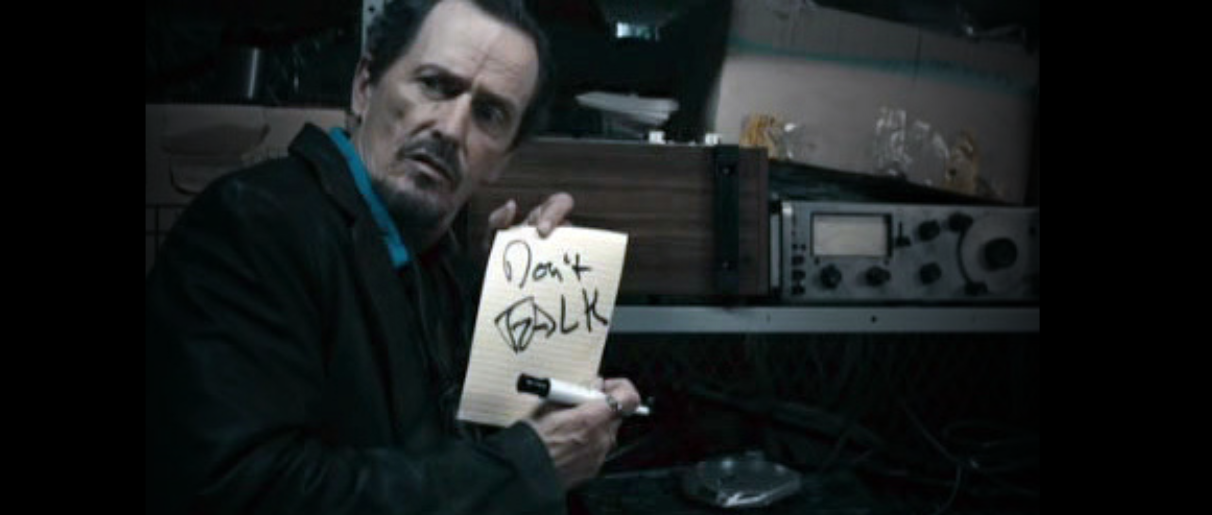
In Pontypool (2008), infection isn’t carried in the bloodstream but embedded in language itself. Words cease to function as tools of communication and instead become vectors. Certain phrases trigger collapse. Meaning destabilises. Speech loops, fractures, devours itself. The infected are spoken through. Understanding becomes exposure. There is no need to touch. Only to listen.
Repetition is where this horror tightens its grip.
Say it once, and it is a word.
Say it twice, and it becomes familiar.
Say it enough times, and it begins to feel inevitable.
Horror turns language into ritual, into invocation, and into something that behaves less like communication and more like compulsion.
In Candyman (’92, ’95, ’21), the act is simple: say his name five times. There’s no force or coercion, only pattern. You hear it.
You repeat it. You complete it. And in completing it, you participate, and you’re on the hook. Repetition bypasses belief.

Neural Linguistics, Repetition, and Control
Neural linguistics offers an unnerving companion to this idea. Language leaves residue, forming pathways that strengthen with repetition, making certain phrases easier to retrieve, easier to repeat, easier to accept. The more something is heard, the more readily it returns; not because it is true, but because it is familiar. The brain privileges pattern over accuracy, recognition over interrogation. A phrase repeated enough times begins to feel correct even when it is not (we all know a frenemy whose lies become fact), while a word slightly altered produces discomfort, not because it’s wrong, but because it resists the pattern the brain has already begun to build.
We rely on this mechanism constantly, often without noticing it. Children are taught through repetition long before they are taught through understanding. Songs, chants, and pledges spoken in unison, where rhythm precedes meaning and collective recitation smooths over ambiguity. The words arrive first as sound, as pattern, as something to be said correctly rather than something to be questioned. Understanding, if it comes, arrives later. By then, the structure is already in place, embedded not as knowledge but as reflex. This is why certain entities like to indoctrinate early.
But this structure doesn’t disappear with age; it refines itself. Corporate language operates through the same logic, embedding values through memorability rather than scrutiny, encouraging employees to internalize phrases that can be repeated cleanly, confidently, without hesitation. What begins as external language, like mission statements, brand identities, and cultural mantras screenprinted on the back of company retreat t-shirts, gradually shifts inward. It becomes the way individuals describe their work, then their purpose, then themselves. Repetition doesn’t feel like enforcement when it’s framed as ‘brand alignment’. The language fits easily in the mouth. It feels correct when spoken, and that sense of correctness is rarely interrogated.
Political language cranks up the message further by stripping away complexity in favor of phrases that travel quickly and survive repetition without degradation. These are constructions designed to be carried. They move from broadcast to conversation with minimal resistance, maintaining their structure even as their context shifts. Repetition replaces nuance, and recognition replaces understanding. A phrase encountered often enough begins to feel self-evident, because it’s been encountered repeatedly, from multiple directions, until questioning it requires a conscious disruption of the pattern the brain has already accepted.
Even desire is shaped along these lines. Language moves from description to instruction, collapsing the distance between what is imagined and what is enacted. In The Rocky Horror Picture Show, the line “don’t dream it, be it” functions less as encouragement and more as a directive, bypassing deliberation in favour of immediacy. It offers a pattern to inhabit rather than an idea to consider. The appeal lies in its simplicity, its rhythm, its ease of recall. What begins as a suggestion becomes an orientation through repetition that settles into the body before it is fully processed.
Horror does not invent this mechanism, but it sure does love to show it off! It removes the reassuring contexts, education, corporate culture, and political rhetoric and exposes the underlying process in its most distilled form. A word repeated too many times. A phrase that refuses to resolve. The familiar becomes unstable because its persistence becomes visible.
The terror lies in how little resistance familiarity requires.

Liminal Language in Horror
If language settles into the brain through repetition, horror is interested in what happens when those patterns start to slip. It rarely builds something entirely unfamiliar. Instead, it takes what we already know, how a room should behave, how a sentence should land, how cause leads to effect, and nudges it just enough that it no longer sits right. A door isn’t locked by someone. The door is locked.
It sounds small, but something shifts. The person disappears from the sentence. There’s no one to confront, no one to reason with. The world starts to feel like it’s acting on its own terms, and you’re left inside it. That same unease shows up in space. Corridors stretch too far. Rooms feel larger on the inside than they should be (thank you, T.A.R.D.I.S.)
That same unease carries into how horror treats language itself, not just as something spoken, but something that activates.
In all five installments of The Evil Dead franchise, the Necronomicon is dangerous because it’s read aloud. The text doesn’t sit quietly on the page. It requires a voice. It requires repetition. Once spoken, the words call something ancient forward, give it shape, and allow it to move. The act of reading it feels almost inevitable….of course they will.
Language becomes a threshold.
All it needs is a voice to cross it.
In The Evil Dead, the Necronomicon is treated as a text that shouldn’t be read because it is not meant for those reading it. The danger sits in translation, and in the arrogance of believing the words can be handled, contained, and understood. Speaking them aloud becomes an act of trespass as much as invocation.
That same logic appears in The Vast of Night (2019), where a recorded voice carries something unknowable across distance and time. The sound itself is enough. It doesn’t need a body, doesn’t need context, doesn’t even need to be fully understood. It moves through wires, through air, through speakers, slipping easily from one listener to the next. The characters lean in, trying to make sense of it, but in doing so, they draw closer to something that resists explanation.

You don’t have to see it.
You only have to hear it.
In The Vast of Night, the voice isn’t contained to a single listener; it spreads, carried by an infrastructure designed for entertainment, now repurposed for something else entirely. What begins as a sound becomes exposure.
Sound, here, behaves like language under pressure. Slightly distorted, slightly out of place, but recognisable enough that the brain keeps trying to resolve it. That effort, trying to understand, trying to place, becomes the point of entry. The listener participates simply by listening.
Whispers operate in much the same way. They don’t overwhelm; they invite. You have to work a little harder to hear them, to follow them, to fill in what’s missing. That effort draws you in. You’re no longer just receiving language, you’re helping to complete it. And once that happens, it doesn’t stay external for long. Words begin to do things. Not metaphorically, but functionally within the world of the film. They summon, shift, distort. You’re given just enough to start building the rest yourself, pulling from your own fears, your own expectations, your own internal logic. The horror isn’t fully on the screen. It’s assembled in your head.

Language Turned Into Power and Silence
This is where things get a little less abstract. If language shapes how we understand the world, then controlling language shapes who gets to be understood at all.
Women in horror are rarely silent, but they are often unheard. They repeat themselves, insist, try to explain what’s happening, only to be dismissed, reframed, or labelled unstable. The issue isn’t that they don’t speak. It’s that their words don’t land with authority. They’re spoken into a space that refuses to recognise them as truth.
For characters of color, the dynamic often shifts. Their voices aren’t just dismissed, they’re distorted. Accents, dialects, or cultural differences are treated as unfamiliar, and that unfamiliarity is quickly recoded as threatening. What isn’t immediately understood becomes something to fear.
From there, it’s a short step to one of horror’s most persistent ideas: the curse.
A curse is just language with consequences. But those words are rarely neutral, and their power is framed as something unknowable and therefore dangerous. What isn’t understood becomes supernatural. What isn’t translated becomes a threat…or sweet bedtime read if you’re the Necronomicon.
By the time we recognize language as something that shapes us, it has already decided what feels true, what sounds wrong, and which voices we will never fully hear.

Mo Moshaty is an acclaimed horror writer, lecturer, and producer whose work combines visceral storytelling with the psychological insight of her Cognitive Behavioral Therapy background. She has lectured internationally, including as a keynote speaker at Nightmares from Monkeypaw: A Jordan Peele Symposium (Prairie View A&M), No Return: A Yellowjackets Symposium (Horror Studies BAFSS Sig), The Whole Damn Swarm: Celebrating 30 Years of Candyman (University of California), and with the Centre for the History of the Gothic (University of Sheffield). Mo has also presented at the BFI, Miskatonic Institute of Horror Studies, and Final Girls Berlin Film Festival’s Brain Binge on women’s trauma in horror cinema, Cine-Excess on The Creepy Kid Horror Subgenre and Mother/Daughter Trauma in Horror, and Romancing the Gothic on Cosmic Horror’s Havoc on The Body Electric Her short film, 13 Minutes of Horror: Sci-Fi Horror, won the 2022 Rondo Hatton Classic Horror Award for Best Short Film. As a core producer with Nyx Horror Collective, Mo co-created the 13 Minutes of Horror Film Fest and partnered with Shudder in 2021 and 2022, while also establishing a Stowe Story Labs fellowship supporting women creatives over 40+ in horror. A member of the Black Women in Horror Class of 2023 and featured in 160 Black Women in Horror, Mo’s short fiction appears in A Quaint and Curious Volume of Gothic Tales (Brigid’s Gate Press) and 206 Word Stories (Bag O’ Bones Press). Her debut novella, Love the Sinner, was released July 5, 2024, with Clairviolence: Tales of Tarot and Torment released in October 2025. The first of her five-volume non-fiction series, The Annex of the Obscure: The Afterlife, will be released in 2027 from Tenebrous Press. As the Editor-in-Chief of NightTide Magazine and founder of Mourning Manor Media, Mo champions marginalized voices in horror. Under her leadership, NightTide plans to launch a film festival in 2028, furthering her mission to reshape the genre through inclusivity and representation.
Leave a Reply