
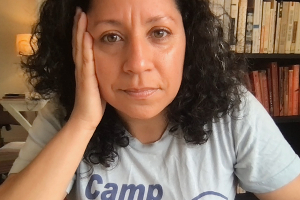
Welcome to NightTide’s Author Snapshot! Snapshots are quick, engaging, bite-sized interviews with writers that we love! This week, we chat with the outstanding Cynthia Gómez!

1. Give us your best elevator pitch on your work.
Anti-capitalist spec fiction that deals with revenge and resistance and ghosts and what happens when oppressed people fight back using magic. A friend said that my stories “explore the monsters the world tries to make of brown women,” which made me cry.
2. What was your first published work?
It’s called The Hallway; it’s about a queer woman named Susana who moves into a new apartment and she starts hanging her photo collection on what seems to be this perfect spot. But then things start happening to whoever is in the photos that she hangs up there. It was the first time I let myself embrace the supernatural and the weird, instead of trying to make myself write literary fiction.
3. Is there a story inside that you have seeds of but can’t seem to connect that’s dying to get out?
Lots. When I get better at worldbuilding, I want to write a world that’s actually one we’d want to live in, inspired by worlds like Um-Helat (in N.K. Jemisin’s “The Ones Who Stay and Fight”) or Marge Piercy’s Woman on the Edge of Time. When I started writing, all of my ideas were jostling and trying to elbow each other out of the way. Now that I write them all down in a list and they know that I’ll get to them eventually, they’ve mostly learned to wait their turn.
4. How do you handle a rejected story?
It used to be a lot harder! When a rejection came I’d be sad and maybe not even write for a few days. Now that I’ve had some really nice acceptances, and also some really nice rejections, I can be much more sanguine about the rejections.
5. What does literary success look like to you?
That’s a difficult question! I think it’s going to keep changing depending on what stage I’m in. Right now, the thing that makes me really happy is having fans. People who discover my writing and decide that something in it speaks to them and then want to read more.
But, if we’re thinking of examples, here’s one, that a lot of writers want: to have my work be adapted into something for TV or film. That’s a wish I have not just for myself or for my characters, who would love their moment in the spotlight (my impish little god Huitzol is always ready for his closeup) but also for Oakland, where most of my work is set. Oakland has been
home to so many artists and writers, but it gets very little attention on the screen, and I’d love to see that change. Also, if you’re reading this: watch I’m A Virgo.
6. Do you read your book reviews and if so, how do you deal with bad or good ones?
I do read them, because I’m dying to know how my work connected and what kind of a reach it has. Good reviews I savor like nothing else, and I reread them when I’m feeling down. So far, I haven’t encountered a negative review that bothered me very much; if there’s an aspect of my story that I loved but that didn’t connect with the reviewer, that’s okay.
7. What is the most difficult part of your artistic process?
I’m great with vibes, not so much with plot. So often I know the beginning and I know the end and I still can’t knit both ends together so the stitches don’t show.
8. The truth is often stranger than fiction. What has been the hardest scene or chapter you’ve had to write if you were channeling personal experience?
A lot of my characters, especially their deep flaws, are heavily based on me: I take my own weaknesses and the things I’m most ashamed of about myself and I basically dial them up to eleven. You’d think that that would be difficult, but it’s actually soothing, because I can have compassion for my characters in a way that’s really hard for me to have for myself.
9. What inspired your latest work?
I’ve got an upcoming collection (it’s called The Nightmare Box and Other Stories and it’s out this summer) that’s inspired pretty heavily by the works I loved when I was growing up (and many other things.)
I love vampire stories (OMG, that new adaptation of Interview With the Vampire) but I kept asking: why isn’t there more stuff about working-class vampires? What if COINTELPRO* had a supernatural/magical division, sort of like The Shop? There’s an homage to Ira Levin, another to all those The Twilight Zone episodes I watched as a kid. When I was watching and reading all this stuff, I hadn’t yet discovered all of the amazing BIPOC/queer sffh writers I know now. So I almost never saw main characters who were Latine, queer, fat, middle-aged, working-class, or any combination of the above. We have to impose ourselves onto those stories, writing ourselves in like I played a write-in part in junior high drama class. I wanted them to take center stage, those shadowy inky people that so many of us have to call up when we read or watch the stories we love.
10. If you could tell your younger writing self anything, what would ti be?
I’d tell her: you’re a horror kid. You grew up on Roald Dahl and Stephen King and Wes Craven. Embrace what you love, and write what you love.
11. What’s the best advice you’ve received from a fellow writer?
When in doubt about plot, go back to who your character is and what this decision point has to say about who that character is.
12. What is your go-to comfort horror/Sci-Fi book?
13. If you were to genre-hop, which genres would you most like to try writing?
I’m actually pretty happy in my current genre home, where most of the rooms are horror and a few are sort of dark fantasy, with the occasional light fantasy space. I might like to try writing analytical/critical essays about horror. But there are so many rooms in my house I haven’t even explored yet, and dark closets where I can hear thumping behind the locked door.
14. Can you tell us about an upcoming project?
I just finished a novella that I gave the working title of When The Fingersmith sat with some Dolls reading Mexican Gothic with The Invisible Man. But with witchcraft. If that gives you any sense of its inspirations. It’s very queer, very gothic, and it takes place in the crumbling home of a wealthy Latine family who are obsessed with color and class. She’s now titled Muñeca, and she’s in the editing phase, and soon I’m going to work on giving her a home.
**COINTELPRO was a taxpayer-funded, U.S. government program, a project of Edgar Hoover’s FBI, whose sole goal was to destroy radical political movements of the ‘60s and ‘70s. By any means necessary, including murder.
Order Cynthia’s latest work, SPLIT SCREAM VOL. 2, here.

Mo Moshaty is an acclaimed horror writer, lecturer, and producer whose work combines visceral storytelling with the psychological insight of her Cognitive Behavioral Therapy background. She has lectured internationally, including as a keynote speaker at Nightmares from Monkeypaw: A Jordan Peele Symposium (Prairie View A&M), No Return: A Yellowjackets Symposium (Horror Studies BAFSS Sig), The Whole Damn Swarm: Celebrating 30 Years of Candyman (University of California), and with the Centre for the History of the Gothic (University of Sheffield). Mo has also presented at the BFI, Miskatonic Institute of Horror Studies, and Final Girls Berlin Film Festival’s Brain Binge on women’s trauma in horror cinema, Cine-Excess on The Creepy Kid Horror Subgenre and Mother/Daughter Trauma in Horror, and Romancing the Gothic on Cosmic Horror’s Havoc on The Body Electric Her short film, 13 Minutes of Horror: Sci-Fi Horror, won the 2022 Rondo Hatton Classic Horror Award for Best Short Film. As a core producer with Nyx Horror Collective, Mo co-created the 13 Minutes of Horror Film Fest and partnered with Shudder in 2021 and 2022, while also establishing a Stowe Story Labs fellowship supporting women creatives over 40+ in horror. A member of the Black Women in Horror Class of 2023 and featured in 160 Black Women in Horror, Mo’s short fiction appears in A Quaint and Curious Volume of Gothic Tales (Brigid’s Gate Press) and 206 Word Stories (Bag O’ Bones Press). Her debut novella, Love the Sinner, was released July 5, 2024, with Clairviolence: Tales of Tarot and Torment released in October 2025. The first of her five-volume non-fiction series, The Annex of the Obscure: The Afterlife, will be released in 2027 from Tenebrous Press. As the Editor-in-Chief of NightTide Magazine and founder of Mourning Manor Media, Mo champions marginalized voices in horror. Under her leadership, NightTide plans to launch a film festival in 2028, furthering her mission to reshape the genre through inclusivity and representation.

Leave a Reply