
by Mo Moshaty
There’s a lot to be said about longevity. Some stand the test of time, where others, well, let’s just say the problematic and well-worn find themselves at the bottom of the bargain bin. But there’s nothing like a horror film that pulls you in by the simple use of shadow, of mystery, of mayhem, and completely devoid of modern slick color grading.
Here lie my Top 10 Murderously Monochrome movies that still make me shudder after all this time.

Carnival of Souls (1962)
After a traumatic accident, a woman becomes drawn to a mysterious abandoned carnival.
It’s the surrealness and existential dread for me. Mary (Candace Hilligoss) is a character I go back to again and again when I lecture about women’s trauma within horror cinema. After her car accident, Mary uproots herself and settles in a brand new town hoping for escape from being plagued by nightmares and horrific visions. Within this new town, she is drawn to an abandoned carnival where she encounters even stranger visions and ghostly figures. Mary’s descent into madness is not only disorienting but deeply tragic and it’s a discomfort that stays with you long after.
Diabolique (1955)
The wife and mistress of a loathed school principal plans to murder him with what they believe is the perfect alibi.

The girls are fighting…and going insane. In a triangulation gone wrong, meek teacher Christine (Vera Clouzot) knows her narcissistic and brooding husband (and boss) Michael (Paul Meurisse) is schtuping her co-worker Nicole (Simone Signoret). Rather than cause a stir and divorce, Christine and Nicole decide to give the louse the permanent heave-ho and dispose of the body in an orderly fashion. There’s one catch…the body is never found. The film turns into a whoddunit, whocanyoutrust, girlwhat? and I absolutely love it for it. It’s hands down much more atmospheric and unsettling than it’s glossy 1995 remake coated in Coty Matte Red Lipstick.
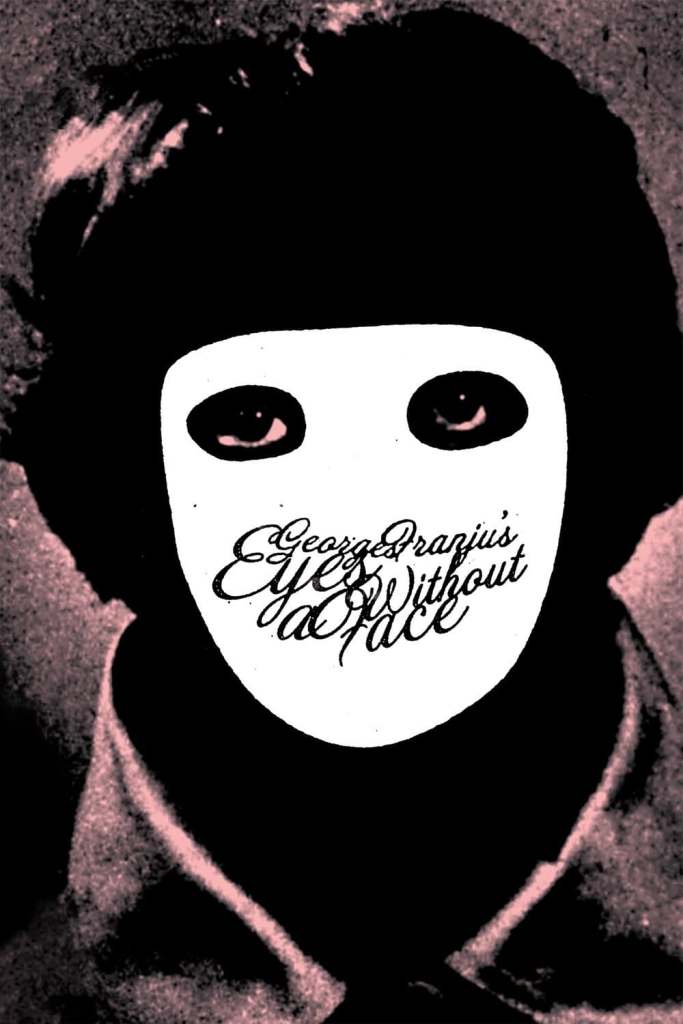
Eyes Without a Face (1960)
A surgeon causes an accident which leaves his daughter disfigured and goes to extreme lengths to give her a new face.
You could say Christiane has a daddy issue, and that issue is that her father, Dr. Génessier (Pierre Brasseur), is an odious murderer that just wants his conscious laundered, rinsed and drip-dried. I’ve always had an incredibly large soft spot for Christiane (Edith Soob) in the fact that her whole life ceased to be under her own control and agency the minute before the accident. She remains in a terrifying limbo of a half-life, a “secret” hidden away from the world. Her father’s accomplice, Louise (Alida Valli) fully in pick-me mode, helps facilitate Dr. Genessier’s evil deeds, but she could really just tell him, “you’re not a very good surgeon” and get on with it.
Under all of that pressure, depression, malaise and madness take root within Christiane, and it’s last 1/3 will have you clapping.
HÄXAN (1922)
Fictionalized documentary showing the evolution of witchcraft, from its pagan roots to its confusion with hysteria in Eastern Europe.

When Benjamin Christensen set out to create HÄXAN, the rumblings were “Thank God, he’s gonna tell the children about the dangers of society and the virtue of the Church”. Well, he did everything but that. What’s interesting about this film is that it depicts the verboten in such a way that almost makes it conquerable, you’re drawn into the debauchery of it all. Christensen’s veiled-enough-to-make-it-pass mission was to highlight the overblown and damaging messaging from the Church about mental disorders and societal degradation and that most of what we fear was no more than a secular put-up job.
There are some scenes that are favored by red and blue lighting but the lion’s share of the film fits the bill here.

The Picture of Dorian Gray (1945)
A corrupt young man somehow keeps his youthful beauty, but a special painting gradually reveals his inner ugliness to all.
“That boy ain’t right” is the best tagline for this film. Well, it should have been. From the top of the film we know there’s something a bit off about Dorian Gray (Hurd Hatfield), who has just finished standing for a portrait. He’s socially awkward, mechanical and stoic, almost frozen in mood and demeanor. But his softness peeks through just enough to throw you off balance. Dorian sets his sights on a beautiful songstress named Sibyl (Angela Lansbury serving 10/10 no notes face card here) in a local family-run tavern. She gives him the brush off but eventually caves in, falling desperately in love with him putting Dorian over the moon. That feeling lasts all of about 15 minutes as he shares his short-lived joy with his misogynistic cad of friend, Lord Henry Wolton (George Sanders), who tells him to act like he all of a sudden couldn’t care less about her and watch her desperation from a far. Having no real experience in this arena, he follows suit, sending a crushing blow to Sibyl. Dorian is crest-fallen, but only long enough to know that his acute manipulation tactics are just the tip of the iceberg and this sends him on his journey to even more heinous deeds with no one being the wiser. That is unless they looked at his portrait, who has begun to represent the putrid and devilish soul that hides underneath.
Nosferatu: A Symphony of Horror (1922)
Vampire Count Orlok expresses interest in a new residence and real estate agent Hutter’s wife.

Bearing positively one the best silhouette shots in cinematic history, Nosferatu created the template for so many horror films, from stylistic choices to the vampire look itself. F.W. Murnau did wonders with an already beautiful story penned by Henrik Galeen and brought the heady blend of terror, unrequited love and a passion that crosses the boundaries of time and humanity. When Count Orlok (Max Schreck) is visited by real estate agent Thomas Hutter (Gustav von Wangenheim), Hutter shows him a portrait of his wife, Ellen (Greta Schröder). Orlok becomes instantly infatuated. Captivated by her beauty, Orlok proceeds to travel to and make home in Wisborg (Hutter’s home town) under the guise of Hutter being a persuasive agent but he seeks to claim Ellen for himself, culminating in a fascinating and suspenseful climax and also a bit of the plague.
Note to self: don’t cut your finger around this guy.
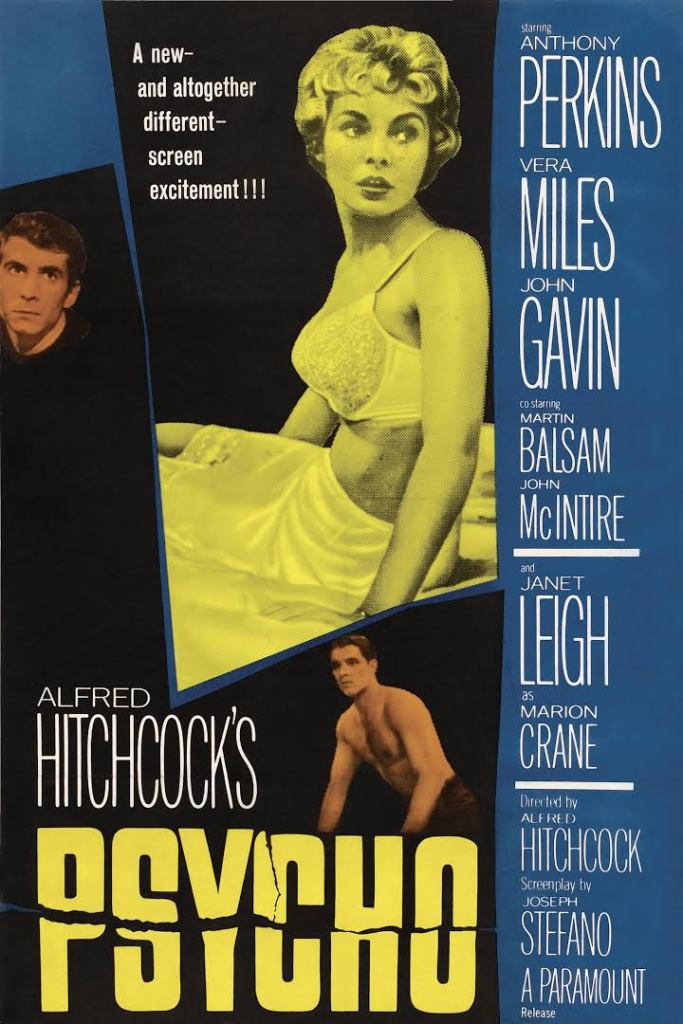
Psycho (1960)
A secretary on the run for embezzlement takes refuge at a secluded California motel owned by a repressed man and his overbearing mother.
There’s not much new news I need to share here. Hitchcock’s swerve into psychological and dissociative disorders has paid handsomely into the horror pool for almost 65 years. “What’s a girl gotta do to get married?” secretary Marion Crane (Janet Leigh) asks herself. Her flailing fiancée Sam (John Gavin) blames his gambling debts as the main reason for the delay of their wedding day (who hasn’t heard that million times?), so Marion decides to embezzle 40 large from her boss Mr. Lowery (Vaughn Taylor) and feign a headache to escape for the day. Once caught hours later on the street by said boss, Marion panics and takes to the road. After a run-in with a police officer ruffles her last available nerve, she switches cars at a local used car lot. As the torrential downpour ensues Marion seeks out shelter at the Bates Motel, where she meets caretaker and manager, the unassuming yet odd, Normal Bates (Anthony Perkins). And that’s when things go a little awry.
Norman, tormented by the callous belittling and constant demands of what the audience believes is his mother, he balances on a knife’s edge – a prisoner to his mind. Norman’s personality is split, taking on the persona of his long dead mother to cope with the mental fracture and Marion pays the eventual price. It isn’t until Marion’s sister Lila (Vera Miles) comes looking for her that we really see the origin of that fracture and it’s never-ending splintering.
Blood down a drain is still scary in black and white.
Cat People (1942)
An American man marries a Serbian immigrant who fears that she will turn into the cat person of her homeland’s fables if they are intimate together.
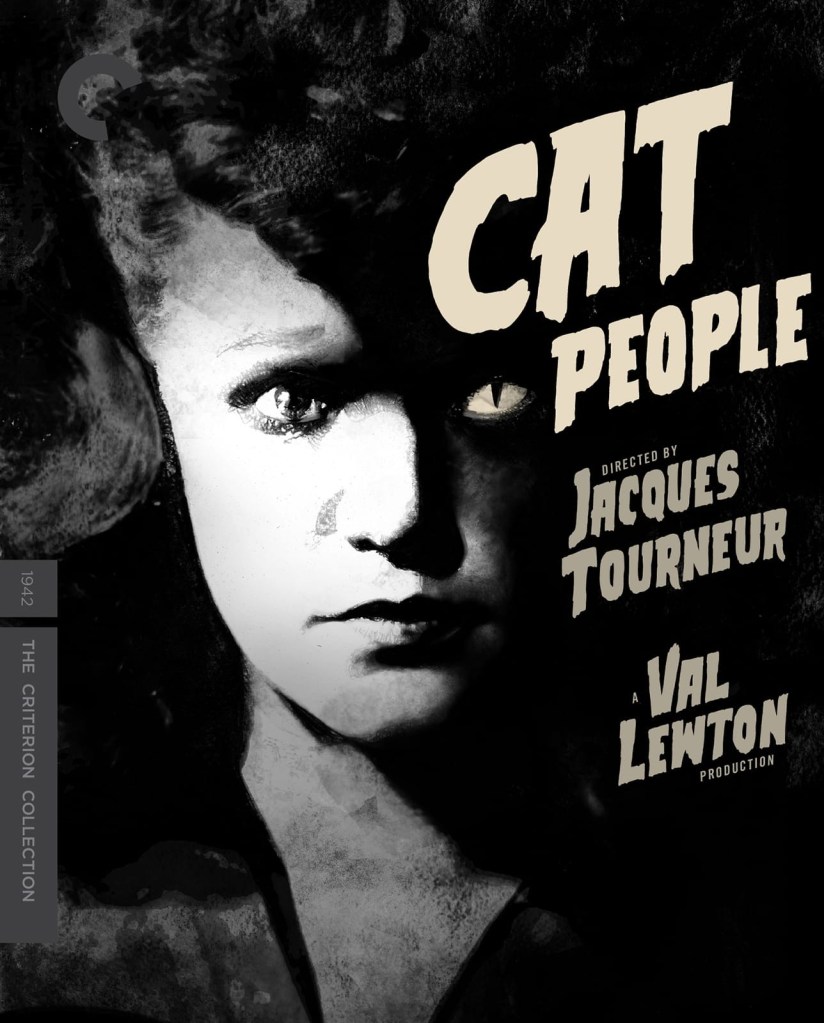
Gender, sex, and evil are intricately intertwined in 1942’s Cat People and the exploration of repressed sexuality and transformation are front and center. Fashion designer Irena (Simone Simon) struggles with her fear of an ancient curse, from her homeland in Serbia, that she will turn into a panther should get aroused by passion. A GIANT metaphor for the “dangers” of untamed female sexuality and linking her sexual identity to the terms of “evil” and “uncontrollable”. This really puts a damper on her whirlwind marriage to marine engineer Oliver (Kent Smith). Her inability to finally consummate the marriage is reflective of the societal pressure on women to ignore their own apprehensions and signals and do it when everyone else is good and ready.
Oliver’s co-worker Alice (Jane Randolph), half-grinning, half-there-there-ing, positively beams at the news that Irena won’t follow through and unceremoniously flings herself at Oliver feigning love when it’s only all about lust. And in perfect “that boy is mine” fashion, the internal conflict in Irena takes over as she zealously steps into the role of the beast she always feared so would be.
This film will always remain in my Top 20.

Dead of Night (1945)
Guests invited to a weekend in the country share their supernatural stories, beginning with Walter Craig, who senses impending doom as his half-remembered recurring dream turns into reality.
There’s nothing more unsettling and anxiety-inducing quite like war, and the production of 1945’s Dead of Night churned on during the conflict, accounting for much of the profound eeriness of it. Proudly lauded as one the first horror anthology formats, it’s testament to not showing but letting our mind wander is a masterclass. The entire film is unsettling and disorienting, and it’s composition of five horrific stories each told by a guest at an isolated country house has spawned many later anthology films (I see you “The Vault of Horror“). The closing segment, The Ventriloquist’s Dummy, has been incredibly influential in inspiring later works such as Magic (1978), Slappy from Goosebumps and the truly terrifying and uncanny power to possess inanimate objects: Annabelle (2014), Child’s Play (1988), Poltergeist (1982) Ringu (1998) and Christine (1983).
Keep a lamp on.
The Cabinet of Dr. Caligari (1920)
Hypnotist Dr. Caligari uses a somnambulist, Cesare, to commit murders.

Sleep depravation is real. The opposite is also true if you hang with ol’ Caligari. Told through a flashback, this story takes place in a village called Holstenwall filled with winding streets and twisted buildings.
Both Francis and his friend Alan are vying for the affections of Jane and on their visit to a town fair, they run into a man named Dr. Caligari who seeks a permit for his show that features a somnambulist (or for us laymen, a sleepwalker) named Cesare. He is mocked by the town clerk who later ends up dead. In his show, Caligari seems to have total control over the somnambulist who takes to answering questions from audience. At the show, Alan asks the when he will die, the somnambulist predicts that he will be dead by the morning light and well…poor Alan.
In a flurry of what seems of a serial killer stalking the streets of Holstenwall, Francis, Jane and her father Dr. Olsen seek to find the evidence that will leads to the arrest of the killer. One evening, Francis discovers Cesare trying to kidnap Jane, but Cesare dies while trying to escape. Long story short, Francis learns later, that Caligari is actually an asylum director fascinated with the work of an 18th century mystic named Caligari who used a somnambulist to commit murders.
With a twist that left me shook at first watch, it’s still a gut-punch to this day. TO THIS DAY!
Whatever your flavor of horror, there’s always a fun one that came decades before it, leaving itself open to inspire others and create the many subgenres we hold so dear.
German-American Photographer Ruth Bernhard once wisely said, “What the human eye sees is an illusion of what is real. The black and white image transforms illusions into another reality.”
Mo Moshaty is a horror writer, lecturer and producer. As a Cognitive Behavioral Therapist and life long horror fan, Mo has lectured with Prairie View A&M Film & TV Program as a Keynote, BAFSS Horror Studies Sig and The University of Sheffield in the United Kingdom. Mo has partnered with horror giant, Shudder Channel, to co-produce the 13 Minutes of Horror Film Festival 2021 and 2022 with Nyx Horror Collective and her literary work “Love the Sinner” was published with Brigid’s Gate Press in July of 2023 and her two volume collection, “Clairviolence: Tales of Tarot and Torment will be published in 2025.
Mo is the creator and Editor-in-Chief of NightTide Magazine and the Founder of Mourning Manor Media.

 NightTide Magazine
Leave a comment