
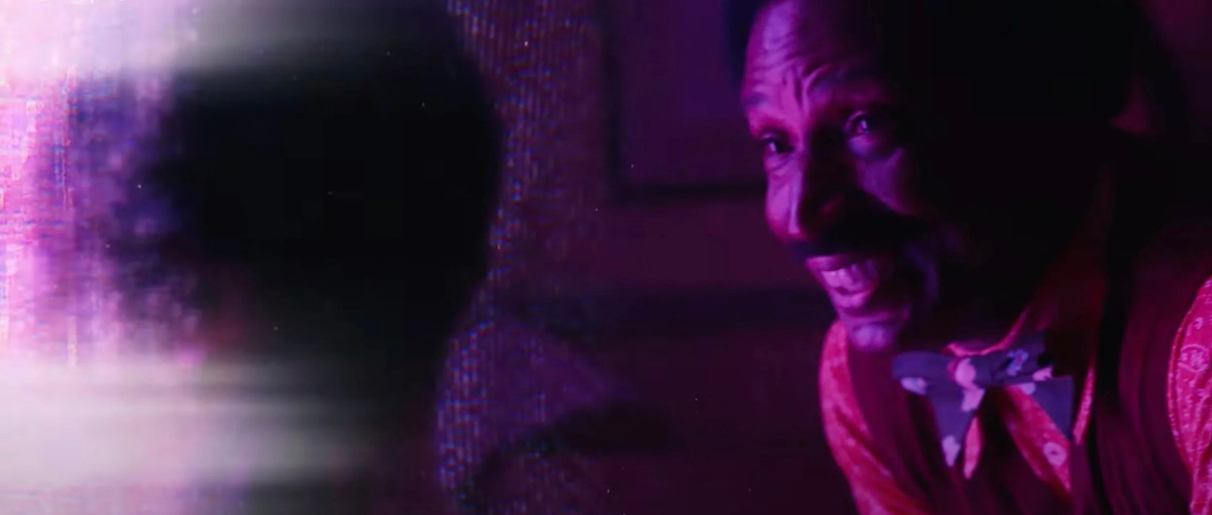

In case you somehow missed it, a new Black horror icon landed in 2024. The popular short film Mr. Crocket was turned into a full-length feature that reminded us that the kids aren’t alright. The face, voice, and mannerisms of Mr. Crocket belong to Elvis Nolasco (who gives an outstanding performance) and continue to send shivers down our spines. However, we all know every monster is only as good as the team behind it. Which is why we caught up with director and co-writer Brandon Espy to unpack what it’s been like watching his beloved movie receive some well-deserved attention.
Sharai Bohannon: For people who don’t know, you have a background in marketing. This led to you working with Regina Hall on an ad, and we don’t talk about this enough! What was it like working with her? Is she one of the actors you would like to work with in the MCU (Mr. Crocket Universe), or one of the other films you’re currently writing?
Brandon Espy: She was amazing. Such a nice person and hilarious as expected. I have always wanted to work with her and hope I’m able to one day. She’s a legend.
SB: People act like filmmakers just arrive on the scene, but you all had day jobs and survival gigs before hitting the red carpet, too. What are some skills you picked up in marketing that came in clutch when working on your films?
BE: Marketing helped me to treat a film like a product. This led me to identify the target audience, what the trends are, what factors make this audience gravitate towards a film like this, etc. It truly helped me focus on the commerce portion of selling films and building visual decks that clearly explained my idea.
SB: When did you know you wanted to tell stories in the horror genre?
BE: When I started writing, I initially focused on writing a half-hour comedy. During that process, I noticed the commonality of high stakes and realized that I did have a deeper love for horror than I thought. A lot of fond memories of watching movies growing up surrounded by this genre.

SB: What were you doing when you found out you were nominated for an NAACP? How did you find out, and what was that like?
BE: I was lying in bed and saw an article about the NAACP nominations. I was scrolling and not even thinking that I would see my name. Especially with horror. No way. When I saw it, I jumped up and almost ran through my wall. It was a very validating moment for me. I took my mom to the awards show, and it was a special moment for us to share together.
SB: Watching Mr. Crocket rack up nominations that year healed me because the horror genre is often looked down on. We are also all painfully aware of the way too many non-Black critics disregard Black art. So, it’s such an uphill battle for Black creatives in this space, which made seeing the love via the NAACP and the Fangoria Chainsaw Awards that much cooler. Did you know during filming that your first feature was going to be that girl?
BE: During filming, I was just excited to create my own horror villain that’ll be visible on such a huge platform. I was hoping for a Chainsaw Award nomination, but it wasn’t a confident thought in my head. When I was notified I won the Chainsaw Award, I was in a coffee shop in Inglewood at some panel. I quietly ran outside into the street, called my best friends on speaker, and did the most manly, chest-bumping yell I could let out. That moment let me know that I could really make a mark on horror film history. Very emotional.
SB: Mr. Crocket was originally a short. Adapting your own work into longer formats is hard. What’s one thing you learned during your process and want to pass on to filmmakers about to do the same?
BE: I would focus on the path of your protagonist and make sure that your emotional beats resonate heavily with your target audience. The fun and games can be built around that, but if that’s not solid at its core, then everything else will not matter. Don’t treat your audience as if they are dumb. Watch how much expositional dialogue you deliver. Really understand the style and tone you want to achieve and make sure it’s consistent throughout the whole script so that you look like you are owning the overall vibe of your film.
SB: Mr. Crocket resonates with a lot of people for many reasons. When did you know this was going to hit so hard with so many horror fans?
BE: Our production crew consisted of people from various walks of life, but they all liked horror in some form. When I saw them getting excited about working with Mr. Crocket each day, I knew that we were onto something. To even have MastersFX and Alex Pardee wanting to work with us and get excited about the process. The fact that it was a demonic kid’s show host from the 1970s, who was Black, and played by the amazing Elvis Nolasco, I knew we had something special on our hands.
SB: We love practical effects. So, one of the many cool things about Mr. Crocket is the puppets? Can you explain why you chose to go this route instead of questionable CGI?
BE: I haven’t been a fan of CGI, and I did not want to make a horror film that would be considered “new age” because of it. I wanted to honor the period in which the film took place, which was a time when mostly practical effects were used. Although we had to use CGI to finish certain shots that were practical, I tried my best to let MastersFX shine.

SB: I love that you mix different kinds of media in Mr. Crocket. Not only does it make it feel more like a kids’ show from the ’90s, but it’s also just visually cool. What was it like working with animators, puppeteers, etc.? What were some of the references you gave them to help get them on the same page?
BE: The animators were great to work with, shoutout to Cartuna. We started with Schoolhouse Rock! References for the cartoon direction to stay in that era, around the 1970s. The kids’ show was my favorite part! Sid and Marty Krofft, McDonaldland, Mr. Rogers, ZOOM, Picture Pages, Reading Rainbow, The Electric Company, and Pee-Wee’s Playhouse were all close references to help build out this role and his character within the kids’ show.
SB: As a ’90s kid, I didn’t enjoy most shows aimed at kids, so I skipped them. However, I would’ve been all over Mr. Crocket.
BE: Yes, I would’ve loved Mr. Crocket. I would have wanted to watch him when I was young, too. But [we] either got LaVar Burton for Reading Rainbow, Bill Cosby for Picture Pages, and Morgan Freeman for The Electric Company. I would still love to make a Mr. Crocket kids series one day, as he does really have a lot of important lessons to teach.
SB: Wrangling children is not for the weak! How did your experience as a dad help you prepare to work with your younger cast members?
BE: It helped me have the ability to talk to them on their level. I didn’t treat them as if they were kids who didn’t know much, and that helped them respect me and want to listen to me. I allowed for ample playtime outside of that, and they were excited to learn about the practical effects. How often do kids get to see realistic-looking intestines from one of the top practical effects studios around? They all had amazing parents, too, and it was great to see them watch their kids live out their dreams.

SB: Another thing I personally love about Mr. Crocket is that it doesn’t shy away from the harsh realities of the world we live in (like Crocket’s death via police). However, it handles it with care instead of traumatizing its audience. How did you and co-writer Carl Reid find that delicate balance?
BE: We did not want to approach this film with a race or politically charged agenda. We wanted to make a film with universal themes that happen to be told from a Black person’s perspective. Through that, we didn’t want to alienate groups who couldn’t understand the experience. This was a period that was very politically charged. However, that is such a small part of this overall story that it would do the narrative a disservice if we really decided to focus on it. This was not the film for that.
SB: I have to ask…can we get an update on this sequel?
BE: I appreciate you asking. Unfortunately, I can’t say anything other than I am excited for when I get to dive back into Mr. Crocket’s World!
SB: I know you have a few things you’re working on, but are you allowed to talk about any of them yet? I’m nosey, and this suspense is killing me, dude.
BE: At this time, I will say that I have some really crazy stuff coming up. [All in] in stages where I can’t speak on them just yet, but you already know you are going to be one of the first I tell when I get the updates. Lol.
SB: What’s one thing you’ve been dying to talk about and no one has asked you yet? It can be about Mr. Crocket, life, football, or whatever.
BE: Great question. I think it’s what other genres I would like to explore, and the films from my childhood that I would like to do a remake of. I want to explore fantasy, darker thrillers, and sports dramas. Remake-wise, I would love to do The NeverEnding Story, The Pagemaster, 3 Ninjas, Adventures in Dinosaur City, and Not Quite Human.
SB: Where can people find you online to keep up with all your work?
BE: I am pretty private on IG at @espyespy. On X at @espyornah.


Sharai is a writer, horror podcaster, freelancer, and recovering theatre kid. She is the host of the podcast A Nightmare On Fierce Street and is also one-half of Blerdy Massacre. She has bylines at Fangoria, HorrorBuzz, Neon Splatter, and is Co-EIC of Horror Movie Blog. She spends way too much time with her TV while failing to escape the Midwest.

Leave a Reply