
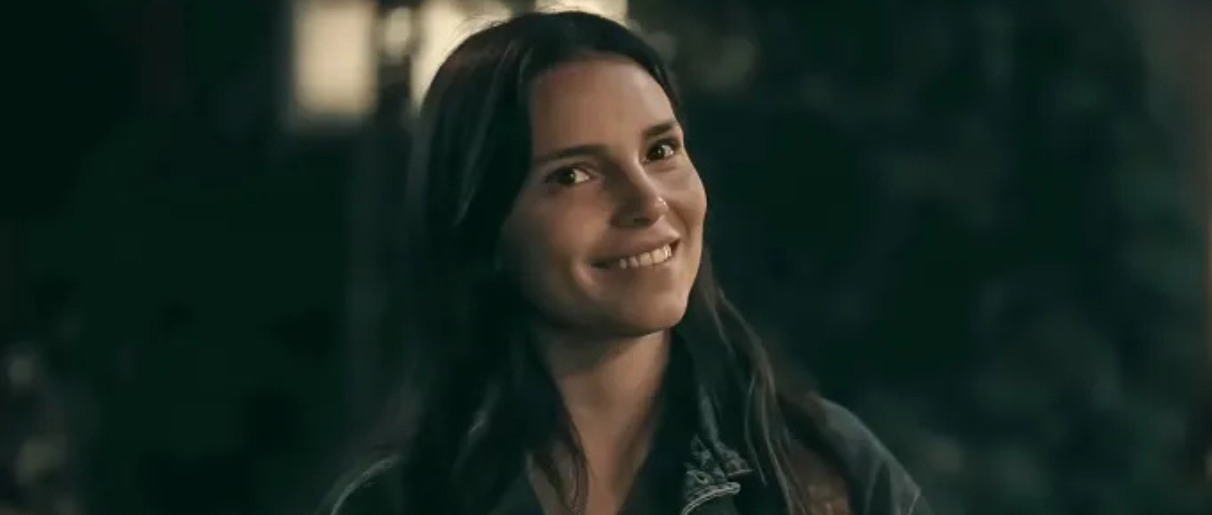
By Mo Moshaty

The internet has spent the better part of the week putting Obsession on trial.
“Nikki’s the villain.”
“No, Bear’s the villain!”
“Actually, Ian is worse because he knowingly strung his friend along while secretly sleeping with Nikki.”
“Wait, Sarah is the real problem because she spends half the film tearing Nikki apart before practically volunteering herself as Bear’s replacement girlfriend.”
Everyone has a culprit. Everyone has a theory.
Long story short, the film focuses on how men will choose a woman’s complete lack of autonomy instead of taking responsibility and being honest, and then complaining to anyone who’ll listen, BUT what nobody seems particularly interested in is the simpler possibility: None of these people are Nikki’s friends.
Not really.
That sounds harsh until you begin examining the evidence. Strip away the “romantic” tensions, the betrayals, the bad decisions, and bruised feelings, and a curious truth emerges. Nobody in Nikki’s orbit seems to value Nikki for Nikki.
Bear loves an idea of her, a fantasy. A version of Nikki assembled from longing, projection, and wishful thinking. He wants her affection with intensity that suggests possession more than understanding. His disappointment stems from discovering she is an actual person with desires independent of his own. Ian wants access without accountability. He enjoys Nikki’s company, her body, her attention, yet remains unwilling to tell the truth to the friends standing directly beside him. Honesty would require self-sacrifice. Ian is not interested in self-sacrifice.
Then there’s Sarah, perhaps the film’s most quietly fascinating character. Sarah speaks about Nikki with the emotional smoke reserved for a workplace enemy. Every conversation feels like an opportunity to catalogue flaws, expose weaknesses, and subtly position herself as the superior alternative. The moment a gap appears in Nikki’s relationship, Sarah is ready to step into it. This isn’t friendship. It’s opportunism wearing friendship’s coat.
The horror lurking beneath Obsession (outside of Bear’s odious and stank wish) has less to do with romance than recognition. Nikki is surrounded by people who need something from her, yet nobody seems willing to offer anything in return. Everyone wants a piece of her; nobody wants her whole.
That dynamic should feel familiar to horror fans because the genre is chock full of them. The monster rarely destroys these relationships. It simply exposes them.

Take Jennifer’s Body. Jennifer is supposedly adored. She’s the gravitational center of every room she enters. Yet much of the affection surrounding her is transactional. People want access to her beauty and her status, her confidence and her social power. Even Needy’s devotion exists in conversation with resentment, dependence, fascination, and desire. Jennifer’s loved, certainly, but she’s also consumed.
Or look at Bodies, Bodies, Bodies, where an entire friendship group appears inseparable until circumstances remove any ability to perform affection. What remains is a landfill of grudges, jealousies, insecurities, hot takes, and old wounds. Nobody actually likes one another very much. The hurricane merely traps them long enough for the truth to come out.
Sissy offers an even crueler variation. Cecelia spends years longing for reconnection, believing friendship can restore a version of herself she has lost. But she discovers that inclusion and acceptance aren’t the same thing. Being invited into a group doesn’t guarantee anyone genuinely wants you there. A Strong undercurrent if we’re looking from the angle of Black women who find themselves in predominantly white friendships.
For decades, The Craft has been framed as a story about female empowerment gone wrong, yet its friendships are built upon an unspoken contract. Nancy, Bonnie, Rochelle, and Sarah find one another through shared marginalization. Together, they become powerful precisely because they’re outsiders. At the moment that the power begins to be distributed unevenly, the friendship fractures. Sarah becomes useful when she strengthens the coven, but once she stops serving that purpose, the affection transforms into hostility and danger. The sisterhood his genuine but only within certain boundaries, and the friendship survives so long as everyone’s needs remain aligned. When one person seeks something different, the group responds like an immune system attacking a threat, and it reveals how much of their connection depended upon utility. They needed one another; they didn’t necessarily know one another.
Yellowjackets is perhaps one of the most ruthless examinations of friendship television has produced in years. But the series understands that shared trauma doesn’t automatically create affection; it creates dependency. The girls need one another. They protect one another. They save one another’s lives. They also manipulate, exploit, resent, betray, and abandon one another with astonishing regularity. What binds them together is necessity. The adult timeline makes it painfully clear that decades later, many of these women remain emotionally entangled despite barely liking one another. They share history, they share danger. They share guilt and secrets. What they don’t share is genuine fondness. The wilderness strips away the social etiquette that normally disguises these types of truths, and in that sense, Yellowjackets may be the purest expression of horror’s recurring friendship nightmares.

Then there’s All My Friends Hate Me, a title so blunt it almost feels impolite. The film transforms friendship itself into a source of dread because every interaction exists in a liminal space between affection and humiliation. The protagonist spends the entire story asking a question many adults secretly fear. Do my friends actually like me?
The answer remains slippery because the film understands something really uncomfortable about modern relationships. Genuine care and casual cruelty often occupy the same space, and affection and resentment frequently share a table. Perhaps that’s why these stories continue to resonate. They’re not fundamentally about murder or ghost stories or possession or romance or witches or monsters or ghosts lurking in the attic. They’re about conditional affection. They’re about discovering that your value within a social circle entirely depends upon what you can provide.
Beauty, entertainment, status, attention, sex, validation. And the moment those resources disappear, the relationship begins to wobble or fracture or curdle into obsession. Which brings us back to Nikki.
One of the most fascinating things about Obsession is how completely Nikki functions as a repository for everyone else’s desires and emotions. Bear projects longing, Ian projects convenience, and Sarah projects competition. Each character approaches Nikki carrying some sort of agenda, and each one demands something from her and interprets her choices according to their own emotional needs.
Yet remarkably few people seem interested in Nikki herself. For a film that spends so much time revolving around her, very little attention is given to who she actually is beyond everyone else’s perception of her. We learn fragments. We catch glimpses of her closeness with her mother, the grief that follows. The complicated dynamics within her family. But nobody within the friendship group appears particularly interested in putting those pieces together. Nobody asks what keeps her awake at night. Bear doesn’t ask what she deems the difference between a romance and a love story. What would be a love story to her? If he were truly invested, he would want to create her love story instead of making her a puppet for himself. Nobody asks where she sees herself in five years. Nobody asks why certain wounds still hurt. Nobody asks what she needs. Is she just mysterious, or has no one put in the actual effort to excavate?
The loneliest place in horror seems to be not the abandoned asylum, or the haunted house, or the dark woods beyond the city limits, or even the creepy basement. It’s standing in the middle of a room of people who claim to love you and care about you, while slowly realizing they only love the version of you they’ve invented. The version that comforts them, the version that validates them, and the version that belongs to them.

Mo Moshaty is an acclaimed horror writer, lecturer, and producer whose work combines visceral storytelling with the psychological insight of her Cognitive Behavioral Therapy background. She has lectured internationally, including as a keynote speaker at Nightmares from Monkeypaw: A Jordan Peele Symposium (Prairie View A&M), No Return: A Yellowjackets Symposium (Horror Studies BAFSS Sig), The Whole Damn Swarm: Celebrating 30 Years of Candyman (University of California), and with the Centre for the History of the Gothic (University of Sheffield). Mo has also presented at the BFI, Miskatonic Institute of Horror Studies, and Final Girls Berlin Film Festival’s Brain Binge on women’s trauma in horror cinema, Cine-Excess on The Creepy Kid Horror Subgenre and Mother/Daughter Trauma in Horror, and Romancing the Gothic on Cosmic Horror’s Havoc on The Body Electric Her short film, 13 Minutes of Horror: Sci-Fi Horror, won the 2022 Rondo Hatton Classic Horror Award for Best Short Film. As a core producer with Nyx Horror Collective, Mo co-created the 13 Minutes of Horror Film Fest and partnered with Shudder in 2021 and 2022, while also establishing a Stowe Story Labs fellowship supporting women creatives over 40+ in horror. A member of the Black Women in Horror Class of 2023 and featured in 160 Black Women in Horror, Mo’s short fiction appears in A Quaint and Curious Volume of Gothic Tales (Brigid’s Gate Press) and 206 Word Stories (Bag O’ Bones Press). Her debut novella, Love the Sinner, was released July 5, 2024, with Clairviolence: Tales of Tarot and Torment released in October 2025. The first of her five-volume non-fiction series, The Annex of the Obscure: The Afterlife, will be released in 2027 from Tenebrous Press. As the Editor-in-Chief of NightTide Magazine and founder of Mourning Manor Media, Mo champions marginalized voices in horror. Under her leadership, NightTide plans to launch a film festival in 2028, furthering her mission to reshape the genre through inclusivity and representation.

Leave a Reply