

By Tuğçe Kutlu

Spoilers follow.
Lee Cronin’s The Mummy announces itself as a reinvention. Instead of reviving an ancient king, priest, or warrior, it makes a missing American girl the body through which the mummy returns. Katie disappears while her family is living in Cairo and is discovered eight years later, impossibly alive inside a sarcophagus. By then, her family has moved to New Mexico. Her return appears to answer a prayer, but it carries an ancient force into the home.
The change in the monster is significant. Cronin removes the mummy from the familiar role of the foreign man who rises from a tomb and pursues Western intruders. He turns the story into domestic horror, parents washing, feeding, watching and fearing the child they have spent years mourning. The film’s most disturbing question is not whether the dead can return, but whether love can survive a return that offers no restoration. Katie is physically present, yet the family cannot know whether she is still their daughter.
That emotional premise gives the film real force. It also allows The Mummy to appear more culturally self-aware than many earlier versions of the story. Arabic is spoken. Egyptian characters are not confined to anonymous crowds. Detective Dalia Zaki has intelligence, persistence and a decisive role in understanding what happened to Katie. Cairo is presented as a contemporary city rather than only an archaeological playground.
Yet Orientalism does not disappear simply because representation becomes more detailed. It can survive without cartoonish accents, faceless servants or colonial adventurers. It also operates through narrative design, through the division between places that generate mystery and people who are permitted interiority; through the assumption that one culture exists as material to be interpreted by another; and through the conversion of a living society into an atmosphere of danger, antiquity and secrecy.
Edward Said’s account of Orientalism remains useful because it describes more than inaccurate images. Orientalism produces “the East” as a field of knowledge constructed for Western needs, ancient rather than modern, mysterious rather than ordinary, spiritually excessive rather than rationally legible (Said 1978). In Cronin’s film, Egypt is not represented with the crudest hostility. The deeper problem is that it is still organised as the place from which horror comes.
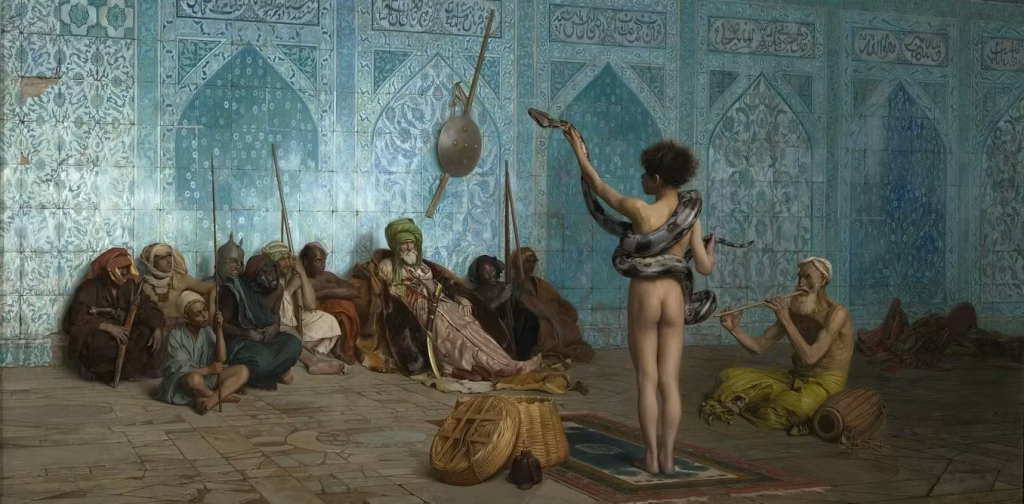
Katie disappears in Cairo, but the disappearance is not allowed to open the film toward Egyptian social life. Instead, Egypt rapidly becomes a threshold between the everyday and the occult. The city contains police offices, families, streets and media work, yet these signs of modernity remain secondary to the film’s governing imagery such as desert, scarab, sarcophagus, forbidden ritual, buried structure, supernatural sand. Egypt is contemporary enough to host the plot but ancient enough to explain it.
This is a familiar representational arrangement. Modern Egypt is visible, but Pharaonic Egypt is treated as its essential truth. The present becomes a thin surface beneath which an allegedly timeless and dangerous antiquity waits. Such a structure denies Egyptian modernity full narrative weight. Egypt is not granted the ordinary density that New Mexico receives through bedrooms, meals, Catholic rituals, family resentments and the routines of care. Cairo initiates the catastrophe; the American home becomes the place where that catastrophe acquires psychological depth.
The relocation matters. Once Katie is returned, the film’s emotional centre settles firmly within the Western family. Their guilt, grief, marital strain and parental responsibility organise the audience’s relationship to the horror. Egypt becomes the origin point, the source of clues and the location of ritual knowledge. The United States becomes the location of suffering that the film asks us to inhabit.
This does not mean the Cannon family’s pain is illegitimate. The problem is one of asymmetry. Egyptian characters are connected to the plot through function; they investigate, translate, harm, warn, remember, or transmit knowledge. The Western characters are permitted contradiction. They can be loving and selfish, hopeful and resentful, protective and exhausted. They possess the messy interiority that makes characters feel alive.
Dalia comes closest to challenging this division. She is neither a superstitious guide nor a corrupt official. Her determination prevents the Egyptian sections from collapsing entirely into exotic background. But she is still positioned as the person who carries knowledge from Egypt toward the Cannon family’s crisis. Her labour makes the family’s story intelligible. The film gives her agency, yet that agency remains attached to solving a Western tragedy.
Representation cannot be reduced to counting positive and negative images. A film may replace an openly racist stereotype with a competent, sympathetic character while preserving a Eurocentric structure around that character. Dalia’s presence improves The Mummy, but it does not automatically alter the story’s centre of gravity. She is included in the narrative without becoming the consciousness through which Egypt is known.
The film’s treatment of antiquity carries an even longer history. European Egyptology did not develop outside colonial power. Archaeological institutions, museums, tourism and systems of collection helped transform Egyptian material culture into knowledge that could be owned, classified, removed and displayed. The struggle over Egyptian antiquities was also a struggle over sovereignty, of who could excavate the past, who could interpret it, and who had the authority to claim it.
The mummy occupies an especially violent place in this history. It is not merely an artefact but a human body made available to the colonial gaze. Mummified remains were unwrapped, exhibited, studied, collected and circulated as curiosities. Popular culture then turned the violated dead into threatening figures. The resulting fantasy displaced the violence of extraction; instead of asking why outsiders entered tombs and treated bodies as property, mummy stories asked why Egypt responded with a curse.
The mythology of “mummymania” demonstrates how the mummy’s curse became a flexible cultural narrative shaped by changing Western attitudes toward archaeology, death, race and the Middle East. The curse performs a convenient reversal. Colonial intrusion recedes into the background while Egyptian resistance, imagined as magical, irrational and vengeful, becomes the source of fear.

Cronin’s film avoids the conventional scene of European or American archaeologists opening a royal tomb. Nevertheless, it continues to treat Egyptian antiquity as portable horror. The sarcophagus, scarab, bindings, pyramid forms and ritual language do not build a coherent Egyptian religious world. They operate as immediately recognisable signs of ancient danger. They are detached from history and recombined into a supernatural system designed for the family narrative.
The result is not exactly an Egyptian mummy story. It is a possession story dressed in the visual authority of Egypt.
That distinction is crucial. Possession horror usually requires a framework in which the body becomes contested territory. Katie’s body is occupied, read, restrained, and treated as evidence. Her parents desperately search for signs of the child they remember, while the force inside her turns care into danger. The film’s reimagining of the mummy therefore rests on containment; the preserved body is a vessel, and the bindings are part of a system that keeps evil enclosed.
This imagery echoes the museum even when no museum appears. Museums have historically made mummies legible by enclosing them, in cases, catalogues, scientific narratives and imperial collections. Cronin transforms that history into family horror. Katie is found inside an Egyptian container, transported across national borders and placed inside an American domestic space where others attempt to interpret her body. The ancient world becomes something carried home.
Making Katie white, Western, female and young may seem to reverse the traditional politics of the mummy. The monster is no longer an Egyptian man threatening Western womanhood. But the reversal is incomplete because Egypt still supplies the contaminating force. Katie’s body becomes the route through which a foreign antiquity enters the American family. The threat is no longer embodied by an Egyptian person; it is absorbed into a Western child.
In this form, otherness becomes invisible and intimate. The danger can pass as vulnerability. It can be welcomed into the home because it wears the face of someone loved. The film intensifies horror by asking the family to distrust the returned child, but this device also converts Egypt into an invasive presence lodged inside Western innocence.
The family’s grief further obscures the cultural politics of the story. Cronin is most interested in loss without closure. Katie’s parents have built their lives around absence; her return does not repair them but exposes what mourning has done to each person. The mummy becomes a metaphor for grief preserved past its natural limits, a body kept present, a wound that cannot decay, a past that refuses to become past.
It is a strong metaphor. Yet the film again assigns Egypt the task of materialising Western psychic pain. Egyptian antiquity becomes a symbolic language through which an American family confronts guilt, failed care and parental sacrifice. The cultural material is not explored for itself. It is used because it offers an established vocabulary of burial, preservation, secrecy and return.
This is where the title’s promise of reinvention falters. The film changes who is wrapped, but not who is centred. It changes the mummy’s body, but not the old division between an enigmatic Egypt and a psychologically complex West. It gives Egyptian characters more dignity than many predecessors, yet it still treats Egypt primarily as the narrative unconscious of another culture.
A genuinely decolonial mummy film would not require perfect or uniformly “positive” Egyptian characters. It would require a different distribution of knowledge and subjectivity. It would ask what antiquity means within modern Egyptian life rather than treating the ancient past as detached occult property. It would recognise that archaeology, museums and the mummy’s cinematic afterlife are bound to histories of possession. Most importantly, it would allow Egyptian characters to exist beyond their usefulness to Western discovery, fear or healing.
Lee Cronin’s The Mummy understands that preserved bodies are unsettling because they collapse distance. They make the past physically present. But its own past, the colonial history embedded in the mummy genre, remains insufficiently examined. The film brings the monster into a new body and a new home while carrying forward the same imaginative geography.
The mummy has changed. The gaze that wraps it has not.



Leave a Reply