

Female Intuition and the Horror of Walking Down the Aisle
By Emily Pille

Lisa Brühlmann (directed 2 episodes) Axelle Carolyn (directed 2 episodes)/Netflix, Upside Down Pictures
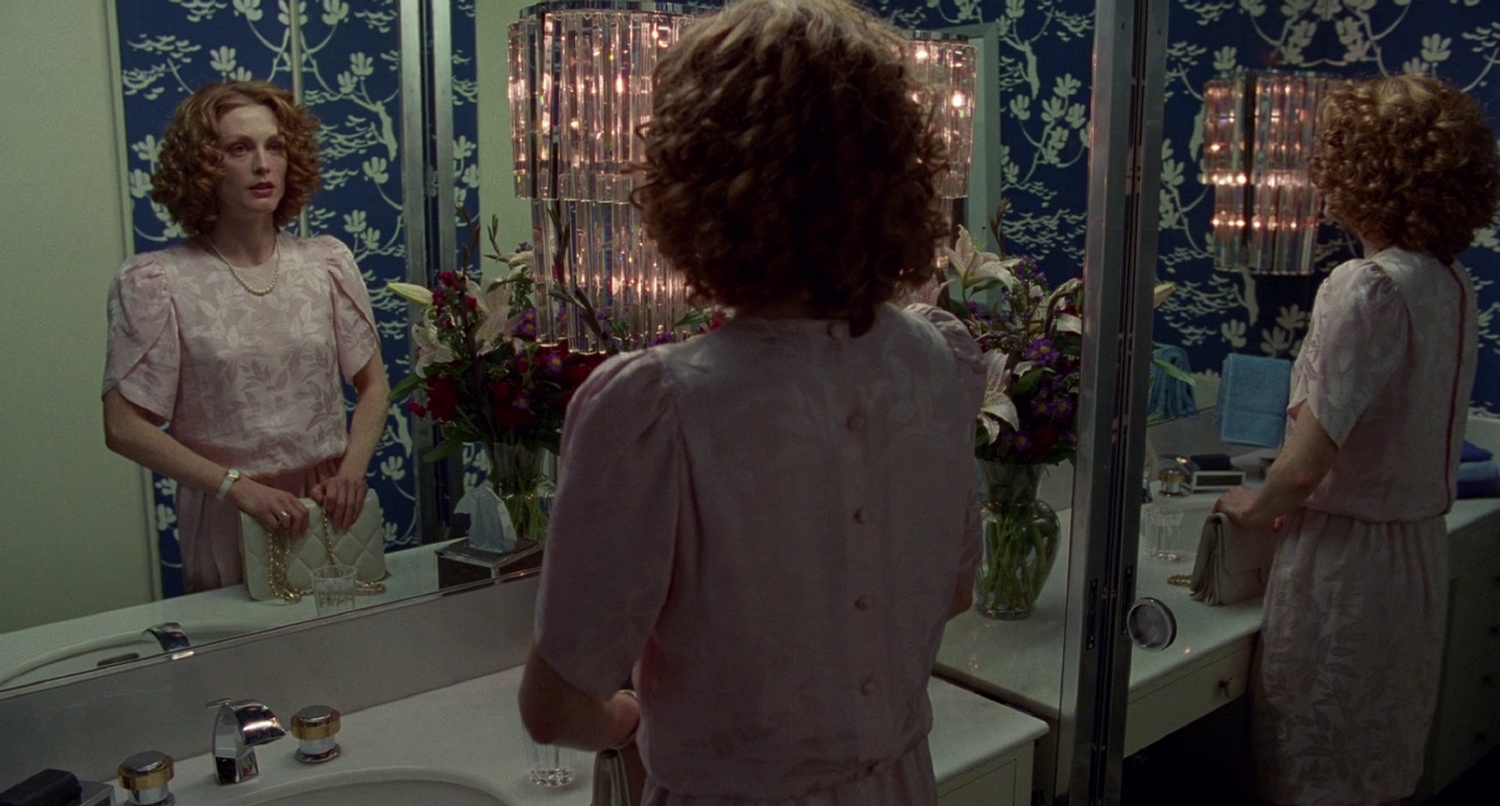
Haley Z. Boston’s pilot opens with jarring and captivating juxtaposition, as any unsettling horror series should. Heavy breathing and an eerily muffled “Bridal Chorus” accompany a shot of a veiled woman walking down the aisle. An occasion intended to be joyous, her dark procession feels less like an arrival at a promised happy ending and more like a march to the executioner’s block. As her heartbeat pounds for viewers to hear and “Bridal Chorus” warps, mixed flashbacks of both tension and happiness between the couple quickly cut to a scene of devastation: trails of blood lining the aisle, screams echoing through the wedding venue. The audience is then transported back to five days prior and begins to witness the curious and dread-filled journey toward “I do”. A contemporary exploration of the traditional Gothic genre, Something Very Bad is Going to Happen showcases a distinctly female perspective in the horror world. Chiefly, it paints marriage as rife with danger for women. In Gothic stories full of secrets and supernatural hauntings, a woman is never more vulnerable than when a man desires to marry her. If and when she suspects such danger, her premonitions are dismissed as irrational. A dark marital escapade deep in the woods brimming with troubled family dynamics and unsettling isolation, Boston’s series displays a distinct horror: that women know when something bad is going to happen, but no one believes them.
Gothic stories are filled with the Uncanny: curses, hauntings, psychological torment, and looming dread. The Female Gothic genre, while incorporating these elements, distinguishes itself from the Male Gothic. Female Gothic is associated with “female authorship, themes of societal and bodily constraints for women, the portrayal of the heroine as both victim and hero, and the eventual rational explanation of supernatural elements.” Male Gothic, in turn, is more frequently associated with elements such as “unrestrained horror, negative representation of women, and ambiguous or unsettling conclusions” (Leonardi 2015).


Jane Eyre (2006); Crimson Peak (2015); Woman of Stone (adap. Man-Sized Marble, 2024)
The Gothic genre flourished in the Victorian era, an era that was also notably marked by tensions around the shifting place of women in society. Women wove stories that blended traditional Gothic elements with fears around the restriction and powerlessness of female identity. One such example is the short story by Edith Nesbit, “Man-Size in Marble”. A tenant in a new village, the protagonist is warned by a local woman that formidable marble soldiers become reanimated the night before Halloween, and that he should take heed to protect himself and his wife. Disregarding the woman’s warning, the protagonist leaves his wife vulnerable on the night when the veil is thinnest, resulting in her death. Heavily influenced by the novel Rebecca, the film Crimson Peak tells the story of a young woman writer who marries into a mysterious aristocratic family. She is taken to an imposing family estate in the middle of nowhere, where clay the color of blood oozes up from the frozen ground. Bouts of sickness and a menacing sister-in-law leave her feeling something terrible is afoot. She uncovers that she is the latest of multiple wives, all a part of a scheme to steal young women’s fortunes to foot the bill for a haunted and crumbling family legacy. One of the most celebrated Gothic narratives, Jane Eyre, follows Jane as she navigates isolation, a Byronic hero, and a quest for autonomy in a world that offers a young woman very little. She experiences suspicion and dread at several moments throughout her story, particularly when she expects her love interest is hiding something from her. To her discovery, he hides not only a complicated past but a “mad” wife in his attic. These female characters suffer confinement, terror, and even death when they are romantically involved with men. As hauntings and malice loom in Gothic stories for women, they have little to trust and rely upon other than their own ability to intuit danger.

Lisa Brühlmann (directed 2 episodes) Axelle Carolyn (directed 2 episodes)/Netflix, Upside Down Pictures
The heroine of her own distinctly Gothic tale, Rachel is travelling with her fiancé Nicky to his family home for their wedding. Something Very Bad is Going to Happen presents the couple as affectionate and romantic amidst their wintry road trip. However, a conversation at a pit-stop diner reveals some key differences between the two. As they discuss children, Nicky is playfully adamant that they should have children themselves. Rachel is less sure. She proclaims that she doesn’t want to be “torn open” to do so. She also fears the pressure of motherhood and references the fact that her own mother died when Rachel was still an infant. Furthermore, the couple references how Rachel said, all her life, that she didn’t want to get married. Even so, Rachel now braves dark omens (including a gutted fox in a gas station bathroom and an abandoned baby left in the car in a parking lot) on the road trip to Nicky’s home to be married after all.
In a later episode, viewers watch footage of Rachel’s mother and father on a road trip for their elopement. In the footage, a conversation between Rachel’s mother and father displays a mirrored fear of marriage; Rachel’s mother expresses doubt about getting married and recounts a nightmare she had in which something terrible would happen to her daughter in the future. She is filled with a sense of dread for what awaits her after walking down the aisle, and he fears are dismissed by her husband to be. He blames Rachel’s grandmother for instilling fear in the women of the family over a perceived curse, a superstition that they will die if they get married. This curse, however, is revealed to be entirely real and utterly terrifying when Rachel encounters the Witness, a long-lived figure that comes to bear witness to each marriage in the family. He explains that if Rachel marries Nicky, and they are not true soulmates, she will die. If she retreats and leaves him at the altar, the curse will then be passed onto his family and all their descendants. While Boston’s show certainly examines the fear around romantic dissatisfaction and the pressure of marrying the “right” one, the entwinement of marriage and a curse that results in death, most often for the female characters, reflects a pattern within the female Gothic: marriage as a life-threatening institution. In Gothic tales, women risk confinement, hauntings, and death when entering marriage. In a more modern example of the Female Gothic, the novel Mexican Gothic by Silvia Moreno-Garcia follows a young Mexican woman, Noemí, who finds herself in a deeply haunted house run by a malicious settler colonial family in rural Mexico. The family not only subjugates local indigenous Mexicans but also darkly appropriates indigenous magic to further their agenda. The eldest son seeks to marry the heroine for the purpose of procreation and enhancing their magic. Such a marriage would result in a disturbing loss of her autonomy. In Crimson Peak, aristocrat Thomas does fall in love with heroine Edith, but finds himself and his new bride too deeply entrenched in a nefarious plot hatched by Thomas’ sister to kill his bride and take her fortune. Whether love is there or not, marriage is a death sentence for the Gothic heroine.
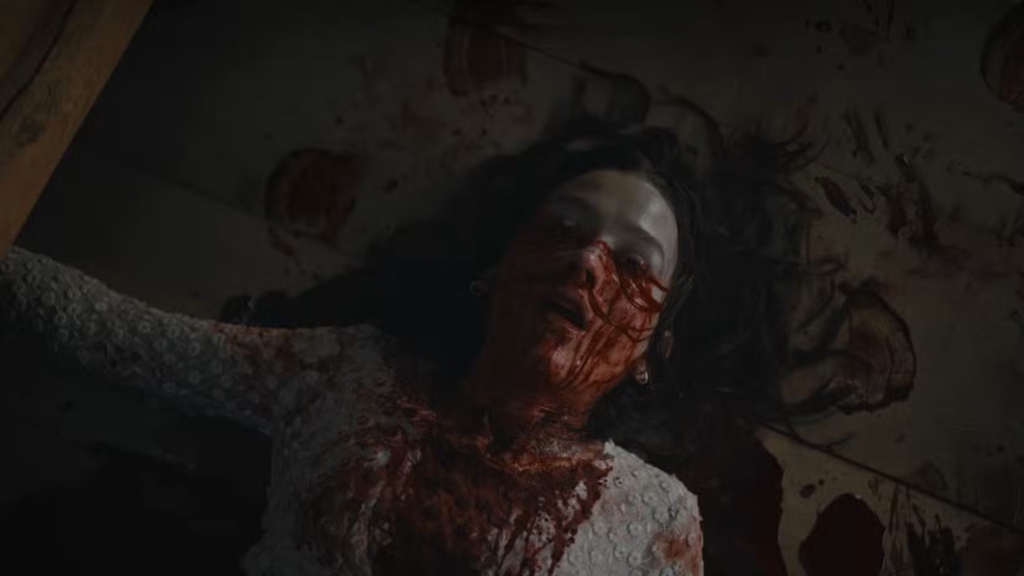
Despite Rachel’s mother’s protests, she is lulled into acceptance by her husband, and the two are wed. The same day, all captured in footage that is then revealed to an adult Rachel, Rachel’s mother dies a horrific death. Still in her wedding dress, she bleeds profusely until she collapses, to the shock and horror of her husband; he realizes too late that her fears were right. What’s more, Rachel’s mother was pregnant as she died. In a desperate and gruesome attempt to preserve the baby’s life, Rachel’s father cuts open her mother’s stomach to save Rachel. Rachel’s mother suffered the fullest extent of Rachel’s own mentioned fear around motherhood: being “torn open”, losing autonomy amidst mutilation to bring life into the world. In the wake of tragedy, is it only after the death of his wife that Rachel’s father appreciates the gravity of her warning and the truth of her curse? Now, he is the only one who remains alive to warn Rachel of the curse.
Lisa Brühlmann (directed 2 episodes) Axelle Carolyn (directed 2 episodes)/Netflix, Upside Down Pictures
As Rachel arrives at Nicky’s family home, her consistently all-black attire is dubbed as “funereal” by the groom’s sister, Portia. A nod to the potential death that awaits Rachel, marriage is continuously described with a degree of violence. While Nicky’s mother claims that marriage to the “right” person can be bliss, she asserts that marriage to the “wrong” one is “like being chained to a shipwreck at the bottom of the sea” (EP 02). Nicky’s father described marital union as “being impaled with a rod” (EP 08). Marriage is repeatedly referred to with a language of brutality, and as something inescapable that happens to someone. Chained to a shipwreck or impaled with a rod, both are incidents of lethal violence upon the body that render someone ultimately powerless. For the Gothic heroine, marriage facilitates violence and restriction upon her mind, body, and spirit, and her sense of dread leading up to the event compounds her isolation.
While marriage, particularly for the female characters, is presented as a dangerous and deadly institution, women’s intuitive experiences are also presented as inherently isolating in Something Very Bad is Going to Happen. At the end of the pilot episode, Rachel shares with Nicky that she’s experiencing “deja vu, and not the good kind” (EP 01). As the episodes progress, she expresses her mounting dread, certain that something bad is going to happen, but uncertain of the how, what, and when. This dread is compounded by alienating experiences at the hands of the groom’s family. When Rachel’s wedding dress is mysteriously misplaced, she is quickly fitted into Nicky’s mother’s dress. The women of the family quickly strip away Rachel’s jewelry to replace the pieces with their own heirlooms while ripping and cutting away pieces of the dress to modify and modernize it. While Nicky is away in search of the original dress, Rachel’s anxiety becomes heightened; she calls him, panicked that she is merely filling a “bride-shaped hole” for the family; an anxiety that feels nearly confirmed when, not long after, she is painted into an empty chair in the family portrait that has always been intended for Nicky’s future wife. Rachel spirals, certain something is off with the family. The lack of Nicky’s presence for even an episode is noted, as Rachel becomes unmoored without him, and her anxiety only grows in his daunting family home. Not quite the traditional Gothic Victorian manor, the home of the Cunningham family is still one that serves to heighten the fear and isolation of the characters inhabiting it. Dark, modern, and sprawling, the home feels utterly cold and confusing. Rachel frequently gets turned around, finding herself overwhelmed both physically and emotionally by the cavernous space and the expectations of the Cunningham family. The Mansion is utterly isolated in the woods of upstate New York. The isolated Gothic space serves to sever its inhabitants from sanity and reality, rendering them more vulnerable to hauntings and harm. In the Gothic narrative, the house is a character in and of itself, operating as breeding grounds for spiritual activity and madness. In the Female Gothic narrative, it is also a place of restriction; as the Victorian woman was relegated to the private sphere of the home, she nonetheless retained little power within it. It remains a place ultimately under man’s dominion and thus, a place of restriction. Rachel’s experience in the modern manor echoes the Victorian woman’s experience still: she flounders around her in-laws-to-be, liminal and utterly reliant upon Nicky to navigate both the labyrinthian complexity of the house and the unfamiliarity of wedding preparations. Rachel’s literal and physical isolation increasingly becomes mental and emotional; the more she dreads the wedding to come, the more she questions her relationship, and the further she feels from her fiancé, even when he is sitting beside her.

Lisa Brühlmann (directed 2 episodes) Axelle Carolyn (directed 2 episodes)/Netflix, Upside Down Pictures
Rachel’s internal isolation is heightened by her fear that she is unsuited for Nicky. After reuniting with her father and meeting the Witness, she becomes aware of the curse on her bloodline. Desperate and panicked, she hunts city hall records and summons spirits via Ouija board to seek answers on how to prevent tragedy in the wake of her marriage. She discovers a ritual that has the potential power to turn her into Nicky’s soulmate, assuming she isn’t already. The ritual is macabre, requiring Rachel to acquire the blood of an enemy and to sever a piece of her own bones. She enlists the help of Nicky’s sister-in-law, Nell, to enact the spell. Nell expresses concern, wondering if such an act would cause Rachel to lose her sense of self and turn her into a “Stepford Wife”. The Stepford Wives is a Gothic novel of the suburban variety. In a wealthy East Coast suburb, a men’s club methodically murders their wives and replaces them with robot replicas, which are more obedient, less mouthy, and more sexually available than their real wives. The “Stepford Wives” are the robotic replicas of the real thing, shells that exist to cater to a man’s needs. Rachel’s desire to make this marriage work may come at the cost of her autonomy and personhood. In a Gothic tale and in the modern world, how often does marriage require a woman, more so than her male counterpart, to alter herself for marriage? She is expected to change her name to take her husband’s. Should they have children, as Nicky so desires for him and Rachel, it is her body that will make the changes to carry new life. It is Rachel alone who will be torn apart for the life that Nicky desires, and it is she who is willing to alter herself, through pain and witchcraft, for him.
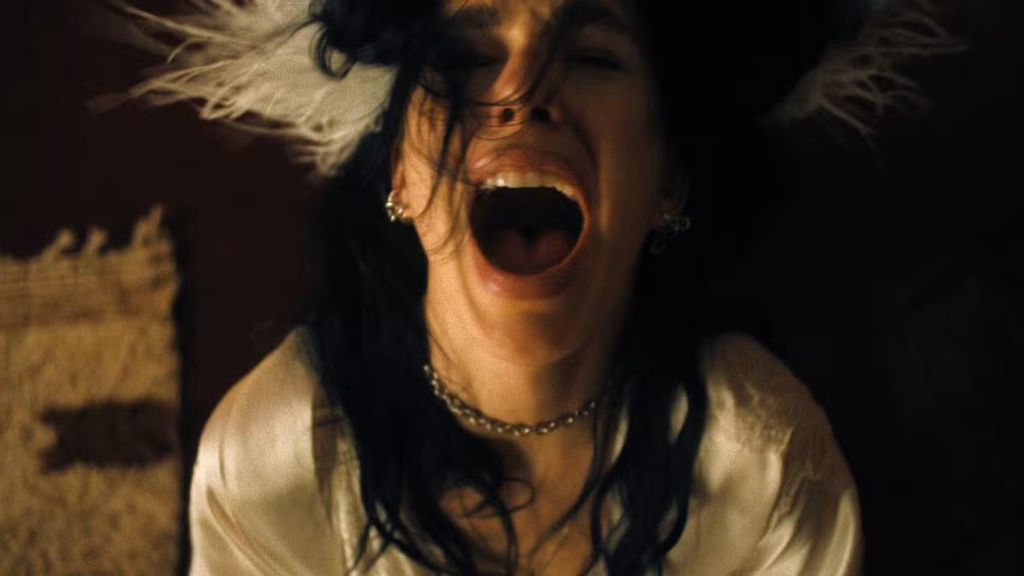
When it is revealed that Nicky’s mother was concealing a terminal cancer diagnosis to preserve a perfect wedding celebration, Rachel’s previous suspicions of secrets and hidden motives within the family seem momentarily justified. Family structures within Gothic narratives are complex and often wrought with secrets and tragedy. In Moreno-Garcia’s Mexican Gothic, the villainous Doyle family killed innocents and harbored their bodies for nefarious magical purposes for decades. In Jane Eyre, Rochester secretly locked away his first wife, to the horror and eventual discovery of young Jane. The harm done by family secrets can rival that of supernatural dangers within the Gothic genre. In Something Very Bad is Going to Happen, secrets compound and grow more harmful when Nicky discovers that his parents’ seemingly perfect marriage is anything but. His mother had an affair, though the couple elected to remain together. This shatters Nicky’s idealized vision of marriage and leads him to suggest to Rachel while at the altar that they remain together but unmarried. Rachel, who had decided to abstain from the ritual and simply take a leap of faith that she and Nicky are soulmates, begins to reel. She insists that now, because of the confines of the curse, they must be married by the end of their wedding day, or else the curse will spread to Nicky’s entire family. Nicky does not believe her until the curse comes to fruition and the hallways trailed with blood teased in the pilot now run red. Every marriage in his family that is not one of true “soulmates” is now marked by death. Desperate, he begs Rachel to marry him, insisting that she is, in fact, his soulmate. Betrayed by his lack of belief in her, Rachel retorts: “I’m not going to betray myself for you. All you had to do was believe me” (Ep 08).
Lisa Brühlmann (directed 2 episodes) Axelle Carolyn (directed 2 episodes)/Netflix, Upside Down Pictures
In the wake of Gothic tragedy, it is wise to return to the beginning of the story. The beginning, and the first stirrings of a heroine’s intuition, foretell a great deal about the harrowing journey ahead. The beginning, for Nicky and Rachel, was at an airport. Rachel was dreading her upcoming flight, a terrible feeling plaguing her all day. It was there, in that place and in that state, that she met Nicky. They hit it off and resolved to drive to a shared destination instead. Intuition is a funny thing. For the Gothic heroine, and for the readers and viewers witnessing her story, her intuition cannot reveal the exact reason for her dread. Alongside her navigation of isolation and family secrets, we only receive confirmation of her suspicions after the fact. Sometimes, realization comes too late, and no amount of knowing can save her. Until then, she doesn’t know how, and despite the protests from men around her, she knows that something is wrong. Before the wedding that ended in bloodshed, Rachel tells the wedding guests the story of how she met Nicky. It amounts to this: that she knew something very bad was going to happen, and then Nicky arrived.
Bibliography
Leonardi, Angela (Author. “GRIN – the Function of Gender in Female and Male Gothic.” Grin.com, 2015, http://www.grin.com/document/351794.

Leave a Reply