
By: Michele Schultz

Dead Media (2025)
The story of a troubled young woman, her lonely Gen X uncle, a haunted DVD, and a movie night that won’t die.
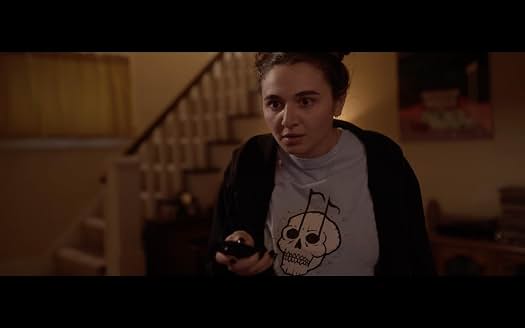
If writer-director Joseph Scrimshaw’s Dead Media is a haunted DVD that terrorizes a slumber party, it follows a young woman, Maggie, her two best friends, and her uncle after the attempt to watch the late 90s horror ‘Night of the Lurchers’, the events from the disc start to materialize from onscreen into real life.
Dead Media filmmaker’s long-standing engagement with pop culture, particularly co-hosting a Star Wars podcast with Ken Knapsock and Jennifer Landa for 10 years, how the experience informed his perspective on generation divides, possessiveness within fandoms, his own deep personal connection to the film’s message with nostalgia and physical media, in addition to the process of creating another movie, ‘Night of the Lurchers’.
Dread, Haunted Found Footage, Film Within a Film Horror
Dead Media is {spoiler} a film within a film, ‘Night of the Lurchers’, a fictional late-nineties B-level horror establishing the tone that was a deliberate choice by the director to blend the haunted found footage with slumber party horror. Dead Media addresses the era when DVDs were a new, “shiny” and exciting medium, contrasting with the rise of creepy VHS found-footage films like The Blair Witch Project and The Ring, and whether DVDs could ever be haunted.
“I really like horror films that have a sense of dread as well as more direct, scary terror,” Scrimshaw said, explaining the importance and the initial spark of inspiration for the film’s central premise, contrasting the newness of DVDs with the established horror trope of haunted VHS tapes. “I remember thinking back in 2000, could DVDs ever be scary like VHS is?”
The pacing begins with the characters seated in the living room, deciding what to watch next, when scrolling upon ‘Night of the Lurchers’, a fictional B-level horror within the actual horror movie Dead Media meant to entertain and amplify the tensions between Maggie and her uncle Heppy.
Moreover, the sense of dread in Dead Media zooms in on the creepy, cold Midwestern late October to create not just jump scares but also atmosphere, mirroring the inner lives left presented heavily through the film, especially the main characters’ internal turmoil. That atmosphere in Dead Media blends haunted found footage with sleepover horror, revealing a close-up on the inner lives of Maggie and Heppy, who are making poor life choices but trying to ignore it.
The major part of Dead Media confirmed the movie-within-a-movie structure of the inner film, Night of the Lurchers, to engage while pressing on the emotional tensions between Maggie, Uncle Heppy, and Brenda, so watching the film reveals the character dynamics rather than just a passive viewing. For inner fictional horror, [Night of the Lurchers] is the catalyst within Dead Media for the characters’ face off the intensify nerves.
For instance, in Dead Media, Heppy and Brenda function as opposing forces to Maggie: Heppy encourages nostalgia and escapism, unable to see how he’s imposing generational experience on her; Brenda pushes her to confront her life and move forward.
“In particular, that Uncle Heppy is a force on one of Maggie’s shoulders, and then Brenda is a force on the other; some of the things made Maggie feel like, ‘Yeah, I just want to have fun, laugh and ignore my problems with my uncle’,” Scrimshaw said, how the inner film triggers Maggie’s conflicting impulses, with Heppy and Brenda symbolizing different paths. “And some of the things made her feel more like what Brenda is pushing towards: look at your life, make decisions, move forward.”
Generational, Nostalgia, Physical Media, Trauma
Besides the dread, Dead Media is partly a way of dealing with the pain of longing for the past without letting nostalgia take over while living in the modern world and learning from the younger generation.
Dead Media tugs on generational conflict and nostalgia, specifically the niece-uncle family bond, emphasizing how Heppy positively influences his niece Maggie to try to make her relive his life, while the generational gap was noted as the inspiration for Dead Media, with nostalgia presented that the Dead Media director referred to as bittersweet, beautiful trauma.
“I was really interested in Uncle Heppy as a character who, in some ways it has a real positive effect on Maggie, but it kind of has blinders on about how much he’s forcing her to relive his life,” Scrimshaw said on Heppy’s dual role as mentor and source of generational pressure, emphasized on nostalgia and physical media articulate the emotional motivation behind the film. “Yeah, I think for me, nostalgia, it’s like a bittersweet, beautiful trauma that we have to deal with ad I thought a lot about the Carrie Fisher quote, ‘Take your broken heart and make it art’.”
Creating Dead Media within a fictional late 90s flawed pressured B-level horror film
The logistics of how characters in the “real world” interact with the DVD and its movie [Night of the Lurchers] took a significant amount of time to figure out, as Scrimshaw said. For [Night of the Lurchers] was intentionally created within the actual horror film Dead Media as Dead Media director Scrimshaw said about imagined [Night of the Lurchers] to feel like something that “could have been good but went off the rails” as being directed by Rita, a a horror fan with a dark sense of humor and a woman working in Hollywood in 1999, facing specific pressures and the constraints.
“I wanted to make Night of the Lurchers, the film within the film entertaining; so that what we were seeing in Night of the Lurchers in the film within the film would press on the nerve of what was going on between the characters,” Scrimshaw said, justifying the choice to have characters watch a movie for much of the first act, explaining the creative approach to the fictional horror film, how it reflects the imagined struggles of its director, Rita, in 1999 Hollywood.
“What I really wanted to do with it is have a film that was like, ‘Oh, this could have been good, but it went off the rails’; she ran out of time, she ran out of budget, producers made her do that. She maybe got mad and made a weird decision.”

Part of the approved Cherry Picks critic community, with span across independent-run digital publications. Past experience includes contributions to FanSided’s entertainment and lifestyle verticals, notably Culturess, 1428 Elm*l, and TripSided. Journalistic roots began as a City University of New York (CUNY) undergraduate student journalist.
Armed with a signature in theatrical data analytics and out of home (OOH) marketing measurement. Outside of the digital editorial newsroom and after hours, reporting on culture continues.

Leave a Reply